Lazio History Guide

HOME » POPULAR ITALIAN DESTINATIONS » ITALIAN TRAVEL GUIDES BY REGION » LAZIO TRAVEL GUIDE » LAZIO HISTORY GUIDE

Lazio Travel Guide        Culture        History        Food and Wine        Things to Do        Plan My Trip

About this guide: This guide to the history of Lazio was written by the Italian-born travel specialists at Trips 2 Italy, a custom tour operator that has designed hand-crafted Italian vacations since 2003. Every recommendation below reflects the same first-hand knowledge our team draws on when we build a private Lazio itinerary around a traveler’s interests, dates, and pace. Read it for your research, then let us translate it into a trip designed entirely around you.

How Did Lazio Begin?

Before Rome, there were the Etruscans and the Latins. From the ninth century BC the Etruscans built sophisticated cities across northern Lazio, trading with Greece, mastering metalwork, and burying their dead in monumental tomb cities that survive at Cerveteri, where grass-covered mound tombs line ancient streets, and at Tarquinia, whose underground chambers keep the liveliest painted art of the pre-Roman Mediterranean. Both necropolises are UNESCO World Heritage Sites and remain astonishingly atmospheric to walk.

South of the Tiber, the Latin tribes gave the region its name, Latium, and their hilltop villages along the river held a strategic crossing that legend crystallized into a founding: Romulus tracing the walls of Rome in 753 BC. Archaeology confirms settlement on the Palatine Hill from roughly that era, and the city’s early centuries under kings, including Etruscan ones, laid down the institutions the Republic would inherit.

Walking this deep past is one of the region’s great experiences. The Palatine’s hut foundations, the Etruscan collections of the Villa Giulia in Rome, and the tomb cities of the north bring the centuries before empire vividly close, and we pair them with guides who can people these places again. The Etruscans in particular, with their banquets, their dancing, and their partly undeciphered language, remain one of history’s most seductive mysteries.

How Did Rome Rise From Village to Empire?

The Republic, founded by tradition in 509 BC, turned a river town into the master of the Mediterranean through five centuries of expansion, law, and engineering. The Roman Forum grew into the political heart of the known world, the Appian Way, begun in 312 BC, pointed the legions south, and aqueducts, bridges, and roads stitched together an empire that at its height ringed the entire Mediterranean and reached from Britain to Mesopotamia.

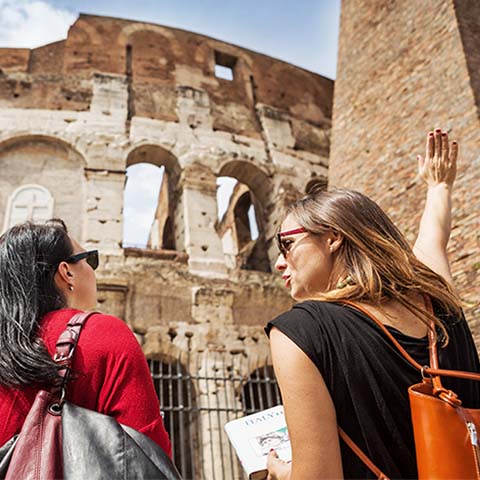
The emperors rebuilt the capital in marble and spectacle. Augustus claimed to have found Rome brick and left it marble, and his successors raised the Colosseum, where fifty thousand spectators watched the games, the imperial fora, the Pantheon with its perfect dome, and bath complexes the size of small cities. Ostia, Rome’s port at the Tiber mouth, swelled into a cosmopolitan city of warehouses, apartment blocks, and temples serving every god the empire knew.

Lazio’s countryside carries the imperial age as vividly as the capital. Hadrian’s Villa at Tivoli spread an emperor’s private world across a landscape of pools, libraries, and pavilions that quoted the monuments of his travels, and the arches of ruined aqueducts still stride across the Roman campagna. Few experiences in Italy match standing in the Pantheon’s rotunda while a guide explains how its unreinforced concrete dome has held for nineteen centuries.

What made the achievement durable was administration as much as architecture. Roman law, citizenship, roads, and running water organized daily life at a scale the world would not see again for over a thousand years, and Lazio is where that machinery can still be read on the ground. Walking the Forum with a historian who can reconstruct a working day in the ancient capital turns rubble into narrative, and it is one of the encounters we take the greatest care to arrange well.

How Did Christianity Transform Rome and Its Region?

Christianity grew in Rome’s shadows before it inherited Rome’s world. The faith arrived within a generation of the crucifixion, and the apostles Peter and Paul were both martyred in the city, their tombs becoming the gravitational centers of Christendom. Miles of catacombs along the Appian Way preserve the burials and frescoes of the early Christian centuries, and descending into them remains one of the most moving experiences Rome offers.

With Constantine’s conversion in the early fourth century, the persecuted faith became the empire’s own. The emperor endowed the first great basilicas, including the original St. Peter’s and the cathedral of Rome at St. John Lateran, and as imperial power faded, the popes gradually became the city’s rulers and the region’s landlords, a temporal role that would shape Lazio for fourteen centuries.

The countryside wrote its own chapter through monasticism. Around 500 AD, Benedict of Nursia withdrew to a cave above Subiaco, where the Sacro Speco monastery now clings to the cliff, and later founded Montecassino on its mountain above the Liri valley, where he composed the Rule that organized Western monastic life. Destroyed and rebuilt several times, most recently after the great battle of 1944, Montecassino remains one of the most consequential religious sites in Europe, and both abbeys reward the journey into the Ciociaria.

What Was Lazio Like in the Age of the Popes?

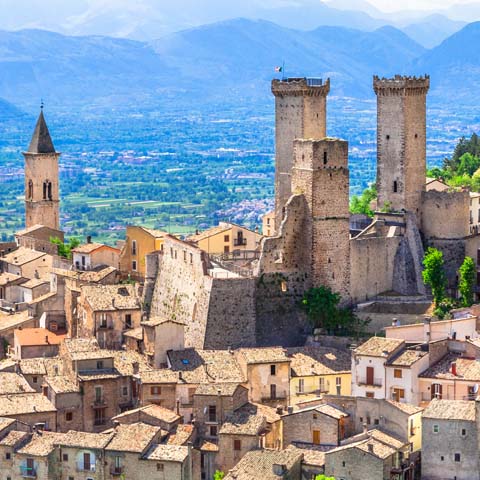
For centuries after the empire, the popes were Lazio’s princes, and the region’s map still shows it. Viterbo served as the papal seat in the thirteenth century, and its Palazzo dei Papi hosted the longest papal election in history, nearly three years, until the exasperated citizens locked the cardinals in and removed the roof, inventing the conclave. Fortified towns, monasteries, and pilgrimage roads, above all the Via Francigena flowing toward St. Peter’s tomb, organized medieval life across the region.

The Renaissance returned the papacy from Avignon to a ruined Rome and rebuilt it as a statement. Julius II summoned Bramante, Raphael, and Michelangelo, beginning the new St. Peter’s and the Sistine ceiling, and the papal court’s cardinals spread villa culture across the region, from the Villa d’Este’s water gardens at Tivoli to the Farnese palaces of the Tuscia. Rome became the drawing board of European art.

The Baroque completed the transformation. After the Counter-Reformation, Bernini and Borromini turned the city into sacred theater, raising the colonnade of St. Peter’s Square, the fountains of Piazza Navona, and facades that ripple like drapery. The Rome most travelers fall in love with at first sight, the Rome of fountains, domes, and golden stone, is largely this seventeenth-century city, built by popes to overwhelm, and it still does.

How Did Lazio Become the Heart of Modern Italy?

For most of the nineteenth century, Rome remained the pope’s capital while the new Kingdom of Italy formed around it, and the unresolved Roman Question dominated the age. On September 20, 1870, Italian troops breached the walls at Porta Pia, Rome joined the kingdom, and the following year it became the national capital, ending eleven centuries of papal rule and confining the popes to the Vatican until the Lateran Treaty of 1929 created the world’s smallest sovereign state.

The capital’s new role remade the region. Ministries, boulevards, and entire neighborhoods rose for the machinery of government, the Tiber received its embankments, and in the twentieth century the draining of the Pontine marshes created farmland and new towns across a plain that malaria had ruled for millennia. The Second World War brought occupation and the terrible battle of Montecassino, whose rebuilt abbey and war cemeteries remain places of pilgrimage and reflection.

Postwar Rome added a final golden layer: the years of the dolce vita, when the film studios of Cinecitta made the city the Hollywood of Europe and the Via Veneto its most photographed street. Today Lazio holds the capital of the Republic, the seat of the Church, and a countryside whose towns, abbeys, and ruins carry every century of the story in walking distance of one another.

For travelers, the modern chapters are among the most rewarding to trace because they are the least expected. The breach at Porta Pia, the rationalist architecture of the EUR district, the war cemeteries of the Liri valley, and the studio gates of Cinecitta each open a Rome beyond the ancient postcard, and we weave them into history-focused itineraries for travelers who want the story carried all the way to the present.

Which Places Bring Lazio's History to Life Today?

Rome itself is the great archive. The Colosseum, the Forum, and the Palatine hold the ancient capital; the catacombs and the basilicas carry the Christian centuries; the Vatican Museums gather the papal collections beneath Michelangelo’s ceiling; and the Capitoline Museums, the Ara Pacis, and the Palazzo Massimo keep the sculpture and frescoes that make the ancient city personal. Sequenced well, the city tells its own story century by century.

The region completes it. Ostia Antica preserves the empire’s daily life in complete streets and mosaic floors, Hadrian’s Villa and the Villa d’Este at Tivoli hold imperial ambition and Renaissance delight within minutes of each other, and the Etruscan tomb cities of Cerveteri and Tarquinia reach back before Rome began. Subiaco and Montecassino carry monastic history on their mountainsides, Viterbo keeps its papal palace and medieval quarter, and the Appian Way still runs south under its pines, paved with the original stones.

Sequence matters as much as selection. We compose history-focused itineraries chronologically where the traveler’s interests allow, from Etruscan tombs to imperial villas to Baroque Rome, so that three thousand years arrive as a story rather than a shuffle. Our historian guides are chosen for exactly that narrative gift, and we include these journeys among our cultural tours across Italy.

How Is Lazio Preserving Its Heritage?

Lazio’s preservation task is unlike any other region’s, because its capital is a functioning city of nearly three million people layered directly over the ancient world. Every metro line and building foundation becomes an excavation, ongoing restorations continually return monuments to view, and institutions from the national archaeological authorities to the Vatican’s own laboratories maintain a concentration of conservation expertise unmatched anywhere.

The results are visible everywhere: the Colosseum’s cleaned travertine, the reopened painted houses on the Palatine, the protected parkland of the Appia Antica where traffic once ran, and the continuing excavation of Ostia and Hadrian’s Villa. UNESCO recognition covers Rome’s historic center, the Vatican, the Tivoli villas, and the Etruscan necropolises, and the region’s smaller towns increasingly treat their walls, abbeys, and historic centers as living trusts rather than backdrops.

For travelers, this means the past here is unusually intact and unusually welcoming, and meeting its custodians is one of the region’s quiet privileges. Where access allows, we arrange encounters with the preservation world itself, from restoration studios to newly opened excavations, so that history in Lazio appears not as a finished exhibit but as a working enterprise that travelers briefly join.

Ready to Begin Planning Your Lazio Vacation?

Lazio deserves more than a template. Since 2003, Trips 2 Italy has designed private Italian vacations one traveler at a time, hand selecting every experience based on what you tell us rather than fitting you into a predefined package. Our Italian-born team plans Lazio with the knowledge of people who call Italy home, from the piazzas of Rome to the wine hills of the Castelli Romani and the harbors of the Pontine islands, and we remain at your side throughout your trip with 24/7 assistance. Tell us how you imagine Lazio, and we will craft the itinerary that matches it.

Explore Our Lazio Vacation Itineraries

Frequently Asked Questions About the History of Lazio

The Etruscans were the great pre-Roman civilization of central Italy, flourishing from the ninth century BC in cities across northern Lazio. Their UNESCO-listed tomb cities survive at Cerveteri, with its monumental grass-covered mounds, and Tarquinia, whose underground chambers hold vivid painted banquets and dancers, and the Villa Giulia museum in Rome keeps the finest Etruscan collection in the world.

Tradition dates the founding to 753 BC, when Romulus traced the city’s walls on the Palatine Hill, and archaeology confirms settlement there from roughly that period. From those origins Rome grew through kingdom, republic, and empire into the capital of the Mediterranean world, and the Palatine, the Forum, and the Colosseum still hold the story in stone.

Ostia Antica was ancient Rome’s seaport at the mouth of the Tiber, and its excavated streets, apartment blocks, baths, theater, and mosaic-floored warehouses make it one of the best-preserved Roman cities anywhere. Just half an hour from central Rome, it offers much of what draws travelers to Pompeii with far more ease, and Trips 2 Italy pairs it with guides who restore its daily life in the telling.

Montecassino, founded by St. Benedict around 529 AD, is the motherhouse of Western monasticism, where the Benedictine Rule was written. Destroyed and rebuilt several times, most recently after the pivotal 1944 battle that bears its name, the hilltop abbey remains a place of pilgrimage, memory, and sweeping views over the Liri valley, and it pairs naturally with Benedict’s cliffside monastery at Subiaco.

On September 20, 1870, Italian troops breached Rome’s walls at Porta Pia and ended eleven centuries of papal rule over the city, which became the capital of unified Italy the following year. The Roman Question was finally settled by the Lateran Treaty of 1929, which created Vatican City as the world’s smallest sovereign state.

Yes. The first miles of the Appia Antica outside Rome’s walls are a protected park, where the original basalt paving stones run beneath umbrella pines past catacombs, tombs, and imperial ruins. Trips 2 Italy arranges guided walks and cycling mornings along the ancient road, often paired with the catacombs and an unhurried lunch in the Roman countryside.