Urbino Travel Guide

HOME » POPULAR ITALIAN DESTINATIONS » URBINO TRAVEL GUIDE

Urbino Travel Guide        Culture        History        Food and Wine        Things to Do        Plan My Trip

About this guide: This Urbino travel guide was written by the Italian-born travel specialists at Trips 2 Italy, a custom tour operator that has designed hand-crafted Italian vacations since 2003. Every recommendation below reflects the same first-hand knowledge our team draws on when we build a private Urbino itinerary around a traveler’s interests, dates, and pace. Read it for your research, then let us translate it into a trip designed entirely around you.

What Makes Urbino One of Italy's Great Renaissance Cities?

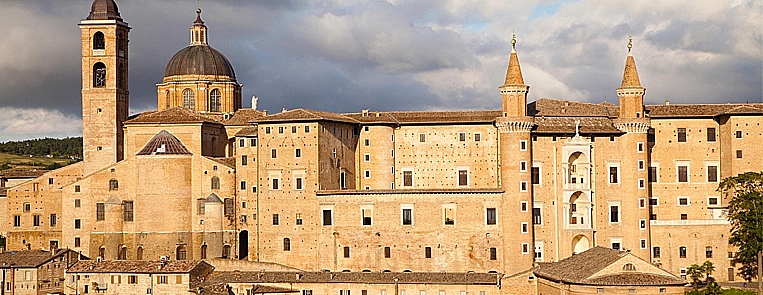
Urbino is the Renaissance in concentrate. For a few decades in the fifteenth century, this small hilltop city in the Montefeltro was one of the most brilliant courts in Europe, and the evidence still crowns its skyline: the Palazzo Ducale of Federico da Montefeltro, a palace so humane and so perfectly proportioned that contemporaries called it a city in the form of a palace. Around it climbs a historic center of brick lanes, Renaissance doorways, and sudden views that UNESCO inscribed as a World Heritage Site in 1998.

Set among the high green hills of the northern Marche region, between the Apennine ridges and the Adriatic coast, Urbino gave the world far more than a palace. Raphael was born here in 1483 and took his first lessons in his father’s workshop, Piero della Francesca painted two of his most debated masterpieces for this court, and Baldassare Castiglione set The Book of the Courtier, the manual of Renaissance civilization, in the palace’s evening salons.

Yet Urbino never became a museum. The university founded in 1506 fills the lanes with students, so the city that perfected courtly conversation now hums with espresso-fueled debate, bookshops, and evening passeggiate. Travelers who give Urbino real time discover a rare combination: supreme Renaissance art in a living, walkable hill town that most itineraries overlook. Our specialists have spent more than two decades designing journeys through exactly this Italy. Use this guide for your research, then let us hand craft the trip itself.

Where Is Urbino and What Is Its Setting Like?

Urbino rises on two hills at about 485 meters above sea level in the historic Montefeltro, the hill country of the northern Marche near the border with Romagna and the tiny republic of San Marino. The Adriatic coast at Pesaro lies roughly thirty five kilometers east, the Apennine peaks of Monte Nerone and Monte Catria close the horizon to the south and west, and in every direction the land rolls in the soft, cultivated waves that fill the backgrounds of Renaissance paintings.

The city itself is a composition. Bastioned walls from the sixteenth century still enclose the historic center, the Palazzo Ducale and cathedral crown one hill, and the quarter around Raphael’s birthplace climbs the other, with the steep spine of Via Raffaello connecting them. From the Fortezza Albornoz on its high grass terrace, the whole ensemble presents itself at once: the palace’s twin turreted towers, the cathedral dome, and the tiled roofs stepping down toward the valleys.

The climate follows the altitude. Summers are warm and bright with refreshingly cool evenings, winters are crisp and occasionally snowy, which turns the palace towers into something from an illuminated manuscript, and spring and autumn bring long weeks of clear, luminous weather that photographers and walkers plan around. Whatever the season, pack comfortable shoes: Urbino’s beauty is vertical, and its finest views reward a short climb.

When Is the Best Time of Year to Visit Urbino?

Summer belongs to the court. Each August the Festa del Duca fills the historic center with Renaissance processions, flag throwers, and costumed reenactments that return Federico da Montefeltro’s era to its own streets, and open-air performances take over courtyards and piazzas through July and August. For travelers who want Urbino at its most theatrical, this is the season, and good vantage points and related experiences deserve to be arranged well in advance.

Spring and early autumn are the connoisseur’s choices. From April through June the Montefeltro turns intensely green, the university year keeps the cafes and lanes lively, and the light on the brick city is at its warmest. September brings the Festa dell’Aquilone, when the city’s neighborhoods compete with hand-built kites above the hills, and October and November bring truffle season to nearby Acqualagna along with harvest in the surrounding vineyards.

Winter is the quiet secret. The Galleria Nazionale delle Marche at its calmest, studious cafe life at its coziest, and the palace courtyard dusted with occasional snow reward travelers seeking Renaissance art without company. When we design an Urbino itinerary, your dates become an instrument: we align festivals, truffle experiences, and gallery visits with what the season actually offers, so the city you meet is the city at its best.

The university calendar adds its own weather. During term the lanes carry a young, animated energy from morning lectures to midnight conversations, while the summer break returns the city to its residents and its visitors, with the August festival as the exception that fills every window with banners. Neither mood is better; they are simply different Urbinos, and knowing which one your dates will meet is part of designing the trip well. We advise on exactly that when we plan your Marche itinerary, down to the day of the week that suits each museum and market.

How Many Days Should I Spend in Urbino?

One full day covers the essentials at a satisfying pace: a long morning in the Palazzo Ducale and the Galleria Nazionale delle Marche, an afternoon for Raphael’s birthplace, the Salimbeni frescoes in the Oratorio di San Giovanni Battista, and the cathedral, then the climb to the Fortezza Albornoz for the view as the light turns gold. The evening passeggiata through Piazza della Repubblica, when students and families reclaim the streets, should never be scheduled over.

A second and third day transform the visit. They allow unhurried returns to the palace’s studiolo and quieter rooms, time in the workshops and bookshops of the upper town, and excursions into the Montefeltro: the castle of Gradara, the cliff-top fortress of San Leo, the ceramic town of Urbania, or a truffle experience near Acqualagna, each within an easy drive.

Because every Trips 2 Italy itinerary is designed by hand, the right length depends on what Urbino is doing in your journey. As a profound day within a wider Marche or central Italy route, one night works beautifully; as a base for the Montefeltro’s castles, tables, and hill roads, three nights repay themselves daily. We weigh your interests and your route, then give Urbino the space it deserves.

Which Sights and Quarters Should Anchor Your Visit?

The Palazzo Ducale anchors everything. Begun for Federico da Montefeltro in the 1460s under the architect Luciano Laurana and continued by Francesco di Giorgio Martini, it is at once fortress, residence, and manifesto, and it houses the Galleria Nazionale delle Marche, whose rooms hold Piero della Francesca’s Flagellation and Senigallia Madonna, Raphael’s portrait known as La Muta, and the famous panel of the Ideal City. The duke’s studiolo, lined with trompe l’oeil wood inlay, is one of the most extraordinary small rooms in Europe.

Across the piazza stands the neoclassical cathedral, rebuilt by Giuseppe Valadier after the earthquake of 1789 and hung with altarpieces by Federico Barocci, Urbino’s own great painter of the late Renaissance. Downhill, the fourteenth-century Oratorio di San Giovanni Battista glows with the Salimbeni brothers’ frescoes of 1416, among the masterpieces of International Gothic painting in Italy, with the stucco Nativity of the Oratorio di San Giuseppe a few steps away.

Then climb Via Raffaello. The painter’s birthplace, a dignified merchant’s house kept by the Accademia Raffaello since the nineteenth century, preserves the courtyard, the kitchen, and an early Madonna fresco attributed to the young artist, and the street ends at his monument on Pian del Monte with the Fortezza Albornoz gardens nearby. Around these landmarks spread the lanes, student cafes, and sudden belvederes that make simply wandering Urbino one of its essential pleasures.

Two humbler spaces complete the anchor list. Piazza della Repubblica, the sloping junction where the city’s main streets meet, serves as Urbino’s living room from morning espresso to evening passeggiata, and the mercatale, the great market terrace below the palace walls, connects to the upper city through Francesco di Giorgio’s remarkable spiral ramp. Our private walking itineraries thread all of these in a sequence matched to opening hours and light, so a single unhurried day delivers the whole city in its best order.

How Do You Get Around Urbino and Its Countryside?

Within the walls, Urbino is a city for walking, and only for walking. The historic center is compact, the distances are measured in minutes, and the steep brick lanes, helped in places by escalators and elevators rising from the parking areas below the walls, reward slow progress with constantly recomposing views. Comfortable shoes and an unhurried schedule are the only equipment the city asks of its visitors.

The countryside is where our arrangements earn their keep. Urbino has no rail station of its own, the nearest is at Pesaro on the Adriatic line, and the Montefeltro’s castles, wine cellars, and hill villages are scattered across ridges and river valleys. We arrange private drivers who know the panoramic roads, the viewpoints worth an unscheduled stop, and the farmhouses and cellars where a tasting becomes an afternoon, so mountain and countryside days unfold as pure pleasure rather than navigation.

Reaching Urbino is straightforward when the logistics are designed well. The airports of Bologna, Ancona, and Rimini all serve the region, Florence and Rome connect across the Apennines, and the final approach through the hills is itself one of the journey’s beautiful moments. Every transfer in a Trips 2 Italy itinerary is arranged in advance and supported around the clock, from the moment you land in Italy to the morning you depart.

How Do We Weave Urbino Into a Complete Italian Itinerary?

Urbino rewards travelers who pair it thoughtfully. Within the Marche region it balances Ascoli Piceno’s travertine squares in the south and the Conero coast’s beaches, while just beyond the Montefeltro lie Ravenna’s mosaics, San Marino, and the Adriatic resorts of Romagna. Across the Apennines, Tuscany and Umbria connect naturally along historic roads, which makes Urbino an inspired hinge between Italy’s most famous art country and its least discovered.

The occasion shapes the composition. For couples, palace courtyards by evening light and quiet hill-country dinners fold naturally into an Italian honeymoon that trades famous crowds for genuine romance. For travelers who plan around art and ideas, the city of Raphael and Federico anchors a chapter of our cultural tours of Italy, and for those composing something larger it becomes a discovery inside a custom trip to Italy designed entirely from what you tell us.

This guide is one of five we have written on the city. Continue with our Urbino culture guide, Urbino history guide, Urbino food and wine guide, and Urbino things to do guide, or widen the lens with our Marche travel guide to see the region around the city.

Ready to Begin Planning Your Urbino Vacation?

Urbino deserves more than a template. Since 2003, Trips 2 Italy has designed private Italian vacations one traveler at a time, hand selecting every experience based on what you tell us rather than fitting you into a predefined package. Our Italian-born team plans Urbino with the knowledge of people who call Italy home, from the twin towers of the Palazzo Ducale to the quiet hill roads of the Montefeltro, and we remain at your side throughout your trip with 24/7 assistance. Tell us how you imagine Urbino, and we will craft the itinerary that matches it.

Explore Our Urbino Vacation Itineraries

Frequently Asked Questions About Traveling to Urbino

Urbino is celebrated as one of the great cities of the Italian Renaissance: the Palazzo Ducale of Federico da Montefeltro with its twin towers and intarsia studiolo, the Galleria Nazionale delle Marche with masterpieces by Piero della Francesca and Raphael, the birthplace of Raphael himself, and a UNESCO World Heritage historic center that remains a lively university town founded around a school dating to 1506.

Urbino sits in the hill country of the Montefeltro in the northern Marche region of central Italy, about thirty five kilometers inland from the Adriatic coast at Pesaro. The Apennines rise to the south and west, San Marino and Romagna lie just to the north, and the city crowns two hills at roughly 485 meters above sea level.

One full day covers the Palazzo Ducale, Raphael’s birthplace, the Oratorio di San Giovanni Battista, and the Fortezza Albornoz viewpoint at a satisfying pace. Three days make Urbino a superb base, adding the castles of Gradara and San Leo, the ceramic town of Urbania, and truffle country around Acqualagna. Trips 2 Italy designs the length around your interests and your wider Italian route.

Late spring through early autumn is ideal. August brings the Festa del Duca with its Renaissance processions, September brings the kite festival above the hills, and October opens truffle season in nearby Acqualagna. Winter rewards travelers seeking the Galleria Nazionale delle Marche at its quietest and the studious cafe life of the university town at its coziest.

Emphatically yes for travelers drawn to Renaissance art and authentic hill towns. Urbino concentrates a ducal palace of European importance, paintings by Piero della Francesca and Raphael, and a living student city into a walkable historic center that large-scale tourism has never claimed. Trips 2 Italy weaves it into central Italy itineraries precisely for that reason.

Urbino has no rail station of its own; the nearest is Pesaro on the Adriatic line, and the airports of Bologna, Ancona, and Rimini all serve the region. The approach climbs through the Montefeltro hills on scenic roads. Trips 2 Italy arranges private transfers and drivers for every leg, so reaching Urbino and exploring its countryside require no logistics on your part.