Emilia Romagna History Guide

HOME » POPULAR ITALIAN DESTINATIONS » ITALIAN TRAVEL GUIDES BY REGION » EMILIA ROMAGNA TRAVEL GUIDE » EMILIA ROMAGNA HISTORY GUIDE

Emilia Romagna Travel Guide        Culture        History        Food and Wine        Things to Do        Plan My Trip

About this guide: This guide to the history of Emilia Romagna was written by the Italian-born travel specialists at Trips 2 Italy, a custom tour operator that has designed hand-crafted Italian vacations since 2003. Every recommendation below reflects the same first-hand knowledge our team draws on when we build a private Emilia Romagna itinerary around a traveler’s interests, dates, and pace. Read it for your research, then let us translate it into a trip designed entirely around you.

How Did Emilia Romagna Begin?

The region’s story begins before its name. The Villanovan culture, the earliest phase of the Etruscan world, took its very name from a site near Bologna, and by the sixth century BC the Etruscans had built Felsina, the city that would become Bologna, along with the trading town of Spina near the Po’s mouth, whose treasures now fill Ferrara’s archaeological museum. Celtic tribes, above all the Boii, swept across the plain in the fourth century BC and left their own mark, including, most scholars agree, the root of Bologna’s name.

Rome organized the land with a single stroke. In 187 BC the consul Marcus Aemilius Lepidus drove a military road from Piacenza to Rimini along the foot of the Apennines, and the Via Aemilia gave the region its cities, its axis, and eventually its name. Roman colonies at Bononia, Mutina, Parma, and Regium Lepidi grew into Bologna, Modena, Parma, and Reggio Emilia, all still strung along the same line, and Rimini preserves the road’s Adriatic gateway in its Arch of Augustus and Bridge of Tiberius.

Few regions anywhere owe their shape so completely to one piece of engineering. Twenty-two centuries later, travelers following the Via Emilia by rail or car are tracing the consul’s original line, city by city, and reading Roman town plans in the street grids around them. It is one of the most satisfying historical throughlines in Italy, and we often design history-focused journeys along it.

Why Did Ravenna Become the Capital of an Empire?

In 402 AD, with the Western Roman Empire under siege, the emperor Honorius moved his capital from Milan to Ravenna, protected by marshes and connected to the sea. For the next three and a half centuries the modest Adriatic city stood at the center of the Mediterranean world: last capital of the Western emperors, then seat of Theodoric the Great’s Ostrogothic kingdom, then the Byzantine exarchate ruling Italy for Constantinople.

Each regime built in glass and gold. Galla Placidia, the empress whose mausoleum’s starred vault still astonishes, Theodoric with his palace church of Sant’Apollinare Nuovo and his strange domed mausoleum carved from a single 300-ton stone, and Justinian’s Byzantium with the Basilica of San Vitale, where the emperor and empress Theodora gaze from the walls in the most famous imperial portraits of late antiquity. The result is eight UNESCO monuments holding the finest mosaics in the Western world.

Ravenna’s imperial afterlife had one more gift for history: Dante Alighieri, exiled from Florence, completed the Divine Comedy here and died in the city in 1321. His tomb stands beside the Basilica of San Francesco, and Ravenna has guarded his remains for seven centuries, politely declining Florence’s requests for their return. Walking from the mosaics to the poet’s tomb compresses a thousand years of civilization into a few hundred meters.

For travelers, the practical wonder is how much survives at eye level. These are not archaeological fragments but complete interiors, still serving the purposes their builders intended, and a single well-guided day moves through them in chronological order. It is the closest experience Europe offers to walking through the fall of Rome and the birth of the medieval world in an afternoon.

What Made Bologna's Middle Ages Extraordinary?

Around 1088, teachers and students of law in Bologna organized themselves into what became the University of Bologna, the oldest university in continuous operation in the Western world. Scholars traveled from across Europe to study Roman law here, the word universitas itself comes from these guilds of students, and the city built its identity around learning: the Archiginnasio’s walls still carry thousands of student coats of arms above its seventeenth-century anatomical theater.

Medieval Bologna was also a forest of towers. Prosperous families raised perhaps a hundred stone towers over the city in the twelfth and thirteenth centuries, part fortress and part status, and the two that still define the skyline, the 97-meter Asinelli and its leaning companion the Garisenda, were already famous enough for Dante to cite. In 1256 the commune passed the Liber Paradisus, a law abolishing serfdom and ransoming thousands of the unfree, an act the city still commemorates with pride.

The porticoes grew from the same civic energy. As the university swelled the population, the city required covered walkways so buildings could expand overhead without stealing the street, and the result, accumulated over centuries, is the nearly 40-mile network UNESCO honored in 2021. Bologna’s Middle Ages were not dark; they were an experiment in urban civilization, and the modern city still lives comfortably inside it.

Walking this history with a guide who can people it again is one of the region’s richest days: the tower climb, the student quarters, the anatomical theater where medicine was taught by candlelight, and the basilica of Santo Stefano’s interlocking churches, begun in late antiquity and layered ever since. We pair travelers with historians who tell medieval Bologna as the living story it is.

How Did the Renaissance Courts Shape the Region?

Emilia Romagna’s Renaissance was written by dynasties. In Ferrara, the Este family ruled for three centuries and made their court one of Europe’s most brilliant: patrons of Ariosto, whose Orlando Furioso was composed here, hosts of a musical establishment famed across the continent, and builders on a visionary scale. In the 1490s Duke Ercole I commissioned Biagio Rossetti to double the city with the Addizione Erculea, a planned expansion so ahead of its time that historians call Ferrara the first modern city in Europe, and UNESCO inscribed it together with the Po Delta.

Parma and Piacenza became a duchy of the Farnese family in 1545, carved out by Pope Paul III for his son, and the dynasty ruled for nearly two centuries, commissioning the vast Palazzo della Pilotta and the all-wooden Teatro Farnese, one of the most breathtaking theater interiors in existence. Earlier, the Apennine ridge had belonged to Matilda of Canossa, the eleventh-century countess at whose castle an emperor famously knelt in the snow before Pope Gregory VII in 1077, an event Italians still invoke with the phrase going to Canossa.

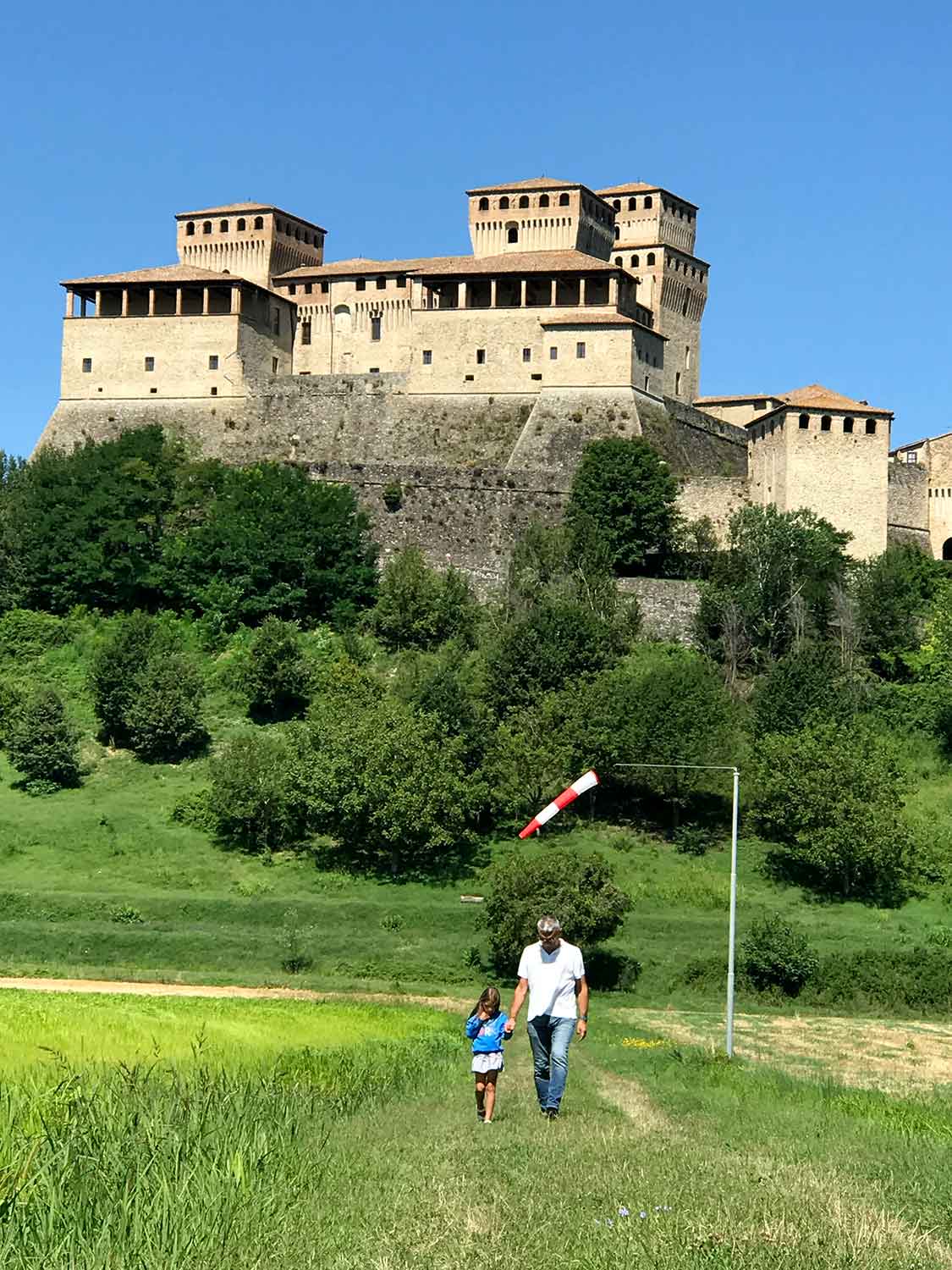
The courts left the region studded with castles, from the moated Castello Estense at Ferrara’s heart to Torrechiara’s frescoed halls above the Parma hills, and their rivalries seeded the artistic schools of Correggio, Parmigianino, and the Ferrarese painters. A well-designed itinerary can move court by court, and we compose exactly such journeys, castle mornings and painted domes sequenced so the dynastic stories stay distinct.

How Did Emilia Romagna Enter the Modern Age?

The modern Italian story begins, quite literally, in Reggio Emilia. In January 1797, delegates of the short-lived Cispadane Republic met there and adopted the green, white, and red tricolore that would become Italy’s national flag, and the Sala del Tricolore preserves the room. Through the Risorgimento the region’s cities voted their dukes and papal governors away, joining the new Kingdom of Italy in 1860, and the Via Emilia corridor industrialized around its ancient strengths: food, mechanics, and trade.

The twentieth century tested the region severely. The Gothic Line, Germany’s last great defensive front of the Second World War, ran through these Apennines in 1944 and 1945, and Emilia Romagna’s partisan resistance was among the most active in Italy, a memory the region keeps carefully. From the rubble of war came an economic flowering: Enzo Ferrari, born in Modena in 1898, built his company at Maranello, Ferruccio Lamborghini answered from Sant’Agata Bolognese, and with Maserati, Ducati, and later Pagani, the plain between Bologna and Parma became the Motor Valley, the densest concentration of dream engineering on earth.

The same decades made the food heritage a modern industry governed by fiercely protective consortiums, and Bologna’s university kept the region at the center of Italian intellectual life. Today Emilia Romagna ranks among Europe’s most prosperous regions, and its genius remains what it was under the Romans: a talent for turning fertile ground and a good road into civilization.

Which Places Bring the Region's History to Life Today?

Ravenna is the great time capsule: San Vitale, the Mausoleum of Galla Placidia, Theodoric’s mausoleum, and Sant’Apollinare in Classe carry the fifth and sixth centuries whole, and Dante’s tomb closes the imperial chapter with literature. In Bologna, the Asinelli tower climb, the Archiginnasio’s anatomical theater, and the basilica of Santo Stefano, a labyrinth of interlocking churches begun in late antiquity, let travelers walk the medieval city at its own pace.

Ferrara’s Castello Estense still stands in its moat at the center of town, and a bicycle circuit of the Renaissance walls remains the best short course in urban history in Italy. Modena’s cathedral and Ghirlandina tower preserve the Romanesque age at its peak, Parma’s Teatro Farnese and Pilotta hold the Farnese century, and Rimini bookends everything with its Roman arch and bridge, both still in daily use.

Sequence matters as much as selection. We compose history-focused itineraries chronologically where the traveler’s interests allow, from Roman Rimini through imperial Ravenna and medieval Bologna to the Renaissance courts and the Motor Valley, so two thousand years arrive as a narrative rather than a list. Our historian guides are chosen for exactly that storytelling gift, and the region’s compact geography makes the chronology genuinely walkable.

How Is Emilia Romagna Preserving Its Heritage?

The region holds an exceptional portfolio of UNESCO World Heritage: Ravenna’s eight early Christian monuments, Modena’s cathedral, Ghirlandina tower and Piazza Grande, Ferrara as a planned Renaissance city together with the Este delta estates, and Bologna’s porticoes, inscribed in 2021. Behind the designations stands serious craft: Ravenna’s mosaic restoration school trains conservators from around the world, and the university community makes preservation a living discipline rather than a bureaucratic one.

Emilia Romagna also pioneered the preservation of intangible heritage. Its food consortiums, for Parmigiano Reggiano, Prosciutto di Parma, and traditional balsamic vinegar among many others, are guardians of method as much as of markets, enforcing practices documented for centuries, while the sfogline’s pasta craft and Faenza’s ceramics are passed on through schools and workshops. Even the Motor Valley curates its own legacy in museums at Maranello, Modena, and Sant’Agata Bolognese.

For travelers, this means the past here is unusually intact and unusually welcoming. We arrange encounters with the preservation world itself where access allows, from mosaic ateliers to consortium aging vaults and castle archives, as part of our cultural tours across the region. History in Emilia Romagna is a working enterprise, and meeting its custodians is one of the region’s quiet privileges.

Ready to Begin Planning Your Emilia Romagna Vacation?

Emilia Romagna deserves more than a template. Since 2003, Trips 2 Italy has designed private Italian vacations one traveler at a time, hand selecting every experience based on what you tell us rather than fitting you into a predefined package. Our Italian-born team plans Emilia Romagna with the knowledge of people who call Italy home, from the porticoes of Bologna to the mosaics of Ravenna and the cheese vaults of Parma, and we remain at your side throughout your trip with 24/7 assistance. Tell us how you imagine Emilia Romagna, and we will craft the itinerary that matches it.

Explore Our Emilia Romagna Vacation Itineraries

Frequently Asked Questions About the History of Emilia Romagna

The Via Emilia is the Roman road built in 187 BC by the consul Marcus Aemilius Lepidus from Piacenza to Rimini, along the foot of the Apennines. It gave the region its name, its axis, and its cities, including Bologna, Modena, Parma, and Reggio Emilia, which still line the same route today, making it one of history’s most consequential pieces of engineering.

In 402 AD the emperor Honorius moved the Western capital to Ravenna for its marsh-protected position and sea access. The city then served as capital for the last Western emperors, Theodoric’s Ostrogothic kingdom, and the Byzantine exarchate, and each era left the mosaic-filled monuments that earned Ravenna eight UNESCO World Heritage sites.

The University of Bologna, dated to 1088, is the oldest university in continuous operation in the Western world, and the word universitas itself originated with its medieval student guilds. Travelers can visit the Archiginnasio, its historic seat, with thousands of student coats of arms and a remarkable seventeenth-century anatomical theater.

Dante Alighieri died in Ravenna in 1321 after completing the Divine Comedy in exile, and his tomb stands beside the Basilica of San Francesco in the city center. Ravenna has guarded the poet’s remains for seven centuries, and a visit pairs naturally with the mosaic monuments a few streets away.

Enzo Ferrari, born in Modena in 1898, built his company at nearby Maranello, and Lamborghini, Maserati, Ducati, and Pagani all grew from the same plain of mechanical craftsmanship between Bologna and Parma. Trips 2 Italy arranges Motor Valley days combining the museums, historic workshops, and driving experiences for enthusiasts.

Yes, and it is one of the most satisfying history journeys in Italy: Roman Rimini, imperial Ravenna, medieval Bologna, Renaissance Ferrara and Parma, and the modern Motor Valley, all within a compact region. Trips 2 Italy composes exactly this kind of chronological itinerary, paired with historian guides chosen for their storytelling gift.