

Milan Rome and Perugia Cultural Travel Package
Discover vibrant Milan, the rolling hills of Umbria, and timeless Rome, where art, history, and culinary delights come together to create unforgettable memories for every traveler. Starting from $6,862
HOME » POPULAR ITALIAN DESTINATIONS » ORVIETO TRAVEL GUIDE » ORVIETO HISTORY GUIDE
About this guide: This guide to the history of Orvieto was written by the Italian-born travel specialists at Trips 2 Italy, a custom tour operator that has designed hand-crafted Italian vacations since 2003. Every recommendation below reflects the same first-hand knowledge our team draws on when we build a private Orvieto itinerary around a traveler’s interests, dates, and pace. Read it for your research, then let us translate it into a trip designed entirely around you.
Orvieto’s rock was settled by the Etruscans by the ninth to eighth centuries BC, and the city that grew on it, known as Velzna to its people and Volsinii to the Romans, became one of the most powerful and sacred centers of the Etruscan world. Ancient sources associate it with the Fanum Voltumnae, the federal sanctuary where the twelve cities of the Etruscan League gathered each year for council and games, and excavations in the plain below the cliff have brought a great sanctuary complex to light. No town in Umbria reaches deeper into Italy’s pre-Roman past.
The site chose itself. The tufa butte, thrown up by the eruptions of the Volsini volcanoes, offered a defended tabletop with commanding views over the routes between the Tiber valley and the interior, and the soft rock could be cut for wells, cisterns, and tombs with bronze tools. From the beginning, the Orvietans dug as much as they built, beginning the underground city that would grow for twenty-five centuries.
Velzna flourished on bronze work, ceramics, and trade, and its wealth became proverbial: Roman writers recorded that the conquerors carried off some two thousand bronze statues when the city finally fell. Its temples crowned the rock, its artisans’ quarter hummed in the caves, and its dead were laid in orderly streets of tombs at the foot of the cliff, a city of the dead mirroring the city of the living above.
The most moving survival lies at the base of the northern cliff: the Necropoli del Crocifisso del Tufo, a sixth-century BC cemetery laid out on a strict grid like a miniature town, its chamber tombs built of tufa blocks and lined along straight funerary streets. Over each doorway a lintel carries the family name of the dead in Etruscan letters, one of the largest collections of Etruscan inscriptions in situ anywhere, so that walking the lanes you read the citizens of Velzna name by name.
On the rock itself, the ruins of the Belvedere temple near the funicular station preserve the podium of a fifth-century BC sanctuary, and the town’s museums hold the treasure recovered from the tombs. The Museo Claudio Faina, in a palazzo facing the Duomo, displays one of Italy’s great private Etruscan collections, from painted Attic vases imported by Velzna’s elite to bronzes, jewelry, and the famous Venus of Cannicella, while the national archaeological museum behind the cathedral keeps painted tombs reassembled entire.
The underground completes the picture. Deep beneath the medieval cellars, guided visits reach Etruscan wells cut square through the rock to improbable depths and cisterns lined with waterproof plaster, the hidden waterworks that let a great city live on a dry rock. We arrange Etruscan days that stitch these layers together with an archaeologist, from the necropolis at the cliff foot to the museum cases and the caves, and for travelers drawn to the deep past they rank among the most compelling experiences central Italy offers.
Velzna was the last of the great Etruscan cities to fall. After decades of pressure and internal upheaval, the Romans besieged and took the city in 264 BC, stripped it of its statues and treasure, and removed its surviving population to a new town on the shore of Lake Bolsena, Volsinii Novi, so that the rock itself would never again shelter resistance. For centuries the great tabletop stood largely abandoned, a quarry of memories above the consular roads.
The old city never disappeared entirely, and its very name preserves the story: the medieval settlement that grew back on the rock was known in Latin as Urbs Vetus, the old city, which softened over the centuries into Orvieto. Goths, Byzantines, and Lombards contested the site in the turbulent years after the empire, precisely because the cliff that had made Velzna great made its successor equally defensible.
By the eleventh and twelfth centuries Orvieto had reemerged as a free commune, governing itself, fighting its neighbors, and growing rich on the roads between Rome and Tuscany. Tower houses rose over the lanes, the great civic palaces followed, and the town of golden tufa that travelers see today took shape in a burst of medieval confidence built directly on Etruscan foundations, sometimes literally, with cellars descending into ancient wells.
Medieval Orvieto’s defensibility and its position a day’s ride from Rome made it a favored refuge of the papacy. More than thirty popes resided here across the Middle Ages, and the town they knew still stands: the Palazzo dei Papi beside the Duomo, the fortified halls, and the churches where the curia worshiped. Urban IV governed the church from Orvieto in the 1260s, and it was here in 1264 that he instituted the feast of Corpus Christi after the Miracle of Bolsena.
The town’s intellectual life rose with its guests. Thomas Aquinas taught at the Dominican studium in Orvieto during Urban’s residence and composed the office of Corpus Christi at his request, hymns still sung across the world today. The commune, meanwhile, built on its own account: the Palazzo del Popolo, the great tufa palace of the people’s captain, remains one of the most imposing civic monuments of thirteenth-century Italy, and the Torre del Moro rose at the crossing of the town’s four quarters.
The Duomo crowned the age. Begun in 1290 to honor the relic of Bolsena and to declare the town’s standing, it drew the Sienese master Lorenzo Maitani, who engineered and beautified the facade from 1310, and generations of successors including Andrea Pisano and Andrea Orcagna. Its construction ran three centuries and gathered mosaicists, sculptors, and painters from across Italy, culminating in Signorelli’s frescoes at the Renaissance’s height.
Papal Orvieto had its darker seasons of faction as well, Guelph against Ghibelline, family against family, and by the mid-fourteenth century plague and feuding had exhausted the commune’s independence. Cardinal Albornoz took the town for the Papal States, raising the fortress at the eastern end of the rock, and Orvieto settled into five centuries as a proud provincial city of the popes’ domain.
In May 1527 the armies of Emperor Charles V sacked Rome, and Pope Clement VII fled up the Tiber valley to the safest rock he knew. Installed in Orvieto, the pope confronted the fortress city’s one weakness: water. If the town were besieged, its cisterns might fail, and so in 1527 he commissioned the Florentine architect Antonio da Sangallo the Younger to sink a great well to the aquifer at the base of the tufa.
Sangallo’s solution remains one of the most elegant feats of Renaissance engineering. The shaft drops some 175 feet, wide enough to hold two independent spiral staircases wound around each other in a double helix, each of 248 steps, lit by seventy windows opening into the central void. Mule trains descended one stair, loaded water at the bottom, and climbed the other without ever meeting oncoming traffic, a one-way system carved in rock three centuries before the traffic engineers.
The well took about a decade to complete, finished under Sangallo with the humanist name of Pozzo della Rocca; popular legend later renamed it for St Patrick, likening its descent to the Irish saint’s fabled purgatorial cave, and the name Pozzo di San Patrizio stuck so firmly that in Italian a bottomless store of anything is still called a pozzo di San Patrizio. Clement never needed his siege water, but his well became the town’s Renaissance signature, and descending its cool spiral, with the disk of sky shrinking overhead, remains one of the singular experiences of central Italy.
The narrative reads best in sequence. Begin below the northern cliff at the Necropoli del Crocifisso del Tufo among the inscribed tombs of Velzna, then rise to the rock and the Belvedere temple podium before the Faina museum’s painted vases and bronzes facing the Duomo. The Etruscan morning sets up everything that follows: the town above is, in a real sense, the third city built on the same stone.
The medieval afternoon belongs to the Duomo and its square, the Palazzo dei Papi and the cathedral works museum, the Palazzo del Popolo, and the climb up the Torre del Moro, whose bell of 1313, cast with the emblems of the town’s guilds, still sounds over the rooftops. The underground tours thread the whole story together, descending through medieval olive presses and dovecotes into Etruscan wells beneath the same houses.
The Renaissance closes the day at the eastern end of the rock, where the Albornoz fortress gardens overlook the valley and the Pozzo di San Patrizio spirals into the deep. History this layered benefits from sequence, and sequence is our craft: we compose Orvieto days chronologically with guides chosen for their storytelling as much as their scholarship, so that three thousand years arrive as one continuous story rather than a shuffle of monuments.
For travelers who want to follow the threads outward, the historical landscape continues beyond the rock: Bolsena on its lake, where the miracle occurred and the exiled Volsinians rebuilt; Civita di Bagnoregio on its own eroding pinnacle of the same volcanic tuff; and Todi on its Tiber hill. We arrange these as half-day extensions with a private driver, each one deepening the Orvieto story from a different direction.
Orvieto’s greatest conservation challenge is the rock itself. The tufa cliff that protected the town for three millennia erodes and occasionally sheds its edges, and after alarming collapses in the late twentieth century the Italian state funded a landmark consolidation campaign, anchoring the cliff faces, mapping the voids, and regulating the caves. The project made Orvieto a European reference point for the science of preserving cities built on fragile stone.
That mapping had an unexpected cultural dividend: the systematic survey of the underground documented well over a thousand cavities beneath the historic center and opened the finest of them to guided visits, turning a hidden liability into one of the town’s signature experiences. Meanwhile the Opera del Duomo, the cathedral works institution that has cared for the Duomo continuously since the Middle Ages, sustains an unbroken tradition of restoration, from the facade mosaics to Signorelli’s frescoes, which underwent comprehensive conservation in recent decades.
Preservation extends to the living town: the historic center is protected from through traffic, the Cittaslow charter signed here in 1999 binds Orvieto to a humane urbanism, and the surrounding Classico vineyards and oak country are farmed much as they long have been. We arrange encounters with this preservation world where access allows, from underground specialists to the cathedral workshops, as part of our cultural tours. Few small cities anywhere guard so much, above ground and below, on behalf of so many.
Orvieto deserves more than a template. Since 2003, Trips 2 Italy has designed private Italian vacations one traveler at a time, hand selecting every experience based on what you tell us rather than fitting you into a predefined package. Our Italian-born team plans Orvieto with the knowledge of people who call Italy home, from the golden facade of the Duomo to the wine cellars carved deep into the volcanic tufa, and we remain at your side throughout your trip with 24/7 assistance. Tell us how you imagine Orvieto, and we will craft the itinerary that matches it.
Discover vibrant Milan, the rolling hills of Umbria, and timeless Rome, where art, history, and culinary delights come together to create unforgettable memories for every traveler. Starting from $6,862
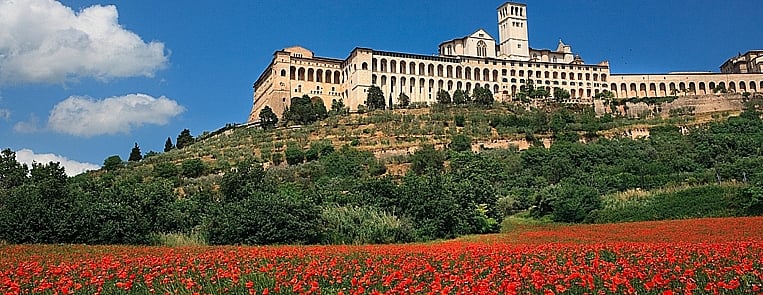
Enjoy the charming Umbria, from the Medieval and Majestic Orvieto to the peaceful Assisi. See the places where St. Francis of Assisi lived.
The rock has been inhabited for some three thousand years, settled by the Etruscans by the ninth to eighth centuries BC as Velzna, one of the most important cities of their league. After Rome destroyed the city in 264 BC and moved its people to Lake Bolsena, the site revived in the early Middle Ages as Urbs Vetus, the old city, from which the name Orvieto derives.
Velzna, called Volsinii by the Romans, was among the most powerful and sacred Etruscan cities, associated with the Fanum Voltumnae, the federal sanctuary of the twelve-city Etruscan League. Its wealth was legendary: Roman sources record two thousand bronze statues carried off when the city fell in 264 BC. Its grid-planned necropolis and museum collections make Orvieto one of the best places in Italy to encounter the Etruscans.
It is a sixth-century BC Etruscan cemetery at the foot of Orvieto’s northern cliff, laid out on a grid of funerary streets lined with tufa chamber tombs, each doorway inscribed with the family name of the dead. Walking its lanes is like reading the census of a vanished city, and Trips 2 Italy arranges visits with archaeologists who bring Velzna vividly to life.
Pope Clement VII commissioned the well from Antonio da Sangallo the Younger in 1527, after fleeing the Sack of Rome, to secure Orvieto’s water supply against siege. Its double-helix staircases, 248 steps each around a shaft some 175 feet deep, never intersect. The name came later from the legend of St Patrick’s cave, and in Italian a bottomless reserve is still called a pozzo di San Patrizio.
Yes. More than thirty popes resided in Orvieto during the Middle Ages, drawn by its impregnable rock a day’s ride from Rome. Urban IV instituted the feast of Corpus Christi here in 1264, with Thomas Aquinas, then teaching in the town, composing its office, and Clement VII sheltered here after the Sack of Rome in 1527, commissioning the famous well.
Yes. Guided tours descend daily into the Orvieto Underground, a labyrinth of more than a thousand caves, wells, cisterns, olive presses, and dovecotes carved into the tufa over twenty-five centuries. Trips 2 Italy arranges private underground visits led by specialist guides, woven into a day that connects the caves to the Etruscan necropolis and the town above.