
Rome History Guide

HOME » POPULAR ITALIAN DESTINATIONS » ROME TRAVEL GUIDE » ROME HISTORY GUIDE

Rome Travel Guide        Culture        History        Food and Wine        Things to Do        Plan My Trip

About this guide: This guide to the history of Rome was written by the Italian-born travel specialists at Trips 2 Italy, a custom tour operator that has designed hand-crafted Italian vacations since 2003. Every recommendation below reflects the same first-hand knowledge our team draws on when we build a private Rome itinerary around a traveler’s interests, dates, and pace. Read it for your research, then let us translate it into a trip designed entirely around you.

How Did Rome Begin?

Legend gives Rome the most famous founding story in the world: Romulus and Remus, twin sons of Mars, suckled by a she-wolf and raised beside the Tiber, with Romulus tracing the city’s first furrow on the Palatine Hill on April 21, 753 BC. Archaeology, remarkably, half agrees. Excavations on the Palatine have uncovered Iron Age huts and fortifications from the eighth century BC, and travelers exploring the hill today, at the heart of the Lazio region, stand quite literally on the city’s birthplace.

Early Rome grew where it did for practical reasons: a ford across the Tiber, defensible hills above the crossing, and a position between the Etruscan cities to the north and the Greek colonies to the south. Its early kings, several of them Etruscan, gave the settlement its first institutions and its first great engineering, including the Cloaca Maxima drain that turned a marsh into the Roman Forum and still functions beneath the city today.

The Etruscans, the great civilization to Rome’s north, left deep fingerprints on the young city: the arch and the atrium house, the toga and the triumph, temple design and the reading of omens all carried Etruscan lessons. Rome’s gift, then and always, was absorption, taking what worked from every neighbor and making it unmistakably its own. The Villa Giulia museum, holding the finest Etruscan collection in the world, tells that older story superbly for travelers who want the full arc.

In 509 BC, tradition holds, the Romans expelled their last king and swore never to be ruled by one again. The republic they invented, with its senate, elected magistrates, and balanced powers, would become one of history’s most consequential political experiments, studied by every constitution writer since. Walking the Forum with a historian who can rebuild it in words, from the Senate house to the speaker’s platform, is where Rome’s story best begins.

How Did the Roman Republic Rise to Power?

Over five centuries the republic grew from a city-state into the master of the Mediterranean. Rome’s legions, roads, and talent for absorbing others’ ideas carried its power across Italy, then through the epic wars against Carthage that made it a naval empire, then east into Greece, whose art and learning conquered the conqueror in return. The Via Appia, begun in 312 BC and still walkable today under its umbrella pines, is the republic’s ambition laid in stone.

Success strained the system that created it. Wealth from conquest concentrated in few hands, land crises fueled populist tribunes and civil wars, and ambitious generals discovered their soldiers were loyal to them rather than to the senate. Julius Caesar, brilliant in Gaul and unstoppable at home, crossed the Rubicon in 49 BC, took power, and was assassinated on the Ides of March 44 BC in the theater complex of Pompey. The republic effectively died with him.

The Forum preserves this drama in its stones: the temple where Caesar’s body was burned still receives flowers each March, the Senate house rebuilt by his heir still stands, and the speaker’s platform where Cicero’s orations rang out remains. We pair travelers with guides who tell the republic’s story as narrative rather than inventory, because it is, among much else, the greatest political thriller ever lived.

What Did Rome Look Like at the Height of Empire?

Caesar’s heir Augustus ended the civil wars, kept the republic’s forms while holding its power, and boasted truthfully that he found Rome brick and left it marble. The two centuries that followed were the empire’s golden age, when Rome governed perhaps a quarter of humanity, its population passed one million, a scale no European city would reach again for seventeen centuries, and its emperors built to match.

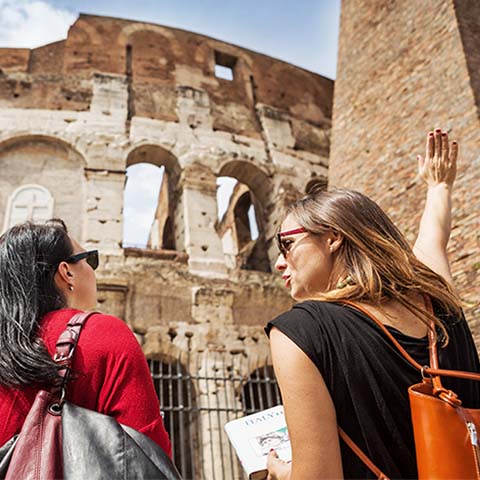
The monuments of that confidence still dominate the city. The Colosseum, inaugurated in 80 AD, seated some fifty thousand spectators with an efficiency modern stadiums still envy. Trajan’s Column spirals a war diary in carved stone a hundred feet high. The Pantheon, rebuilt by Hadrian around 126 AD, spans its perfect concrete dome over a single beam of moving sunlight, and the Baths of Caracalla gave ordinary Romans daily luxury on a scale that still staggers visitors walking their ruins.

The empire’s true genius, though, was infrastructure. Eleven aqueducts carried water across the countryside on arches that still stride through the fields south of the city, feeding hundreds of fountains and baths; a road network radiating from the golden milestone in the Forum bound three continents to this one hill; and Roman concrete, poured into domes and harbors, outlasted the empire itself by two thousand years. Modern Rome still drinks from a restored ancient aqueduct at the Trevi Fountain, a continuity no other city can offer.

Imperial Rome is where expert guiding earns its keep, because these sites are magnificent but fragmentary, and the difference between rubble and revelation is a storyteller. We arrange access that deepens the encounter where available, including the Colosseum’s arena floor and underground chambers, and sequence the ancient city so it accumulates into a coherent, unforgettable whole.

How Did Christian Rome Emerge From the Empire?

Christianity arrived in Rome within a generation of its founding, carried along the empire’s own roads. Tradition holds that both Peter and Paul were martyred in the city under Nero, and for over two centuries the faith grew quietly and at intervals dangerously, its dead buried in the catacombs whose tufa galleries stretch for miles beneath the Appian Way and still move visitors with their lamp-lit frescoes and carved farewells.

Everything changed with Constantine. After 313 AD the emperor legalized Christianity and endowed its first great basilicas, including San Giovanni in Laterano, still the cathedral of Rome, and the original St. Peter’s above the apostle’s tomb. As imperial power drained east to Constantinople and the western empire fell in 476 AD, the city that had ruled by the sword began its second life ruling by the spirit, its bishops gradually becoming the popes who would shape Europe.

Layered churches make this transformation physically visible, nowhere better than San Clemente, where a twelfth-century basilica stands on a fourth-century church standing on a first-century Roman lane and pagan shrine. Descending its staircases is descending through a thousand years, and it is one of the most quietly astonishing experiences we build into Roman itineraries.

How Did the Popes Rebuild Rome in the Renaissance and Baroque?

Medieval Rome had shrunk to a fraction of its ancient self, but the popes’ return from Avignon in 1420 began one of history’s greatest urban resurrections. Renaissance pontiffs summoned the finest artists alive: Julius II set Michelangelo to the Sistine ceiling and Raphael to the papal apartments in the same astonishing years, while Bramante began rebuilding St. Peter’s into the largest church in Christendom, a project that would take twelve decades and every great architect of two centuries.

The Counter-Reformation then gave Rome its present face. Determined to overwhelm doubt with splendor, seventeenth-century popes unleashed the Baroque: Bernini’s colonnade embracing St. Peter’s Square, his fountains performing in Piazza Navona, Borromini’s geometrically daring churches, and ceiling frescoes that dissolve stone into heaven. The eighteenth century added the final flourishes travelers now consider eternal, including the Spanish Steps and the Trevi Fountain, completed in 1762.

The great papal families wrote themselves into the streetscape as they built. The Farnese raised the most beautiful palace of the Renaissance, the Barberini put their heraldic bees on fountains and facades across the city, and the Borghese assembled the villa and collection that remain Rome’s most concentrated gallery of genius. Learning to read these family emblems on churches and fountains turns any walk through the center into a detective story, and it is a skill our guides delight in teaching.

This is the Rome most visitors fall in love with first, and its story is best told as the family and artistic drama it was, of rival popes, rival geniuses, and a city treated as a canvas. Our historian and art historian guides specialize in exactly that telling, and we sequence Baroque Rome as its builders intended, as theater.

How Did Rome Become the Capital of Modern Italy?

For most of the nineteenth century Rome remained the pope’s city while Italy unified around it. On September 20, 1870, Italian troops breached the Aurelian Walls at Porta Pia, ending eleven centuries of papal rule, and Rome became the capital of the young kingdom the following year. The new state built its monuments beside the old, most conspicuously the white marble Vittoriano above Piazza Venezia, and laid out the ministries and boulevards of a working capital.

The twentieth century wrote its own dramatic chapters. The Lateran Treaty of 1929 created Vatican City as the world’s smallest sovereign state and settled the long quarrel between church and nation. After the war, Rome rebounded into its dolce vita decades, when Cinecitta’s studios made the city a film capital and its cafes and fountains became the backdrop of a newly glamorous Italy. The 1960 Olympics announced the recovered capital to the world.

Today’s Rome layers all of these identities daily: seat of the Italian government, center of world Catholicism, film city, and living archive. Understanding the modern chapters deepens everything else a traveler sees, which is why our history itineraries carry the story all the way to the present rather than stopping at the ancient walls.

Which Places Bring Roman History to Life Today?

The ancient core is the essential beginning: the Colosseum, Forum, and Palatine as one continuous story, the Pantheon as the empire’s most perfect survivor, and the Capitoline Museums, the world’s oldest public museums, holding the she-wolf, the colossal fragments of Constantine, and the equestrian Marcus Aurelius. The Ara Pacis preserves Augustus’s altar of peace in carved marble, and Palazzo Massimo’s frescoed garden room is among the most beautiful ancient interiors anywhere.

Beyond the center, the Appian Way offers history at walking and cycling pace, past catacombs, tombs, and aqueduct arches striding across the fields. Castel Sant’Angelo carries a single building from Hadrian’s mausoleum through papal fortress to museum, and Ostia Antica, the empire’s port city, preserves streets, theaters, warehouses, and mosaic-floored baths with an intimacy that rivals anything in Italy.

Rome’s preservation is itself a story worth meeting: archaeologists still excavate in the center, restorers work continuously on frescoes and facades, and every metro extension becomes a dig. We arrange encounters with that living scholarship where access allows, and we compose history-focused journeys as part of our cultural tours of Italy, sequenced so three millennia arrive as a story rather than a shuffle. History in Rome is not behind glass. It is underfoot, overhead, and ongoing.

Ready to Begin Planning Your Rome Vacation?

Rome deserves more than a template. Since 2003, Trips 2 Italy has designed private Italian vacations one traveler at a time, hand selecting every experience based on what you tell us rather than fitting you into a predefined package. Our Italian-born team plans Rome with the knowledge of people who call Italy home, from the galleries of the Vatican to the trattorias of Trastevere, and we remain at your side throughout your trip with 24/7 assistance. Tell us how you imagine Rome, and we will craft the itinerary that matches it.

Explore Our Rome Vacation Itineraries

Frequently Asked Questions About the History of Rome

Tradition dates the founding to April 21, 753 BC, when Romulus is said to have traced the city’s boundary on the Palatine Hill, and archaeology confirms settlement there from roughly that era. Rome still celebrates its birthday each April 21 with reenactments and processions around the Circus Maximus.

The republic, founded in 509 BC, governed Rome through an elected senate and magistrates for nearly five centuries until civil wars brought Julius Caesar and then his heir Augustus to sole power. From Augustus onward, emperors ruled what became the empire, whose golden age monuments, including the Colosseum and Pantheon, still dominate the city.

The Colosseum was inaugurated in 80 AD under the emperor Titus, making it nearly two thousand years old. It seated around fifty thousand spectators for gladiatorial games and public spectacles. Trips 2 Italy arranges guided visits including special access to the arena floor and underground chambers where available, which transforms the experience.

Yes. Several early Christian catacombs along and near the Appian Way are open with guided visits, their underground galleries preserving frescoes and inscriptions from the faith’s earliest centuries. We pair the catacombs with a walk or cycle along the ancient Appian Way for one of Rome’s most atmospheric half days.

San Clemente is a twelfth-century basilica built directly above a fourth-century church, which itself stands over first-century Roman buildings and a pagan shrine. Descending through its excavated levels is the most vivid way to experience Rome’s layered history, and Trips 2 Italy builds it into history-focused itineraries with expert guides.

Very much so. Rome’s ancient port city, under an hour away, preserves streets, apartment blocks, baths, taverns, and a theater in remarkable condition, often with a fraction of the visitors the central sites receive. We arrange it as a half-day excursion with a private driver and a guide who repopulates the streets in the telling.