
The oldest model of architecture in Rome is part of the Etruscan-Italic style characterized by a different type of temple compared to the Greek model. In fact, the Etruscan temples were oriented on a higher podium and had wooden roofs covered with polychrome terracotta tiles. There are only a few remains left of these edifices, such as the Temple of Jupiter Optimus Maximus.
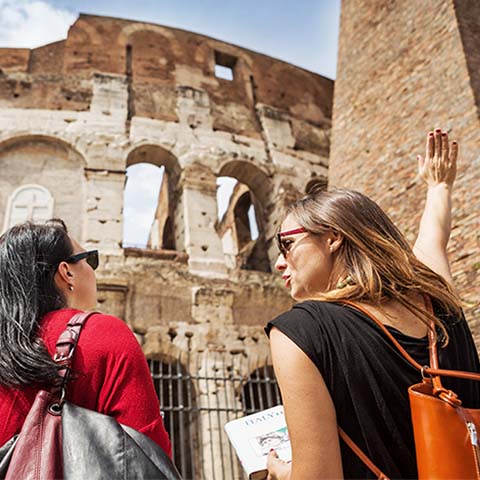
The Roman architecture belonging to the imperial age is probably the most widely documented. Probably the most famous example of architecture of the era is Amphitheater Flavio, also known as the Colosseum.
From the Republican age, it is worth mentioning Domus Aurea, an important complex of buildings with great significance. Another stunning example of the age is the Roman Forum. Among the most grandiose architectural achievements are the Baths of Diocletian.
Regarding religious architecture, Rome is the place where it is easy to note the transition from complex temples worshiping pagan gods to the first examples of Christian basilicas and baptisteries.
Among the most ancient monuments of Christian Rome, apart from the Basilica of Saint Peter in Vatican City, we have to mention the church of San Giovanni in Laterano. Built between 311 and 314 AD, this is one of the oldest Christian edifices on the territory.
The Basilica of Saint Paul is also remarkable, built outside the walls and erected on the apostle’s grave. The basilica was transformed and embellished for centuries, then destroyed in a fire in 1823. After the fire, the edifice was rebuilt in a manner faithful to the pre-existing construction and it now hosts a ciborium by Arnolfo di Cambio from the thirteenth century, a mosaic representing Christ and the saints, work of the Venetian school, in the apse, and many other works.
There isn’t much evidence of the original forms of Romanesque basilicas; however, they were undoubtedly a model for the many basilicas in the following centuries.
The architectural vision changed through the time, and in the fifth century another typical example of basilica was used for the construction of the Basilica of Santa Maria Maggiore. Similar to other religious edifices, the basilica changed its appearance with the time and it has been rebuilt and redecorated according to the personal tastes of the various popes.
One of the most important early Christian creations in Rome is the Basilica of Santa Sabina that still retains part of its original physiognomy of a church with three naves. Its importance, however, is due to the importance of the luminary factor compared to the traditional Romanesque structural style. The doors of the basilica, a very rare example of early Christian sculpture in wood, are also important.