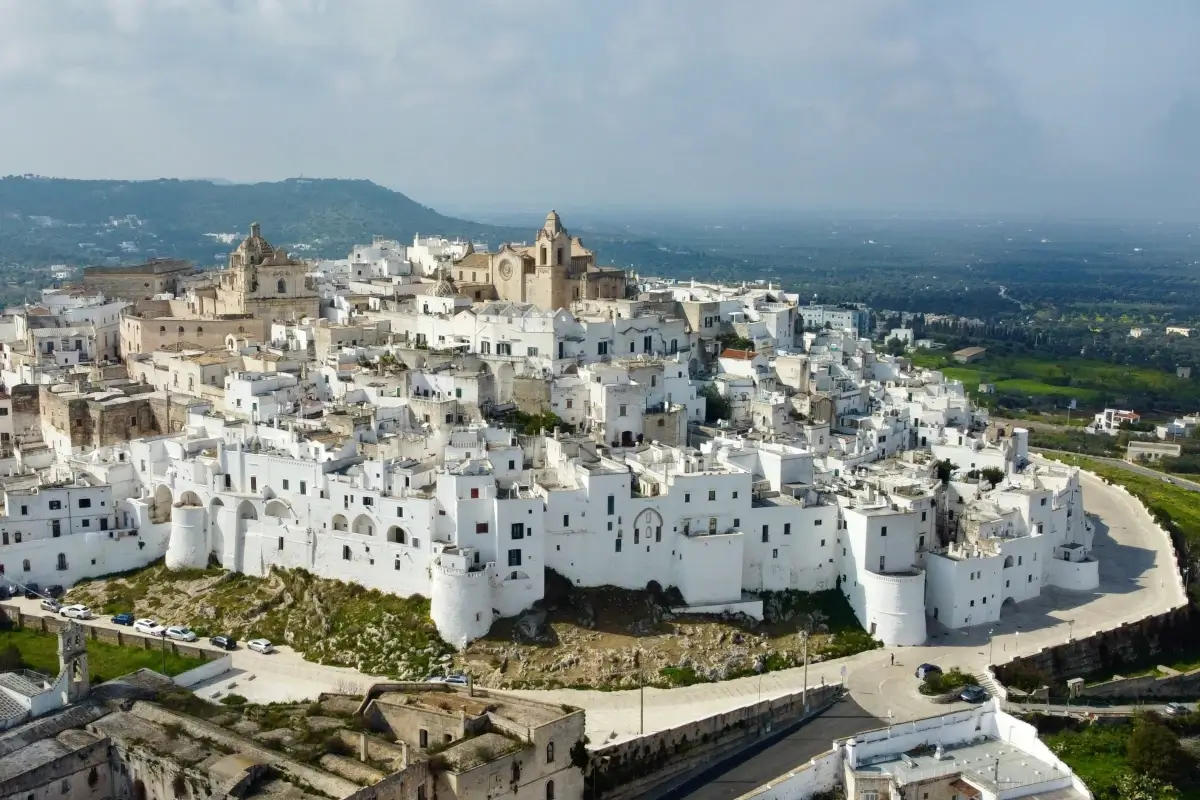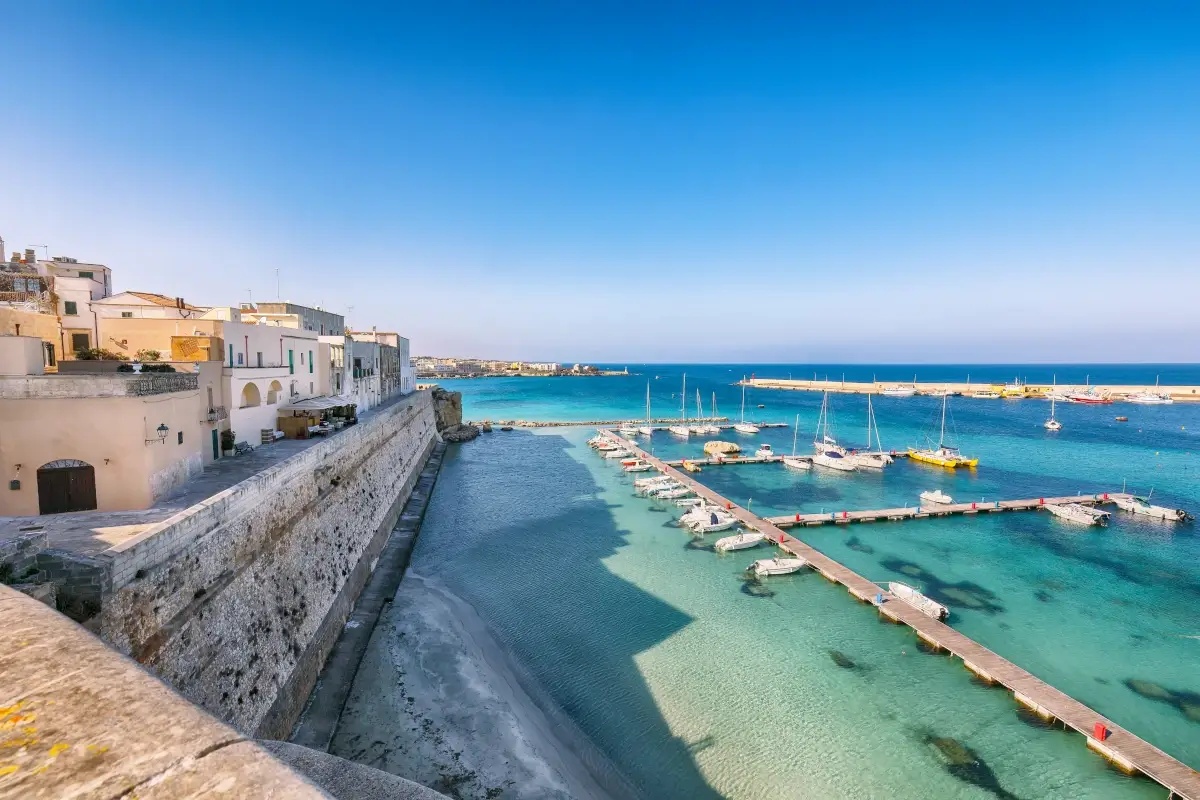
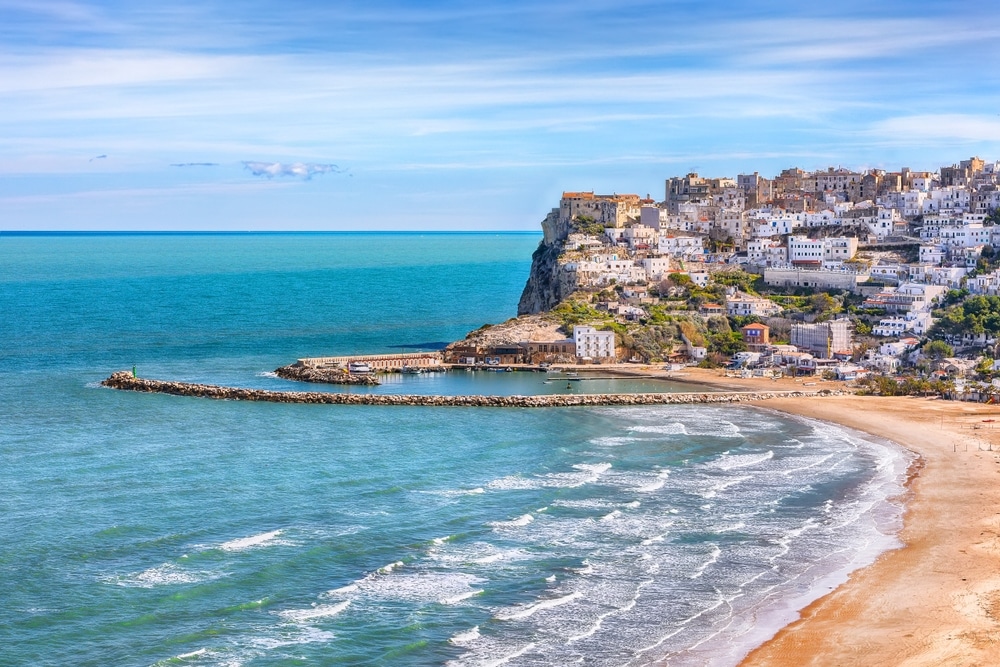
Apulia is one of the southernmost regions of Italy, overlooking the Adriatic sea. Characterized by a narrow and elongated shape, the region boasts two peninsulas, Gargano and Salento, which is bathed by the Adriatic and by the Ionian Seas.

Considered the “Gate of the Orient” since Roman times, Apulia represents a bridge to Greece and the Levant. In fact, the ports of Bari, Brindisi, and Otranto represent the mainstay of passengers moving towards Albania, Turkey, and Greece. Thanks to this characteristic, Apulia’s culture shaped itself differently from the other regions of Italy.

From a territorial point of view, the region is dominated by limestone plateaus and a succession of hilly and plain areas that are prolific for agriculture. From the point of view of cultural identity, Apulia can be divided into three areas that up until Italian Unification in the 1860s constituted three distinctive administrative units: Capitanata, Terra di Bari, and Terra d’Otranto with capitals in Foggia, Bari and Lecce, respectively. These boundaries are still tied to local cultural identity.

Apulia is an entity characterized by a diversity both from an environmental and an artistic and cultural point of view. The environmental diversity is given by the geographical location, while the culture is the result of the many civilizations that passed through the region. This incredible cultural diversity is mostly observed in the local dialects that have various influences including the Albanian language in Brindisi and Lecce, the Illyrian dialects in Capitanata, and Greek dialects in Salento.

These Eastern traits characterize the cultural aspects that can be found in the unique architecture such as the Trulli, declared as UNESCO World Heritage Sites. These round houses are very similar to the dwellings constructed in the Near East and Central Africa.

Another example of the diversity of culture in the region is the mysterious building of Castel del Monte, also a UNESCO World Heritage Site. Castel del Monte is the result of the eccentricity of Emperor Frederick II who wanted to synthesize in this place his enlightened cosmopolitan vision of the world, joining together elements of classical culture and of northern and eastern influences inspired by temples, Gothic cathedrals, desert castles and fortified monasteries, all linked together by the octagon shape of an esoteric meaning.

Additionally, Bari can be considered Apulia’s most vibrant centers from a cultural point of view, mainly because of the university and historical theaters such as Piccinni and Petruzzelli.

Lecce has also distinguished itself thanks to both the university and the vast architectural and artistic heritage, earning it the nickname “The Florence of the South”, while Taranto has the merit of holding an International Conference on Magna Graecia that brings together the highest representatives of both Italian and foreign archeology each year.

Apulia’s Art and Architecture

The archaeological importance of Apulia is documented from the second millennium BC. The Mycenae pottery in the region attests to the first important contact with the Aegean world, and even though Taranto was considered the only significant Greek colony in the region, other centers boast Greek origins too.

Apart from the ruins, such as the Doric Temple from the sixth century BC, Taranto’s archaeology is made up of the remains of a necropolis rich in pottery and other ceramics imported from Greece, limestone reliefs, crockery and jewels of Hellenistic origins.

From the fourth century BC, the artistic production gained greater uniformity and the influence of Taranto in the Italian culture became more apparent, especially with regards to an extensive production of pottery and ceramics.

Less documented are other forms of art, at least until the Roman times. Under the Roman domination, the centers along Via Appia and Via Appia Traiana were among the most important centers in Apulia, above all Brindisi, which was the main Roman harbor to the East.

Besides the remarkable bronze sculptures discovered underwater near the harbor of Brindisi, other important monuments can be admired in Lucera, Lecce, Canosa, and Taranto.

The rich archeological finds of Apulia are collected in numerous museums in Taranto, Bari, Foggia, Lecce, Lucera, Ruvo, and Brindisi.

Between the seventh and twelfth centuries, the most interesting artistic manifestations are represented by the churches and crypts built inside caves that emerged throughout the different areas of the region in places such as Massafra, Fasano, or Gravina in Puglia, to name just a few. Excavated in the rock and often decorated with frescoes, these religious sites are seen as unique representations of spirituality, not only in Italy, but worldwide.

Some constructions, such as the so-called “Tomb of Rotari” in the Sanctuary of Monte Sant’Angelo and the Mausoleum of Prince Boemondo in Canosa are examples of the fusion between the Byzantine, Classical and Barbaric elements.

From the twelfth century, a period of great splendor regarding art in Apulia began. The local Romanesque architecture was influenced by different styles, such as the classical-Roman style, the Lombard, Norman, and even Tuscan styles, resulting in a unique expression of this form of art. Among the first examples of the Romanesque style in Apulia is the Basilica of Saint Nicholas in Bari in which the Norman elements of the structure combine with the Lombard-Emilian elements of the wall arches and pilasters.

The Basilica of Saint Nicholas is considered a prototype of a series of other spiritual edifices present throughout Terra di Bari, such as the Cathedral of San Sabino in Bari and the Cathedrals of Bitonto, Trani, and Ruvo.

Alongside the model of Saint Nicholas, some of Apulia’s churches show different influences. In particular, in the area of Capitanata, the influences of Pisa are evident, especially in the architecture of the Cathedral of Troia and in the Abbey of San Leonardo, near Manfredonia.

The Church of Santa Maria Maggiore, in Monte Sant’Angelo, is another example of the Tuscan influences in Apulia and is striking with the decorations of the façade.

The Cathedrals of Taranto and Otranto, on the other hand, offer an insight on the local interpretation of the Romanesque motifs with Byzantine derivations. The Romanesque sculptures in Apulia are strongly linked to the architecture, and a wide variety of motifs are constant between the two forms of art, from the geometric figures to bizarre interpretations of animals.

Some examples of sculptures that are not linked to the architecture are present in the Basilica of Saint Nicholas in Bari, in the Cathedral of Trani and in the interesting Church of Saint Cataldo in Lecce, where the Byzantine elements and classical decorations blend with French Gothic motifs.

The thirteenth century also saw a splendid artistic flourishing with the grafting of Gothic and classical forms of art in the traditional Romanesque structures. Particularly noteworthy are the accomplishments promoted by Frederick II, such as the Castles of Bari, Lucera, Gioia del Colle and, above all, Castel del Monte near Andria.

In fact, Castel del Monte, erected in 1240, is characterized by an octagonal shape with architectonic motifs derived from classical design. After being used as a hunting lodge and a prison, the castle fell into a state of disrepair and many of its treasures, including its marble, were looted during the 18th century. Eventually, the castle was purchased by the Italian government in the 20th century and restored. Castel del Monte’s unique architecture has imparted a veil of mystery, which continues to captivate.

Up to the sixteenth century, the architecture in the region was rather modest and was dominated by Venetian-Dalmatian influences found in the Cathedrals of Manduria, Ostuni, and Mottola.

In the seventeenth century, Apulia returned to the artistic scene of Italy, majorly thanks to the examples of the Baroque in Lecce. Baroque manifested itself with original characters in the region and it is somewhat linked to the Spanish Baroque, overlapping an imaginative decoration of the linear structures.

In the first half of the seventeenth century, artists such as Cesare Penna and Michele Coluzio completed incredible artworks such as the Basilica of Santa Croce in Lecce, which was enlarged by architect Giuseppe Zimbalo between 1659 and 1670.

Beginning with the eighteenth century, the characteristic Baroque of Salento spread through the smallest centers of Terra d’Otranto in towns such as Nardò, Galatone, and Tricase.

In particular, Nardò experienced a period of architectural flowering that was largely dependent on the presence of Neapolitan architect Ferdinando Sanfelice. The architect also had influenced the architectural styles of Lecce and other centers throughout Salento while a series of local architects, including Mauro Manieri, influenced the restoration and the Baroque transformation of the Cathedral of Brindisi, the reconstruction of the façade of the Cathedral of Taranto, and the reconstruction of some churches in Lecce.

At the end of the eighteenth century, the late Baroque of Salento approached its end and the Baroque style, now oriented towards Naples and Rome, conquered the northern part of Apulia.

In the eighteenth century, the architectural activity in central Apulia and Capitanata became very intense. Among the accomplishments of the period, we can mention the Church of Santa Teresa in Trani, erected between 1754 and 1768, and the Church of Purgatory in Barletta built in 1727 and whose unfinished façade represents a rare example of local eighteenth-century churches that abandoned the traditional longitudinal plant to accommodate patterns inspired by the Roman and Neapolitan schools.

A popular phenomenon of the century is the attempt to transform the Romanesque architecture of some of the cathedrals to Baroque. One of the architectural symbols of Apulia that is representative for this period of transition is the Cathedral of Foggia, rebuilt after an earthquake in 1743. While preserving its medieval façade, the edifice received new elements, including a series of remarkable cornices in the twentieth century.

The Cathedral of Bari also went through transformations made by the Neapolitan architect Domenico Antonio Vaccaro. Another example of the artist’s skill is the restoration of the Medieval Church of San Giacomo in Bari that received fine decorations made with stucco stitch. Beyond the wall decorations, the artist also added marble tiles to the altar and floor.

At the end of the eighteenth century, the first reflections of the Neoclassical style arrived in Apulia. The Church of Santa Chiara in Mola features work of the architect Vincenzo Ruffo and is a splendid example of the architecture of the era.

Regarding painting, the artistic style became ornamented in the first half of the eighteenth century by the works of the followers of Luca Giordano and Francesco Solimena, two painters from Campania that influenced art in southern Italy.

In 1813, under the orders of Gioacchino Murat who wanted to create a new city of Bari, Apulia met a period of architectural transformation that resulted in the construction of nineteenth-century edifices not only in Bari, but in small towns and villages along the coast and the inland.

From this moment and throughout the nineteenth century, the number of architects and engineers operating in Apulia was impressive, and in this period a few symbolic edifices of the region such as Piccinni Theatre in Bari and the Cathedral of Cerignola were erected.

In the field of restoration, the medieval of the churches and Cathedrals in Bari, Bitonto, Nardò, and Ruvo met a rediscovery of the Romanesque style characteristic of Apulia.

Additionally, the nineteenth century was extremely prolific for the construction of theaters. There are two distinct manifestations, one linked to the field of restoration and one linked to the rise of the bourgeoisie. Unfortunately, many of the theaters belonging to the era, such as the municipal theater of Trani, have been destroyed. Others, such as Piccinni in Bari or Curci in Barletta continue to exercise their function even today.

Throughout the nineteenth century, sculpture and painting did not offer significant manifestations in Apulia. A change in the artistic scene emerged in the early twentieth century when the well-known local painter Raffaele Armenise had been commissioned to paint the cupola and other mural decorations of Petruzzelli Theater in Bari.

With the advent of fascism, the three capitals of Apulia underwent a period of profound urban transformation. In Bari the coastal road that surrounds the old town was built, while in Taranto the promenade and some monumental public buildings were erected.

The official architects of this period were Armando Brasini and Cesare Bazzani, and some of their works are featured in the Town Hall of Foggia and the Palace of the Prefecture, the Post Office and the Bank of Italy in Taranto.

During the Second World War the cities of Foggia, Bari, and Taranto suffered serious damage, but fortunately, the rest of the region remained almost intact and preserved the vast majority of the artistic and cultural landmarks. As such, the architecture of the twentieth century isn’t well represented in the region, although there are a few edifices that represent a reference point in Italian architectural culture.

Among them, we can mention the Church of Gran Madre di Dio in Taranto, one of the most important works of the Milanese architect Giovanni Ponti, and San Nicola Stadium in Bari, designed by the architect Renzo Piano for the World Cup in 1990.

Explore Our Apulia Vacation Itineraries