Trieste History Guide

HOME » POPULAR ITALIAN DESTINATIONS » TRIESTE TRAVEL GUIDE » TRIESTE HISTORY GUIDE

Trieste Travel Guide        Culture        History        Food and Wine        Things to Do        Plan My Trip

About this guide: This guide to the history of Trieste was written by the Italian-born travel specialists at Trips 2 Italy, a custom tour operator that has designed hand-crafted Italian vacations since 2003. Every recommendation below reflects the same first-hand knowledge our team draws on when we build a private Trieste itinerary around a traveler’s interests, dates, and pace. Read it for your research, then let us translate it into a trip designed entirely around you.

What Are the Ancient Origins of Trieste?

Trieste began as Tergeste, a settlement of the Carni and Histri peoples that Rome absorbed in the second century BC and raised to a colony under Julius Caesar, who mentions it by name in his commentaries. Its position, where the amber and trade routes from Central Europe met the Adriatic at the edge of what is now the Friuli Venezia Giulia region, made it valuable to Rome from the start, and Octavian fortified it with walls and towers in the 30s BC.

The Roman city climbs into view in the middle of the modern one. The Roman theatre, built in the first and second centuries AD into the slope beneath San Giusto hill, seated several thousand spectators with the sea at their backs, and it still hosts summer performances. Nearby, the Arch of Riccardo, a gate from the Augustan walls, stands in a small old town piazza where laundry dries above two thousand years of masonry.

On the hilltop itself, the forum’s columns and the foundations of the Roman basilica lie beside the cathedral, so a single short climb crosses the city’s entire ancient chapter. We pair travelers with historian guides who can people these stones again, reading the port’s Roman origins into the modern streets, and for enthusiasts of the ancient world we extend the day to Aquileia, once among the great cities of the Roman Empire, less than an hour away.

The castle museum on the hill deepens the chapter with its lapidarium, where inscriptions, altars, and carved stones gathered from the ancient city line the old fortifications. Standing among them with the gulf below, it is easy to grasp why Rome valued this shore: Tergeste was where the roads from the Danube lands met the sea, a role the city would play again, under different flags, for the next two thousand years.

How Did Trieste Come Under the Habsburgs?

Medieval Trieste was a small walled commune living in the long shadow of Venice, whose fleets dominated the Adriatic and whose merchants had little patience for rivals. After repeated wars and Venetian occupations, the exhausted city made a decision in 1382 that would shape the next five and a half centuries: it placed itself voluntarily under the protection of Leopold III of Habsburg, Duke of Austria.

The dedication was shrewd. Trieste kept substantial self-government while gaining a powerful continental protector, and it remained a Habsburg possession, with brief interruptions, until 1918. For its first three Habsburg centuries the city stayed modest, a salt-producing town of a few thousand souls gathered around San Giusto hill, its great transformation still waiting on an emperor’s signature.

That long medieval chapter is best read on the hilltop. The cathedral of San Giusto, completed in the fourteenth century by joining two earlier churches into one asymmetrical facade, glows inside with Byzantine-influenced mosaics, and the castle beside it, built and enlarged by the Habsburgs between the fifteenth and seventeenth centuries, still watches the gulf from its ramparts. Together they form one of the most rewarding historical hours in the city.

What Did the Free Port of 1719 Change?

In 1719 Emperor Charles VI declared Trieste a free port, sweeping away customs barriers and inviting the world to trade under imperial protection. His daughter Maria Theresa then built the city the invitation required, draining the old salt pans and laying out the rational grid of streets that still bears her name, the Borgo Teresiano, with the Canal Grande dug through its center in the 1750s so cargo could float to the warehouse doors.

The results were explosive. A town of perhaps five thousand people in 1700 grew into a cosmopolitan port of tens of thousands within a century, drawing Greek, Serbian, Jewish, Armenian, German, and Slovenian communities with guarantees of religious tolerance extraordinary for the age. Each community raised its own church and its own trading houses, and the mixture became the city’s character.

This is the moment Trieste became Trieste, and the Borgo Teresiano is its living document. Walking the grid today, from the canal’s church-closed vista past the former warehouses and merchant palaces, travelers read the eighteenth century directly from the facades. Our historian-led walks decode it building by building, tracing how an emperor’s economic decree turned a fishing town into the Mediterranean’s most surprising boomtown.

The reforms reached beyond commerce. Joseph II’s decrees of the 1780s extended religious tolerance and gave the Carso’s farmers the right to sell their own wine at home, the origin of the osmiza tradition that still flourishes on the plateau. Few cities preserve so direct a line from imperial paperwork to living custom, and tasting Terrano at a farm table today is, quite literally, drinking an eighteenth-century decree.

What Was Trieste's Nineteenth-Century Golden Age?

The nineteenth century made Trieste the fourth city of the Austro-Hungarian Empire, after Vienna, Budapest, and Prague, and the empire’s only great seaport. Through its quays passed the coffee, cotton, and commerce of an empire of fifty million people, and the institutions to move it all were founded here: mighty shipping lines from 1836 onward and insurance houses whose names would become global, born within sight of the harbor.

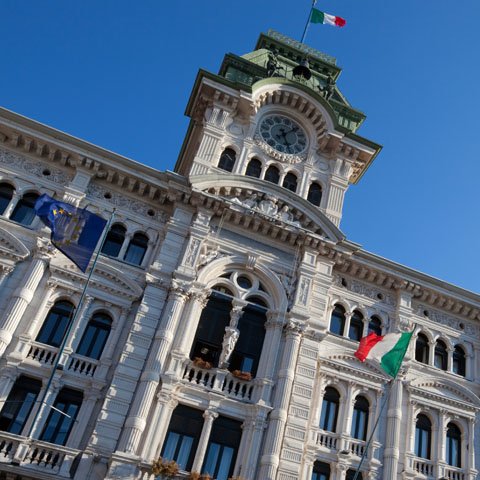
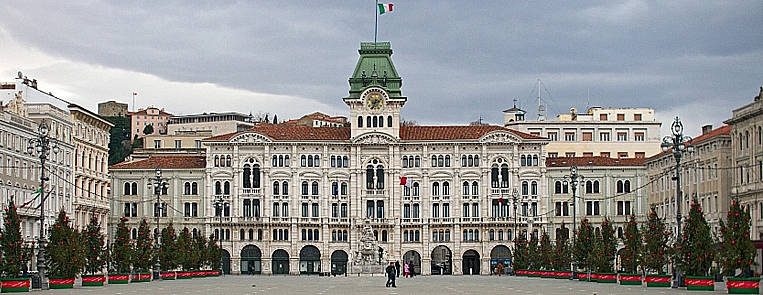
Prosperity built the city travelers see today. The grand facades of Piazza Unita d’Italia rose in these decades, along with the opera house, the stock exchange, the vast neoclassical churches, and boulevard after boulevard of merchant palaces. The port’s engineers pushed new moles into the gulf, and the railway over the karst, completed in 1857, bound the harbor to Vienna and made Trieste the Mediterranean gateway of Central Europe.

The numbers tell the story as vividly as the architecture. By the eve of the First World War, Trieste had grown to nearly a quarter of a million inhabitants, ranking among the busiest ports of the Mediterranean, its warehouses moving coffee for half of Central Europe and its shipyards launching liners for the Atlantic trade. Emperors and archdukes visited, and the city carried itself, as it still faintly does, like a capital.

Yet the same century planted the tension that would define the next. As the city grew rich under the double eagle, its Italian-speaking majority increasingly looked toward the young Kingdom of Italy, while the empire held its indispensable port ever tighter. That unresolved question, prosperity under one flag and sentiment under another, gives the city’s golden-age architecture a poignancy travelers can still feel on the great square.

How Did Maximilian and Miramare Enter the Story?

In the 1850s the Archduke Maximilian, younger brother of Emperor Franz Joseph and commander of the Austrian navy, fell in love with a wooded promontory north of the city and built upon it the white castle of Miramare, completed around 1860 for himself and his wife, Charlotte of Belgium. Its rooms were fitted like ship’s cabins, its windows aimed at the sea, and its gardens planted with species gathered on his voyages.

The idyll lasted only a few years. In 1864 Maximilian accepted the crown of Mexico, a venture sponsored by Napoleon III, and sailed from Miramare’s little harbor to the throne that would destroy him. Abandoned by his sponsors, he was captured and executed in 1867, and Charlotte, who had crossed the Atlantic seeking help for him, descended into a madness from which she never recovered. The castle became a memorial to Habsburg tragedy.

Today Miramare is Trieste’s most beloved excursion, its state rooms preserved with the couple’s furnishings, its park cascading toward a protected marine reserve. We arrange visits with guides who tell the story in full, from naval ambition to Mexican catastrophe, and time the morning so the castle’s seaward rooms hold their light. Few places anywhere compress the empire’s glamour and grief into a single afternoon so completely.

What Happened to Trieste in the Twentieth Century?

The twentieth century arrived like the Bora. The First World War turned the karst above the city into one of its most terrible fronts, where the battles of the Isonzo consumed hundreds of thousands of lives, and in 1918 Italian troops landed at the Molo Audace, ending five centuries of Habsburg rule. Trieste had joined Italy, but severed from the imperial hinterland it had served, the great port entered a long, reflective quiet.

The Second World War brought the city’s darkest chapter, including the Risiera di San Sabba, the rice mill the occupying Germans turned into a detention and deportation camp, preserved today as a national memorial visited in respectful quiet. After 1945 the city’s fate hung unresolved between Italy and Yugoslavia, and for nine years it existed as the Free Territory of Trieste under Allied administration, a city-state with its own stamps and an uncertain future.

In 1954 Trieste returned to Italy, an event still commemorated with deep feeling, while its karst hinterland passed to Yugoslavia. For decades the city sat at the very edge of Western Europe, the Iron Curtain beginning in its suburbs, until Slovenia’s independence and European integration dissolved the border entirely. The frontier that once divided families is now a line walkers cross on plateau trails without breaking stride.

Which Places Bring Trieste's History to Life Today?

The city is its own museum, arranged in concentric centuries. San Giusto hill holds the Roman forum, the mosaic-lit cathedral, and the Habsburg castle in a single climb; the old town below keeps the Arch of Riccardo and the Roman theatre; the Borgo Teresiano preserves the free port’s eighteenth-century optimism; and Piazza Unita d’Italia performs the imperial nineteenth century every evening when its facades are lit.

The surrounding coast completes the story. Miramare holds the Habsburg twilight in white stone, the Duino cliffs carry both Rilke’s poetry and the memory of the karst front, and the village cemeteries and war memorials of the plateau speak quietly of the border century. The Risiera di San Sabba memorial and the city’s museums, from the history collections of the castle to the Revoltella gallery of a great merchant’s bequest, deepen every chapter.

Sequence turns these sites into a story, and that is our craft. We compose history-focused Trieste itineraries chronologically where interests allow, from Roman stones to Habsburg salons to the borderland’s memorials, with historian guides chosen for their narrative gift, as part of our Italian cultural tours. Few cities in Europe tell the last three centuries so vividly in so short a walk.

Ready to Begin Planning Your Trieste Vacation?

Trieste deserves more than a template. Since 2003, Trips 2 Italy has designed private Italian vacations one traveler at a time, hand selecting every experience based on what you tell us rather than fitting you into a predefined package. Our Italian-born team plans Trieste with the knowledge of people who call Italy home, from the great sea-facing square to the wine cellars of the Carso plateau, and we remain at your side throughout your trip with 24/7 assistance. Tell us how you imagine Trieste, and we will craft the itinerary that matches it.

Explore Our Trieste Vacation Itineraries

Frequently Asked Questions About the History of Trieste

Trieste placed itself under Habsburg protection in 1382 and served as the great seaport of the Austro-Hungarian Empire until 1918. Its neoclassical boulevards, Viennese-style cafes, and grand insurance and shipping palaces were built to Vienna’s taste during that long era, giving the city a Central European elegance unique in Italy.

Archduke Maximilian of Habsburg, brother of Emperor Franz Joseph, built Miramare Castle on the gulf around 1860 for himself and his wife Charlotte of Belgium. He left it in 1864 to become Emperor of Mexico and was executed there in 1867. The castle preserves the couple’s rooms and gardens, and its tragic story makes it one of Italy’s most affecting historic houses.

Yes. Roman Tergeste survives in the theatre built into the slope beneath San Giusto hill, the Arch of Riccardo from the Augustan city walls, and the forum ruins beside the cathedral on the hilltop. The great Roman city of Aquileia, with its celebrated mosaics, lies under an hour away and pairs naturally with a Trieste history day.

Italian troops landed at the Molo Audace in 1918 at the end of the First World War, ending five centuries of Habsburg rule. After the Second World War the city spent nine years as the Free Territory of Trieste under Allied administration before returning definitively to Italy in 1954, an anniversary the city still marks with feeling.

The hill gathers the city’s whole story: the ruins of the Roman forum, the fourteenth-century cathedral of San Giusto with its glowing mosaics, and the Habsburg castle whose ramparts hold the finest panorama over the city and gulf. Trips 2 Italy arranges the climb with historian guides who read each layer in sequence.

Yes. We compose private history itineraries with expert guides, moving from Roman Tergeste through the free port and the imperial golden age to Miramare and the border century, and we extend the story to Aquileia, the Isonzo front, and the karst villages when travelers wish to go deeper.