Trieste Culture Guide

HOME » POPULAR ITALIAN DESTINATIONS » TRIESTE TRAVEL GUIDE » TRIESTE CULTURE GUIDE

Trieste Travel Guide        Culture        History        Food and Wine        Things to Do        Plan My Trip

About this guide: This guide to the culture of Trieste was written by the Italian-born travel specialists at Trips 2 Italy, a custom tour operator that has designed hand-crafted Italian vacations since 2003. Every recommendation below reflects the same first-hand knowledge our team draws on when we build a private Trieste itinerary around a traveler’s interests, dates, and pace. Read it for your research, then let us translate it into a trip designed entirely around you.

What Defines the Culture of Trieste?

Trieste is Italy’s great cultural crossroads, the city where the Latin, Slavic, and Germanic worlds of Europe meet on a single waterfront. For nearly two centuries it flourished as the seaport of the Austro-Hungarian Empire, drawing merchants from every corner of the Mediterranean and Central Europe, and that layered identity still distinguishes it within the Friuli Venezia Giulia region and within Italy as a whole.

The evidence is written into the streetscape. Within a few blocks of the Canal Grande stand a Serbian Orthodox church crowned with blue domes, a Greek Orthodox church facing the harbor, one of the largest synagogues in Europe, and Catholic churches in neoclassical dress. Each community arrived under the free port’s promise of tolerance and prospered, and their descendants remain part of the city’s fabric today.

Triestine identity absorbed all of it. The local dialect carries Venetian roots with German, Slovenian, and Croatian borrowings, the pastry shops sell strudel beside Italian pastry, and the city’s temperament, reflective, ironic, faintly melancholy, has been described by generations of writers who found in Trieste a place that belongs entirely to itself. Travelers who love cities with layered souls find this one inexhaustible.

The culture also keeps a bookish, unhurried grain rare in port cities. Antiquarian bookshops survive in the old town, the tradition of reading a newspaper at length in a cafe remains a daily practice, and the city’s museums, from a great merchant’s palace of paintings to collections of maritime and Habsburg history, reward slow visits. We compose cultural days here at the city’s own tempo, because Trieste reveals itself to patience rather than to checklists.

Why Is Trieste One of Europe's Great Literary Cities?

Few cities of this size occupy more space in modern literature. James Joyce arrived in 1904 and stayed the better part of eleven years, teaching English, raising his family, and writing most of Dubliners and A Portrait of the Artist as a Young Man while the ideas behind Ulysses took shape. The city honors him with a life-size bronze on the canal bridge, mid-stride, hat tilted, as if late for a lesson.

His most famous student became his peer. Italo Svevo, a Triestine businessman writing in obscurity, showed his work to his English tutor, and Joyce’s encouragement helped carry Zeno’s Conscience to the world. Umberto Saba, the city’s great poet, ran an antiquarian bookshop that still operates in the old town, and Rainer Maria Rilke began his Duino Elegies while staying at the castle on the cliffs just up the coast.

Literary Trieste is best experienced on foot, and we arrange private walks with guides steeped in this heritage: the statues of Joyce, Svevo, and Saba, the cafes where they wrote and argued, the bookshop, and the Joyce museum, ending with the Rilke path above the sea. For devoted readers, we can shape an entire day, or an entire itinerary, around the words this coastline produced.

What Is the Cafe Culture of Trieste?

Trieste treats coffee as a civic institution. The city has been one of the Mediterranean’s principal coffee ports since the eighteenth century, when the free port began landing sacks of beans for the empire behind it, and roasting houses founded here generations ago carry the city’s name around the world. Coffee is not a pause in the Triestine day; it is the day’s punctuation.

The historic cafes are the culture’s living rooms. Founded in the nineteenth and early twentieth centuries in the grand Viennese style, they served as parlors and debating chambers for merchants, insurgents, and the literary circle of Joyce and Svevo, and they still serve locals reading newspapers beneath chandeliers and gilt mirrors. A morning in one of them, unhurried, is among the city’s essential experiences.

The city even keeps its own coffee language. An espresso is a nero, an espresso with a cloud of milk foam is a capo, and served in a small glass rather than a cup it becomes the beloved capo in b. We arrange coffee experiences that decode all of it, from historic cafe visits with a cultural guide to tastings that trace the bean’s journey from the port warehouses to the cup, a story only Trieste can tell in full.

Cafe etiquette here is its own quiet pleasure. Regulars keep their tables for hours over a single cup and a book, waiters in white jackets remember preferences across decades, and the afternoon pairing of coffee with a slice of presnitz or a Viennese cream cake is treated as a small ceremony. Learning to take coffee at this pace is, for many of our travelers, the habit of the trip they most want to carry home.

How Does Architecture Reveal the Habsburg City?

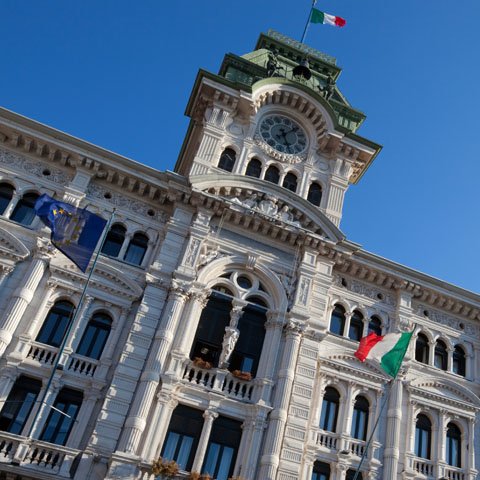
Trieste looks like no other Italian city because it was built to Vienna’s taste. The Borgo Teresiano, commissioned by Maria Theresa in the eighteenth century, laid a rational neoclassical grid over the old salt pans, and the nineteenth century filled it with the palaces of shipping magnates and insurance houses, their facades crowded with allegorical statuary celebrating commerce and the sea.

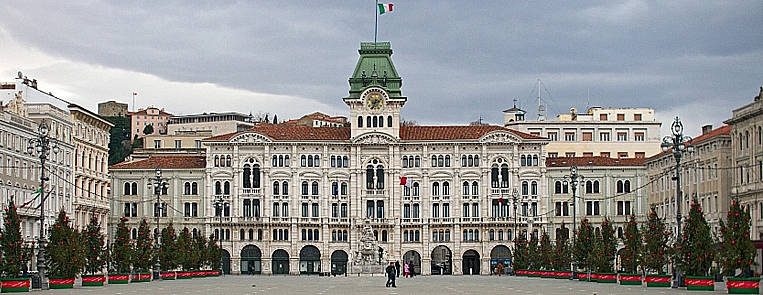
Piazza Unita d’Italia gathers the style’s full ambition into a single space. The city hall with its clock tower, the former palace of the Austrian Lloyd shipping line, and the seat of the regional government frame three sides, while the fourth opens theatrically to the gulf. The ensemble was designed to announce a great imperial port to every ship that entered the harbor, and it still performs that role each evening when the facades are lit.

Around the grand set pieces, the city rewards architectural curiosity at every turn: Art Nouveau apartment houses with sinuous ironwork, the severe beauty of the neoclassical churches, the vast synagogue of 1912, and the Habsburg romanticism of Miramare Castle on its promontory. We arrange architecture-focused walks with specialists who read these buildings fluently, tracing how an empire’s confidence was translated into stone on the Adriatic shore.

The sacred buildings alone justify a themed morning. The Serbian Orthodox church of San Spiridione glows with icons and gilded domes beside the canal, the Greek Orthodox church of San Nicolo faces the harbor that made its congregation wealthy, and the synagogue, among the largest in Europe when it opened, testifies to the Jewish community’s central role in the city’s commerce and letters. Read together, they are the free port’s promise of tolerance written in architecture.

What Festivals and Performances Animate Trieste?

The Barcolana is the city’s defining ritual. Held on the second Sunday of October since 1969, it has grown into one of the largest sailing regattas on earth, with thousands of boats, from Olympic-class racers to family cruisers, crossing a single starting line in the gulf. For a week beforehand the waterfront becomes a village of sail, and on race morning the entire city turns out to watch the gulf turn white.

Music runs on an operatic scale. The Teatro Verdi, the city’s opera house, has staged seasons since 1801, and its tradition reflects the city’s position between Italian lyric passion and Viennese formality. Concerts fill church naves and palace courtyards through the year, and summer brings open-air performances along the waterfront and in the castle courtyard of San Giusto.

Theater and letters keep their own seasons. Literary events gather readers in the historic cafes, the city’s museums stage exhibitions that draw on its extraordinary archives, and the Slovenian community maintains its own theater and cultural life, a reminder that this city performs in more than one language. For travelers, the result is a calendar with something rewarding in nearly every month.

The calendar carries the borderland’s imprint as well, from the feast of San Giusto in early November to Central European Christmas markets and the traditions of the Slovenian villages on the plateau. We time itineraries around these moments as part of our entertainment and festival experiences in Italy, securing seats, viewpoints, and tables so the celebration becomes the centerpiece of the trip rather than a lucky accident.

How Do the Carso and Its Osmize Shape Local Identity?

Above the city spreads the Carso, the limestone plateau whose Slovenian-speaking farming villages have provisioned Trieste for centuries. This is a borderland culture in the truest sense: bilingual road signs, churches where mass is sung in Slovenian, and a cuisine and wine tradition that belong to the plateau itself rather than to either nation. The border with Slovenia, once among Europe’s hardest, is now simply a line travelers cross without noticing.

The osmiza is the plateau’s most beloved institution. By a Habsburg decree of 1784, farmers won the right to sell their own wine, cured meats, cheese, and eggs directly from their homes for a limited number of days each year, and the custom survives exactly in that form. A leafy branch, the frasca, hung at a lane’s entrance signals that a farm is open, and inside, tables fill with plateau families and Triestines who have driven up for the afternoon.

Finding the right osmiza on the right day is local knowledge, and that is precisely what we provide. We arrange Carso afternoons with drivers and guides who know which farms are open and which cellars deserve the detour, pairing Terrano and Vitovska from karst vineyards with prosciutto cured in the Bora wind. It is one of Italy’s most authentic experiences, and one almost no traveler finds alone.

What Is Daily Life Like in Trieste?

The Triestine day begins in a cafe and ends by the sea. Mornings mean a capo in b and a newspaper, midday brings the rebechin, the little snack taken standing in an old-fashioned buffet, and when the workday softens, the city drifts to the water: the Molo Audace pier for the evening light, or in summer the Barcola promenade, where generations of families claim the same stretch of seafront concrete like an inheritance.

Swimming is a year-round conviction for the hardiest, and the sea is democratic here: office workers take a plunge before lunch, retirees hold court on the terraces, and in October the whole city becomes a grandstand for the Barcolana. When the Bora blows, life continues with a lean into the wind and a certain civic pride, since every Triestine measures character by gusts weathered.

For travelers, the deepest pleasure of Trieste is joining these rhythms rather than observing them: an unhurried cafe morning, a buffet lunch among regulars, an aperitivo on the great square as the lamps come on. Our Italian cultural tours are composed of exactly these hours, arranged with the local knowledge that turns a visit into a brief residency.

Ready to Begin Planning Your Trieste Vacation?

Trieste deserves more than a template. Since 2003, Trips 2 Italy has designed private Italian vacations one traveler at a time, hand selecting every experience based on what you tell us rather than fitting you into a predefined package. Our Italian-born team plans Trieste with the knowledge of people who call Italy home, from the great sea-facing square to the wine cellars of the Carso plateau, and we remain at your side throughout your trip with 24/7 assistance. Tell us how you imagine Trieste, and we will craft the itinerary that matches it.

Explore Our Trieste Vacation Itineraries

Frequently Asked Questions About the Culture of Trieste

James Joyce lived in Trieste for over a decade and wrote much of his early work here, Italo Svevo created the modern Italian novel with Zeno’s Conscience, the poet Umberto Saba ran the antiquarian bookshop that still bears his imprint, and Rilke began his Duino Elegies on the cliffs nearby. Statues, museums, and cafes across the city keep this heritage alive.

Trieste has been one of the Mediterranean’s principal coffee ports since the eighteenth century, and roasting houses founded here made the city synonymous with fine espresso. Its historic Viennese-style cafes and its own coffee dialect, where a capo in b means espresso with milk foam in a small glass, make coffee a full cultural experience rather than a quick stop.

The city itself speaks Italian and its own Triestine dialect, while the villages of the surrounding Carso plateau preserve a living Slovenian-speaking culture with bilingual signage and traditions. This borderland character, layered with Austrian, Greek, Serbian, and Jewish heritage from the free port era, is central to what makes Trieste unique.

An osmiza is a Carso farm that opens its doors for a limited period each year to sell its own wine, cured meats, cheese, and eggs, a right granted by Habsburg decree in 1784. A leafy branch hung at the lane marks an open farm. Trips 2 Italy arranges osmiza visits with drivers and guides who know which farms are open and which are worth the journey.

The Barcolana regatta on the second Sunday of October is the city’s signature event, filling the gulf with thousands of sails, while the Teatro Verdi opera season, waterfront summer concerts, and the borderland’s Central European Christmas traditions reward other seasons. We build itineraries so these moments become centerpieces rather than coincidences.

Yes. We arrange private literary walks tracing Joyce, Svevo, and Saba, coffee experiences in the historic cafes, architecture tours of the Habsburg city, and Carso afternoons among Slovenian-speaking wine villages, each composed by hand around your interests and led by specialists who know the city intimately.