Things To Do in L'Aquila

HOME » POPULAR ITALIAN DESTINATIONS » L’AQUILA TRAVEL GUIDE » L’AQUILA THINGS TO DO GUIDE

L’Aquila Travel Guide        Culture        History        Food and Wine        Things to Do        Plan My Trip

About this guide: This guide to things to do in L’Aquila was written by the Italian-born travel specialists at Trips 2 Italy, a custom tour operator that has designed hand-crafted Italian vacations since 2003. Every recommendation below reflects the same first-hand knowledge our team draws on when we build a private L’Aquila itinerary around a traveler’s interests, dates, and pace. Read it for your research, then let us translate it into a trip designed entirely around you.

What Belongs at the Top of Every L'Aquila Itinerary?

The Basilica di Santa Maria di Collemaggio first: the geometric facade of pink and white stone, the Holy Door of the world’s first jubilee, and the luminous restored interior holding the tomb of Celestine V. Give it an unhurried hour with a guide who can tell the story of the hermit pope, because the basilica is not merely beautiful; it is the city’s soul in architectural form.

The Basilica di San Bernardino follows, its grand Renaissance facade climbing in three classical tiers and its interior glowing beneath a gilded baroque ceiling, with the marble mausoleum of the saint carved by Silvestro dell’Aquila. Then walk the Corso Vittorio Emanuele to the castle park, where the massive Spanish Fort broods over the trees beside Renzo Piano’s brightly colored auditorium, the old and new city in a single view.

Finish at the Fontana delle 99 Cannelle in the Rivera quarter, where mountain water has poured from ninety-nine carved masks since 1272 in honor of the founding castles of the capital of the Abruzzo region. We sequence these essential encounters with expert guides and time them to the quiet hours, because monuments this eloquent deserve better than a crowd and a checklist.

What Makes Gran Sasso and Campo Imperatore Unmissable?

Half an hour from the city rises the roof of the Apennines. The Gran Sasso massif culminates in the Corno Grande at over 9,500 feet, sheltering Europe’s southernmost glacier beneath its summit ridges, and the cable car from Fonte Cerreto lifts travelers in minutes to Campo Imperatore, the vast high plateau at 7,000 feet that Italians call Little Tibet.

The plateau is one of the great landscapes of Italy: miles of treeless grassland rolling between peaks, horses and cattle grazing wild through summer, wildflowers in June, snowfields in winter, and a silence that recalibrates the nervous system. Photographers and film directors have used it for decades as a stand-in for the world’s remotest places, yet it sits ninety minutes from Rome.

History and science add their footnotes. The mountaintop hotel where Mussolini was held in 1943 until German gliders landed on the plateau to carry him off is a story guides still tell on the very ground, and the plateau’s astronomical observatory has read these dark, clear skies for nearly a century, while beneath the massif the great underground laboratory probes the universe from the silence of the rock.

We arrange Gran Sasso days with private drivers and mountain guides, timed to the clearest weather windows, paired with lunches of arrosticini and mountain cheese at altitude, and paced so the plateau’s silence is given the hours it deserves. Whether you ride the cable car for the view or walk the high trails for half a day, this is the excursion travelers describe first when they come home.

Which Day Trips Reward Travelers Around L'Aquila?

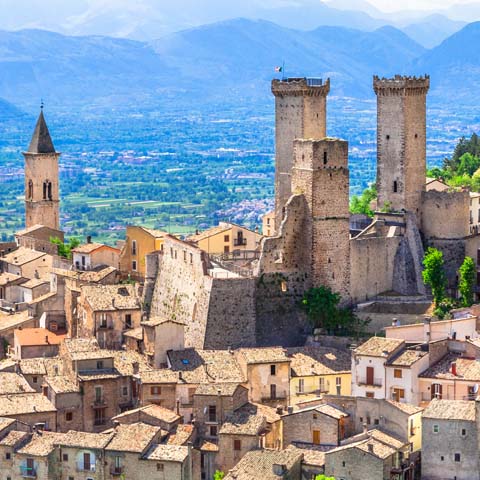
Rocca Calascio leads every list. The highest fortress of the Apennines stands at nearly 4,800 feet on a ridge above the Navelli plateau, a ruined watchtower ringed by later bastions, reached by a gentle walk from the village below. Cinema discovered it decades ago, and one glance explains why: the castle floats above a sea of mountains, especially at golden hour, when the light turns the stone to amber.

Twenty minutes away, Santo Stefano di Sessanio curls around its hilltop in perfect medieval order, a village of stone lanes and low arches once owned by the Medici, whose wool trade left the family crest above its gate. Its sensitive restoration has made it a model for how mountain villages return to life, and its lentil harvest festival each September fills the lanes with long tables. Bominaco completes the triangle with the finest medieval frescoes in the region, the thirteenth-century oratory of San Pellegrino, painted wall to ceiling and rightly called the Sistine Chapel of Abruzzo.

These three compose one of the great day trips in central Italy, and how they are sequenced matters: the fortress in the best light, the oratory unlocked at the right hour, lunch in the village between them. We arrange exactly that, with a driver who knows every switchback and a guide who can read the frescoes image by image.

Which Museums and Cultural Spaces Should You Visit?

The National Museum of Abruzzo gathers the region’s artistic memory in beautifully restored quarters near the Fontana delle 99 Cannelle: the famous skeleton of a prehistoric mammoth discovered in the valley in 1954, medieval wooden Madonnas of startling presence, Renaissance panels, goldsmith work, and paintings that trace the mountains’ devotional centuries. It is one of central Italy’s most rewarding museums, and never crowded.

The city around it functions as a second museum. Restored palaces open their courtyards, the churches of the ninety-nine quarters each hold their treasures, and the Spanish Fort’s park and exhibition spaces host the exhibitions of the Capital of Culture year. The Auditorium del Parco offers concerts inside Renzo Piano’s timber cubes, an architectural experience worth attending regardless of the program.

Science adds an experience found nowhere else in Italy: beneath Gran Sasso operates the world’s largest underground physics laboratory, where experiments on neutrinos and dark matter run in the silence beneath a mile of rock, and the laboratory’s visitor programs open its story to the public on scheduled occasions. We weave museum mornings, concert evenings, and special-access visits into each itinerary according to the traveler’s curiosity, with guides who make every collection speak.

Where Do You Find the Quieter Side of L'Aquila?

Beyond the monuments, the province keeps landscapes of profound calm. Lake Campotosto, the great highland reservoir north of the city, mirrors the Gran Sasso and Laga peaks from its walking and cycling shores. The valleys of the Aterno hide stone villages where the loudest sound is the fountain, and the beech forests of the national parks hold some of the oldest trees in Europe, now protected as UNESCO natural heritage.

Within the city, quiet is a matter of hours and corners: the cloister light of the churches in early morning, the castle park under the pines at midday, the lanes of the Rivera quarter around the great fountain as evening falls. Even in the Capital of Culture year, L’Aquila remains a city where a traveler can hear footsteps on stone, and that acoustic intimacy is part of its charm.

Wildlife gives the quiet its wilder register. The protected mountains around the city hold Apennine wolves, Marsican brown bears in the ranges to the south, chamois on the high crags, and golden eagles riding the thermals above Campo Imperatore, and dawn excursions with expert naturalist guides bring travelers respectfully close to this hidden Italy. Few experiences in the country feel further from the beaten path, and few are easier to reach from a comfortable city base.

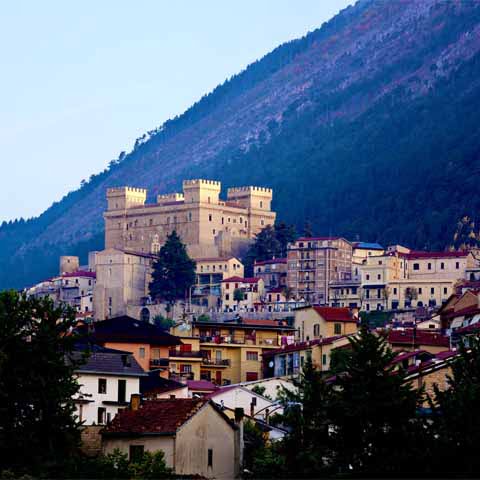
The high villages complete the quiet: Assergi beneath the cable car with its fortified abbey church, Fontecchio and Fossa in the Aterno valley with their medieval fabric, Castel del Monte raked across its hillside above the pastures. Our itineraries deliberately alternate the celebrated with the silent, because the alternation is what makes a mountain journey feel like discovery rather than sightseeing.

What Outdoor and Active Experiences Await Around L'Aquila?

This is the finest mountain playground in peninsular Italy. Summer brings hiking on Gran Sasso, from gentle plateau rambles at Campo Imperatore to the ascent of the Corno Grande for experienced walkers, along with wildlife watching in the national parks, where wolves, chamois, and golden eagles hold territory. Cycling climbs the same legendary roads the Giro d’Italia has made famous, and e-bikes now open the high country to every fitness level.

Winter turns the massif into a historic snow world. Campo Imperatore holds one of Italy’s oldest ski areas, joined by the family-friendly slopes of Campo Felice and Ovindoli in the Velino range, with cross-country trails threading the high plateaus and snowshoe routes into silent beech woods. The season is long, the crowds modest, and the scenery, peaks rising from treeless snowfields, unlike anywhere else south of the Alps.

Between the seasons come riding on the plateau, horseback days among the grazing herds, and climbing and via ferrata for the ambitious. We fold these into itineraries as part of our active trips in Italy, always with certified mountain guides, private transfers, and rewards planned for the end of the effort: a shepherd’s lunch, a thermal soak, a glass of Montepulciano as the peaks turn pink.

How Do You Compose the Perfect Days in L'Aquila?

The art is alternation. A morning among the basilicas wants an afternoon on the plateau; a day of fortresses and frescoed oratories wants an evening of music under Renzo Piano’s timber ceiling or a long trattoria table. L’Aquila’s compact center and dramatic surroundings make this rhythm effortless when the logistics are handled well, and exhausting when they are not.

Timing is the second art. Collemaggio rewards early light, Rocca Calascio the golden hour, Campo Imperatore the clear morning windows, and the Perdonanza the traveler who arrives with seats and vantage points already arranged. The saffron harvest lasts a few weeks, the lentil festival a weekend, the concert seasons follow their calendars, and a specialist who watches all of these professionally turns coincidence into composition.

That is precisely how we work. Every L’Aquila itinerary we design is built by hand from what you tell us, whether the city anchors a mountain week or joins Rome and the coast in a larger custom trip to Italy, with every guide, driver, table, and ticket arranged in advance and supported around the clock. The mountains provide the drama; we provide the ease.

Ready to Begin Planning Your L'Aquila Vacation?

L’Aquila deserves more than a template. Since 2003, Trips 2 Italy has designed private Italian vacations one traveler at a time, hand selecting every experience based on what you tell us rather than fitting you into a predefined package. Our Italian-born team plans L’Aquila with the knowledge of people who call Italy home, from the pink and white facade of Collemaggio to the high meadows of Campo Imperatore, and we remain at your side throughout your trip with 24/7 assistance. Tell us how you imagine L’Aquila, and we will craft the itinerary that matches it.

Explore Our L'Aquila Vacation Itineraries

Frequently Asked Questions About Things to Do in L'Aquila

The Basilica di Collemaggio, the Basilica di San Bernardino, the Fontana delle 99 Cannelle, and the Spanish Fort park in the city, followed by the cable car to Campo Imperatore and a day trip to Rocca Calascio, Santo Stefano di Sessanio, and the frescoed oratory of Bominaco. Trips 2 Italy sequences these with expert guides and private drivers so each arrives at its best hour.

Yes. The Gran Sasso cable car from Fonte Cerreto lifts visitors to the 7,000-foot plateau in minutes, and gentle walks and viewpoints begin at the top station. We arrange Gran Sasso days with private drivers and mountain guides, timed to clear weather and paired with a mountain lunch, for travelers of every activity level.

Absolutely. The highest fortress in the Apennines floats on its ridge at nearly 4,800 feet with panoramas across the whole massif, reached by a gentle walk from the village. Combined with Santo Stefano di Sessanio and Bominaco, it composes one of the finest day trips in central Italy, especially in the late afternoon light.

Ski the historic slopes of Campo Imperatore and the family-friendly areas of Campo Felice and Ovindoli, snowshoe through silent beech woods, then return to the city for museums, concerts, and long mountain dinners. Winter shows the Apennines at their most dramatic, and the city’s restored center is at its most atmospheric under snow.

Wonderfully. Castles and fortresses fire every imagination, the cable car and the high plateau feel like an adventure, wildlife parks and horseback rides fill the afternoons, and the mammoth skeleton at the National Museum of Abruzzo delights every age. We compose family itineraries so history and mountains arrive as play rather than obligation.

The Perdonanza Celestiniana in late August, with its medieval procession and the opening of the Holy Door, leads the calendar, joined by the saffron harvest in late October, the lentil festival of Santo Stefano di Sessanio in September, and the concert and exhibition seasons of the Capital of Culture year. Trips 2 Italy tracks the calendar and builds itineraries so events become centerpieces rather than accidents.