Abruzzo History Guide

HOME » POPULAR ITALIAN DESTINATIONS » ITALIAN TRAVEL GUIDES BY REGION » ABRUZZO TRAVEL GUIDE » ABRUZZO HISTORY GUIDE

Abruzzo Travel Guide        Culture        History        Food and Wine        Things to Do        Plan My Trip

About this guide: This guide to the history of Abruzzo was written by the Italian-born travel specialists at Trips 2 Italy, a custom tour operator that has designed hand-crafted Italian vacations since 2003. Every recommendation below reflects the same first-hand knowledge our team draws on when we build a private Abruzzo itinerary around a traveler’s interests, dates, and pace. Read it for your research, then let us translate it into a trip designed entirely around you.

How Did Abruzzo Begin?

Before Rome, these mountains belonged to the Italic tribes: the Vestini beneath the Gran Sasso, the Peligni around Sulmona, the Marrucini near Chieti, and the Marsi by the great Fucino lake, famed across the ancient world as snake charmers and healers. They were hard mountain peoples, herders and warriors, and Rome spent centuries learning to respect them before absorbing them.

Abruzzo then gave Italy its name its first political meaning. In 91 BC the Italic allies rose against Rome in the Social War, demanding the citizenship their soldiers had earned, and made the Peligna valley town of Corfinium their capital, renaming it Italica. Coins struck there carried the word Italia for the first time in history, a fact the nearby village of Corfinio commemorates to this day.

That deep past is still visible. Chieti’s archaeological museum guards the Warrior of Capestrano, a haunting sixth-century BC stone figure discovered in a vineyard in 1934, along with the bronzes and grave goods of the Italic world. Walking these collections with a scholar who can people the mountains again is one of the most atmospheric historical experiences the region offers, and it is where our history itineraries usually begin.

The Italic legacy also explains something travelers sense without naming it: Abruzzo’s villages feel grown from their mountains rather than placed on them. In a sense they were. The Vestini, Peligni, and Marsi chose these defensible heights more than twenty-five centuries ago, and nearly everything since has been renovation.

What Did Rome Leave in Abruzzo?

Rome’s greatest Abruzzese gift to the world was a poet. Publius Ovidius Naso, Ovid, was born in Sulmona in 43 BC, and the town has never stopped claiming him: his initials mark its civic crest, his statue watches over Piazza XX Settembre, and the love poetry and Metamorphoses he left behind shaped European literature for two thousand years.

The stones tell the rest. Alba Fucens, a Roman colony founded in 303 BC beneath Monte Velino, preserves its forum, basilica, amphitheater, and streets in a mountain setting of extraordinary beauty, while Amiternum, birthplace of the historian Sallust near L’Aquila, keeps its theater and amphitheater in open countryside. Roman engineers also attempted one of antiquity’s boldest projects here, the emperor Claudius’s tunnels to drain the Fucino lake, a feat not completed until the nineteenth century.

These sites share one modern luxury: solitude. Travelers often walk Alba Fucens’s forum with only the wind and the mountains for company, an experience the famous ruins of the capital can no longer offer. We arrange these visits with archaeologists and historians who bring the colonies and their roads back to life, then connect them to the Italic and medieval layers around them.

How Did the Middle Ages Shape Abruzzo?

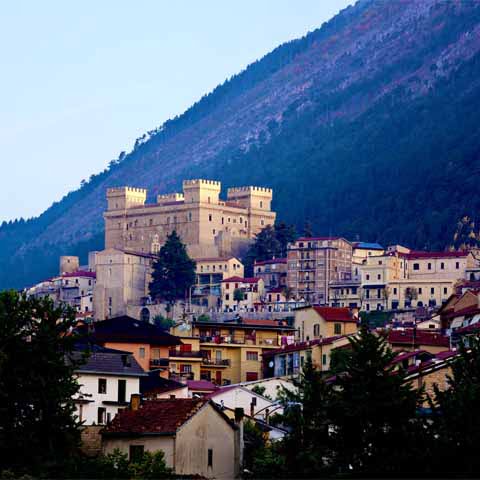
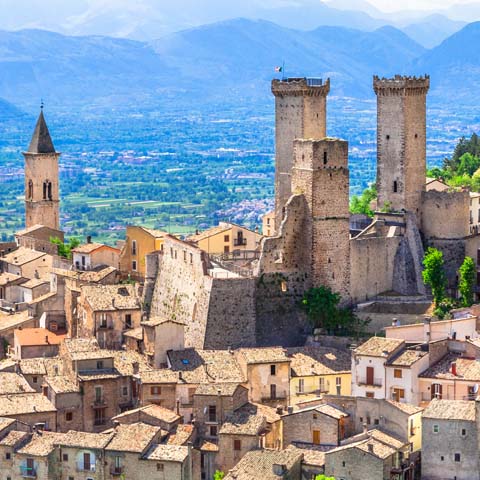
The Middle Ages built the Abruzzo travelers photograph. After Lombard and Norman centuries, the region became the northern frontier of the Kingdom of Sicily and then Naples, and frontiers breed castles: Rocca Calascio rising on its ridge, Celano’s great square fortress in the Marsica, Roccascalegna clinging to its crag, and watchtowers strung along every valley. The hill villages themselves, tight rings of stone around church and tower, are medieval defense made permanent.

L’Aquila was the age’s boldest project. Founded in the mid-thirteenth century, by tradition through the union of ninety-nine castles and villages, the new city honored its origin with the Fountain of the Ninety-Nine Spouts, still flowing today, and grew rich enough on wool and saffron to rank among the kingdom’s great cities. Its merchants traded across Europe, and its churches filled with the wealth of the sheep roads.

In 1294 the city witnessed one of history’s strangest papal chapters. Pietro da Morrone, a hermit from the Majella mountains, was crowned Pope Celestine V in the Basilica of Collemaggio, instituted the Perdonanza forgiveness celebration still held each August, and within months resigned the papacy, the famous great refusal. His hermitages, carved into the cliffs of the Morrone and Majella, remain among the most moving places in Abruzzo.

For travelers, the medieval castles are also the region’s finest walks. Rocca Calascio is reached by an easy path with the Gran Sasso filling the sky, Roccascalegna’s stair climbs its bare crag above the Rio Secco valley, and Celano’s fortress surveys the drained Fucino plain where the Marsi once fished. Each pairs naturally with a village lunch, and we sequence them so history arrives with the best light of the day.

What Were the Wool Centuries Like in Abruzzo?

From the late Middle Ages into the eighteenth century, Abruzzo ran on wool. The transumanza moved flocks in the hundreds of thousands along the tratturi to Puglia each autumn and home each spring, taxed and regulated by the crown as one of the kingdom’s great revenue engines. The Tratturo Magno, the royal road of grass from L’Aquila to Foggia, was the artery of an entire civilization.

The profits built the region’s most distinctive places. Santo Stefano di Sessanio owes its harmonious stone architecture to the Medici, who acquired the village in the sixteenth century for its prized dark carfagna wool and stamped their crest above its gate. L’Aquila’s saffron, cultivated on the Navelli plain since the thirteenth century, traveled the same trade routes to the markets of Milan, Venice, and Germany, making the region’s red gold famous across Europe.

When industrial textiles and changing markets ended the wool centuries, the high villages slowly emptied, and generations of Abruzzesi carried the region’s name to the Americas. That emigration wrote Abruzzo into the family stories of millions, and for many of our travelers, a journey here is also a return. We design ancestry itineraries that pair archives and parish records with the villages themselves, and those trips are among the most emotional we build.

How Did Abruzzo Enter the Modern Era?

Abruzzo joined the Kingdom of Italy in 1860 with the fall of the Bourbon south, and the new age arrived with engineering ambition: between 1854 and 1878 the Torlonia family completed what Claudius had begun, draining the vast Fucino lake and turning Italy’s third-largest lake into its most fertile inland plain almost overnight. Railways threaded the valleys, and Pescara grew from fishing town toward regional metropolis.

The twentieth century tested the region hard. The Avezzano earthquake of 1915 killed some 30,000 people in one of Europe’s deadliest seismic disasters. In 1943 the Gustav Line cut across these mountains, bringing the Second World War to villages and passes, while in September of that year German commandos landed gliders at Campo Imperatore to free Mussolini from his mountain hotel prison, one of the war’s most cinematic episodes. Through it all, emigration continued to drain the high villages.

Yet the same century planted Abruzzo’s modern identity. The national park in the region’s wild heart was founded in 1922 and 1923, beginning a conservation story that now shelters a third of the territory, and the postwar decades brought highways, universities, and the return of pride in mountain life. The earthquake of 2009 struck L’Aquila a grievous blow, and the city’s painstaking restoration since has become one of Europe’s great acts of cultural resilience.

The war years also left the region one of its most moving commemorations. The Gustav Line battles brought Allied soldiers from around the world to these valleys, and the Commonwealth cemetery near Ortona, where nearly 1,400 Canadians rest after the bitter fighting of December 1943, remains a place of pilgrimage. For travelers whose families served in the Italian campaign, we arrange visits with historians who can walk the ground battle by battle.

Which Places Bring Abruzzo's History to Life Today?

L’Aquila is the great archive: Collemaggio’s checkerboard basilica and holy door, the Fountain of the Ninety-Nine Spouts, the Renaissance basilica of San Bernardino, and the sixteenth-century Spanish fort, all woven into a living restoration story. An hour away, Rocca Calascio and Santo Stefano di Sessanio preserve the castle line and wool economy of the medieval kingdom in stone.

Sulmona layers Ovid’s Rome beneath a medieval aqueduct and Renaissance squares, Corfinio remembers the moment Italy first bore its name, and Alba Fucens keeps a Roman colony under the mountains. The abbeys complete the circuit: San Clemente a Casauria’s sculpted portal, San Giovanni in Venere above the trabocchi, and the cliff hermitages of Celestine V in the Majella, each a chapter of faith and power written in Romanesque stone.

Sequence matters as much as selection. We compose history-focused itineraries so the layers arrive in order, from the Warrior of Capestrano to the wool villages to the rebuilt capital, with historians and archaeologists chosen for their narrative gift. Three thousand years make more sense, and more memories, when they arrive as a story rather than a shuffle.

How Is Abruzzo Preserving Its Heritage?

Abruzzo’s boldest preservation is territorial. A third of the region under formal protection means whole medieval landscapes, not just monuments, survive intact: the castle still commands an unbuilt ridge, the tratturo still crosses open pasture, and the village still meets the forest where it always did. Few places in Europe let a traveler see historical countryside at this scale.

The villages themselves are being saved by imagination. Santo Stefano di Sessanio pioneered the albergo diffuso model, restoring abandoned houses into scattered lodgings that revived the village without falsifying it, and borghi across the region have followed. In L’Aquila, restorers, engineers, and art historians continue the patient rebuilding of churches and palaces, and visiting their workshops is a privilege we can often arrange.

For travelers, all this means Abruzzo’s past is unusually whole and unusually welcoming. We build heritage-focused journeys that pair the great sites with the people preserving them, from park rangers to restorers to the families running village museums, as part of our cultural tours of Italy. History in Abruzzo is a working enterprise, and meeting its custodians is one of the region’s quiet privileges.

Ready to Begin Planning Your Abruzzo Vacation?

Abruzzo deserves more than a template. Since 2003, Trips 2 Italy has designed private Italian vacations one traveler at a time, hand selecting every experience based on what you tell us rather than fitting you into a predefined package. Our Italian-born team plans Abruzzo with the knowledge of people who call Italy home, from the high meadows of Campo Imperatore to the trabocchi of the Adriatic shore, and we remain at your side throughout your trip with 24/7 assistance. Tell us how you imagine Abruzzo, and we will craft the itinerary that matches it.

Explore Our Abruzzo Vacation Itineraries

Frequently Asked Questions About the History of Abruzzo

Italic tribes including the Vestini, Peligni, Marrucini, and the snake-charming Marsi held these mountains, herding peoples whose art survives in Chieti’s archaeological museum, home of the celebrated Warrior of Capestrano. In the Social War of 91 BC they made Corfinium their capital and struck the first coins ever to carry the name Italia.

Yes. Publius Ovidius Naso was born in Sulmona in 43 BC, and the town honors him with its civic crest, a statue in its main square, and a deep local pride. Visiting Sulmona with a guide who can read Ovid’s landscape into his poetry is one of the region’s most rewarding literary experiences.

L’Aquila was founded in the mid-thirteenth century, by tradition through the union of ninety-nine castles and villages, and the city commemorates the legend with its Fountain of the Ninety-Nine Spouts. It grew wealthy on wool and saffron, hosted the papal coronation of Celestine V in 1294, and remains the region’s historic capital.

A powerful earthquake struck L’Aquila in April 2009, damaging much of the historic center. The restoration since has become one of Europe’s great conservation undertakings, with the Basilica of Collemaggio and many palaces and churches returned to their former beauty. Trips 2 Italy can arrange visits that include the restoration story itself, told by the people carrying it out.

After his arrest in 1943, Mussolini was held at the isolated hotel on the Campo Imperatore plateau beneath the Gran Sasso, judged escape-proof at over 6,900 feet. In September 1943 German commandos landed gliders on the plateau and flew him out, one of the Second World War’s most dramatic episodes, and the site can still be visited today.

Yes, and these are among the most meaningful journeys we design. Millions of families in the Americas trace their roots to Abruzzo’s villages, and we pair archival and parish research with visits to the ancestral towns themselves, often including local historians and, when the search allows, meetings with distant relatives.