Emilia Romagna Culture Guide

HOME » POPULAR ITALIAN DESTINATIONS » ITALIAN TRAVEL GUIDES BY REGION » EMILIA ROMAGNA TRAVEL GUIDE » EMILIA ROMAGNA CULTURE GUIDE

Emilia Romagna Travel Guide        Culture        History        Food and Wine        Things to Do        Plan My Trip

About this guide: This guide to the culture of Emilia Romagna was written by the Italian-born travel specialists at Trips 2 Italy, a custom tour operator that has designed hand-crafted Italian vacations since 2003. Every recommendation below reflects the same first-hand knowledge our team draws on when we build a private Emilia Romagna itinerary around a traveler’s interests, dates, and pace. Read it for your research, then let us translate it into a trip designed entirely around you.

What Defines the Culture of Emilia Romagna?

Emilia Romagna’s culture rests on three pillars Italians recognize instantly: learning, appetite, and craft. The University of Bologna, founded in 1088 and the oldest in continuous operation in the Western world, made the region a crossroads of ideas for nine centuries. The land’s extraordinary fertility built a food culture so deep that cooking here is treated as cultural patrimony rather than domestic routine. And a tradition of exacting handwork, from mosaic workshops to engine ateliers, connects the Byzantine artisans of Ravenna to the mechanics of Maranello in a single unbroken temperament.

The region is also, famously, the most sociable in Italy. Life is lived in public, under Bologna’s porticoes, around long tables, in piazzas that function as open-air living rooms, and hospitality is considered a regional art form. Emilia Romagna’s people are called the most welcoming in the country by their fellow Italians, and travelers feel it within hours of arriving.

What makes the culture so rewarding to visit is that none of it is staged. The sfogline still roll pasta by hand in workshop windows, the opera public in Parma still judges tenors with legendary severity, and the university still fills Bologna with students and argument. Emilia Romagna’s culture is not a museum exhibit. It is a way of living that continues, and the itineraries we design are built to place travelers inside it.

A traveler’s first evening usually explains the whole region: an aperitivo under the porticoes, a bowl of hand-rolled pasta, conversation offered freely at the next table. Culture here begins with welcome, and everything else follows from it.

Why Is the Art of Emilia Romagna So Distinctive?

The region’s supreme artistic treasure predates the Renaissance by a thousand years. Ravenna’s churches and mausoleums hold the finest ensemble of early Christian and Byzantine mosaics in existence, eight monuments inscribed by UNESCO, from the deep-blue starred vault of the Mausoleum of Galla Placidia to the emerald processions of Sant’Apollinare Nuovo and the imperial portraits of Justinian and Theodora in the Basilica of San Vitale. Standing beneath them as the light shifts across a million glass tesserae remains one of the great artistic experiences in Europe.

Later centuries added their own schools. Correggio painted domes in Parma that dissolve architecture into spiraling heaven, anticipating the Baroque by a century; his Assumption of the Virgin in Parma’s cathedral still stops visitors mid-stride. Bologna produced the Carracci family and Guido Reni, whose academy reshaped European painting around 1600, and the city’s Pinacoteca Nazionale tells that story room by room. Ferrara’s Este court fostered its own refined Renaissance school, and the Palazzo Schifanoia’s month-by-month frescoes remain among the most fascinating painted cycles of the fifteenth century.

The difference between seeing this art and understanding it is the storyteller. We pair travelers with art historians who unfold Ravenna’s mosaics scene by scene, arrange visits to Parma’s domes and Bologna’s collections at their quietest hours, and sequence the encounters so fifteen centuries of images arrive as a story rather than a shuffle. For serious enthusiasts, we compose entire itineraries around a single thread, from Byzantium to the Baroque.

How Does Architecture Tell the Story of Emilia Romagna?

Begin with the porticoes. Bologna built covered walkways along its streets from the Middle Ages onward, until nearly 40 miles of them laced the city, and UNESCO recognized them as World Heritage in 2021. They are architecture as social contract: shelter and street life for everyone, in every weather, including the famous portico of San Luca climbing almost two and a half miles uphill to its sanctuary on 666 arches. Add the leaning medieval towers of the Asinelli and Garisenda, and Bologna’s skyline still reads as the city its merchant families built.

The Romanesque age left masterpieces along the Via Emilia, above all Modena’s cathedral, begun in 1099 by the architect Lanfranco with sculpture by Wiligelmo, and its slender Ghirlandina tower, together a UNESCO ensemble that defined church building across the Po plain. Ferrara answers with the Renaissance: in the 1490s the Este dukes doubled their city with the Addizione Erculea, a planned extension by Biagio Rossetti so visionary that Ferrara is often called Europe’s first modern city, its moated castle and diamond-studded Palazzo dei Diamanti anchoring streets laid out five centuries ago.

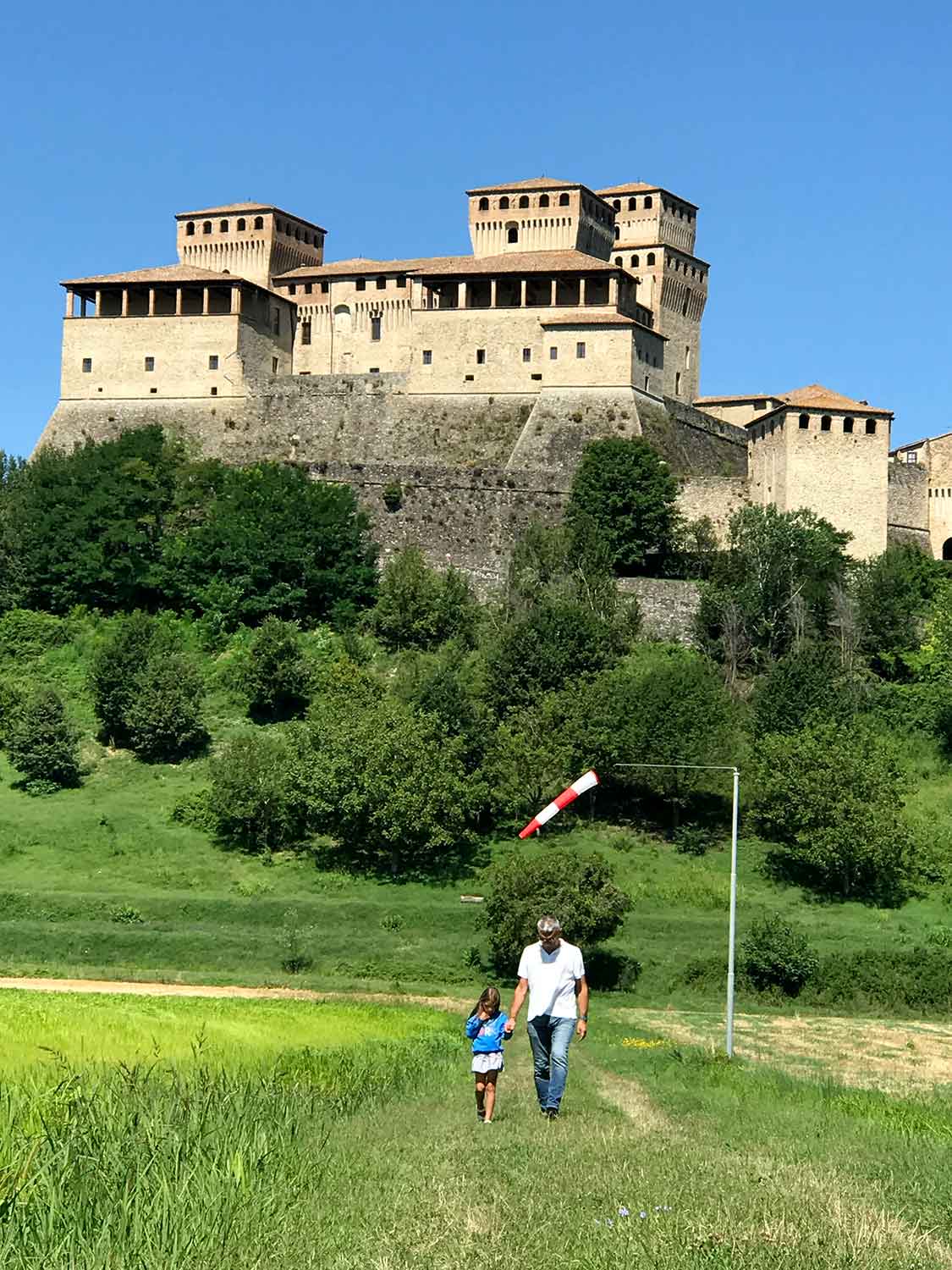
The countryside carries its own architecture of power and appetite: the castles of the Duchy of Parma at Torrechiara and Fontanellato, fortress villages of Matilda of Canossa in the Apennines, and the great farm courtyards of the plain. We build architecture-focused days with specialists who read these buildings fluently, from mosaic vault to tower top, including climbs and vantage points travelers rarely find alone.

What Role Do Music and Festivals Play in Emilia Romagna?

No region in Italy hears opera more seriously. Giuseppe Verdi was born near Busseto in the Parma countryside, and his homeland honors him each October with Parma’s Verdi Festival, sung before what is considered the most demanding opera public in the world at the Teatro Regio. Modena gave the twentieth century Luciano Pavarotti, whose home outside the city is now a museum, and Parma also produced Arturo Toscanini. Bologna, a UNESCO Creative City of Music, adds the historic Teatro Comunale, where Wagner’s operas had their Italian premieres.

The festival calendar reaches far beyond opera. The Ravenna Festival fills early summer with concerts set among the mosaics, Ferrara’s Palio, documented since 1259 and among the oldest in Italy, sends costumed districts racing each May, and Cento stages a carnival exuberant enough to be twinned with Rio de Janeiro. Food festivals crowd the autumn, celebrating everything from truffles to chestnuts in the hill towns.

Music and festivity are among the best doors into the region’s life, and timing is everything. We fold performances at the Regio and the Comunale, festival evenings, and village sagre into itineraries as part of our entertainment and festival experiences in Italy, with seats and access arranged months ahead so the calendar becomes a reason to travel rather than an accident.

For travelers who want the deepest immersion, we arrange visits to Verdi’s birthplace and villa near Busseto, private evenings built around performances, and encounters with the region’s living musical world, from luthiers to conservatory rehearsals where access allows.

Which Craft Traditions Still Live in Emilia Romagna?

The region’s most celebrated crafts are edible. The sfogline, the pasta makers who roll golden sheets of dough with long wooden pins, still work in shop windows across Bologna and Modena, and their skill is treated as heritage in the fullest sense. The acetaie of Modena tend batteries of wooden barrels in family attics where balsamic vinegar ages for twelve years and often far beyond, passed between generations like heirlooms. Parmigiano Reggiano masters and prosciutto curers practice crafts governed by rules older than most nations.

Other workshops shaped the wider world. Faenza, in Romagna, gave its very name to glazed ceramics, faience, and its International Museum of Ceramics and working studios continue a tradition seven centuries old. Ravenna maintains mosaic workshops and a renowned restoration school where the ancient art is still taught tessera by tessera, and travelers can watch, or try, the craft themselves.

The Motor Valley belongs in this company, because Emilia Romagna treats engineering as craft. The ateliers of Ferrari, Lamborghini, Maserati, Pagani, and Ducati grew from the same culture of patient, obsessive handwork as the acetaie, and visiting them in sequence makes the connection unmistakable.

This is where our insider access matters most. We arrange sessions at the sfoglina’s board, visits to family acetaie and dairies at working hours, mosaic ateliers in Ravenna, and ceramics studios in Faenza, hands-on where travelers wish it. Anyone can taste the region’s products. Meeting the hands that make them, in the rooms where it happens, is a different experience entirely, and it is one we have spent two decades earning the relationships to offer.

What Is Daily Life Like in Emilia Romagna?

Daily life here is organized, unapologetically, around the table. Mornings belong to the market, and Bologna’s Quadrilatero, the medieval grid of food streets beside Piazza Maggiore, remains the region’s theater of appetite, its stalls piled with mortadella, fresh pasta, and seasonal produce. Lunch is taken seriously, the afternoon has its espresso rituals, and the evening opens with aperitivo under the porticoes before dinner restores the day’s importance.

The university keeps Bologna young; a city of medieval towers runs on student energy, bookshops, and debate, as it has for more than nine centuries. Ferrara moves by bicycle, with more cyclists per resident than almost anywhere in Italy, and the passeggiata along its Renaissance streets and nine kilometers of walls is a civic institution. On the coast, Romagna adds its own beach-town conviviality, a culture of hospitality refined over a century of Adriatic summers.

The deepest travel experiences here come from stepping inside these rhythms rather than observing them: a market morning with a cook who shops it daily, an afternoon in a village bar during the passeggiata, a family dinner where the pasta course explains the region better than any museum. Our Italian cultural tours are composed of exactly these hours, arranged through relationships and timed to the life of the place.

How Do We Open Emilia Romagna's Culture to Our Travelers?

Emilia Romagna’s culture is generous, but its best rooms open by relationship rather than by ticket. A mosaic cycle becomes a different experience with a scholar who reads its iconography aloud. An acetaia becomes unforgettable when the family that has tended it for four generations pours the oldest barrel. An opera evening in Parma becomes legend when you understand why that particular public’s approval matters so much.

Because our team is Italian-born and has worked these connections since 2003, we plan the region’s culture from the inside: workshop visits that do not advertise, festival seats arranged months ahead, dairy and cellar mornings at true working hours, and tables where the conversation is as memorable as the food. These are not options selected from a list. They are arrangements composed for each traveler based on what they tell us.

That method is the difference between a cultural tour and a cultural life briefly shared. It is also why travelers who first come to Emilia Romagna for the food return for everything around it, and why so many of our itineraries for returning guests grow deeper into the region rather than wider across the map.

Ready to Begin Planning Your Emilia Romagna Vacation?

Emilia Romagna deserves more than a template. Since 2003, Trips 2 Italy has designed private Italian vacations one traveler at a time, hand selecting every experience based on what you tell us rather than fitting you into a predefined package. Our Italian-born team plans Emilia Romagna with the knowledge of people who call Italy home, from the porticoes of Bologna to the mosaics of Ravenna and the cheese vaults of Parma, and we remain at your side throughout your trip with 24/7 assistance. Tell us how you imagine Emilia Romagna, and we will craft the itinerary that matches it.

Explore Our Emilia Romagna Vacation Itineraries

Frequently Asked Questions About the Culture of Emilia Romagna

The region is celebrated for Ravenna’s UNESCO Byzantine mosaics, Bologna’s porticoes and its university founded in 1088, the opera heritage of Verdi and Pavarotti, and a food culture so deep it is treated as patrimony, from hand-rolled pasta to balsamic vinegar aged in family attics. Faenza’s ceramics and the Motor Valley’s engineering ateliers complete a culture built on learning, appetite, and craft.

Eight monuments in and around Ravenna hold the mosaics, led by the Basilica of San Vitale, the Mausoleum of Galla Placidia, Sant’Apollinare Nuovo, and Sant’Apollinare in Classe. They are best experienced with an expert who reads the iconography scene by scene, and Trips 2 Italy arranges guided mosaic days timed to the quietest hours.

La Dotta honors the University of Bologna, the Western world’s oldest, founded in 1088; la Grassa salutes the city’s legendary kitchen, from mortadella to tortellini; and la Rossa describes the terracotta and rose tones of its rooftops and porticoes. The three names together are a fair summary of the city’s character.

Giuseppe Verdi was born near Busseto and is honored each October at Parma’s Verdi Festival, sung before the most demanding opera public in the world. Modena produced Luciano Pavarotti, Parma produced Toscanini, and Bologna is a UNESCO Creative City of Music. We arrange opera evenings, Verdi heritage visits, and festival experiences throughout the year.

Yes. The sfogline of Bologna and Modena still roll pasta sheets by hand with long wooden pins, often in open workshop windows, and hands-on sessions at the sfoglina’s board are among the region’s most beloved experiences. Trips 2 Italy arranges private workshops where travelers learn tortellini and tagliatelle from masters of the craft.

Parma’s Verdi Festival each October, the Ravenna Festival’s early-summer concerts among the mosaics, Ferrara’s Palio in May, one of Italy’s oldest, and Cento’s exuberant carnival lead the calendar, joined by autumn food festivals across the hills. We track the regional calendar year-round and build itineraries so festivals become the trip’s centerpiece rather than a lucky accident.