Taormina Culture Guide

HOME » POPULAR ITALIAN DESTINATIONS » TAORMINA TRAVEL GUIDE » TAORMINA CULTURE GUIDE

Taormina Travel Guide        Culture        History        Food and Wine        Things to Do        Plan My Trip

About this guide: This guide to the culture of Taormina was written by the Italian-born travel specialists at Trips 2 Italy, a custom tour operator that has designed hand-crafted Italian vacations since 2003. Every recommendation below reflects the same first-hand knowledge our team draws on when we build a private Taormina itinerary around a traveler’s interests, dates, and pace. Read it for your research, then let us translate it into a trip designed entirely around you.

What Defines the Culture of Taormina?

Taormina’s culture is the culture of the stage. For more than two thousand years this small town has existed to frame beauty and receive audiences: Greek theatergoers, Roman spectators, Grand Tour aristocrats, belle epoque wintering Europeans, film stars, and today’s travelers. That long apprenticeship in hospitality produced a place that is Sicilian to the bone yet cosmopolitan by ancient habit, fluent in welcoming the world without surrendering its own character.

Beneath the polish runs the deep, layered identity of eastern Sicily, which we explore across the island in our Sicily travel guide: Greek foundations, Roman engineering, Arab gardens and sweets, Norman stonework, Spanish baroque flourishes. Taormina compresses all of it into one walkable terrace, where a single stroll passes a Hellenistic theater, a medieval palazzo with Arab-Norman windows, and a baroque church facade in the space of twenty minutes.

What makes the town so rewarding for cultural travelers is that none of this is inert. The ancient theater still hosts performances, the feast days still fill the Corso, the granita ritual still opens every summer morning, and the families of Castelmola still press their almond wine. Taormina’s culture is not an exhibit; it is a continuing performance, and we design itineraries that seat our travelers inside it rather than at the edge.

Why Is the Ancient Theater the Heart of Taormina's Cultural Life?

The Teatro Antico is one of the most extraordinary cultural monuments in the Mediterranean, and its genius is the view. The Greeks who first shaped it in the third century BC carved the cavea into the hillside so the stage frames Mount Etna and the sweep of the Ionian coast, making the landscape itself the permanent scenery. The Romans later rebuilt it in brick for larger spectacles, and it remains the second largest ancient theater in Sicily after Syracuse.

What sets it apart from nearly every other classical site in Italy is that it still works. Each summer the theater carries a full season of opera, symphonic music, ballet, and film, and an evening performance there, with the volcano darkening behind the stage and the sea below, ranks among the great cultural experiences in Europe. Goethe judged the site’s combination of art and nature without equal, and audiences have been agreeing ever since.

We treat the theater as both monument and living venue. By day we arrange visits with expert guides at the quiet hours, when the cavea is nearly empty and the acoustics can be demonstrated rather than described. When the calendar allows, we secure seats for performance evenings in the ancient theater, timed within an itinerary so the day builds naturally toward it. Few experiences we arrange anywhere in Italy are remembered more vividly.

How Did the Grand Tour and the Belle Epoque Shape Taormina?

Modern Taormina was, in a real sense, invented by its admirers. Goethe’s rapturous 1787 account in his Italian Journey placed the town on the itinerary of every cultivated European, and the painters who followed, above all the German artist Otto Geleng, sent images of the theater against a snow-capped Etna to salons in Paris and Berlin, where viewers refused to believe such a composition was real.

By the late nineteenth century the town had become one of Europe’s fashionable winter salons. Aristocrats and artists settled in for whole seasons, grand hotels rose along the terrace, and the English noblewoman Florence Trevelyan planted the gardens that remain the town’s green heart, follies and all. Writers kept arriving through the twentieth century: D. H. Lawrence lived above the town at Fontana Vecchia in the early 1920s, and Tennessee Williams, Truman Capote, and generations of actors and directors followed.

That belle epoque legacy is still legible everywhere: in the eclectic villas and hotel terraces, in the Corso’s easy internationalism, in a certain theatrical elegance the town wears as naturally as its bougainvillea. We design cultural walks that read this era building by building, from Trevelyan’s gardens to the writers’ haunts, with guides who tell the story of the town’s admirers as vividly as the story of its stones.

The era also left Taormina its distinctive social texture: a small Sicilian town accustomed to conversation in half the languages of Europe. Cafes, galleries, and hotel terraces here have hosted a century and a half of painters, poets, and exiles, and the town wears that memory lightly, welcoming today’s travelers into the same unhurried theater of terrace, view, and talk.

What Should You Notice in Taormina's Art and Architecture?

Taormina’s architecture is a compact anthology of Sicilian history. Palazzo Corvaja, at the head of the Corso, stacks an Arab tower, Norman windows, and a Catalan Gothic facade into a single building where the Sicilian parliament gathered in 1411. The Badia Vecchia’s swallowtail battlements and lava-and-limestone inlay mark the fourteenth century, and the Duomo of San Nicolo wears the crenellated look of a small fortress, its rose window and portals softened by centuries of devotion.

The town’s churches reward slow attention. San Giuseppe presides over Piazza IX Aprile in confident baroque pink, the tiny church of the Madonna della Rocca is carved partly into the cliff above the town, and Sant’Agostino, now a library, anchors the piazza’s seaward side. Everywhere, the local grammar of black lava stone against pale limestone gives facades, doorways, and pavements a distinctly Sicilian graphic elegance.

The decorative arts flourish on a domestic scale: ceramic balcony rails, painted majolica stair risers, the checkerboard pavement of the piazza, and the famous ceramic teste di moro, the paired Moorish heads that watch from balconies and doorways across the town. Our guides unfold the legends and the craft behind these details, turning an ordinary stroll along the Corso into a readable history of the island.

Which Festivals Fill Taormina's Calendar?

The signature event is the Taormina Film Fest, founded in 1955 and among the oldest film festivals in Italy. Its screenings and award evenings in the ancient theater, with the audience seated where Greek spectators sat and Etna glowing faintly beyond the screen, have drawn the great names of world cinema for decades. Around it, the summer arts season fills the theater with opera, ballet, and concerts from June into September.

The devotional calendar runs just as deep. The feasts of the Madonna della Rocca in September and San Pancrazio, the town’s patron and by tradition its first bishop, in July bring processions, brass bands, illuminated streets, and fireworks over the bay. In the surrounding villages, patronal feasts, Easter rites, and harvest celebrations follow rhythms that long predate tourism, and they remain among the most authentic windows into Sicilian life a traveler can find.

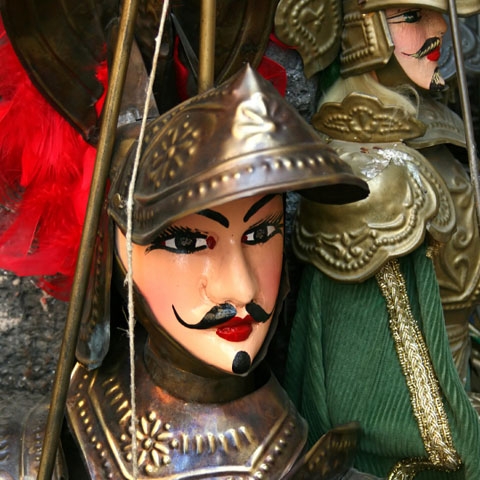
Folk traditions surface throughout the year: Sicilian cart parades, folk music and dance in the piazzas, and the puppet theater tradition of the opera dei pupi, recognized by UNESCO as a masterpiece of intangible heritage. We fold these dates into itineraries as part of our entertainment and festival experiences in Italy, securing seats and timing stays so the calendar becomes a reason to travel rather than a lucky accident.

Which Craft Traditions Live On in and Around Taormina?

Sicilian ceramics lead the way. The workshops of Taormina and the great ceramic towns of eastern Sicily keep alive a maiolica tradition of saturated blues, yellows, and greens, from the teste di moro and pine-cone finials that decorate every balcony to hand-painted tableware that carries the island’s exuberance home. Watching a master painter load a brush and lay a pattern by memory explains the tradition better than any museum label.

The needle arts have deep roots here: Taormina lent its name to a form of drawn-thread embroidery, and lace and linen work from the surrounding hill towns furnished the trousseaus of generations. Wood inlay, coral and filigree jewelry from the island’s older workshops, and the carved and painted panels of the Sicilian cart tradition round out a craft culture of remarkable range for so small a place.

The confectioner’s art deserves its own mention, because in Sicily it is one: frutta martorana, the almond-paste fruits perfected in island convents, are modeled and painted with a miniaturist’s precision, and marzipan, torrone, and candied citrus remain living workshop traditions. We arrange studio visits and hands-on sessions with ceramicists, embroiderers, and pastry masters, the kind of encounters that come from two decades of relationships rather than a ticket window.

For travelers who want to bring the island’s craft story home, we arrange unhurried studio time rather than shop stops: watching a teste di moro pair take shape on the wheel, commissioning a piece painted to order, or learning the first stitches of the embroidery that carries the town’s name. Objects acquired this way carry their makers with them, and they become the trip’s most lasting souvenirs.

What Is Daily Life Like in Taormina?

The town keeps Sicilian hours beneath its international polish. Mornings begin at the bar with espresso or, in the warm months, granita con brioche taken slowly with the newspaper. The stone lanes fill gradually, errands and conversation moving at walking pace, and lunch remains a genuine pause. In the late afternoon the passeggiata gathers the whole town onto Corso Umberto, an unhurried social parade from gate to gate that has served as Taormina’s living room for centuries.

Evenings belong to the piazza and the terrace. Piazza IX Aprile fills with families, musicians, and travelers as the light turns gold over the bay, church bells mark the hour, and dinner starts late and ends later. In Castelmola above, the rhythm is slower still: old men at the cafe tables, almond wine poured for guests, and a panorama that residents still stop to look at after a lifetime.

For travelers, the deepest cultural experience here is joining these rhythms rather than observing them: a market morning with a local cook, an aperitivo hour on a terrace as the passeggiata flows below, a feast day spent in the procession’s wake. Our specialists build unstructured hours into every Taormina itinerary deliberately, because the town’s true luxury is time lived at its pace.

Sunday remains the clearest window into local rhythm: families in their best clothes after Mass, long lunches that dissolve the afternoon, the piazza filling twice, once at noon and again at dusk. Travelers who plan a Sunday in town rather than an excursion often call it the day Taormina made sense to them.

Ready to Begin Planning Your Taormina Vacation?

Taormina deserves more than a template. Since 2003, Trips 2 Italy has designed private Italian vacations one traveler at a time, hand selecting every experience based on what you tell us rather than fitting you into a predefined package. Our Italian-born team plans Taormina with the knowledge of people who call Italy home, from the marble seats of the ancient theater to the wine villages on Etna’s slopes, and we remain at your side throughout your trip with 24/7 assistance. Tell us how you imagine Taormina, and we will craft the itinerary that matches it.

Explore Our Taormina Vacation Itineraries

Frequently Asked Questions About the Culture of Taormina

The ancient Greek theater, which frames Mount Etna and the Ionian Sea behind its stage and still hosts a full season of opera, concerts, ballet, and the historic Taormina Film Fest each summer. Around it cluster the medieval palazzi of Corso Umberto, the gardens of Florence Trevelyan, and a belle epoque legacy of artists and writers from Goethe to D. H. Lawrence.

Yes. The summer season fills the Teatro Antico with opera, symphonic music, ballet, film, and major concerts, and an evening there ranks among Europe’s great cultural experiences. When the calendar allows, Trips 2 Italy secures seats for performance evenings in the ancient theater and builds the surrounding days of the itinerary to lead up to them.

Founded in 1955, it is one of Italy’s oldest film festivals, celebrated for screenings and award ceremonies held in the ancient Greek theater under the open sky. The festival has drawn leading figures of world cinema for decades and remains the glamorous centerpiece of Taormina’s summer, and we time itineraries around it for travelers who want to experience it.

Goethe’s 1787 praise placed the town on every cultivated itinerary, and painters like Otto Geleng convinced Europe the view of Etna above the theater was real. By the belle epoque, Taormina was a fashionable winter salon, and D. H. Lawrence, Tennessee Williams, and Truman Capote all lived or worked here, drawn by the light, the setting, and the town’s tolerant, cosmopolitan air.

Hand-painted Sicilian ceramics, including the iconic teste di moro heads, drawn-thread embroidery in the tradition that carries Taormina’s name, lace and linen from the hill towns, and the confectioner’s art of frutta martorana marzipan. Trips 2 Italy arranges visits to working studios and hands-on sessions with master artisans, encounters built on long personal relationships.

They are paired ceramic heads, a Moor and a maiden, rooted in a medieval Palermo legend of love and jealousy, and they have become an emblem of Sicilian ceramics. You will see them on balconies, doorways, and shopfronts across Taormina, and watching them take shape in a ceramicist’s workshop is one of the finest craft experiences we arrange.