
Milan Rome and Perugia Cultural Travel Package
Discover vibrant Milan, the rolling hills of Umbria, and timeless Rome, where art, history, and culinary delights come together to create unforgettable memories for every traveler. Starting from $6,862
Perugia Travel Guide Culture History Food and Wine Things to Do Plan My Trip
About this guide: This Perugia travel guide was written by the Italian-born travel specialists at Trips 2 Italy, a custom tour operator that has designed hand-crafted Italian vacations since 2003. Every recommendation below reflects the same first-hand knowledge our team draws on when we build a private Perugia itinerary around a traveler’s interests, dates, and pace. Read it for your research, then let us translate it into a trip designed entirely around you.
Perugia crowns its hilltop like a city that has never doubted its own importance, and it never has. The capital of Umbria was one of the twelve great cities of the Etruscan world before Rome existed as a power, and nearly three thousand years of continuous ambition are stacked along its ridgetop streets: Etruscan gates, medieval palaces, Renaissance frescoes, and a modern life kept young by two universities and a calendar of world-class festivals.
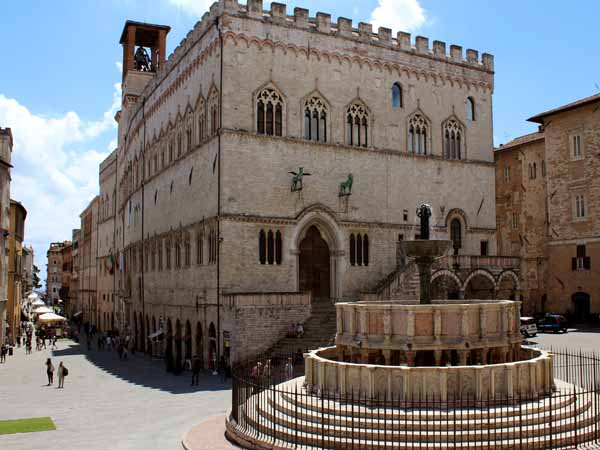
The city’s heart makes the case in a single glance. In Piazza IV Novembre, the Fontana Maggiore, carved in the 1270s by Nicola and Giovanni Pisano, stands before the battlemented Palazzo dei Priori, one of Italy’s grandest civic palaces, with the Cathedral of San Lorenzo closing the square. Few piazzas in Italy compress so much medieval confidence into so small a space, and the evening light on its pink and white stone is a memory travelers keep.
Yet Perugia refuses to behave like a museum. July fills the streets with the Umbria Jazz festival, October with Eurochocolate, and every term with students from around the world drawn by the University for Foreigners. The result is a hill town with the pulse of a capital, where the passeggiata along Corso Vannucci is as rewarding as any gallery.
Our specialists have planned Perugia for art lovers, food travelers, honeymooners, and families for more than two decades, and this guide distills what that experience has taught us. Read it for orientation, then let us compose the version of Perugia that matches you.
Perugia rises roughly 1,600 feet above sea level on a cluster of hills overlooking the valley of the Tiber, almost exactly midway between Rome and Florence. The historic center rides the summit in a star of ridges, with five medieval boroughs descending along them like fingers, so that nearly every walk ends at a belvedere with green Umbrian hills rolling to the horizon.
That geography explains the city’s character. The Etruscans chose the site for its command of the Tiber crossings, the medieval commune fortified it, and modern Perugia still enters the historic center from below, by escalators that climb through the buried streets of a Renaissance fortress. Arrival here is a piece of theater no other Italian city quite matches.
The climate follows the rhythms of inland central Italy: hot, bright summers softened by the hilltop breeze, crisp winters that occasionally dust the rooftops with snow, and long, luminous springs and autumns that are ideal for walking. The surrounding countryside changes costume with the seasons, from May sunflowers and poppies to the silver-green of the November olive harvest, and views over the Tiber valley reward every month of the year.
For travelers, the location is a gift of pure convenience. Perugia sits close enough to Rome and Florence to slot between them, close enough to Assisi, Lake Trasimeno, and the Umbrian hill towns to reach any of them within an hour, and far enough from the heaviest tourist currents to keep its own unhurried character. Few Italian cities combine centrality and authenticity so completely, which is why we so often recommend it as the hinge of a central Italian journey.
July belongs to Umbria Jazz, one of Europe’s most celebrated music festivals, which has filled Perugia’s piazzas, theaters, and gardens every summer since 1973. The city becomes a single open-air stage for ten days, and travelers who love music should plan around it deliberately, with lodging and key performances secured far in advance. That advance work is precisely what we handle.
October answers with Eurochocolate, the festival that celebrates the city’s signature industry with tastings, sculptures, and events along the entire length of the center. Autumn also brings truffle season and the wine harvest to the hills around the city, which makes late September through November the connoisseur’s window for food-focused itineraries.
Spring offers wildflowers, mild walking weather, and quiet churches, while winter shows Perugia at its most local, with steaming cups of thick hot chocolate in historic cafes and the Galleria Nazionale dell’Umbria nearly to yourself. There is no closed season here. When we plan your dates, we align them with what the city does best in that moment, whether that is a festival evening or a silent morning among the Perugino altarpieces.
Shoulder seasons carry particular rewards for travelers who value ease. In May, June, and September the weather is at its most gracious, the festival crowds are absent, and the countryside around the city is either flowering or harvesting. Museum reservations breathe, terrace tables open, and the passeggiata stretches long into the warm evening. Many of our returning guests now request these months by name, and we design their Perugia days to take full advantage of the calm.
Two full days let you meet the essential city: the Piazza IV Novembre ensemble and the Galleria Nazionale dell’Umbria on the first, the Etruscan monuments, the underground Rocca Paolina, and the basilicas of San Pietro and San Domenico on the second, with the Corso Vannucci passeggiata closing both evenings. It is a compact center, but a dense one, and rushing it wastes its principal pleasure, which is atmosphere.
Perugia also makes one of central Italy’s most intelligent bases. Assisi is under half an hour away, Lake Trasimeno and the ceramic town of Deruta are closer still, and Gubbio, Spoleto, Todi, and Orvieto all sit within comfortable day-trip range. Travelers who give the city three or four nights can explore a different corner of Umbria each day and return each evening to a hilltop aperitivo.
Because every Trips 2 Italy itinerary is built by hand, we weigh Perugia against the rest of your Italian journey rather than applying a formula. For some travelers the city is a rich two-night chapter between Rome and Florence; for others it anchors a full Umbrian week. Both are right when they are designed around you.
Everything begins on the acropolis, the flat summit where Corso Vannucci runs from Piazza IV Novembre to the panoramic Giardini Carducci. This is the city’s drawing room, lined with palaces, historic cafes, and the Palazzo dei Priori, and it carries the evening passeggiata as gracefully as it has for centuries. Most of the sights a first visit wants sit within ten minutes of this spine.
From the summit, the five historic boroughs descend along their ridges, each gathered around a gate and a church. Follow Corso Cavour southeast and you reach San Domenico and, farther on, the frescoed basilica of San Pietro; climb northeast toward Porta Sole for the finest views over the Tiber valley; descend Via Ulisse Rocchi and the Etruscan Arch rises ahead, as it has since the third century BC.
Below the historic crown lies the modern city, home to the rail station and the contemporary districts, linked to the summit by escalators and the MiniMetro line. Where you stay shapes the trip: a palazzo near the Corso keeps the whole historic center at your door, while a countryside estate just outside the walls pairs the city with vineyard quiet. We match the base to the traveler every time we plan.
It is worth knowing that the boroughs reward wandering as much as the summit rewards sightseeing. Medieval aqueduct walkways turned into pedestrian lanes, staircase alleys that end in sudden panoramas, and neighborhood churches with quiet masterpieces wait a few minutes off the main axis. Perugia hides more than it advertises, and the travelers who love it most are the ones whose itineraries deliberately left room to get pleasantly lost.
On its summit, Perugia is a walking city, and a rewarding one, provided you accept that a hill town involves hills. The signature ride is vertical: public escalators climb from the lower city up through the lamplit underground streets of the Rocca Paolina and deliver you directly to the top of Corso Vannucci, turning a simple transfer into one of the city’s best experiences. The small MiniMetro line adds a swift link between the station area and the center.
For arrivals, departures, and everything beyond the walls, we arrange private drivers who handle the approach roads, the limited-traffic zones, and the luggage while you watch Umbria unroll. Perugia sits about two and a half hours from Rome and two from Florence by road, and a private transfer turns those distances into scenic interludes rather than logistics.
The same applies to the countryside that makes a Perugia stay so rich. Wine estates, hill towns, and lake shores are scattered across the region, and a knowledgeable driver stitches them into effortless days. Every transfer in a Trips 2 Italy itinerary is arranged before you land and supported around the clock, so the only decision left to you is where to look.
Rail travelers are equally well served. Perugia connects to Florence and Rome with straightforward journeys, and we frequently sequence itineraries so a scenic train handles one leg while a driver handles the countryside days. The principle is always the same: each mode where it serves best, arranged in advance, so that a hilltop city famous for its vertical geography becomes one of the easiest places in Italy to actually visit.
Perugia sits at the geographic heart of the peninsula, which makes it a natural hinge in almost any Italian journey. It slots gracefully between Rome and Florence for travelers following the classic route, gives hill-country depth to a Tuscany itinerary, and anchors any exploration of Umbria itself. For travelers who plan around the table, the city and its surrounding truffle woods and wine hills can carry a full Italian culinary journey.
The occasion shapes the composition. History and art lovers pair Perugia with Assisi and Orvieto as part of the cultural tours we design across central Italy, while travelers composing something larger make it a movement in a custom trip to Italy built entirely from what they tell us. However it fits, we sequence the days so Perugia’s unhurried rhythm lands exactly where your journey needs it.
This guide is one of five we have written on the city. Continue with our Perugia culture guide, Perugia history guide, Perugia food and wine guide, and Perugia things to do guide, or widen the lens with our complete Italy travel guide.
Perugia deserves more than a template. Since 2003, Trips 2 Italy has designed private Italian vacations one traveler at a time, hand selecting every experience based on what you tell us rather than fitting you into a predefined package. Our Italian-born team plans Perugia with the knowledge of people who call Italy home, from the carved basins of the Fontana Maggiore to the underground streets beneath the Rocca Paolina and the chocolate workshops the city is famous for, and we remain at your side throughout your trip with 24/7 assistance. Tell us how you imagine Perugia, and we will craft the itinerary that matches it.
Discover vibrant Milan, the rolling hills of Umbria, and timeless Rome, where art, history, and culinary delights come together to create unforgettable memories for every traveler. Starting from $6,862
Discover Bettona, Assisi and Perugia as hilltop towns, art, olive oil and chocolate reveal the heart of Umbria’s timeless charm. Starting from $998 per person.
This short tour is dedicated to discovering the rustic beauty of this marvelous region full of cultural and natural richness waiting to be explored.
Every season rewards a visit. July brings the Umbria Jazz festival, October brings Eurochocolate and truffle season, spring offers mild weather and quiet churches, and winter shows the city at its most local, with hot chocolate in historic cafes and uncrowded galleries. The specialists at Trips 2 Italy align your dates with what Perugia does best in that moment.
Two full days cover the essential city, from the Fontana Maggiore and the Galleria Nazionale dell’Umbria to the Etruscan Arch and the underground Rocca Paolina. Three or four nights turn Perugia into an ideal base for Assisi, Lake Trasimeno, Deruta, and the Umbrian hill towns, with each evening ending back on the hilltop.
Yes. Perugia sits almost midway between the two, roughly two and a half hours from Rome and two from Florence by road, which makes it a natural hill-country chapter in the classic Italian journey. We arrange private transfers so the drive becomes a scenic interlude rather than a logistical exercise.
The historic summit is compact and walkable, and Perugia’s famous escalators carry visitors from the lower city up through the underground streets of the Rocca Paolina directly to Corso Vannucci. With a private driver handling arrivals and day trips, which Trips 2 Italy arranges for every itinerary, the hilltop setting becomes pure pleasure rather than effort.
The Fontana Maggiore and Palazzo dei Priori, the Perugino masterpieces of the Galleria Nazionale dell’Umbria, its Etruscan walls and arch, the buried Renaissance fortress of the Rocca Paolina, and two beloved traditions: chocolate making, celebrated each October at Eurochocolate, and the Umbria Jazz festival each July.
Assisi and its Basilica of Saint Francis lie under half an hour away, Lake Trasimeno offers shoreline villages and island crossings, Deruta has painted majolica ceramics in workshops that have fired them for centuries, and Gubbio, Spoleto, Todi, and Orvieto all sit within easy reach. We compose each excursion with a private driver so the day unfolds without a single logistic.