Urbino Culture Guide

HOME » POPULAR ITALIAN DESTINATIONS » URBINO TRAVEL GUIDE » URBINO CULTURE GUIDE

Urbino Travel Guide        Culture        History        Food and Wine        Things to Do        Plan My Trip

About this guide: This guide to the culture of Urbino was written by the Italian-born travel specialists at Trips 2 Italy, a custom tour operator that has designed hand-crafted Italian vacations since 2003. Every recommendation below reflects the same first-hand knowledge our team draws on when we build a private Urbino itinerary around a traveler’s interests, dates, and pace. Read it for your research, then let us translate it into a trip designed entirely around you.

What Defines the Culture of Urbino?

Urbino’s culture rests on an astonishing claim for a city of its size: for a generation in the fifteenth century, this hilltop town defined what European civilization aspired to be. The court of Federico da Montefeltro gathered painters, architects, mathematicians, and humanists into a working model of the ideal Renaissance state, and the conversation that culture perfected, learned, witty, and humane, was later written down here as The Book of the Courtier and read by every court in Europe.

That inheritance never hardened into a monument. The university founded in 1506 kept the city thinking, and today students roughly equal residents within the walls, filling the lanes of this corner of the Marche region with bookshops, debate, and late cafe hours. The result is a rare cultural weather: Renaissance masterpieces upstairs, university life in the street, and no barrier between them.

For travelers, this means Urbino is best experienced as a living whole rather than a checklist. The palace explains the paintings, the paintings explain the court, the court explains the conversation still audible in the piazzas, and a well-designed visit moves through all of it in sequence. Our specialists compose Urbino days in exactly that spirit, pairing the great rooms with the city’s living rhythms so the Renaissance arrives as a culture rather than a collection.

Why Was Federico da Montefeltro's Court the Model of the Renaissance?

Federico da Montefeltro was that rarest of Renaissance figures: a professional soldier who spent his fortunes on wisdom. One of the most successful condottieri of his century, he turned his earnings into a court where mathematics, classical scholarship, painting, and architecture advanced together, and into a library of manuscripts so magnificent it was reckoned second only to the Vatican’s. His famous profile portrait by Piero della Francesca, broken nose and scarlet hat, remains the emblem of the era.

The court’s character mattered as much as its treasures. Federico governed with unusual accessibility, walking his city unarmed and greeting his people, and his palace was designed for conversation rather than intimidation, with light courtyards, human proportions, and rooms scaled to the voice. Under his son Guidobaldo and Duchess Elisabetta Gonzaga, those rooms hosted the evening discussions that Baldassare Castiglione shaped into The Book of the Courtier, published in 1528 and translated across Europe.

That book made Urbino a school for the continent, teaching diplomacy, grace, learning worn lightly, and the ideal of the well-rounded person that still shadows every use of the phrase Renaissance man. Walking the very rooms where those conversations happened, with a guide who can repopulate them, is one of the most quietly thrilling cultural experiences in Italy, and we arrange it with historians who tell the story superbly.

The court’s reach extended into science and design as well. The mathematician Luca Pacioli, who codified double-entry accounting and the geometry of proportion, moved in Urbino’s orbit, the duke’s scriptorium employed teams of scribes and illuminators to build his celebrated library, and Donato Bramante, the architect who would later reimagine Saint Peter’s in Rome, was born just down the valley at Fermignano and formed by this court’s ideas. Urbino was, for a generation, a small city thinking on a continental scale.

What Art Treasures Does the Galleria Nazionale delle Marche Hold?

The Galleria Nazionale delle Marche occupies the Palazzo Ducale itself, which means its masterpieces hang in the palace they were made for. The most debated is Piero della Francesca’s Flagellation, a small panel whose serene geometry and mysterious foreground figures have generated centuries of interpretation, and near it glows his Senigallia Madonna, a work of such still, pearly light that scholars read it as a summit of fifteenth-century painting.

The collection widens from there. Raphael’s La Muta, his enigmatic portrait of a gentlewoman, returns the city’s greatest son to his birthplace, and the celebrated panel of the Ideal City, an empty, perfect piazza in flawless perspective, distills the court’s architectural dreams into a single image. Around them gather Titian, Paolo Uccello’s predella, the flemish tapestries and court portraits of the ducal age, and Federico Barocci’s altarpieces from the city’s later golden moment.

The prize of the visit is architectural: the duke’s studiolo, a small study lined entirely with intarsia, inlaid wood rendering shelves, books, instruments, and open cabinet doors in astonishing perspective illusion. It is the Renaissance mind built in walnut and fruitwood. We arrange visits with art historians who unfold these rooms painting by painting, timed for the quiet hours so the Flagellation gets minutes of contemplation rather than seconds of passage.

What Is Raphael's Legacy in His Birthplace?

Raphael Sanzio was born on Via Raffaello in 1483, the son of Giovanni Santi, court painter and poet to the Montefeltro dukes. His father’s workshop gave him his first training and, just as importantly, the court gave him his manner: the grace, diplomacy, and ease that later made him the most beloved artist in Rome began as Urbino’s ordinary courtly air. The city has never stopped considering him its own.

His birthplace survives as a dignified merchant’s house, kept since 1873 by the Accademia Raffaello, and visiting it is an exercise in intimacy: the courtyard where colors were ground on a stone mortar, the family rooms, and a tender fresco of the Madonna and Child attributed to the teenaged artist. At the top of the street, his bronze monument surveys the hills from Pian del Monte, and in the Galleria Nazionale delle Marche, La Muta shows what the boy from this street became.

For art-loving travelers, we compose Raphael-threaded itineraries that begin in these rooms and follow him outward, through the Marche and Umbria of his apprentice years and on to Florence and Rome, so a whole journey acquires a narrative spine. Few experiences in Italy match standing in the small house where European painting’s most graceful career began, then seeing his hand mature gallery by gallery.

Which Architecture and Craft Traditions Shape Urbino?

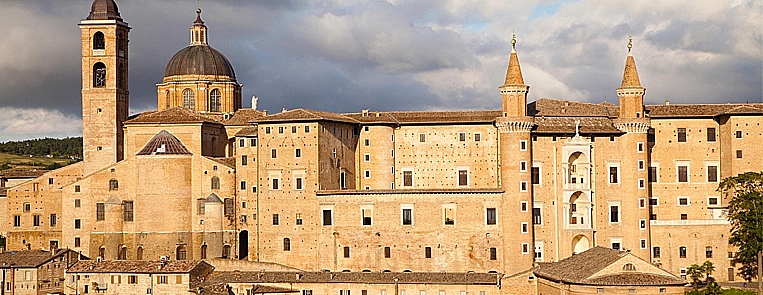
Urbino’s architecture is a single great argument about proportion. Luciano Laurana’s facade of the torricini, the two slender turrets flanking loggias stacked above the valley, gave the Renaissance one of its most poetic images, and Francesco di Giorgio Martini, who succeeded him, threaded the palace with ingenious services, ramps, and fortifications that made it a machine for civilized living. The city around it followed suit, in warm brick, modest scale, and doorways carved with ducal emblems.

The craft traditions of the duchy remain close at hand. The intarsia of the studiolo represents woodworking’s highest historical achievement, and the region’s majolica tradition, centered on nearby Urbania, the old Casteldurante, produced some of the most prized painted ceramics of the Renaissance, a craft still practiced in family workshops there today. Urbino itself sustains printmaking and book arts nourished by its long academic tradition.

This is where our insider access matters most. We arrange visits to ceramic workshops in Urbania where masters still paint in Renaissance patterns, sessions with restorers and artisans where access allows, and architecture-focused walks with specialists who read Laurana’s facades fluently. Watching a craftsman’s brush repeat gestures four centuries old explains the duchy’s culture as vividly as any gallery label.

The tradition also has a modern chapter. In the postwar decades the architect Giancarlo De Carlo wove new university colleges and faculties into the historic fabric with a tact that became internationally studied, proving that Urbino’s architectural conversation did not end with the dukes, and the city’s design and art institutes continue to train young makers within sight of the studiolo. For travelers interested in how a Renaissance city stays alive, that continuity is itself worth a guided morning.

What Festivals and Traditions Fill the Urbino Calendar?

The Festa del Duca is the city’s great pageant. Each August the historic center returns to the fifteenth century with costumed processions, flag throwers, drummers, and reenactments that culminate in celebrations around the Palazzo Ducale, and for a few days the court of Federico seems merely to have stepped out for a generation. Experiencing it well, from the right vantage points and with the surrounding feasts, rewards arrangements made in advance.

September brings a gentler spectacle: the Festa dell’Aquilone, when the city’s neighborhoods compete with hand-built kites above the hills outside the walls, a tradition celebrated in verse by the poet Giovanni Pascoli, who studied here. The university year adds its own rituals, from graduation days when laureled graduates parade the lanes to the nightly passeggiata that turns Piazza della Repubblica into the city’s living room.

Through the year, courtyard concerts, early music courses that fill Renaissance rooms with period instruments each summer, and the antique fairs and sagre of the surrounding Montefeltro complete the calendar, with the truffle festivities of nearby Acqualagna crowning the autumn. We fold these into itineraries as part of our entertainment and festival experiences in Italy, timed so a festival becomes the trip’s centerpiece rather than a lucky accident, with vantage points, tables, and the days around it arranged in advance.

What Is Daily Life Like in Urbino Today?

Urbino lives at student tempo inside Renaissance walls. Mornings begin with espresso taken standing amid lecture-hall gossip, the market and food shops supply a cuisine still tied to the surrounding farms, and the steep lanes fill and empty with the rhythm of the academic day. By late afternoon the passeggiata gathers everyone, professors, farmers, and visitors alike, into the funnel of Via Vittorio Veneto and Piazza della Repubblica.

The dukes would recognize more than the buildings. The city still prizes conversation as an art form, the bookshops and academies still anchor its identity, and the surrounding countryside still feeds it, with crescia flatbread griddled in family kitchens and casciotta cheese arriving from the same hills that supplied the court. Few places in Italy keep such continuity between their golden age and their present tense.

Market days and the academic calendar give the week its texture: stalls of cheeses, cured meats, and seasonal produce below the walls, graduation afternoons when laureled graduates parade the lanes to applause, and Sunday lunches that empty the town into the countryside farmhouses. Visitors who match their own days to these rhythms find themselves treated less like tourists and more like guests.

The deepest travel experiences here come from stepping inside these rhythms rather than observing them: a morning with a local historian who greets half the street, a farmhouse lunch in the hills the palace windows frame, an evening among the students as the light leaves the torricini. Our Italian cultural tours are composed of exactly these hours, arranged through relationships and timed to the life of the place.

Ready to Begin Planning Your Urbino Vacation?

Urbino deserves more than a template. Since 2003, Trips 2 Italy has designed private Italian vacations one traveler at a time, hand selecting every experience based on what you tell us rather than fitting you into a predefined package. Our Italian-born team plans Urbino with the knowledge of people who call Italy home, from the twin towers of the Palazzo Ducale to the quiet hill roads of the Montefeltro, and we remain at your side throughout your trip with 24/7 assistance. Tell us how you imagine Urbino, and we will craft the itinerary that matches it.

Explore Our Urbino Vacation Itineraries

Frequently Asked Questions About the Culture of Urbino

Urbino is celebrated as the seat of the ideal Renaissance court: the Palazzo Ducale of Federico da Montefeltro, the Galleria Nazionale delle Marche with Piero della Francesca’s Flagellation and Senigallia Madonna, the birthplace of Raphael, and The Book of the Courtier, which Castiglione set in the palace’s evening salons. Its UNESCO historic center doubles as a lively university town.

Baldassare Castiglione’s Book of the Courtier, published in 1528, records idealized evening conversations held at the Urbino court of Duke Guidobaldo and Duchess Elisabetta Gonzaga. It taught Europe the Renaissance ideals of grace, learning, and courtesy, and travelers can stand in the very palace rooms where those conversations were set.

The essential works are Piero della Francesca’s Flagellation and Senigallia Madonna, Raphael’s portrait known as La Muta, the panel of the Ideal City, and Federico’s studiolo with its astonishing intarsia illusions. Trips 2 Italy arranges visits with art historians timed for the quiet hours, so the masterpieces receive contemplation rather than a hurried pass.

Yes. The Casa Natale di Raffaello on Via Raffaello, kept by the Accademia Raffaello since 1873, preserves the family rooms, the courtyard with the stone where pigments were ground, and an early Madonna fresco attributed to the young painter. It pairs naturally with La Muta in the Galleria Nazionale delle Marche.

The Festa del Duca each August fills the city with Renaissance processions, flag throwers, and reenactments around the Palazzo Ducale, and the Festa dell’Aquilone in September sends the neighborhoods’ hand-built kites over the hills. Trips 2 Italy tracks the calendar and arranges vantage points and surrounding experiences so festivals become a trip’s centerpiece.

Very much so. The University of Urbino, founded in 1506, brings thousands of students into the walled city, filling its lanes, cafes, and bookshops with year-round energy. The combination of Renaissance architecture and student life gives Urbino a living cultural atmosphere that travelers consistently name among its greatest charms.