
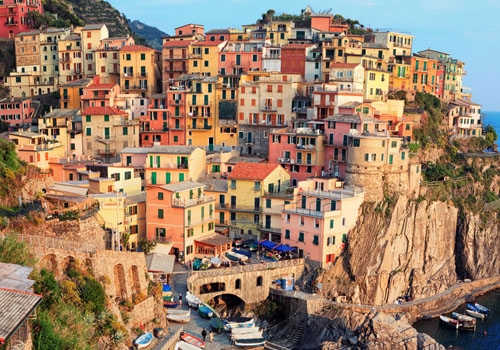
A Taste of the Cinque Terre Tour | Vacation Packages for 2025 – 2026
Experience Rapallo, Cinque Terre and Portofino as seaside villages, coastal trails and Ligurian flavors create the perfect Italian Riviera escape. Starting from $680 per person.
HOME » POPULAR ITALIAN DESTINATIONS » PORTOFINO TRAVEL GUIDE » PORTOFINO HISTORY GUIDE
About this guide: This guide to the history of Portofino was written by the Italian-born travel specialists at Trips 2 Italy, a custom tour operator that has designed hand-crafted Italian vacations since 2003. Every recommendation below reflects the same first-hand knowledge our team draws on when we build a private Portofino itinerary around a traveler’s interests, dates, and pace. Read it for your research, then let us translate it into a trip designed entirely around you.
Portofino enters written history under Rome. Pliny the Elder recorded the harbor as Portus Delphini, the port of the dolphin, a name that testifies both to the animals once common in the gulf and to the anchorage’s value on the coastal route between Genoa and the south. The deep, sheltered inlet, protected by the mountain at its back, made a natural refuge on a coast with few of them. The wider story of this seafaring region unfolds in our Liguria travel guide.
The site was likely used long before the Romans named it. The promontory offered fresh water, timber, and defensible ground, and the harbor’s shape has changed remarkably little: the amphitheater of hills travelers see today is essentially the one ancient sailors steered for. Few places in Italy let you read two thousand years of continuity in a single glance from a church terrace.
After Rome’s decline, the village passed through the turbulence common to the Ligurian coast, raided from the sea and contested by local powers, until the medieval order arrived in the form of monks and then of Genoa. Portofino’s early history is the history of a perfect small harbor that everyone wanted and no one could enlarge.
The name itself is the village’s oldest artifact. Two thousand years of sailors, monks, merchants, and travelers have entered the same narrow harbor mouth that Pliny’s contemporaries knew, and the continuity is not a poetic flourish but a matter of geography: the deep cove and its guardian mountain fixed the settlement’s shape before history began recording it.
In the tenth century, Benedictine monks established the abbey of San Fruttuoso in a hidden cove on the promontory’s seaward side, reachable then as now only by boat or trail. The abbey became the spiritual anchor of the headland and, under the patronage of Genoa’s powerful Doria family, its stone halls grew to include the family’s tombs. The gray-and-white abbey above its tiny beach remains one of the most evocative medieval sites on the Italian coast.
The village itself passed into the orbit of the Republic of Genoa, which valued the harbor as a naval station and way port. Genoa fortified the headland against the Saracen raids and later corsair threats that harried the whole coast, and Portofino’s men served the republic’s fleets and merchant convoys through the centuries when Genoa contested the Mediterranean with Venice.
Genoese rule left durable marks: the fortress that became Castello Brown, the watch positions along the promontory, the banded Romanesque stonework of the Divo Martino church, and the administrative habits of a village that answered to one of Europe’s great maritime republics. When the republic fell to Napoleon’s reordering of Italy at the end of the eighteenth century, Portofino followed Liguria into the Kingdom of Sardinia in 1815 and then into united Italy.
San Fruttuoso repays unhurried attention on any historical itinerary. The abbey’s octagonal tower, its cloister, and the Doria tombs in their striped stone compress five centuries of monastic and dynastic history into a single small building, and the crossing by water to reach it reproduces the only approach the site has ever had. We arrange the visit with guides who bring both the monks and their patrons back to life.
The fortress above the harbor mouth exists because the harbor was worth defending. A stronghold stood here in the medieval era, and in the sixteenth century Genoa rebuilt it into an artillery fort as raids from the sea intensified across the Ligurian coast. Its guns commanded the narrow entrance below, and garrison rosters and repairs run through the archives for three centuries.
The fort saw its last military service in the Napoleonic era, when the coast changed hands amid the wars that ended the Genoese republic. Decommissioned in the nineteenth century, it found an unlikely second life: Montague Yeats-Brown, the British consul in Genoa, purchased it in 1867 and transformed the fortress into a villa, adding loggias, gardens, and the pair of pines that still frame the view from its terrace.
The castle passed through English hands into the ownership of the town, and it is now a museum whose rooms and gardens narrate both lives, fortress and villa. Standing on its terrace, with the harbor below and the sea lanes beyond, travelers grasp Portofino’s entire strategic story in a single view, and it is a stop we build into nearly every history-minded itinerary.
The nineteenth century turned the fortress coast into a destination. The railway reached Santa Margherita Ligure in 1868, placing the gulf within reach of travelers on the new grand circuits of Italy, and the British community that wintered on the Riviera discovered the little harbor at the promontory’s tip. Yeats-Brown’s castle was an early landmark of that adoption, and villas began to rise discreetly among the pines.
Writers and artists carried the village’s name outward. Maupassant praised the harbor after anchoring here, Nietzsche walked this coast during his Rapallo winters, and by the Belle Epoque the gulf towns had hotels, promenades, and an international season. Portofino itself stayed small, which became precisely its distinction: the retreat of those who preferred a fishing village to a resort.
The pattern set in those decades has never really broken. Portofino’s fame grew through the twentieth century, but the village’s physical form did not, and the meeting of international society with an unchanged Ligurian harbor remains the essence of the place. Understanding that history explains why Portofino feels different from every other celebrated stop on the Italian coast.
The gulf towns preserve this era in their own fabric. Santa Margherita Ligure keeps its Belle Epoque seafront and the gardens of Villa Durazzo, Rapallo its promenade and the sanctuary of Montallegro above, and the villas in the pines around Portofino their discreet histories of wintering families. A day spent reading the gulf’s nineteenth century, villa by villa, is one of the quiet pleasures we build for history-minded travelers.
Two protections defined the modern era. In 1935, the Monte di Portofino was set aside as a natural park, among the earliest landscape protections in Italy, sparing the headland the building booms that transformed so much of the Mediterranean coast. Strict planning rules in the village itself kept the harbor’s amphitheater intact through the century’s pressures.
The postwar decades brought the village its most photographed era, when film stars, industrialists, and royalty made the piazzetta a fixture of the illustrated magazines. The village met that attention with characteristic understatement, remaining a working harbor whose fame never translated into expansion. In 1954, the bronze Christ of the Abyss was lowered onto the seabed off San Fruttuoso, honoring Dario Gonzatti, a pioneer of Italian diving, and all those lost to the sea.
The century closed with the sea itself protected, when the waters around the promontory became a marine protected area in 1999. Taken together, park, planning, and marine reserve explain the miracle travelers notice immediately: a place this famous, still this small, with its landscape and harbor essentially as the nineteenth century found them.
It is worth pausing on how unusual that outcome is. Across the Mediterranean, the twentieth century rewarded famous coastlines with concrete; Portofino’s fame arrived early enough, and its protections soon enough, that the village never paid that price. The photographs from the 1950s and the view from Castello Brown today differ mainly in the rigging of the boats.
Start at the water and read upward. The piazzetta and harbor front preserve the working village, their painted facades a living archive of Ligurian building. The Divo Martino church keeps its twelfth-century Romanesque core, and the church of San Giorgio above the harbor holds the relics that sailors’ tradition brought home from the Crusades, with the finest terrace view in the village.
Castello Brown narrates fortress and villa in one climb, and the lighthouse walk beyond it follows the watchers’ path to the promontory’s tip. Across the headland by boat, the abbey of San Fruttuoso delivers the medieval chapter whole: cloister, Doria tombs, and the tiny cove that hid a monastery from a dangerous sea for a thousand years.
We sequence these places so the story builds, usually from harbor to castle to abbey, with guides chosen for their narrative gift as much as their scholarship. For travelers who structure journeys around the past, these walks join our cultural tours across Italy, and few small places anywhere reward the approach so richly.
Portofino’s preservation is layered and deliberate. The Natural Park guards the terrestrial promontory, the marine protected area conserves the waters and the seabed, and the village’s planning regime protects the harbor’s celebrated silhouette. The abbey of San Fruttuoso has been in the care of FAI, Italy’s national trust, since 1983, restored and opened to visitors while remaining a consecrated place.
Preservation extends to living traditions: the trompe l’oeil painting craft maintained by Ligurian artisans, the olive terraces still worked on the headland, the small fleet that keeps fishing rights alive, and the festivals, from San Giorgio’s bonfire to the ceremony at the Christ of the Abyss, that carry the village’s memory forward in public.
For travelers, the result is history unusually intact and unusually walkable. A single day can pass from a Romanesque nave to a sixteenth-century rampart to a medieval abbey reached across protected water, all within a few miles. We plan that day, and the quieter hours around it, as carefully as any gallery visit in Florence, because Portofino’s history deserves the same craft.
Preservation here also has a human face worth meeting. The park’s wardens, the abbey’s custodians, the artisans who repaint the facades, and the families who keep the olive terraces are the working inheritors of the village’s long story, and where access allows we arrange conversations with them. History in Portofino is not an exhibit; it is a maintenance schedule kept faithfully for centuries.
Portofino deserves more than a template. Since 2003, Trips 2 Italy has designed private Italian vacations one traveler at a time, hand selecting every experience based on what you tell us rather than fitting you into a predefined package. Our Italian-born team plans Portofino with the knowledge of people who call Italy home, from a private launch across the Gulf of Tigullio to a quiet table above the painted harbor, and we remain at your side throughout your trip with 24/7 assistance. Tell us how you imagine Portofino, and we will craft the itinerary that matches it.
Experience Rapallo, Cinque Terre and Portofino as seaside villages, coastal trails and Ligurian flavors create the perfect Italian Riviera escape. Starting from $680 per person.
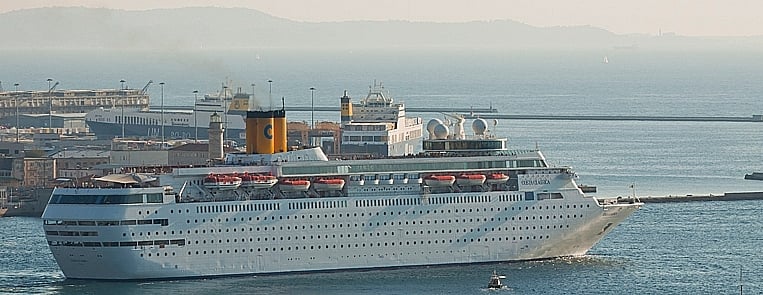
Our Portofino, Santa Margherita and Rapallo tour lets you explore three stunning Ligurian villages, learn about their history and enjoy a relaxing shore excursion during your cruise around Italy
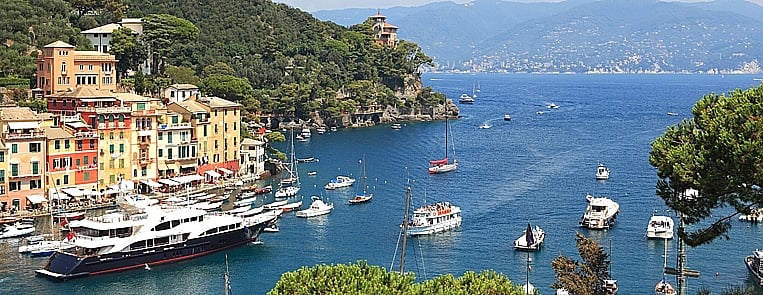
This 8.3-hour Portofino, Santa Margherita Ligure and Pisa tour is an excellent way to visit some of Italy’s most profound historic and cultural areas, all wrapped up in a
The name descends from Portus Delphini, the port of the dolphin, recorded by Pliny the Elder in Roman times. The dolphins that frequented the Gulf of Tigullio gave the anchorage its name, and over the centuries the Latin evolved through local usage into Portofino.
Castello Brown is the fortress above Portofino’s harbor mouth, rebuilt by the Republic of Genoa in the sixteenth century and converted into a villa after the British consul Montague Yeats-Brown purchased it in 1867. Now a museum with celebrated gardens, its terrace holds the finest view in the village, and we include it in nearly every history-focused Portofino itinerary.
The Benedictine abbey of San Fruttuoso was established in the tenth century in a hidden cove on the seaward side of the Portofino promontory. Enlarged under the patronage of Genoa’s Doria family, whose tombs it preserves, it has been cared for by FAI, Italy’s national trust, since 1983 and is reached only by boat or trail.
The Christ of the Abyss is a bronze statue lowered onto the seabed of San Fruttuoso’s bay in 1954, honoring Dario Gonzatti, a pioneer of Italian diving, and all those lost at sea. It can be seen by snorkeling, diving, or from glass-bottomed boats in calm water, and an annual summer ceremony lays wreaths above it.
Three protections converged: the Portofino Natural Park of 1935 spared the headland from development, strict village planning preserved the harbor’s amphitheater, and the marine protected area of 1999 conserved the surrounding waters. The result is a famous harbor that remains physically the small village the nineteenth century discovered.
Yes. Trips 2 Italy arranges private historian-led walks from the piazzetta to San Giorgio and Castello Brown, boat crossings to the abbey of San Fruttuoso, and sequences that let two thousand years arrive as a story rather than a shuffle. Every history itinerary is composed around your interests, dates, and pace.