
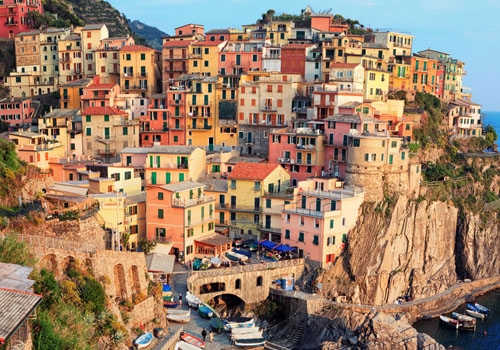
A Taste of the Cinque Terre Tour | Vacation Packages for 2025 – 2026
Experience Rapallo, Cinque Terre and Portofino as seaside villages, coastal trails and Ligurian flavors create the perfect Italian Riviera escape. Starting from $680 per person.
HOME » POPULAR ITALIAN DESTINATIONS » PORTOFINO TRAVEL GUIDE » PORTOFINO CULTURE GUIDE
About this guide: This guide to the culture of Portofino was written by the Italian-born travel specialists at Trips 2 Italy, a custom tour operator that has designed hand-crafted Italian vacations since 2003. Every recommendation below reflects the same first-hand knowledge our team draws on when we build a private Portofino itinerary around a traveler’s interests, dates, and pace. Read it for your research, then let us translate it into a trip designed entirely around you.
Portofino’s culture rests on a double identity held in balance for more than a century: a working Ligurian fishing village and an international retreat of quiet distinction. The same piazzetta serves both. Fishermen still mend nets a few steps from galleries, and the rhythms of the harbor follow the sea as much as the season. It is the most concentrated expression of the coastal culture explored in our Liguria travel guide.
The Ligurian character runs deep here: reserve rather than display, craftsmanship rather than spectacle, and a fierce attachment to place. Liguria’s people spent centuries wringing a living from steep terraces and a demanding sea, and that inheritance shows in Portofino’s proportions, its terraced olive groves, and its refusal to grow beyond its natural amphitheater.
For travelers, the reward is a culture that can be experienced at walking pace in a single small square, yet deepens the longer you look: in the painted facades, the church terraces, the boatyards’ descendants, and the villagers’ unhurried evenings. Our itineraries are designed to place travelers inside that life rather than in front of it.
The visitor feels this balance quickly. A single circuit of the harbor passes working moorings, a Romanesque church, galleries, and the tables of the piazzetta, each occupying its own unhurried place in the ensemble. Nothing announces itself loudly, which is the Ligurian way, and travelers who match that register, observant and unhurried, are rewarded with a village that opens far more than it performs.
Portofino entered the world’s imagination through its admirers. Guy de Maupassant, arriving by yacht in the 1880s, described a little village spreading like a crescent moon around its calm basin, and generations of painters followed the same light, setting easels along the harbor to work through the changing colors of the facades and the water. Friedrich Nietzsche, wintering in nearby Rapallo, composed part of Thus Spoke Zarathustra on walks along this stretch of coast.
By the early twentieth century the village had become a fixture of European travel culture, beloved by British and German visitors who built villas in the pines and wrote letters home about the harbor. The mid-century decades added film stars, royalty, and photographers, and the piazzetta became one of the most photographed small squares in Europe.
The village absorbed all of it without changing its shape, which is itself the cultural achievement. Portofino never rebuilt for its fame; it simply continued. Travelers who explore with one of our guides hear that story told building by building, from the fishermen’s chapel to the villas above, with the discretion the village itself has always practiced.
The harbor front is a textbook of Ligurian coastal building: tall, narrow houses in deep ochres and roses, pressed shoulder to shoulder, their windows framed by painted architectural details in the trompe l’oeil tradition the region perfected. Paint substituted for carved stone on a coast where wealth went into ships, and the effect, doubled in the water, gives Portofino its instantly recognizable face.
Above the square, the church of San Giorgio holds relics of Saint George that local tradition says returning sailors brought from the Crusades, and its terrace balances the whole village below. The parish church of San Martino, called the Divo Martino, preserves its Romanesque bones from the twelfth century in banded stone. Higher still, Castello Brown layers a sixteenth-century Genoese fortress with the gardens and rooms of the villa it later became.
The ensemble ends at the lighthouse on Punta del Capo, white against the pines, marking the promontory for ships as its towers once watched for raiders. Read together, the architecture tells the whole cultural story: defense, faith, seafaring, and finally the art of living well. We pair travelers with guides who read these buildings fluently, from pigment traditions to fortress engineering.
Look up as you walk. The facades reward attention floor by floor: painted balustrades that cast no shadow, marble window frames that are pigment and skill, and the soft palette of ochres and roses that Ligurian tradition assigns to the sea’s edge. Restorers still maintain these surfaces with the old techniques, and a guided hour spent reading them teaches more about coastal Liguria than a shelf of books.
The sea named the village. The Romans knew this harbor as Portus Delphini, the port of the dolphin, and every century since has been organized around the water: fishing fleets, coral divers, coastal traders, and the naval service of the Republic of Genoa. The gozzo, the small wooden fishing boat of Liguria, still rides at moorings beside the yachts, and a few families still fish the gulf.
Maritime devotion remains visible. San Giorgio, protector of the village, is honored with processions and a bonfire each April, and the Christ of the Abyss, a bronze figure set on the seabed off San Fruttuoso in 1954, receives an annual ceremony honoring those the sea has taken. Across the promontory, Camogli, once home to one of the Mediterranean’s great merchant fleets, keeps the same faith with its own festivals.
Travelers meet this tradition best on the water. We arrange days with skippers who grew up on the gulf, visits timed to the small fleet’s rhythms, and crossings to San Fruttuoso that trace the same routes the monks and fishermen used. The sea is not scenery here; it is the culture’s first language.
The promontory’s fishing culture also survives in its most tangible form at Punta Chiappa, the rocky point below Camogli, where the ancient tonnarella nets are still set each season in one of the Mediterranean’s last such traditions. Visiting the point by boat, with the nets in the water and the abbey cove beyond, connects travelers to a way of working the sea that predates every villa on the coast.
The feast of San Giorgio, on April 23, is the village’s own: a procession bearing the saint’s relics, the piazzetta filled with residents, and a great bonfire beside the harbor after dark. It is Portofino at its most local, held weeks before the summer season, and travelers who time a spring visit around it see the village celebrating for itself rather than for an audience.
Summer brings the ceremony of the Christ of the Abyss in the bay of San Fruttuoso, when divers descend with lights to the submerged statue and wreaths are laid on the water in memory of those lost at sea. Across the headland in May, Camogli’s Sagra del Pesce fries the gulf’s catch in a giant pan on the waterfront, one of Liguria’s most beloved festivals.
Through the warm months, the gulf towns add regattas, patronal feasts, and fireworks over the water, including Rapallo’s July celebrations for the Madonna di Montallegro. We fold these dates into itineraries as part of our entertainment and festival experiences in Italy, arranging vantage points and timing so a festival becomes the trip’s centerpiece rather than a lucky accident.
Timing a visit to coincide with one of these dates changes the trip’s whole texture. A traveler who stands in the piazzetta as the San Giorgio bonfire is lit, or watches the wreaths settle over the Christ of the Abyss from a quiet boat, experiences Portofino as a community rather than a view. Our specialists track these calendars year round and design spring and summer itineraries around them.
The village keeps a rhythm older than its fame. Early morning belongs to the residents: fishermen checking boats, shopkeepers arranging doorways, espresso taken standing while the harbor is still glass. Midday brings the visitors and the theater of the piazzetta, and then evening restores the balance, when the day boats leave and the square returns to conversation and the sound of halyards.
Life is compact by necessity. A few hundred people live in the village year round, and everything, church, school runs, errands, happens within the amphitheater of the harbor or up the lanes behind it. Neighboring Santa Margherita Ligure serves as the everyday town, and the bond between the gulf communities, linked by boat and corniche road, is part of daily texture.
The passeggiata here follows the water: along the harbor, up to San Giorgio for the view, or out toward the lighthouse as the light lowers. Travelers who stay overnight inherit these rhythms naturally, which is why our Portofino itineraries are built around residence rather than transit. The village’s deepest luxury is its ordinary hours.
Off-season daily life is the connoisseur’s Portofino. Between late autumn and early spring the village returns to a few hundred residents, the trails stay green in the mild coastal air, and the harbor’s rhythms turn entirely local. Travelers who come in these months, and we plan for them gladly, find the piazzetta at its most authentic and the coast’s beauty undiluted by any season’s company.
Portofino’s culture is intimate, and intimacy requires introductions. A walk through the village becomes a different experience with a guide who knows which facade hides a medieval warehouse and which family has fished the gulf for five generations. A crossing to San Fruttuoso becomes a story when the skipper narrates the coast he grew up on.
Because our team is Italian-born and has worked this coast since 2003, we plan Portofino from the inside: private boat days timed to the light, visits to Castello Brown and the churches at their quietest hours, pesto and focaccia traditions met in the kitchens that keep them, and festival dates woven into the itinerary’s design. These experiences anchor many of our Italian cultural tours along this coast.
None of it is selected from a list. We compose each cultural itinerary from what travelers tell us, hand selecting the guides, boats, tables, and hours that match it. That method is the difference between visiting a famous harbor and briefly sharing the life of a village that has perfected the art of remaining itself.
Portofino deserves more than a template. Since 2003, Trips 2 Italy has designed private Italian vacations one traveler at a time, hand selecting every experience based on what you tell us rather than fitting you into a predefined package. Our Italian-born team plans Portofino with the knowledge of people who call Italy home, from a private launch across the Gulf of Tigullio to a quiet table above the painted harbor, and we remain at your side throughout your trip with 24/7 assistance. Tell us how you imagine Portofino, and we will craft the itinerary that matches it.
Experience Rapallo, Cinque Terre and Portofino as seaside villages, coastal trails and Ligurian flavors create the perfect Italian Riviera escape. Starting from $680 per person.
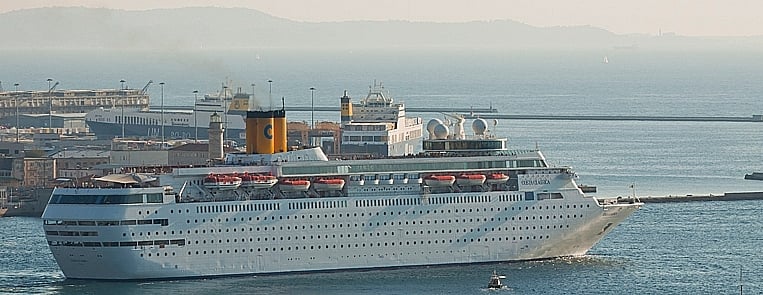
Our Portofino, Santa Margherita and Rapallo tour lets you explore three stunning Ligurian villages, learn about their history and enjoy a relaxing shore excursion during your cruise around Italy
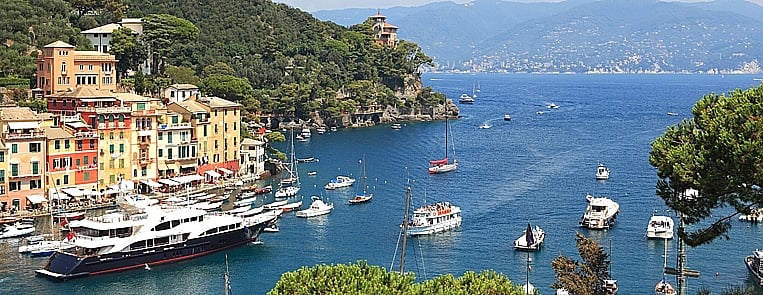
This 8.3-hour Portofino, Santa Margherita Ligure and Pisa tour is an excellent way to visit some of Italy’s most profound historic and cultural areas, all wrapped up in a
Portofino is celebrated for its painted harbor and piazzetta, the trompe l’oeil facades of the Ligurian tradition, the church of San Giorgio and Castello Brown on the headland, its maritime heritage reaching back to the Roman Portus Delphini, and more than a century as a retreat for artists, writers, and travelers of quiet distinction.
The piazzetta is the small cobbled square that opens directly onto the harbor and serves as the village’s living room. Ringed by painted facades and cafe tables, it has been the stage of Portofino life for centuries, from fishermen’s mornings to festival bonfires, and it remains the natural starting point of every visit.
The painted window frames, cornices, and shutters belong to Liguria’s trompe l’oeil tradition, in which decoration was painted rather than carved on a coast whose wealth went into ships and trade. The technique is still maintained by specialized artisans, and reading the facades with a knowledgeable guide is one of the village’s quiet pleasures.
The feast of San Giorgio on April 23 brings a procession and a bonfire beside the piazzetta, summer adds the underwater ceremony at the Christ of the Abyss near San Fruttuoso, and Camogli’s Sagra del Pesce each May fries the gulf’s catch in a giant pan. Trips 2 Italy tracks the coastal calendar and arranges vantage points so festivals become an itinerary’s centerpiece.
The yachts are one thread in a much older fabric. Portofino remains a genuine Ligurian village with a fishing tradition, Romanesque churches, terraced olive groves, and festivals held for its own residents. Travelers who stay overnight and walk the headland discover a place defined far more by proportion and continuity than by its famous visitors.
Yes. We arrange private guided walks through the village and its churches, visits to Castello Brown at quiet hours, boat crossings to San Fruttuoso with skippers who narrate the coast, and encounters with the pesto and focaccia traditions of the gulf towns. Every arrangement is composed around your interests, dates, and pace.