
A Taste of Umbria Tour | Vacation Packages for 2025 – 2026
Discover Bettona, Assisi and Perugia as hilltop towns, art, olive oil and chocolate reveal the heart of Umbria’s timeless charm. Starting from $998 per person.
Spoleto Travel Guide Culture History Food and Wine Things to Do Plan My Trip
About this guide: This Spoleto travel guide was written by the Italian-born travel specialists at Trips 2 Italy, a custom tour operator that has designed hand-crafted Italian vacations since 2003. Every recommendation below reflects the same first-hand knowledge our team draws on when we build a private Spoleto itinerary around a traveler’s interests, dates, and pace. Read it for your research, then let us translate it into a trip designed entirely around you.
Spoleto rises against the wooded flank of Monteluco at the southern end of the Umbrian valley, a town of pale stone lanes climbing from Roman gates to the great papal fortress that crowns its summit. Few places in Italy compress so much history into so walkable a space: a Roman theatre still in use each summer, a cathedral holding Filippo Lippi’s final fresco cycle, a Lombard basilica on the UNESCO World Heritage list, and a medieval aqueduct bridge that ranks among the most dramatic structures of its age anywhere in Europe.
Spoleto also carries a modern distinction. Since 1958 it has hosted the Festival dei Due Mondi, the Festival of Two Worlds founded by the composer Gian Carlo Menotti, which fills its piazzas, theatres, and ancient ruins every summer with opera, dance, and music of international rank. The festival made Spoleto a name known to artists around the world, yet outside those weeks the town settles back into the unhurried rhythm that draws travelers to Umbria in the first place.
The setting completes the argument. Spoleto looks north over the wide green valley toward Assisi and Perugia, and backs directly onto the holm oak forest of Monteluco, ground held sacred since antiquity, so that ten minutes of walking separates the cathedral square from birdsong and hermitage silence. Travelers who arrive for a few hours discover a town built for slow evenings, when the stone turns honey-colored and the fortress glows above the rooftops.
Our specialists have planned Spoleto for festival-goers, art lovers, walkers, and travelers composing longer Umbrian journeys, and this guide reflects what more than two decades of designing Italian itineraries has taught us. Use it to shape your thinking, then let us shape the trip itself, hand selected experience by experience around what you tell us.
Spoleto sits in southern Umbria, roughly eighty miles north of Rome and about an hour south of Perugia, at the point where the broad Umbrian valley narrows against the mountains. The town climbs a spur beneath Monteluco, a limestone mountain rising to more than two thousand feet whose evergreen holm oak forest has been protected since Roman times, when the Lex Spoletina, carved on stone markers in the third century BC, forbade the cutting of its sacred wood.
Below the walls, the valley floor runs north toward Trevi, Montefalco, and Assisi in an almost continuous ribbon of olive groves. The band of terraced olives between Assisi and Spoleto has been farmed for centuries and is recognized by the United Nations as a globally important agricultural heritage landscape, which explains why the oil on Spoleto’s tables tastes the way it does. Behind the town, the Valnerina, the steep wooded valley of the Nera river, winds east toward Norcia and the Sibillini mountains.
The climate follows the gentle inland pattern of central Italy: warm, dry summers softened by the mountain’s evening air, long luminous springs and autumns ideal for walking, and quiet winters when mist pools in the valley while the upper town stands in the sun. Because Spoleto faces the open valley, its light is a daily performance, and the views from the fortress walk reward every hour of the day.
This geography also makes Spoleto an unusually versatile base. The valley towns, the wine country of Montefalco, the mountain landscapes of the Valnerina, and the waterfalls of Marmore all sit within an easy drive, so a single unpacking can serve nearly a week of very different days.
The Festival dei Due Mondi defines early summer. For roughly seventeen days from late June to mid July, Spoleto becomes one of the most artistically charged places in Europe, with performances in the Roman theatre, the opera house, cloisters, and churches, closing with the celebrated final concert in Piazza del Duomo. Attending well requires planning far ahead: performances, accommodations within the walls, and dinner tables all fill months in advance, and arranging that properly is exactly the work we do.
Spring and early autumn are the connoisseur’s alternatives. May and June bring green hillsides, wildflowers on Monteluco, and perfect temperatures for the panoramic walks around the fortress, while September and October add the grape harvest in nearby Montefalco and the first mushrooms and game on the town’s menus. November opens the olive harvest across the Assisi and Spoleto groves, when the year’s new oil arrives on every table.
Winter belongs to the black truffle. The prized tartufo nero of the Spoleto and Norcia hills reaches its peak from December through early March, scenting menus across the town, and the quiet season rewards travelers who want the Duomo, the Rocca, and the lanes nearly to themselves. When we plan a Spoleto itinerary, we align your dates with these rhythms so the town you meet is doing what it does best.
A full day with an overnight is the honest minimum. The Duomo and its Lippi frescoes deserve an unhurried visit, the Rocca Albornoziana and the walk beside the Ponte delle Torri fill a glorious late afternoon, and the evening, when day visitors have gone and the piazzas return to the locals, is when Spoleto becomes most fully itself.
Two or three days transform the experience. The second day opens the Roman theatre and archaeological museum, the Casa Romana, the Romanesque churches of Sant’Eufemia and San Pietro, and the ascent of Monteluco to the hermitage founded by St Francis. A third day reaches into the Valnerina toward Norcia or pairs the Cascata delle Marmore with the wine cellars of Montefalco, two of central Italy’s most rewarding excursions.
During the festival, we recommend at least three nights so that performances, sightseeing, and long dinners breathe rather than compete. Because every Trips 2 Italy itinerary is built by hand, we weigh how Spoleto fits the rest of your Italian journey and give it the space it deserves rather than the space a standard tour allows.
The historic center divides naturally into an upper and a lower town. The lower town, nearest the railway station, holds the Roman amphitheatre district, the church of San Gregorio Maggiore, and the everyday commerce of modern Spoleto. From there the old lanes climb through Porta Fuga, the gate named for Hannibal’s repulsed attack, toward the heart of the upper town.
The upper town is where travelers spend their days. Piazza del Mercato, the site of the Roman forum, remains the town’s living room, ringed by food shops and cafes, with the first-century Arch of Drusus and Germanicus standing at its edge. A few steps beyond, the cathedral square opens suddenly below street level, one of the most theatrical piazzas in Italy, with the Duomo’s Romanesque facade and its 1207 gilded mosaic facing the broad staircase where festival audiences gather each summer.
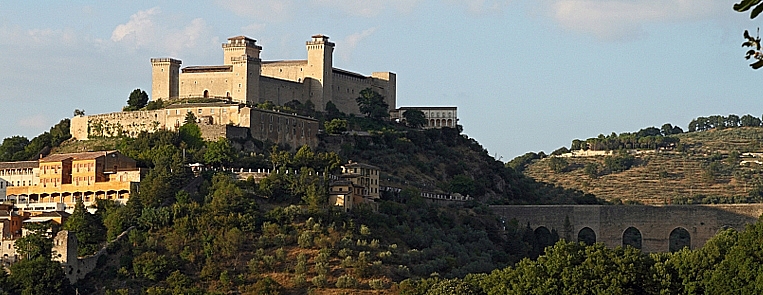
Above everything stands the Rocca Albornoziana on its hilltop, encircled by the level panoramic path of the Giro della Rocca, with the Ponte delle Torri spanning the gorge behind it toward Monteluco. Below the southern walls, the church of San Pietro extra moenia displays the finest Romanesque facade sculpture in Umbria, and the mountain road climbs to the sacred forest and hermitage of Monteluco.
Where you stay shapes the visit. A room inside the upper town means evening piazzas and the Duomo at first light; the valley and countryside around town offer converted farmhouses among the olives. Matching the base to the traveler is one of the first conversations we have when planning.
Spoleto is among the easiest hill towns in Italy to reach. It sits on the main rail line between Rome and Ancona, roughly ninety minutes from Rome, and the drive from Rome’s airports takes about two hours through increasingly beautiful country. We arrange private transfers door to door, so the journey begins the moment you land, with a driver who knows where to pause for the first full view of the town beneath its fortress.
Within the walls, Spoleto has quietly solved the hill town problem: a system of escalators and moving walkways rises from the lower town and the parking areas into the heart of the upper town, so the climb that once deterred travelers now happens effortlessly underground. The historic lanes themselves are best on foot, and the distances are short, though the cobbles reward good shoes.
The surrounding country asks for wheels: Monteluco’s summit, the Valnerina, Norcia, Montefalco, and the Marmore falls are all short drives on roads that are part of the pleasure. Every transfer and excursion in a Trips 2 Italy itinerary is arranged in advance and supported around the clock, which in a region of small roads and restricted traffic zones is the difference between arriving gracefully and arriving flustered.
During festival weeks the logistics matter doubly: the historic center’s traffic restrictions tighten, performance venues scatter across the town, and evenings end late. We plan festival stays so lodging, dining, and venues align on foot, with drivers positioned for the excursion days, so that the only decision left to you at ten in the evening is whether to take the long way home through the lamplit lanes.
Spoleto anchors southern Umbria naturally: Montefalco, Trevi, and Spello lie minutes away, Assisi and Perugia under an hour, Orvieto and Todi within easy reach, and the Valnerina opens directly behind the town. It also fits gracefully into larger journeys, sitting on the direct rail line from Rome so that the classic Rome and Florence itinerary gains a green, uncrowded middle movement. Many of our travelers tell us afterward that Spoleto was the place their trip slowed down and deepened.
The occasion shapes the composition. For travelers planning around the Festival dei Due Mondi, we build the entire journey backward from the performances as part of our entertainment and festival experiences in Italy. For lovers of art, walking, and the table, Spoleto takes its place in a custom trip to Italy designed entirely from what you tell us.
This guide is one of five we have written on the town. Continue with our Spoleto culture guide, Spoleto history guide, Spoleto food and wine guide, and Spoleto things to do guide, or widen the lens with our Umbria travel guide.
Spoleto deserves more than a template. Since 2003, Trips 2 Italy has designed private Italian vacations one traveler at a time, hand selecting every experience based on what you tell us rather than fitting you into a predefined package. Our Italian-born team plans Spoleto with the knowledge of people who call Italy home, from the frescoed apse of the Duomo to the sacred forest of Monteluco, and we remain at your side throughout your trip with 24/7 assistance. Tell us how you imagine Spoleto, and we will craft the itinerary that matches it.
Discover Bettona, Assisi and Perugia as hilltop towns, art, olive oil and chocolate reveal the heart of Umbria’s timeless charm. Starting from $998 per person.
The ideal tour package for those seeking tranquility and purity in a region that is still relatively undiscovered. A perfect location also for families with children.
A short active holiday in Umbria for a taste of nature hiking through the National park of Monti Sibillini and surrounding charming villages. Tour includes a taste of the
Late June to mid July brings the Festival dei Due Mondi, when the town fills with world-class opera, dance, and music; May, June, September, and October offer ideal weather for walking and the harvest seasons; and winter is black truffle season, when the town is at its quietest. The specialists at Trips 2 Italy align your dates with the season that best matches your interests.
One full day with an overnight covers the Duomo, the Rocca Albornoziana, and the Ponte delle Torri, but two or three days allow the Roman sites, Monteluco’s hermitage, and day trips into the Valnerina or the Montefalco wine country. During the festival, three nights let performances and sightseeing breathe rather than compete.
Absolutely. Filippo Lippi’s fresco cycle in the cathedral, the fortress and its panoramic walks, the Roman theatre and Casa Romana, the UNESCO-listed Basilica of San Salvatore, and the sacred forest of Monteluco reward travelers year-round, and outside festival weeks the town keeps a calm, deeply local rhythm that many visitors come to prefer.
Spoleto sits on the main rail line from Rome, roughly ninety minutes away, and the drive takes about two hours. Trips 2 Italy arranges private transfers door to door with drivers who know the region, so the journey becomes a scenic part of the trip rather than a logistical exercise.
The upper town climbs, but Spoleto has an excellent system of escalators and moving walkways rising from the parking areas and lower town into the historic center, so the steepest work happens effortlessly. Within the upper town, distances are short, and we sequence visits so the walking flows downhill wherever possible.
You can, and many travelers do from Rome or Perugia, but the town rewards an overnight: the evening piazzas after the day visitors leave, the fortress glowing above the rooftops at sunset, and the Duomo square at first light are among Spoleto’s finest experiences, and they belong to those who stay.