Best of Italy’s Lake District and Dolomites Semi Escorted Tour
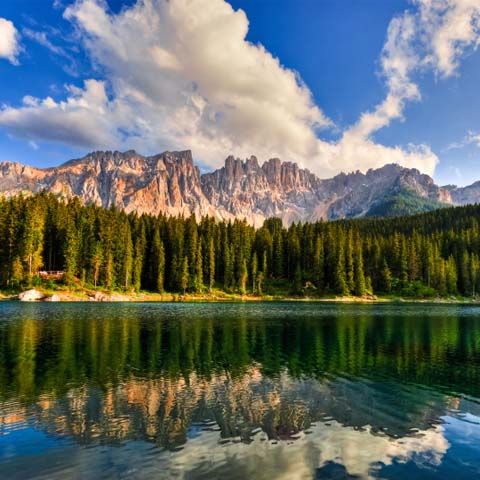
The majesty of the Italian Alps, charming Villas and picturesque sights, are all breathtaking landscapes on this enchanting tour along Italy’s northern Lakes and Alps.
HOME » POPULAR ITALIAN DESTINATIONS » TRENTO TRAVEL GUIDE » TRENTO CULTURE GUIDE
About this guide: This guide to the culture of Trento was written by the Italian-born travel specialists at Trips 2 Italy, a custom tour operator that has designed hand-crafted Italian vacations since 2003. Every recommendation below reflects the same first-hand knowledge our team draws on when we build a private Trento itinerary around a traveler’s interests, dates, and pace. Read it for your research, then let us translate it into a trip designed entirely around you.
Trento’s culture grew where two worlds meet. For nearly eight centuries the city was ruled by prince-bishops who answered to the Holy Roman Emperor yet looked south to Italy for their art, their architects, and their language, and that double inheritance still shapes the southern half of the Trentino Alto Adige region. The result is a city thoroughly Italian in speech and spirit, carrying an alpine discipline and a Central European composure in its bones.
The Council of Trent left a deeper mark than any building. For eighteen years in the mid sixteenth century, cardinals, theologians, and ambassadors from across Europe filled these streets, and the city acquired the palaces, frescoes, and cosmopolitan confidence of a place accustomed to weighty company. Trento has thought of itself as a meeting point between Italy and the wider European world ever since.
What makes the culture so rewarding for travelers is its scale and its liveliness. This is a city of just over 100,000 people with a major university, museums of national importance, and a festival calendar that runs from mountain film to medieval pageantry, all walkable in an afternoon. Nothing here is staged for visitors. The itineraries we design simply place travelers inside a cultured alpine city going about its life.
Trento also offers a fascinating counterpoint within its own region. An hour north, Bolzano and South Tyrol live in German as much as Italian, while Trento remains an entirely Italian-speaking city, and the province’s hard-won autonomy funds its museums, restorations, and festivals with unusual generosity. Travelers who visit both capitals in one journey watch a single alpine region express two distinct souls, a comparison we build into many of our itineraries here.
Renaissance Trento decorated itself the way other cities built: on the outside. Merchants and courtiers competing for standing during the conciliar years covered their palace facades with frescoes of gods, virtues, and allegories, and enough survive that the city is still known as the urbs picta, the painted city. Walking here means reading walls.
The masterpiece stands on Piazza Duomo itself. The twin Case Cazuffi-Rella carry facades entirely painted in the 1530s by Marcello Fogolino, their panels of fortune, time, and virtue watching over the cafe tables below, beside the baroque Neptune fountain whose trident echoes the city’s Roman name. From the square, Via Belenzani runs north past the frescoed Palazzo Geremia and the grand Palazzo Thun, still the city hall.
The pleasure of the painted city is that it rewards slowness and knowledge in equal measure. We pair travelers with art historians who unfold the facades panel by panel, explaining who commissioned what and why during the years when all of Catholic Europe was watching Trento. What looks like decoration reveals itself as ambition, politics, and wit painted at street level.
Light matters as much as knowledge. The facades on Piazza Duomo take the morning sun, Via Belenzani glows in the late afternoon, and after dark the illuminated square becomes a different gallery altogether. Our walking itineraries are timed to those hours, with pauses built in at the cafe tables that happen to hold the best sightlines, because the painted city is best read sitting down.
The Castello del Buonconsiglio is the region’s great treasure house. Its halls carry Renaissance frescoes commissioned by the prince-bishop Bernardo Cles from painters including Dosso Dossi and Romanino, and its collections span medieval altarpieces, bronzes, and manuscripts. The summit is the Torre Aquila, where the Cycle of the Months, painted around 1400, portrays the aristocratic and agricultural year in one of the most vivid secular fresco cycles of the European Middle Ages.
The MUSE has become the castle’s contemporary counterpart. Renzo Piano’s glass and steel museum, opened in 2013, rises and falls like a mountain profile beside the Adige and tells the story of alpine nature, science, and sustainability across six floors, from glacier to greenhouse. It is among the most visited science museums in Italy and holds children spellbound as reliably as it does engineers.
The Diocesan Museum on Piazza Duomo preserves the treasury of the cathedral and paintings that document the Council itself, while twenty minutes south, Rovereto’s MART holds one of Europe’s important modern and contemporary collections beneath Mario Botta’s glass dome. We arrange these encounters with curators and specialist guides where access allows, sequencing castle, cathedral, and contemporary galleries so five centuries of art arrive as a single story.
Performance completes the picture. The Centro Santa Chiara theaters carry a season of opera, concerts, and drama through the year, churches across the center host sacred music in the acoustics it was written for, and the festival calendar regularly turns the piazzas themselves into stages. For travelers who care about music, we time itineraries to the season and reserve the right evenings well ahead.
Begin at the cathedral. The Duomo di San Vigilio, raised in the thirteenth century over the grave of the city’s patron saint, is Lombard Romanesque at its most confident, girdled by galleries of small columns and guarded by stone lions, with a great rose window shaped as a wheel of fortune lighting the nave where the Council of Trent held its solemn sessions.
The Buonconsiglio tells the next chapters in one building: the medieval Castelvecchio with its crenellated tower, then the Magno Palazzo that Bernardo Cles added in the 1530s, an Italian Renaissance palace with loggias and frescoed apartments meant to show visiting Europe that this alpine court belonged among the peninsula’s sophisticated capitals. The painted facades of the center carried the same argument into the streets.
The modern city answers with conviction rather than imitation. Renzo Piano’s MUSE mirrors the peaks around it in glass, steel, and zero-emission engineering, standing beside the sixteenth century Palazzo delle Albere as a deliberate conversation across four centuries. Our architecture-focused days move through all of it with specialists who read these buildings fluently, from Romanesque stonework to contemporary sustainability.
June brings the Feste Vigiliane, the city’s exuberant celebration of its patron San Vigilio, when historical processions in Renaissance costume fill the streets, rafts race the Adige, and the piazzas dine outdoors late into the night. It is the moment the city’s ceremonial past and its festive present most visibly join hands.
Spring belongs to an institution of a different kind. The Trento Film Festival, founded in 1952, is the oldest mountain film festival in the world, filling the city each spring with climbers, filmmakers, and storytellers of the high places. Autumn answers in the countryside with harvest festivals in the wine villages, and winter transforms the center into one of Italy’s most beloved Christmas markets, with craft chalets beneath the medieval walls of Piazza Fiera.
These are experiences we build itineraries around rather than stumble into. We reserve Christmas market stays far ahead, secure the right tables and vantage points during the Feste Vigiliane, and fold performances and festivals into journeys as part of our entertainment and festival experiences in Italy, timed so the calendar becomes a reason to travel rather than an accident.
Trento consistently ranks among the Italian cities with the highest quality of life, and a day here shows why. Mornings move through arcaded streets and market stalls at an unhurried pace, lunch is taken seriously, and the late afternoon brings the passeggiata along Via Belenzani and through Piazza Duomo, where every generation of the city seems to circulate beneath the frescoes.
The university, founded in 1962, keeps the historic center young. Students fill the wine bars and bookshops, the lectures and film seasons spill into public life, and the aperitivo hour has a distinctly local sparkle: a glass of Trentodoc, the mountain sparkling wine made in the surrounding hills, poured as naturally here as spritz is poured in Venice.
Mountain life runs quietly underneath it all. Families ski Monte Bondone on winter weekends, hike the Paganella meadows in summer, and keep close ties to the valleys their grandparents farmed, so conversation moves easily between opera seasons and snow conditions. The deepest travel experiences here come from stepping inside these rhythms: a market morning with a local cook, an aperitivo among the regulars, an evening passeggiata with nowhere particular to be.
The seasons give daily life its texture. In winter the arcades and cafes gather the city indoors over hot chocolate and pastries while the Christmas market glows outside, and in the warm months life moves decisively into the piazzas, where dinner stretches long and the mountain light lingers on the facades past nine. Visiting twice, in different seasons, is the closest thing to knowing two different cities for the price of one.
Trento’s culture is welcoming, but its best rooms open by relationship rather than by ticket. A castle visit becomes a different experience with an art historian who can place each fresco in the politics of the prince-bishops’ court. The painted facades become legible with a specialist who knows their patrons and their gossip. A festival becomes unforgettable from the right table at the right hour.
Because our team is Italian-born and has worked these valleys since 2003, we plan Trento’s culture from the inside: private guided visits at the Buonconsiglio and the Diocesan Museum, cellar conversations with the families behind the great sparkling wine houses, artisan and market encounters that never reach guidebooks, and seats at the city’s festivals arranged months ahead. These threads run through our Italian cultural tours, composed for each traveler rather than selected from a list.
That method is the difference between a cultural tour and a cultural life briefly shared. It is also why travelers who first come to Trento for a single afternoon so often return for a week, and why our returning guests’ itineraries grow deeper into these valleys rather than wider across the map.
Trento deserves more than a template. Since 2003, Trips 2 Italy has designed private Italian vacations one traveler at a time, hand selecting every experience based on what you tell us rather than fitting you into a predefined package. Our Italian-born team plans Trento with the knowledge of people who call Italy home, from the frescoed facades of Piazza Duomo to the Trentodoc cellars in the hills and the Brenta Dolomites beyond, and we remain at your side throughout your trip with 24/7 assistance. Tell us how you imagine Trento, and we will craft the itinerary that matches it.

The majesty of the Italian Alps, charming Villas and picturesque sights, are all breathtaking landscapes on this enchanting tour along Italy’s northern Lakes and Alps.

Breathtaking landscapes and enchanting Alpine villages surround the scenery in this fantastic tour along the majestic peaks of the Dolomites.
Trento is celebrated for its painted Renaissance facades, the Castello del Buonconsiglio with the Cycle of the Months frescoes in the Torre Aquila, the cathedral where the Council of Trent convened, and the contemporary MUSE science museum by Renzo Piano. The city pairs this heritage with a lively university culture and one of Italy’s most loved Christmas markets.
During the Renaissance, and especially around the years of the Council of Trent, the city’s palaces were frescoed on their outer facades with gods, allegories, and virtues. Many survive, most famously the Case Cazuffi-Rella on Piazza Duomo and the palaces along Via Belenzani, earning Trento the name urbs picta, the painted city.
Painted around 1400 in the Torre Aquila of the Buonconsiglio castle, the Cycle of the Months portrays the entire year of aristocratic and peasant life, from snowball fights to harvests, in remarkable detail. It ranks among the finest secular fresco cycles of the European Middle Ages, and Trips 2 Italy arranges guided visits that bring its world vividly to life.
Very much so. Designed by Renzo Piano and opened in 2013, the MUSE tells the story of alpine nature and science across six floors under a roofline that echoes the surrounding peaks. It is one of Italy’s most visited museums, engaging for adults and genuinely magical for children, and pairs naturally with a walk along the Adige.
The Christmas market from late November to early January, the Feste Vigiliane in late June with costumed processions and river races, and the Trento Film Festival each spring, the world’s oldest mountain film festival. Trips 2 Italy tracks the calendar year round and builds itineraries so these events become centerpieces rather than lucky accidents.
Wonderfully so. The MUSE was practically designed for curious children, the Buonconsiglio is a proper castle with towers and frescoed halls, cable cars climb straight from the city, and the Christmas market enchants every generation. We compose family itineraries so art and history arrive as adventure rather than obligation.