Urbino History Guide

HOME » POPULAR ITALIAN DESTINATIONS » URBINO TRAVEL GUIDE » URBINO HISTORY GUIDE

Urbino Travel Guide        Culture        History        Food and Wine        Things to Do        Plan My Trip

About this guide: This guide to the history of Urbino was written by the Italian-born travel specialists at Trips 2 Italy, a custom tour operator that has designed hand-crafted Italian vacations since 2003. Every recommendation below reflects the same first-hand knowledge our team draws on when we build a private Urbino itinerary around a traveler’s interests, dates, and pace. Read it for your research, then let us translate it into a trip designed entirely around you.

How Did Urbino Begin?

Urbino began as Urvinum Mataurense, a Roman settlement commanding the hills above the Metauro river valley, along the corridor where the Via Flaminia crossed the Apennines toward the Adriatic. The valley below the city had already entered history in 207 BC, when Roman legions destroyed Hasdrubal’s Carthaginian army at the Battle of the Metaurus, one of the decisive moments of the Punic Wars.

Through the turbulence after Rome’s fall, the hilltop’s defensibility kept it alive. Urbino passed through Gothic wars and Byzantine and Lombard spheres before entering the orbit of the papacy, and by the high Middle Ages it had become a fortified commune in the contested hill country of this northern corner of the Marche region, where every ridge carried a castle and every valley a rivalry.

In 1213 the emperor granted Urbino to the counts of Montefeltro, a family of soldiers from the crag of San Leo whose name would become inseparable from the city’s. For the next three centuries their fortunes and Urbino’s rose together, through Guelph and Ghibelline struggles, papal politics, and the profession that funded it all: commanding armies for hire. The stage was set for one of history’s most improbable golden ages.

Traces of these early chapters still reward attentive walkers. The city’s street pattern preserves the twin-hill logic of its earliest settlement, the fourteenth-century Fortezza Albornoz recalls the era when a papal cardinal fortified the region, and the oldest religious buildings, including the frescoed oratories below the palace, carry the devotional world of the medieval commune. A history-minded walk with one of our specialists reads these layers in an hour and makes everything that follows more vivid.

How Did the Montefeltro Rise to Power?

The Montefeltro were condottieri, professional captains whose disciplined companies were rented by popes, kings, and republics, and they were exceptionally good at it. Dante himself gave the family literary immortality, placing the cunning Guido da Montefeltro among his souls of counsel in the Inferno. Generation by generation, battlefield wages and papal titles consolidated their little state in the hills.

Federico, born in 1422, perfected the family business. Educated in Mantua under the great humanist teacher Vittorino da Feltre, he took command of Urbino in 1444 after his half-brother’s assassination and spent four decades as Italy’s most sought-after general, serving Naples, Milan, the papacy, and Florence at various times while keeping his own duchy scrupulously at peace. He lost his right eye and the bridge of his nose in a tournament, which is why every portrait shows the famous left profile.

What set Federico apart was how he spent his victories. Soldiering’s rewards flowed home as architecture, manuscripts, and salaries for scholars and artists, and in 1474 the pope raised him from count to Duke of Urbino. His court became the wonder of Italy: a warlord’s capital governed with a philosopher’s restraint, where the duke walked unarmed among his people and visitors reported a state without fear.

What Made the Palazzo Ducale a City in the Form of a Palace?

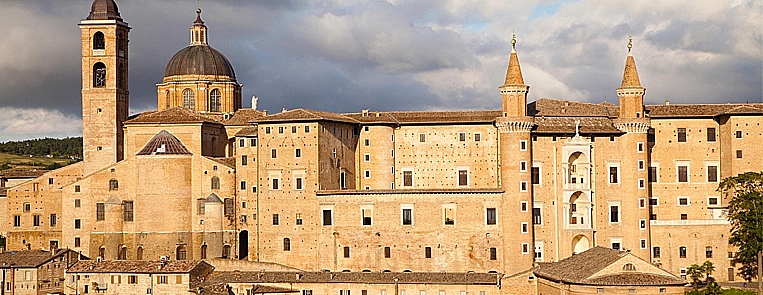
Federico’s palace was conceived as an argument in brick and stone: that power could be humane. From the 1460s the Dalmatian architect Luciano Laurana raised the celebrated facade of the torricini, twin slender towers embracing stacked loggias that gaze across the valley, and the serene arcaded courtyard that remains a touchstone of Renaissance proportion. Francesco di Giorgio Martini of Siena continued the work, weaving in ramps, stables, cisterns, and services so advanced the building functioned like a small city.

Within, the duke built the most refined interior of his century. The studiolo, his private study, was lined with intarsia panels whose inlaid woods conjure cabinets, books, scientific instruments, and even a squirrel in flawless illusionistic perspective, a portrait of the Renaissance mind rendered in timber. His library gathered one of Europe’s great manuscript collections, produced by teams of scribes and illuminators and reckoned second only to the Vatican’s, which later absorbed it.

Around the palace, painters defined the court’s image. Piero della Francesca worked here and left the Flagellation and the Senigallia Madonna, Pedro Berruguete and Justus of Ghent painted the duke and his scholars, and the mathematician Luca Pacioli and the architect-painter tradition that shaped Bramante, born nearby at Fermignano, all drew on Urbino’s air. Castiglione’s later phrase, a city in the form of a palace, simply described what visitors could see.

What Happened to Urbino After the Montefeltro?

Federico died in 1482, and his son Guidobaldo, frail in body but cultivated in mind, presided with Duchess Elisabetta Gonzaga over the court’s silver age, the era of the conversations Castiglione immortalized in The Book of the Courtier. It was a precarious brilliance: Cesare Borgia seized the duchy briefly in 1502, and Guidobaldo died childless in 1508, passing Urbino to his nephew Francesco Maria I della Rovere.

Under the della Rovere dukes the duchy endured another century and a quarter, producing a final artistic flowering in Federico Barocci, whose luminous altarpieces influenced painting across Italy, and sustaining the majolica workshops of Casteldurante and Urbania whose painted ceramics graced courts throughout Europe. The dukes, however, increasingly favored Pesaro on the coast, and Urbino’s political weight slowly drained downhill.

In 1631 the last della Rovere duke died without a male heir and the duchy devolved to the Papal States, taking with it the famous library, transferred to the Vatican, and the duchy’s independence. It was the end of Urbino as a capital, and the beginning of its long, preserving sleep. For travelers, that ending explains the city’s miracle: because power left, the Renaissance stayed.

How Did Urbino Pass the Papal Centuries and Join Modern Italy?

Papal Urbino was a quiet provincial city, and the quiet proved to be a gift. With no court to rebuild it and no industry to redraw it, the Renaissance city survived nearly intact, its palace, walls, and lanes passing the centuries essentially as the dukes left them. The university, refounded and sustained through the papal era, kept learning alive within the walls, and the city’s proudest moment came in 1700, when Gianfrancesco Albani of Urbino was elected Pope Clement XI and showered his hometown with commissions, scholarship, and prestige.

The earthquake of 1789 damaged the cathedral, which Giuseppe Valadier rebuilt in the confident neoclassical form travelers see today. The Napoleonic decades briefly folded Urbino into revolutionary republics and kingdoms, and in 1860 the city joined the new Kingdom of Italy with the rest of the Marche, a provincial chapter in the national story that left its fabric untouched.

The Second World War gave the region a heroic chapter. Pasquale Rotondi, the young art superintendent based in Urbino, secretly gathered thousands of masterpieces from across Italy, works by Giorgione, Titian, and Piero della Francesca among them, and hid them in the Montefeltro, above all in the fortress of Sassocorvaro, saving an irreplaceable share of the nation’s art from the conflict. The story, little known for decades, is now honored as one of Italian conservation’s finest hours.

The twentieth century also brought a renaissance of a different kind. Under the long postwar rectorship of Carlo Bo, the university grew into the city’s modern lifeblood, and the architect Giancarlo De Carlo threaded acclaimed university buildings into and around the historic fabric with a sensitivity that became a model studied worldwide. In 1998 UNESCO inscribed the historic center as a World Heritage Site, recognizing both the Renaissance masterpiece and its remarkable preservation.

Which Places Bring Urbino's History to Life Today?

The Palazzo Ducale is the great archive: the courtyard and grand staircase announcing the new age, the studiolo holding the duke’s mind in inlaid wood, the throne room and duchess’s apartments carrying the court’s daily theater, and the Galleria Nazionale delle Marche hanging the era’s paintings in the rooms that commissioned them. Below, the palace’s underground services, kitchens, baths, cisterns, and stables, reveal the machine beneath the elegance.

The wider city fills in the centuries. The Oratorio di San Giovanni Battista preserves the Salimbeni brothers’ frescoes of 1416 from the era before the golden age, Raphael’s birthplace documents the court’s artistic seedbed, the church of San Bernardino outside the walls holds the tombs of dukes Federico and Guidobaldo in a serene Renaissance mausoleum attributed to Francesco di Giorgio, and the Fortezza Albornoz recalls the papacy’s fourteenth-century grip on the region.

The duchy’s history also continues beyond the walls. The Montefeltro’s fortress towns, San Leo on its crag, Gradara with its lovers’ legend, and Sassocorvaro’s tortoise-shaped stronghold designed by Francesco di Giorgio, extend the ducal story across the landscape that produced it, each within an easy drive of the city.

Sequence matters as much as selection. We compose history-focused days that move chronologically, from the oratories through the palace to the della Rovere and papal city, with historians who can repopulate each room as you stand in it. Three centuries of drama unfold within a few hundred walkable meters, which is precisely what makes Urbino so rewarding for travelers who love the past.

How Is Urbino Preserving Its Heritage?

Urbino’s preservation is itself historic. UNESCO’s 1998 inscription recognized a Renaissance city that survived essentially whole, and the stewardship around it runs deep: the Galleria Nazionale delle Marche conserves and studies the ducal collections, the Accademia Raffaello has guarded the painter’s birthplace and legacy since 1873, and the university sustains institutes devoted to the duchy’s art, books, and history.

The modern city has learned to grow without overwriting itself. De Carlo’s university architecture demonstrated how contemporary design can serve a historic center rather than compete with it, restoration workshops maintain everything from intarsia to fresco, and the surrounding Montefeltro protects the agricultural landscape that frames every view from the palace loggias, the same hills that fill the backgrounds of Piero’s paintings.

For travelers, this means the past here is unusually intact and unusually welcoming. We arrange encounters with the preservation world itself where access allows, from restoration studios to library collections, as part of our cultural tours, and we pair Urbino with the fortress towns and painted churches of the Montefeltro so the duchy’s whole story unfolds across its actual landscape. History in Urbino is a working enterprise, and meeting its custodians is one of the city’s quiet privileges.

Ready to Begin Planning Your Urbino Vacation?

Urbino deserves more than a template. Since 2003, Trips 2 Italy has designed private Italian vacations one traveler at a time, hand selecting every experience based on what you tell us rather than fitting you into a predefined package. Our Italian-born team plans Urbino with the knowledge of people who call Italy home, from the twin towers of the Palazzo Ducale to the quiet hill roads of the Montefeltro, and we remain at your side throughout your trip with 24/7 assistance. Tell us how you imagine Urbino, and we will craft the itinerary that matches it.

Explore Our Urbino Vacation Itineraries

Frequently Asked Questions About the History of Urbino

Federico da Montefeltro, 1422 to 1482, was Italy’s most successful soldier for hire and, from 1474, Duke of Urbino. He spent his battlefield earnings on wisdom, building the Palazzo Ducale, assembling a library reckoned second only to the Vatican’s, and gathering artists and scholars into the model court of the Renaissance. His broken-nosed left profile, painted by Piero della Francesca, remains the era’s emblem.

Begun in the 1460s under Luciano Laurana and continued by Francesco di Giorgio Martini, the palace redefined what a ruler’s residence could be: humane, luminous, and so complete in its services that Castiglione called it a city in the form of a palace. Its studiolo, lined with illusionistic intarsia, is among the most extraordinary rooms of the Renaissance, and the palace now houses the Galleria Nazionale delle Marche.

Yes. Baldassare Castiglione set his dialogues in the evening gatherings of the Urbino court of Duke Guidobaldo and Duchess Elisabetta Gonzaga, where he served in the early 1500s. Published in 1528, the book carried Urbino’s ideal of grace, learning, and courtesy to every court in Europe, and visitors can stand in the palace rooms where the conversations were set.

The duchy passed from the Montefeltro to the della Rovere dukes in 1508 and devolved to the Papal States in 1631, when the famous library went to the Vatican. Centuries of quiet papal rule preserved the Renaissance city nearly intact, and in 1998 UNESCO inscribed the historic center as a World Heritage Site.

UNESCO recognized the historic center in 1998 because Urbino represents an exceptional surviving example of a Renaissance city, transformed during Federico da Montefeltro’s rule into a complete cultural creation whose palace, urban fabric, and surrounding landscape remain remarkably authentic. Its influence on European art and architecture radiated far beyond the Marche.

Yes. The church of San Bernardino, a serene Renaissance mausoleum attributed to Francesco di Giorgio Martini just outside the walls, holds the tombs of dukes Federico and Guidobaldo da Montefeltro, with a celebrated view back toward the palace’s twin towers. Trips 2 Italy includes it in history-focused itineraries with historians who bring the ducal story to life.