

A Taste of Tuscany Tour | Vacation Packages for 2025 – 2026
Experience Monteriggioni, Siena and Chianti as you savor Tuscan wines, cook local cuisine and explore medieval towns in Italy’s countryside. Starting from $1,944 per person.
HOME » POPULAR ITALIAN DESTINATIONS » MONTALCINO TRAVEL GUIDE » MONTALCINO HISTORY GUIDE
About this guide: This guide to the history of Montalcino was written by the Italian-born travel specialists at Trips 2 Italy, a custom tour operator that has designed hand-crafted Italian vacations since 2003. Every recommendation below reflects the same first-hand knowledge our team draws on when we build a private Montalcino itinerary around a traveler’s interests, dates, and pace. Read it for your research, then let us translate it into a trip designed entirely around you.
The hill of Montalcino has watched over the Orcia and Ombrone valleys since long before the town existed. The Etruscans farmed and fortified these ridges of southern Tuscany, and finds from their settlements surface across the territory and in the town’s museum collections. The name itself is a landscape record: Mons Ilcinus, the mount of holm oaks, after the dark evergreens that still crown the hill, and a pair of holm oak branches figures on the town’s coat of arms to this day.
The documented story gathers pace in the early Middle Ages around Sant’Antimo. The great abbey in the valley below, credited by legend to Charlemagne in 781 and endowed by his son Louis the Pious, became one of the most powerful monastic houses in central Italy, controlling lands across the region. The hilltop settlement grew in its orbit, populated in part, tradition holds, by families seeking refuge from raids on the coast and the lowlands.
By the twelfth and thirteenth centuries Montalcino had matured into a walled commune with its own councils, churches, and quarrels. Its position mattered: the town stood beside the Via Francigena’s southern Tuscan corridor, the pilgrimage road that carried travelers, trade, and news between northern Europe and Rome, and whoever held the hill controlled a piece of that artery. Larger powers noticed, and the town’s location soon placed it in the middle of one of history’s great urban rivalries.
For three medieval centuries, Montalcino’s history was written by its position between Siena and Florence, the two great rivals of Tuscany. The town changed alignments more than once as the balance of power shifted, and it paid for its independence in sieges: Sienese armies invested the hill repeatedly through the thirteenth century as Siena moved to secure the roads and territories south of the city.
The decisive century was the fourteenth. After 1361, Montalcino passed definitively into the Sienese state, and Siena, valuing the hill as the southern anchor of its republic, built the great pentagonal fortress at the town’s highest point that same decade. Sienese governance brought institutions, patronage, and art: the gold-ground painters of the Sienese school worked for the town’s churches and confraternities, and the civic buildings around the Piazza del Popolo took the forms they largely keep today.
Life under the republic tied Montalcino’s identity permanently to Siena’s. The town supplied soldiers, grain, wine, and loyalty, and absorbed in return the Sienese civic religion of the common good, the conviction that a small state governed well was worth defending against any odds. That conviction was about to be tested more severely than anyone could have imagined.
The fortress of Montalcino rose in 1361, commissioned by Siena to crown its newly secured southern stronghold. Its builders worked with pragmatic speed, incorporating earlier towers and a stretch of the existing walls into a pentagonal circuit with commanding corner bastions, and the result was less a castle for a lord than a war machine for a republic: a garrison point, an arsenal, and a refuge of last resort for the town within its walls.
For two centuries the fortress did its work quietly, projecting Sienese authority over the valleys and the road south. Its supreme test came in the 1550s, when the wars between France, the Empire, and the Italian states swept into Tuscany. Montalcino endured a punishing siege by imperial forces in 1553, its defenders and citizens holding the walls for months until the attacking army withdrew, an ordeal the town survived with its fortifications, and its reputation, intact.
That resistance set the stage for the fortress’s most extraordinary chapter, as the shelter of a government in exile. Today its ramparts are a belvedere rather than a battlement, open to visitors and crowned with some of the finest views in the Val d’Orcia, and its courtyard hosts concerts and festivals. Walking the walls with a guide who can repopulate them, sentries, besiegers, and refugees, is one of the most vivid historical experiences we arrange in southern Tuscany.
In April 1555, after a siege of terrible length and famine, the Republic of Siena surrendered to the armies of Florence and imperial Spain. But the republic did not die in Siena. Several hundred families of Sienese citizens, unwilling to live under Medici rule, marched south with what remained of their government and their French allies and installed themselves in Montalcino, whose fortress and loyalty they trusted absolutely.
For four years the Republic of Siena Retired to Montalcino functioned as a sovereign state in miniature: it held councils, minted coinage, maintained garrisons, and governed the surrounding territory from the hilltop, defying the new order in Tuscany while the great powers fought on. The town absorbed the exiles and their cause as its own, and the fortress that Siena had built two centuries earlier now sheltered the republic itself.
The end came by treaty rather than assault. The peace of Cateau-Cambresis in 1559 settled the wars between France and Spain, and the little republic on the hill was ceded to the Medici state, later absorbed into the Grand Duchy of Tuscany. Yet the four years of defiance earned Montalcino a permanent place in Sienese memory: at every Palio, the banner of the Republic of Siena in Montalcino still leads the historical procession in the place of honor.
The centuries under the grand duchy and the new Italian kingdom were not kind to Montalcino. The town settled into agricultural remoteness, and by the middle of the twentieth century it was among the poorer communities of Siena’s province, its sharecropping families working land whose true wealth no one yet suspected. The transformation, when it came, grew from a scientific insight of the nineteenth century.
In the 1860s and 1870s, the Montalcino landowner and pharmacist Clemente Santi began isolating and championing a particular strain of Sangiovese suited to the hill’s dry slopes, and his grandson Ferruccio Biondi Santi carried the work to its conclusion, bottling from the 1888 harvest a wine made purely from that clone and built for long aging. That wine, Brunello, was a radical act in an era of light, blended, quickly drunk reds, and for decades it remained a local secret of almost private production.
The twentieth century turned the secret into a standard. Brunello di Montalcino earned DOC recognition in 1966, its producers founded their consortium in 1967, and in 1980 it became the first wine in Italy granted DOCG status, the state’s highest guarantee. Prosperity followed on a scale the town had never known, and the poorest hill in the province became one of the most celebrated wine territories on earth, all within a single lifetime.
The human texture of that transformation is still visible. Families who sharecropped these slopes two generations ago now steward estates known on every continent, abandoned farmhouses have been restored as cellars and country homes, and the town’s population has held steady where so many rural communities emptied. Travelers who taste in the cellars are often hearing the story from the very families who lived its turning point, which is what makes wine touring here feel like oral history.
The fortress is the great primary source, its 1361 walls, incorporated towers, and rampart walk narrating the Sienese centuries at a glance, while the view from the top explains the town’s strategic logic better than any book. Below it, the medieval streets descend past the Palazzo dei Priori, its facade studded with the coats of arms of centuries of governors, to the Piazza del Popolo, the stage of the town’s civic life since the commune’s earliest days.
The Musei di Montalcino, housed beside Sant’Agostino in a former convent, gather the artistic evidence: Etruscan finds from the surrounding hills, gold-ground panels by masters of the Sienese school, and polychrome wooden sculptures of startling presence. They repay an unhurried hour, ideally with a guide who can connect the paintings to the confraternities and churches they were made for.
Sant’Antimo completes the record, carrying the story back past the commune to Charlemagne’s age, and the countryside itself is a document: the sharecropping farmhouses, the terraced slopes, and the estate cellars, some centuries old, that hold the Brunello chapter. We compose history-focused days that read these places in sequence, from abbey to fortress to cellar, often as part of our cultural tours of Italy, with specialists who make eleven centuries feel like one continuous story.
Montalcino’s past is protected today by an unusual alliance of law, landscape, and wine. The inscription of the Val d’Orcia as a UNESCO World Heritage cultural landscape in 2004 recognized the valley, of which Montalcino forms the western gate, as a masterpiece of Renaissance land management, and strict planning rules now govern what can be built and how the countryside may change. The view from the fortress is, in a real sense, a listed monument.
Wine wealth has proved a faithful custodian. Brunello’s prosperity funds the restoration of farmhouses, churches, and walls that poverty once left untouched, and the producers’ consortium ties the wine’s identity explicitly to the integrity of the territory it comes from. The historic quarters maintain their traditions, the museums have been renewed, and the town has grown famous without growing large, keeping its population and its proportions.
For travelers, the result is a place where history is not curated into exhibits but present in working form: a fortress that hosts festivals, an abbey that still sings, cellars whose barrels age beneath medieval vaults. We arrange encounters with the people who maintain that continuity, from restorers to archivists to the families of the estates, because meeting the custodians is the deepest way to understand what has been kept.
Montalcino deserves more than a template. Since 2003, Trips 2 Italy has designed private Italian vacations one traveler at a time, hand selecting every experience based on what you tell us rather than fitting you into a predefined package. Our Italian-born team plans Montalcino with the knowledge of people who call Italy home, from the Brunello cellars beneath the vineyards to the cypress roads of the Val d’Orcia, and we remain at your side throughout your trip with 24/7 assistance. Tell us how you imagine Montalcino, and we will craft the itinerary that matches it.
Experience Monteriggioni, Siena and Chianti as you savor Tuscan wines, cook local cuisine and explore medieval towns in Italy’s countryside. Starting from $1,944 per person.
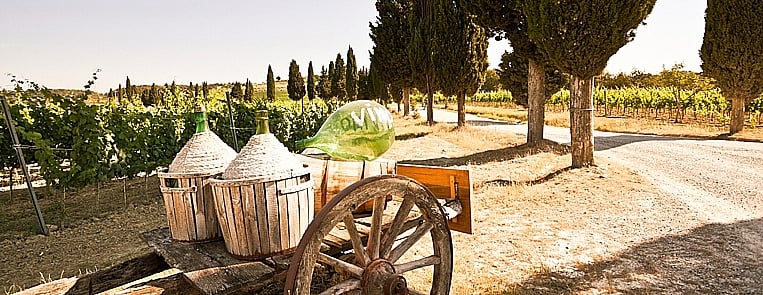
The prestigious Brunello wine is the focus of this private driving tour, as you're escorted to the best wineries in the region, for tastings and tours.
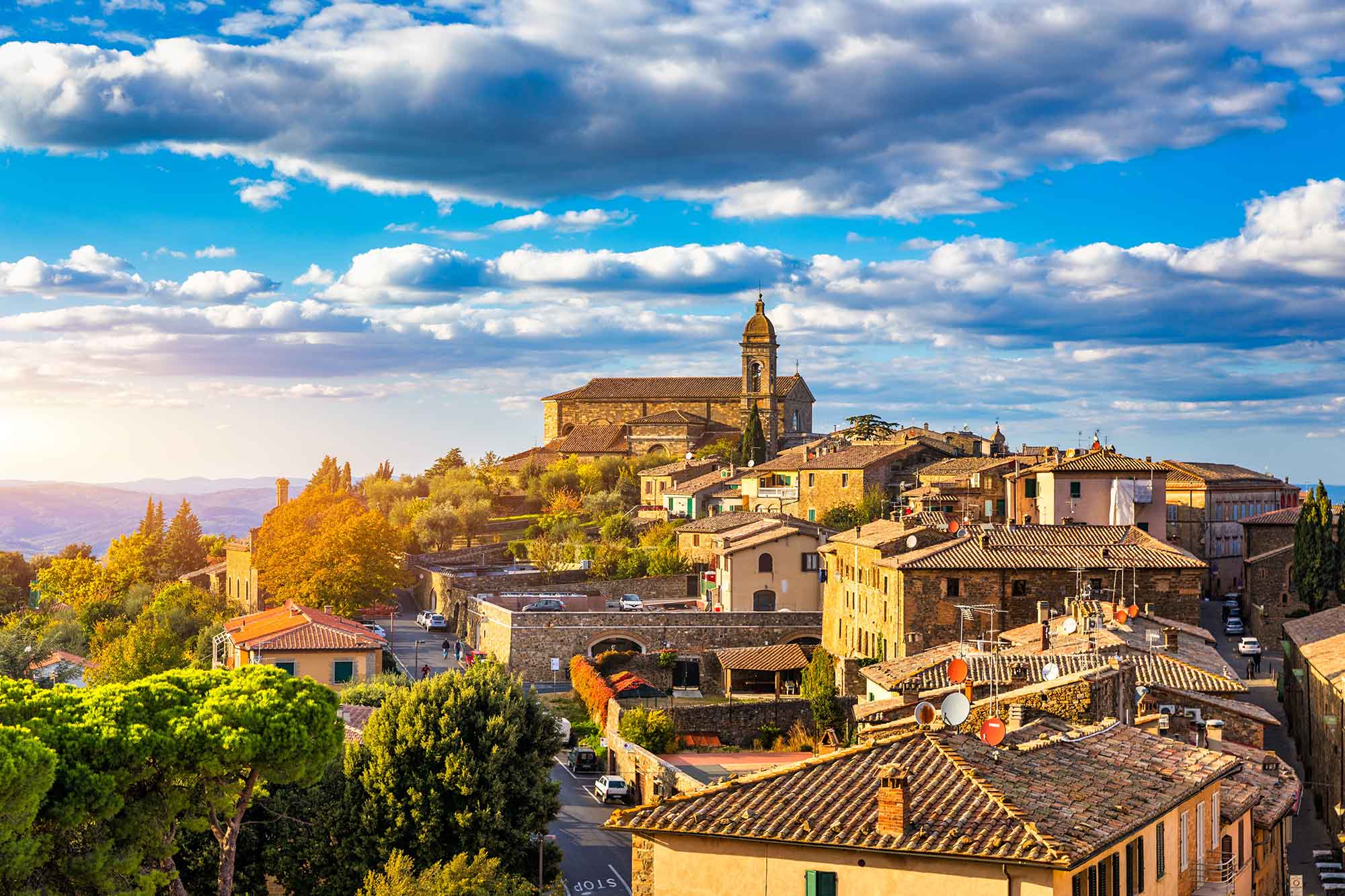
Taste the world renowned wine Brunello and enjoy the unparalleled sight of the Tuscan countryside as we tour the wineries of Montalcino.
Montalcino is remembered as the last stronghold of the Republic of Siena, sheltering the exiled Sienese government from 1555 to 1559 after Siena fell to Florence and Spain. Its 14th-century fortress, built by Siena in 1361, and its medieval center preserve that era intact, and in modern times the town made history again as the birthplace of Brunello, the first Italian DOCG wine.
The pentagonal fortress was built in 1361, immediately after Montalcino passed definitively under Sienese rule, incorporating earlier towers and stretches of the town walls. It withstood an imperial siege in 1553 and sheltered the exiled Sienese republic from 1555 to 1559. Today visitors can walk its ramparts for sweeping views over the Val d’Orcia, and its courtyard hosts concerts and festivals.
After Siena surrendered in 1555, hundreds of Sienese families refused Medici rule and moved their government to Montalcino, where the Republic of Siena Retired to Montalcino governed as a sovereign state for four years, minting coins and holding councils. It ended with the treaty of Cateau-Cambresis in 1559, and Siena still honors the town’s loyalty in the Palio’s historical procession.
The foundations were laid in the nineteenth century by Clemente Santi, who identified a superior strain of Sangiovese on the family estate, and his grandson Ferruccio Biondi Santi, who bottled the first recognizably modern Brunello from the 1888 harvest. The wine earned DOC status in 1966 and in 1980 became the first DOCG in Italy, transforming the town’s fortunes within a generation.
Legend attributes the abbey’s founding to Charlemagne in 781, and it is documented from the early ninth century under his son Louis the Pious. The present Romanesque church was begun in the early twelfth century and is considered one of the finest in Italy. Trips 2 Italy arranges visits timed to the abbey’s sung offices whenever schedules allow.
Yes, and it transforms the experience. Trips 2 Italy pairs travelers with historians and licensed guides who walk the fortress ramparts, the museums, and Sant’Antimo in narrative sequence, connecting the Etruscans, the Sienese republic, and the birth of Brunello into one story. We often pair Montalcino with Siena itself so the two halves of the republic’s history complete each other.