
A Taste of Tuscany Tour | Vacation Packages for 2025 – 2026
Experience Monteriggioni, Siena and Chianti as you savor Tuscan wines, cook local cuisine and explore medieval towns in Italy’s countryside. Starting from $1,944 per person.
HOME » POPULAR ITALIAN DESTINATIONS » MONTALCINO TRAVEL GUIDE » MONTALCINO THINGS TO DO GUIDE
Montalcino Travel Guide Culture History Food and Wine Things to Do Plan My Trip
About this guide: This guide to things to do in Montalcino was written by the Italian-born travel specialists at Trips 2 Italy, a custom tour operator that has designed hand-crafted Italian vacations since 2003. Every recommendation below reflects the same first-hand knowledge our team draws on when we build a private Montalcino itinerary around a traveler’s interests, dates, and pace. Read it for your research, then let us translate it into a trip designed entirely around you.
Start at the top, literally. The 14th-century fortress crowns the town, and the walk around its ramparts is the essential first act of any visit to this corner of Tuscany: a full circle of views across the Val d’Orcia, the Orcia and Ombrone valleys, and the long blue profile of Monte Amiata, with the town’s rooftops stacked below. Few vantage points in the region explain a landscape so completely in fifteen minutes.
From the fortress, the main street descends through the medieval town to the Piazza del Popolo, where the slim tower of the Palazzo dei Priori and the arches of the loggia frame one of Tuscany’s most charming small squares. Pause at the historic caffe founded in 1888, then continue to the Musei di Montalcino for its Sienese gold-ground paintings and wooden sculptures, and to the belvedere by the Madonna del Soccorso for the northern panorama.
The rhythm matters as much as the list. Montalcino’s magic concentrates in the early morning and the late afternoon, when day visitors are absent and the light works its alchemy on stone and vineyard. We sequence town days around those hours, placing museums and cellars in the middle of the day and keeping the walls, the lanes, and the views for the times when travelers have them nearly to themselves.
Allow time, too, for the town’s smaller sanctuaries and churches: Sant’Agostino with its fresco fragments beside the museums, Sant’Egidio, built by the Sienese in the fourteenth century and known as the church of the republic, and the neoclassical Duomo of San Salvatore on the site of the town’s oldest parish. None demands more than a quarter of an hour, and together they thread the town’s nine centuries into a single morning’s walk.
A composed day in Brunello country is the experience travelers cross oceans for: two or three estates chosen for contrast, a walk in the vines to read altitude and exposure, barrel cellars cool beneath old stone, and tastings poured by the people whose name is on the label. Done well, the day builds like a narrative, each estate answering the last, with a long lunch among the vineyards at its center.
The town itself completes the education. Montalcino’s enotecas, including the one installed inside the fortress walls, gather hundreds of labels in one place, ideal for comparing the hill’s quadrants side by side before or after the estate visits, and the wine shops along the main street pour by the glass with real expertise. In winter, the annual presentation of the new vintages turns the whole town into a tasting room.
We compose these days personally, drawing on relationships with estates built since 2003 and matching each visit to the traveler’s palate, from first-timer to collector. A private driver is part of the design, so the gravel roads and cypress avenues between cellars become the scenery of the day rather than its logistics, and every glass can be enjoyed without a second thought.
Ten kilometers south of town, the Romanesque abbey of Sant’Antimo stands alone among olive groves and cypresses, pale travertine glowing against the wooded hills. Founded, legend says, by Charlemagne in 781 and rebuilt in the twelfth century, it is one of the most beautiful churches in Italy, and its isolation is part of the experience: no town, no clamor, just fields, stone, and light that changes by the hour. Arrive in the first hours of the morning or toward closing time and you may share the whole valley with birdsong alone.
The interior rewards unhurried attention, from the alabaster-veined columns to the carved capitals, and when the religious community sings the offices in Gregorian chant, the nave becomes one of the most moving rooms in Tuscany. Outside, walking paths connect the abbey to the village of Castelnuovo dell’Abate and up through vineyards toward Montalcino itself, a route walkers remember for the rest of their lives.
We arrange Sant’Antimo as it deserves: timed to the sung offices when schedules allow, paired with a guide who unfolds its thousand years of history, and combined with an estate visit or countryside lunch nearby so the day flows naturally. For travelers who enjoy walking, we design the abbey as the destination of a guided vineyard walk with a private transfer waiting at the end.
Montalcino is the western gate of the Val d’Orcia, the UNESCO-listed valley whose cypress avenues, lone farmhouses, and sculpted wheat hills form the most photographed countryside in Italy. From the town, ridge roads descend east toward San Quirico d’Orcia and Pienza, and every kilometer offers the compositions travelers know from calendars and films: the chapel with its paired cypresses, the winding white roads, the farmhouse crowning its bare hill.
Light is everything here, and the valley belongs to those who meet it early and late. Dawn brings mist pooling between the hills with towers rising above it; the golden hour before sunset turns the whole valley to amber. With a private driver who knows the viewpoints, a morning or evening circuit becomes a moving gallery with stops exactly where they matter, and photographers can be positioned before the light arrives rather than after.
For the full romance, a hot air balloon flight at dawn floats over vineyards, abbeys, and the fortress itself as the valley wakes below, one of the most requested experiences we arrange in southern Tuscany. Walkers and cyclists have their versions too: quiet stretches of the Via Francigena and vineyard lanes where the valley unrolls at a pace no window can match.
Pienza sits half an hour east, the pocket-sized city a humanist pope rebuilt in the 1460s as the ideal Renaissance town, its cathedral square a perfect stage set and its lanes fragrant with the pecorino the town ages in every cellar. It pairs naturally with San Quirico d’Orcia, whose Romanesque collegiate church and Renaissance gardens reward a quiet hour, and with Bagno Vignoni, the extraordinary village whose main piazza is a steaming Renaissance thermal pool.
Montepulciano, the other great wine town of the south, rises forty minutes away, its Renaissance palaces climbing to a hilltop piazza above cellars carved deep into the rock, home of Vino Nobile and a natural counterpart to a Brunello-focused stay. Siena itself is under an hour north, and its Campo, cathedral, and contrade complete the history a traveler begins in Montalcino, the story of the republic and its last stronghold.
The art of the day trip is restraint and sequence: one destination per day, timed against the light and the crowds, with the return to Montalcino planned for the golden hour on the ridge roads. We compose these excursions with a private driver and, where they add depth, local guides, so each town arrives as a story rather than a stop.
For travelers with more time, the reach extends further: the abbey of Monte Oliveto Maggiore with its great fresco cloister lies just beyond the crete to the north, the thermal terraces of Bagni San Filippo steam on Monte Amiata’s flank to the south, and even Florence is close enough for a dedicated art day. We advise on which extensions genuinely reward the drive from a Montalcino base and which are better woven into another chapter of the journey.
Beyond the fortress and the famous cellars, the territory keeps pleasures most visitors never find. North and east lie the crete of San Giovanni d’Asso, part of Montalcino’s own comune, a lunar landscape of clay hills that hides one of Tuscany’s great secrets: white truffles, celebrated with a museum in the village castle and a market each November. A truffle hunt here, following the dogs through oak woods with a lifelong hunter, is as memorable as any tasting.
South rises Monte Amiata, the ancient volcano whose chestnut forests shade walking trails, hermitages, and stone villages that feel a century removed from the wine roads below. In between, the countryside offers small discoveries at every turn: Romanesque parish churches alone among the fields, beekeepers’ honey houses, shepherds’ dairies where pecorino is still made by hand, and belvederes without a single tour bus.
These quieter threads are where a custom itinerary earns its keep. We weave them between the marquee experiences, a truffle morning after a wine-focused day, a mountain walk before a festival evening, as part of our active trips in Italy for travelers who like their landscapes earned. The Montalcino our guests describe most fondly is usually the one found on these detours.
Evening is Montalcino’s finest hour. Day visitors drain away, the light turns the Val d’Orcia to gold below the walls, and the town returns to itself: the passeggiata along the main street, an aperitivo in the Piazza del Popolo, and dinner in a stone-vaulted room where the wine list runs deeper than most capital cities can manage. Travelers who overnight here understand the town in a way no day trip permits.
The festival calendar concentrates the experience. July’s Jazz and Wine series fills the fortress courtyard with music under the stars; September brings the national honey week and the first stirrings of harvest; late October delivers the Sagra del Tordo, when the four quarters parade in medieval costume and compete at the archery butts below the fortress while the town feasts. Each transforms an evening into a memory with a date attached.
We build evenings deliberately: festival seats and banquet tables arranged in advance, sunset placed on the ramparts or a westward terrace, and dinners reserved where the kitchen matches the occasion. For travelers composing a larger journey, these Montalcino nights become the slow, glowing counterpoint to the great cities within a custom trip to Italy designed entirely around you.
Montalcino deserves more than a template. Since 2003, Trips 2 Italy has designed private Italian vacations one traveler at a time, hand selecting every experience based on what you tell us rather than fitting you into a predefined package. Our Italian-born team plans Montalcino with the knowledge of people who call Italy home, from the Brunello cellars beneath the vineyards to the cypress roads of the Val d’Orcia, and we remain at your side throughout your trip with 24/7 assistance. Tell us how you imagine Montalcino, and we will craft the itinerary that matches it.
Experience Monteriggioni, Siena and Chianti as you savor Tuscan wines, cook local cuisine and explore medieval towns in Italy’s countryside. Starting from $1,944 per person.
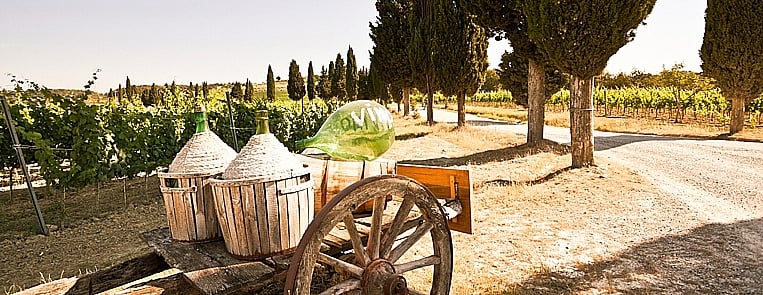
The prestigious Brunello wine is the focus of this private driving tour, as you're escorted to the best wineries in the region, for tastings and tours.
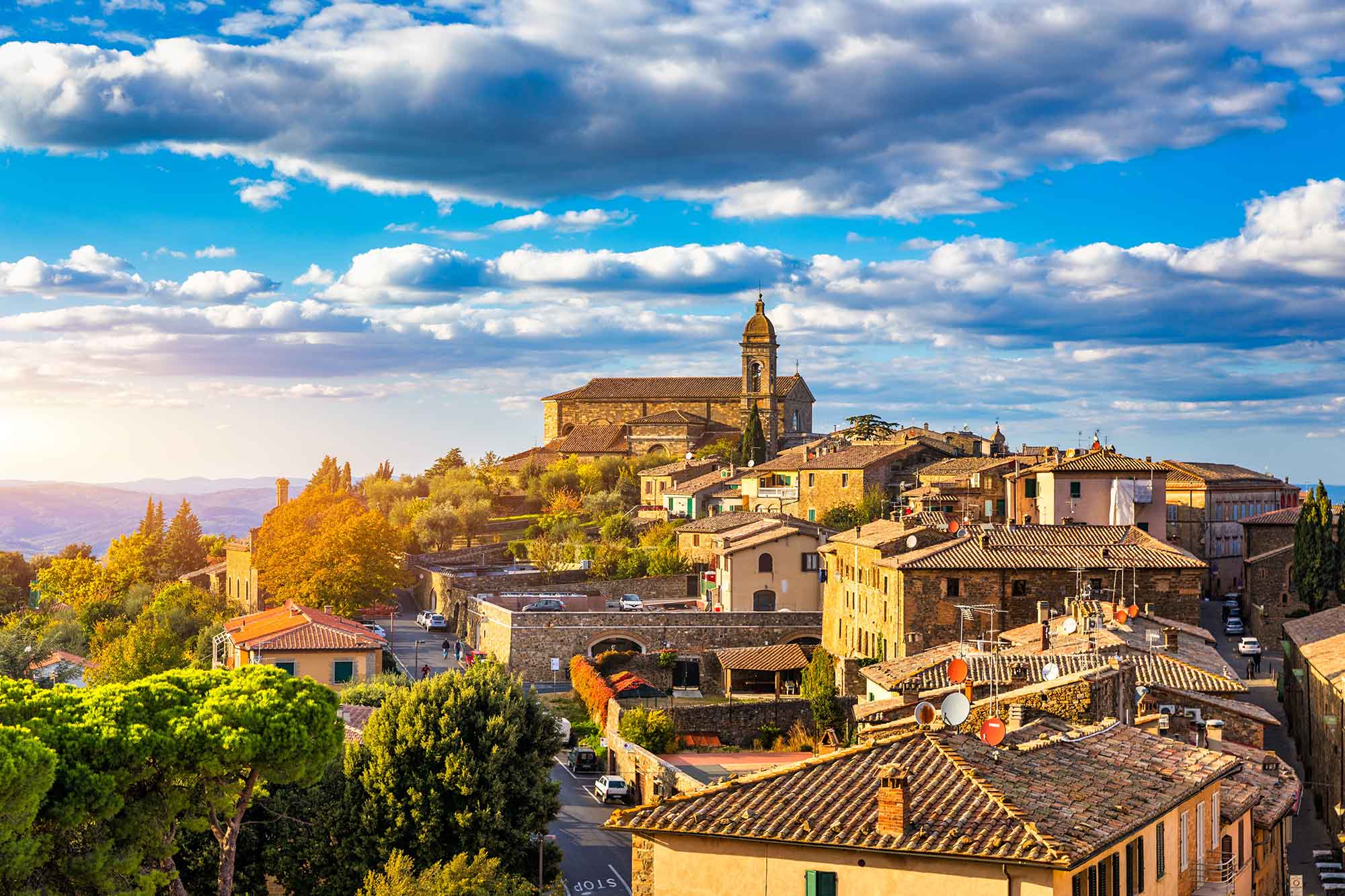
Taste the world renowned wine Brunello and enjoy the unparalleled sight of the Tuscan countryside as we tour the wineries of Montalcino.
Walk the ramparts of the 14th-century fortress, linger in the Piazza del Popolo, visit the Musei di Montalcino, taste Brunello at family estates and the town’s enotecas, hear Gregorian chant at the abbey of Sant’Antimo, and drive the Val d’Orcia’s cypress roads at golden hour. Trips 2 Italy sequences these around the light and the seasons so each arrives at its best.
Yes. The ramparts of the 1361 fortress are open to visitors, and the circuit delivers panoramic views over the town, the Val d’Orcia, and Monte Amiata. The courtyard below hosts an enoteca and, in summer, the Jazz and Wine festival, making the fortress both the historical and social heart of the town.
Emphatically yes. The Romanesque abbey, ten kilometers south of town among olive groves, is one of the most beautiful churches in Italy, founded by legend under Charlemagne and rebuilt in the twelfth century. When the offices are sung in Gregorian chant the experience is unforgettable, and we time visits to the schedule whenever possible.
Pienza, San Quirico d’Orcia, and the thermal piazza of Bagno Vignoni all lie within half an hour, Montepulciano within forty minutes, and Siena under an hour north. Trips 2 Italy composes one-destination days with a private driver, timed against the crowds and returning along the Val d’Orcia’s ridge roads at golden hour.
Montalcino’s great autumn festival takes place the last weekend of October, when the four historic quarters compete in a costumed archery tournament below the fortress, with processions, drummers, and communal feasts. A companion tournament, the Apertura delle Cacce, is held each August. We arrange viewing and banquet access for travelers visiting in season.
Exceptional. The town commands the western Val d’Orcia, whose cypress avenues, lone farmhouses, and dawn mists are the most photographed countryside in Italy, and the fortress ramparts and belvederes offer elevated panoramas in every direction. We arrange dawn and golden-hour circuits with drivers who know the classic viewpoints and the quiet ones.