Things To Do in Emilia Romagna

HOME » POPULAR ITALIAN DESTINATIONS » ITALIAN TRAVEL GUIDES BY REGION » EMILIA ROMAGNA TRAVEL GUIDE » EMILIA ROMAGNA THINGS TO DO GUIDE

Emilia Romagna Travel Guide        Culture        History        Food and Wine        Things to Do        Plan My Trip

About this guide: This guide to things to do in Emilia Romagna was written by the Italian-born travel specialists at Trips 2 Italy, a custom tour operator that has designed hand-crafted Italian vacations since 2003. Every recommendation below reflects the same first-hand knowledge our team draws on when we build a private Emilia Romagna itinerary around a traveler’s interests, dates, and pace. Read it for your research, then let us translate it into a trip designed entirely around you.

What Belongs at the Top of Every Emilia Romagna Itinerary?

Bologna first. Climb the 498 wooden steps of the Asinelli tower for the terracotta panorama, then descend into the city that earns it: Piazza Maggiore with the vast unfinished facade of San Petronio, the Fountain of Neptune, the medieval food streets of the Quadrilatero, and the Archiginnasio, where the university’s centuries are painted on the walls above Europe’s most striking anatomical theater. Reserve one walk for the porticoes themselves, ideally the 666-arch climb to the Sanctuary of San Luca.

Ravenna follows as the region’s other unmissable day: the Basilica of San Vitale, the Mausoleum of Galla Placidia, Sant’Apollinare Nuovo, and Dante’s tomb, all within a compact, walkable center. Then choose by appetite: Modena for the Romanesque cathedral and the Motor Valley, Parma for Correggio’s domes and the food hills, Ferrara for the castle and the Renaissance streets.

This is where planning shows its value. We arrange knowledgeable guides who turn mosaics and towers into stories, time each city for its best hours, and thread the days along the Via Emilia so nothing feels rushed. The region’s marquee sights are blessedly calm by Italian standards, and a well-sequenced itinerary keeps them that way.

Give Bologna more than a checklist. The city changes character by the hour, scholarly in the morning, convivial by aperitivo time, and travelers who return to Piazza Maggiore at different points of the day understand why residents never tire of it. We build unstructured hours into every Bologna day on purpose, because under the porticoes they are where the city does its quiet work.

Why Is a Day Among Ravenna's Mosaics Unforgettable?

Nothing in Italy prepares travelers for the moment the eyes adjust inside the Mausoleum of Galla Placidia and nine hundred golden stars emerge from the deep blue vault. Ravenna’s mosaics are not fragments behind glass; they are entire rooms of the fifth and sixth centuries, intact, luminous, and still doing exactly what their makers intended. San Vitale’s imperial portraits of Justinian and Theodora, the white-robed processions of Sant’Apollinare Nuovo, and the green paradise of Sant’Apollinare in Classe complete a single, astonishing day.

The art rewards expertise more than almost any site in Italy, because every panel is an argument in glass: imperial politics, theology, and craft compressed into images of extraordinary beauty. With a specialist guide reading the iconography, the mosaics stop being decoration and become the most vivid surviving voice of late antiquity.

We compose Ravenna days with exactly such specialists, sequence the monuments to build the story chronologically, and add the workshops where the mosaic craft is still practiced, including hands-on sessions for travelers who want to set tesserae themselves. Paired with a piadina lunch and, in summer, an evening concert of the Ravenna Festival, it is a day travelers describe decades later.

What Is the Motor Valley Experience?

Within an hour’s drive of Bologna lies the densest concentration of automotive legend on earth: Ferrari at Maranello, Lamborghini at Sant’Agata Bolognese, Maserati and Pagani around Modena, and Ducati in Bologna itself. The museums anchor the pilgrimage, from the Enzo Ferrari birthplace museum in Modena with its sweeping yellow roof to Maranello’s trophy-filled halls, but the Motor Valley’s deeper pleasure is understanding that these machines grew from the same culture of obsessive handcraft as the region’s cheeses and vinegars.

The experiences scale to the traveler. Some want the museums and factory-area tours with expert commentary; others want the driver’s seat, and we arrange track and road experiences at the wheel of the marque of their dreams, or passenger laps with professionals for those who prefer the thrill without the responsibility. Collectors and lifelong enthusiasts can go deeper still, into restoration workshops and private collections where access allows.

A Motor Valley day pairs beautifully with the food hills around it, and the combination is pure Emilia: a morning among twelve-cylinder engines, a long lunch in the Lambrusco country, an afternoon in a balsamic attic. We design these days often, for couples split between passions as much as for dedicated enthusiasts, and the region rewards both halves equally.

Which Cities Reward a Dedicated Day?

Parma composes the most elegant single day in the region: Correggio’s dome frescoes in the cathedral, the octagonal pink Baptistery by Benedetto Antelami, the wooden immensity of the Teatro Farnese, and the Teatro Regio for opera lovers, all folded into a center made for walking, with the food hills waiting just south. Ferrara offers the region’s most complete Renaissance experience, best absorbed as its residents do, by bicycle, circling the nine kilometers of walls before visiting the moated Castello Estense and the Palazzo dei Diamanti.

Modena concentrates its riches around one square: the UNESCO ensemble of cathedral, Ghirlandina tower, and Piazza Grande, with the covered Albinelli market and the Pavarotti house museum nearby. Reggio Emilia, often skipped and unjustly so, offers the Sala del Tricolore where Italy’s flag was born, handsome piazzas, and a food tradition locals will argue matches anyone’s.

The art of the itinerary is matching cities to travelers: opera lovers to Parma, cyclists and Renaissance minds to Ferrara, engineers and food purists to Modena. Rather than prescribing all of them, we compose the two or three that fit you, at the depth a real encounter requires, with unhurried lunches built in. Checklists exhaust; the right selection restores.

Timing shapes each of these days as much as selection. Parma is best begun early, when Correggio’s dome catches the morning light and the Baptistery is at its quietest; Ferrara rewards the late afternoon, when the bicycle hour fills the streets and the castle glows against the evening sky. We sequence city days around these rhythms, with every transfer arranged, so travelers meet each place at the hour it shows itself best.

Where Do You Find the Quieter Side of Emilia Romagna?

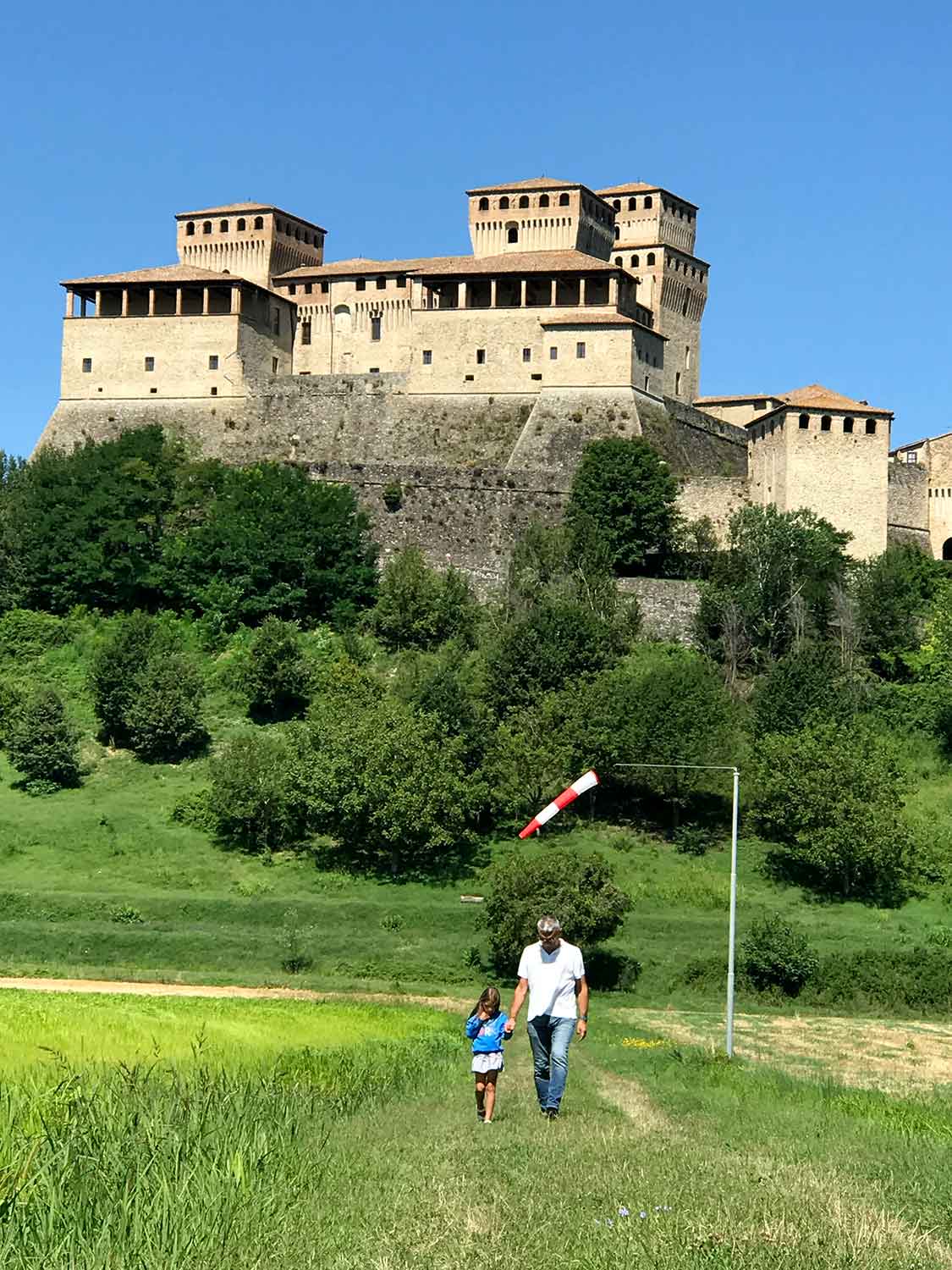
South of Parma, castle country begins: Torrechiara, whose frescoed golden chamber is among the most romantic rooms in Italy, the moated Fontanellato with its Parmigianino frescoes, and a chain of fortresses climbing the Apennine ridge once ruled by Matilda of Canossa. These make splendid half-day excursions from Parma, threaded through vineyard and orchard country most travelers never see.

Eastward, Romagna keeps its own secrets. Brisighella, a medieval village beneath a clifftop fortress and clock tower, has one of Italy’s most atmospheric elevated streets, the Via degli Asini, and celebrated olive oil. The Po Delta spreads lagoons, reed beds, and flamingos around the fishing town of Comacchio, best explored by boat, and Faenza rewards a stop for its world-renowned ceramics museum and working studios. In the hills above Rimini, San Leo balances a fortress on sheer rock in one of the great dramatic settings of the Apennines.

These are the days that transform a good itinerary into a personal one. We alternate the celebrated with the quiet deliberately, adding a castle morning after a museum day or a delta boat afternoon after the mosaics, because the alternation is what keeps a trip feeling like discovery rather than accomplishment.

The Apennines above the plain deserve a word of their own. Thermal towns like Salsomaggiore Terme have welcomed guests for more than a century, chestnut forests and ridge villages offer walking country of real character, and autumn brings truffle and mushroom seasons that fill the mountain trattorias. For travelers who want one day of pure countryside stillness between the food cities, the high road south of Parma or Modena provides it beautifully.

What Do Evenings Look Like in Emilia Romagna?

Evenings begin under the porticoes. Aperitivo is a serious institution in Bologna, where students, professors, and families fill the arcaded streets as the light turns gold, and a glass of Pignoletto with mortadella and Parmigiano is the region’s standard overture. Dinner follows at a pace that honors the kitchen, whether in a wood-paneled trattoria where the broth has simmered all day or in one of the region’s celebrated fine dining rooms.

Culture keeps the evening going. Parma’s Teatro Regio and Bologna’s Teatro Comunale offer some of the most rewarding opera evenings in Italy, the Ravenna Festival sets summer concerts among the mosaics, and the cities themselves reward a slow night walk, Bologna’s towers floodlit, Ferrara’s castle glowing above its moat. In summer, the Adriatic riviera adds its own bright register, with a beach and promenade culture around Rimini and Milano Marittima that Italians have perfected over a century of seaside evenings.

We compose evenings as deliberately as days: opera tickets and pre-theater dinners arranged together, tastings that end at the passeggiata hour, and quiet-night alternatives after full days. In a region this devoted to the table and the stage, the hours after sunset are not the margin of the itinerary. They are half its pleasure.

What Day Trips and Extensions Pair Well With Emilia Romagna?

Bologna’s position makes the whole north of Italy a neighbor. Florence lies under 40 minutes away by high-speed rail, Milan and Venice around 90, so the region pairs naturally with the classic art cities, and many of our travelers use Emilia Romagna as the flavorful middle movement between them. Within the region, the Adriatic coast offers Rimini’s surprising Roman monuments, the arch of Augustus and the bridge of Tiberius, alongside its famous beaches.

Two miniature states sit at the region’s edges: the Republic of San Marino, crowning Monte Titano above the Romagna hills with its three towers and vertiginous views, and, just across the Lombard border, the Renaissance city of Mantua. Active travelers extend into the Apennines for hiking and cycling country, including the celebrated climbs of the Futa and the pilgrim paths toward Tuscany, which we support as part of our active trips in Italy.

How far to reach depends on the trip’s rhythm, and that judgment is our craft. As part of a custom trip to Italy, we sequence extensions so each one refreshes the journey rather than crowding it, with every transfer arranged and supported around the clock. Emilia Romagna rewards travelers who linger, and we design itineraries that make lingering feel like the luxury it is.

Ready to Begin Planning Your Emilia Romagna Vacation?

Emilia Romagna deserves more than a template. Since 2003, Trips 2 Italy has designed private Italian vacations one traveler at a time, hand selecting every experience based on what you tell us rather than fitting you into a predefined package. Our Italian-born team plans Emilia Romagna with the knowledge of people who call Italy home, from the porticoes of Bologna to the mosaics of Ravenna and the cheese vaults of Parma, and we remain at your side throughout your trip with 24/7 assistance. Tell us how you imagine Emilia Romagna, and we will craft the itinerary that matches it.

Explore Our Emilia Romagna Vacation Itineraries

Frequently Asked Questions About Things to Do in Emilia Romagna

Bologna’s historic center, the porticoes, the Asinelli tower, Piazza Maggiore, and the Quadrilatero food streets, is the essential first encounter, followed closely by a day among Ravenna’s UNESCO mosaics. Trips 2 Italy arranges expert guides and sequences both cities along the Via Emilia so each receives the unhurried time it deserves.

Yes. The Motor Valley offers museums at Maranello and Modena, plus Lamborghini, Ducati, and Pagani nearby, and we arrange track and road driving experiences, passenger laps with professionals, and access to workshops and collections for dedicated enthusiasts. A Motor Valley day pairs wonderfully with the food experiences of the same hills.

Absolutely. The eight UNESCO monuments, led by San Vitale and the Mausoleum of Galla Placidia, hold the finest Byzantine mosaics in the Western world, and with a specialist guide the day becomes a journey through late antiquity. Adding a mosaic workshop visit or a summer Ravenna Festival concert makes it richer still.

Pasta-making workshops, tower climbs in Bologna, castle visits at Torrechiara and Fontanellato, flamingo-spotting boat trips in the Po Delta, Motor Valley museums, and beach days on the Adriatic keep every generation engaged. We compose family itineraries so food, history, and adventure arrive in a rhythm children genuinely enjoy.

In summer, the riviera around Rimini, Riccione, and Milano Marittima is Italy’s great seaside playground, with broad sandy beaches and a warm, welcoming beach culture refined over a century. It pairs well with Ravenna’s mosaics and the hill towns of Romagna, and we fold coastal days into summer itineraries for travelers who want them.

Brisighella’s clifftop fortress and medieval lanes, the castles of the Parma hills, the lagoons of Comacchio and the Po Delta, Faenza’s ceramics studios, and San Leo’s rock-top fortress all reward travelers who step off the Via Emilia. These are exactly the days that make an itinerary personal, and we weave them between the region’s great cities.