Things To Do in Rome

HOME » POPULAR ITALIAN DESTINATIONS » ROME TRAVEL GUIDE » ROME THINGS TO DO GUIDE

Rome Travel Guide        Culture        History        Food and Wine        Things to Do        Plan My Trip

About this guide: This guide to things to do in Rome was written by the Italian-born travel specialists at Trips 2 Italy, a custom tour operator that has designed hand-crafted Italian vacations since 2003. Every recommendation below reflects the same first-hand knowledge our team draws on when we build a private Rome itinerary around a traveler’s interests, dates, and pace. Read it for your research, then let us translate it into a trip designed entirely around you.

What Belongs at the Top of Every Rome Itinerary?

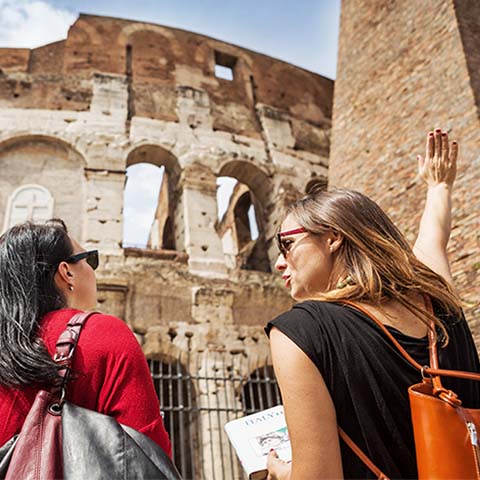
Ancient Rome comes first. The Colosseum, the Roman Forum, and the Palatine Hill form a single archaeological sweep at the heart of the city, and of the wider Lazio region, best experienced as one continuous story with a guide who can raise the marble from the ruins. Special access, from the arena floor to the underground chambers where gladiators and animals waited, transforms the Colosseum from a photograph into an experience, and we arrange it wherever the site’s calendar allows.

The Pantheon follows, the ancient world’s most perfect survivor, its concrete dome open to the sky through the oculus that has admitted sun and rain for nineteen centuries. From there the classic center unfolds on foot: the Trevi Fountain, most theatrical at first light before the crowds arrive, the Spanish Steps, and Piazza Navona over the bones of an ancient stadium. None of these requires a ticket; all of them reward correct timing.

The essential list is famous for good reason, but its quality depends almost entirely on when and how you meet it. We schedule the marquee sites for their best hours, secure timed and early entries where they matter, and thread the walks between them through lanes that stay beautiful even in high season. Rome’s greatest hits, properly sequenced, feel like discoveries rather than obligations.

How Should You Experience the Vatican?

The Vatican rewards strategy more than any site in Italy. The museums hold miles of galleries, and the difference between drifting through them and being guided to their peaks, the classical sculpture court, the Raphael Rooms, the map gallery glowing gold, is enormous. The Sistine Chapel crowns the route, and meeting Michelangelo’s ceiling in relative quiet, on an early entry before general admission, is one of the great arrangements we make for travelers.

St. Peter’s Basilica deserves its own unhurried hour: the Pieta, Bernini’s baldachin above the papal altar, and the climb to the dome, where the lantern balcony delivers the finest panorama in Rome, the colonnade’s embrace opening directly below. Travelers who wish to attend a Wednesday papal audience can do so with tickets arranged in advance, an experience that moves visitors of every background.

For travelers who want to go beyond the standard route, the possibilities deepen. The Vatican Gardens admit small guided groups into the landscaped half of the city-state, the Pinacoteca rewards art lovers with Raphael and Caravaggio in near solitude, and the excavations beneath the basilica descend through the ancient necropolis to the tomb of St. Peter, one of the most extraordinary arrangements in all of travel and one that must be requested months ahead.

We compose Vatican days deliberately: early museum entry with an art historian, the basilica before lunch, and the afternoon kept intentionally gentle, because the Vatican fills both the eyes and the feet. Done well, it is the most overwhelming half day in European travel. Done poorly, it is simply overwhelming, and the difference is planning.

Which Piazzas and Fountains Make the Classic Roman Walk?

Rome’s center is an open-air gallery connected by lanes, and the classic passeggiata threads its masterpieces into a single unforgettable walk. Piazza Navona performs the Baroque at full volume, Bernini’s Four Rivers Fountain holding court between Borromini’s church facade and the painters’ easels. A few lanes away, the Pantheon’s porch shelters its perpetual crowd, and Campo de’ Fiori runs its morning market before turning to evening conviviality.

The fountains are a city within the city. The Trevi, fed by an aqueduct commissioned by Agrippa, receives roughly a coin over the left shoulder from nearly every visitor, a ritual promising return to Rome; the fountain of the bees and the Triton in Piazza Barberini show Bernini at his most playful; and the turtle fountain by the Ghetto may be the most charming small monument in Italy. Between them run the streets of the historic center, where every doorway seems to open onto a courtyard worth a pause.

The Tiber adds its own theater to the walk. Ponte Sant’Angelo carries Bernini’s wind-blown angels across the river toward the round mass of Castel Sant’Angelo, the single most beautiful bridge crossing in Italy, and the views from Ponte Sisto at sunset, with St. Peter’s dome floating above the water, explain why painters have set easels there for three centuries. The river embankments below fill with festival stalls and open-air life on summer evenings.

We design these walks personally rather than generically: routed by a specialist to your interests, timed to the hours when each piazza is at its best, dawn at the Trevi, morning at the market, golden hour on the bridges, and paced with the espresso and gelato stops that Romans consider structural. The walk is the destination, and it is different every time we compose it.

Which Museums and Churches Reward Art Lovers in Rome?

The Borghese Gallery is Rome’s most concentrated marvel: Bernini’s Apollo and Daphne and his David, six Caravaggios, Canova’s Pauline Borghese, and Titian’s masterpieces, all inside a villa built for the pleasure of a seventeenth-century cardinal. Entry is by timed reservation in limited numbers, which keeps the rooms civilized and makes advance planning essential; we secure the slots and pair them with the villa’s gardens for a perfect Roman morning.

The Capitoline Museums, the oldest public museums in the world, gather the she-wolf, the colossal head of Constantine, and the bronze Marcus Aurelius above a piazza designed by Michelangelo, while Palazzo Massimo’s ancient frescoes and bronzes reward connoisseurs. The churches, meanwhile, are free museums of their own: Caravaggio in San Luigi dei Francesi and Santa Maria del Popolo, Michelangelo’s Moses at San Pietro in Vincoli, mosaics glowing in Santa Maria in Trastevere, and Borromini’s geometry at San Carlo alle Quattro Fontane.

Rome rewards art lovers who alternate the famous with the intimate, and that alternation is exactly how we compose art-focused days: a timed masterpiece in the morning, a quiet church or palazzo in the afternoon, with specialists who read the rooms fluently and, where access allows, conversations with the curators and restorers who keep this inheritance alive.

Where Do You Find the Quieter Side of Rome?

The Aventine Hill is the classic escape: the Giardino degli Aranci and its orange-scented panorama over the Tiber, the serene fifth-century basilica of Santa Sabina, and the famous keyhole of the Knights of Malta, through which St. Peter’s dome appears perfectly framed at the end of a garden avenue. Ten minutes away, Testaccio hums with real neighborhood life, and the Protestant Cemetery’s cypress shade holds the graves of Keats and Shelley in improbable tranquility.

The Appian Way offers countryside inside the city: the ancient basalt road running straight between pines, tombs, and aqueduct arches, closed to traffic on Sundays and glorious by bicycle, an easy addition for travelers who enjoy our active trips in Italy. North of the center, the Coppede quarter hides a fantasy of Art Nouveau architecture almost no visitor sees, and Trastevere at eight in the morning, before its evening crowds, belongs entirely to locals and the wise.

Even the famous quarters keep quiet hours for those who know them: the Forum at opening, the Pantheon at closing, the center’s churches at midday. Our itineraries deliberately alternate the celebrated with the hidden, because the alternation is what keeps Rome feeling like a discovery, and the quiet hours are where travelers fall permanently in love with the city.

What Should You Do in Rome in the Evening?

Rome’s evenings begin with the aperitivo, taken at a table with a view of a fountain or on a rooftop as the domes turn amber, and unfold into dinner at the Roman hour, rarely before eight thirty. Trastevere is the classic evening quarter, its lanes filling with conversation, but Monti, the Ghetto, and Testaccio each offer their own register of the night, and choosing the right quarter for the right evening is part of the itinerary’s craft.

The monuments perform after dark. The Trevi Fountain, Piazza Navona, and St. Peter’s colonnade are floodlit into theater, the Colosseum glows above the ancient avenue, and an evening drive or walk through the illuminated center, timed after dinner, is a signature experience we build into nearly every Roman itinerary. In summer, the calendar adds opera under the stars at the Baths of Caracalla and open-air cinema and concerts across the Estate Romana festival.

For travelers who want the night composed, we arrange it end to end: a rooftop aperitivo, dinner reserved in the right quarter, tickets to the evening’s performance, and a driver waiting afterward. Rome after dark is gentler, cooler, and more romantic than its daytime self, and no visit is complete without at least two evenings given entirely to it.

What Day Trips Pair Well With Rome?

Ostia Antica is the closest and most underrated: the ancient port of Rome, under an hour away, preserves whole streets, warehouses, baths, taverns, and a theater among the pines, with an intimacy that lets travelers wander rooms the empire actually lived in. For many of our guests it becomes the surprise favorite of the trip, especially with a guide who repopulates the streets in the telling.

Tivoli, east of the city, pairs two UNESCO World Heritage estates in a single day: Hadrian’s Villa, the emperor’s vast architectural playground of pools and pavilions, and Villa d’Este, the Renaissance cardinal’s garden of five hundred fountains terraced down the hillside. The Castelli Romani, southeast, offer the gentlest excursion: hill towns above volcanic lakes, papal Castel Gandolfo, porchetta and Frascati at a family table, and Rome glittering on the horizon at dusk.

Travelers with more time can reach further still. The gardens of Ninfa, often called the most romantic in the world, bloom among medieval ruins south of the city on a limited calendar of open days, the abbey towns of the Ciociaria preserve a quieter monastic Lazio, and the coast offers seafood lunches by the water within an hour of the center. Rome’s position makes it the best-connected base in Italy, and the countryside around it remains one of the country’s best-kept secrets.

Each excursion runs best with a private driver and a plan matched to your pace, leaving after the morning rush, lunching where the locals do, returning in time for the evening passeggiata. As part of a custom trip to Italy, we sequence these days so they refresh the itinerary rather than crowd it, and every transfer is arranged and supported around the clock.

Ready to Begin Planning Your Rome Vacation?

Rome deserves more than a template. Since 2003, Trips 2 Italy has designed private Italian vacations one traveler at a time, hand selecting every experience based on what you tell us rather than fitting you into a predefined package. Our Italian-born team plans Rome with the knowledge of people who call Italy home, from the galleries of the Vatican to the trattorias of Trastevere, and we remain at your side throughout your trip with 24/7 assistance. Tell us how you imagine Rome, and we will craft the itinerary that matches it.

Explore Our Rome Vacation Itineraries

Frequently Asked Questions About Things to Do in Rome

The ancient sweep of the Colosseum, Roman Forum, and Palatine Hill is the essential first encounter, followed closely by the Vatican Museums and St. Peter’s. Both depend heavily on timing and access, which is why Trips 2 Italy arranges early entries, special access, and expert guides as the foundation of every Roman itinerary.

Yes. The Borghese Gallery admits visitors only by timed reservation in limited numbers, and slots disappear well ahead in high season. Trips 2 Italy secures reservations as soon as an itinerary takes shape and pairs the visit with the surrounding Borghese gardens for one of Rome’s finest mornings.

Special-access routes open the arena floor and the underground chambers where gladiators, stage machinery, and animals waited, and they transform the visit. Availability is limited and calendars shift, so these experiences must be arranged ahead; we build them into itineraries wherever the site allows.

Absolutely, at the right hour. At first light the fountain belongs to a handful of travelers and its aquamarine theater is unforgettable, while midday brings dense crowds. Tradition holds that a coin tossed over the left shoulder ensures a return to Rome. We route morning walks to reach it before the city wakes.

Ostia Antica for a remarkably preserved ancient city under an hour away, Tivoli for Hadrian’s Villa and the fountains of Villa d’Este, and the Castelli Romani hill towns for lakes, wine, and long lunches. Each runs best with a private driver and guide, arranged as an unhurried single day.

Begin with an aperitivo on a rooftop or piazza, dine at the Roman hour in Trastevere, Monti, or the Ghetto, then walk or drive the floodlit monuments, from the Trevi Fountain to St. Peter’s colonnade. In summer, add opera under the stars at the Baths of Caracalla, which we reserve months ahead.