
Italian Peninsula and Sicily 17 Day Escorted Tour | Vacation Packages for 2025 – 2026
Explore Rome, Florence, Venice and Sicily as art, history and breathtaking landscapes create the ultimate Italian journey. Starting from $6,404 per person.
HOME » POPULAR ITALIAN DESTINATIONS » PADOVA TRAVEL GUIDE » PADOVA CULTURE GUIDE
About this guide: This guide to the culture of Padova was written by the Italian-born travel specialists at Trips 2 Italy, a custom tour operator that has designed hand-crafted Italian vacations since 2003. Every recommendation below reflects the same first-hand knowledge our team draws on when we build a private Padova itinerary around a traveler’s interests, dates, and pace. Read it for your research, then let us translate it into a trip designed entirely around you.
Padova’s culture rests on three pillars raised within a single medieval century: a fresco revolution, a university, and a saint. Giotto painted the Scrovegni Chapel in the first years of the fourteenth century, the university had already been teaching since 1222, and the basilica rising over Saint Anthony’s tomb was drawing pilgrims from across Europe. Art, learning, and devotion have shared the city ever since, and each still shapes its daily life.
That inheritance sits within the wider civilization of the Veneto, whose painting schools, villa culture, and long Venetian centuries all left their mark here. Yet Padova kept its own temperament: more scholarly than Venice, more devout than Verona, and prouder of its markets and porticoes than of any single postcard view. Padovans describe their city with an old saying about a saint without a name, a meadow without grass, and a cafe without doors, riddles every visitor learns to solve.
What makes the culture so rewarding for travelers is that none of it is preserved behind glass. Students still argue in the same arcaded courtyards, pilgrims still queue at the tomb, and the markets still open every morning beneath the medieval hall. Padovan culture is not a subject to visit. It is a life still being lived, and the itineraries we design place travelers inside it.
Between 1303 and 1305, Giotto covered the interior of a private chapel built by the banker Enrico Scrovegni with scenes from the lives of the Virgin and of Christ, and in doing so he broke painting free from Byzantine stillness. His figures have weight, his faces grieve and rejoice, his spaces recede, and his Kiss of Judas and Lamentation carry a human drama that painting had not attempted before. Art historians draw a straight line from this room to the Renaissance.
The chapel is only the beginning of painted Padova. UNESCO’s Urbs Picta listing gathers eight fresco complexes from the city’s fourteenth century, including the Baptistery of the cathedral by Giusto de’ Menabuoi, whose dome swirls with hundreds of figures around a monumental Christ, the Oratory of San Giorgio, and the chapters of the Santo. Later, the young Andrea Mantegna painted the Ovetari Chapel in the Eremitani church, and Titian left frescoes in the Scuola del Santo.
Seeing this art well is a matter of sequence and storytelling. Chapel entries are timed, the cycles are scattered across churches and oratories, and the revolution they record unfolds best in chronological order. We arrange reserved entries and private art historians who unfold the story fresco by fresco, so that what might be a beautiful blur becomes one of the most moving artistic encounters in Italy.
The University of Padova was founded in 1222 by scholars seeking freedom from Bologna, and its motto, Universa Universis Patavina Libertas, still promises Paduan liberty for everyone. Under Venetian protection it became one of Europe’s great scientific centers: Galileo Galilei taught here from 1592 to 1610 and called these the best years of his life, Copernicus studied here, William Harvey took his degree here, and in 1678 Elena Lucrezia Cornaro Piscopia became the first woman in the world to receive a university degree.
The university’s historic seat, Palazzo Bo, preserves the wooden Anatomical Theatre of 1594, the oldest permanent theatre of its kind anywhere, where students once ringed six steep tiers to watch dissections by candlelight. Nearby stands Galileo’s battered wooden lectern and the great courtyard armored in the coats of arms of centuries of students. The university also planted the botanical garden in 1545 to grow medicinal plants, a living laboratory that UNESCO recognizes as the origin of botanical gardens worldwide.
Eight centuries of students give Padova its rhythm still. Graduates are crowned with laurel and roasted by friends with hand-painted posters, bicycles stream under the porticoes, and the piazzas fill each evening with a conversation that has never really stopped. Travelers feel it immediately: this is a city where ideas remain a public pleasure, and we design visits to Palazzo Bo and the garden with guides who make the history of science feel like the adventure it was.
Padovans call him simply il Santo, the Saint, without a name, because none is needed. Anthony was a Portuguese-born Franciscan friar whose preaching drew such crowds that fields could not hold them, and when he died just outside the city in 1231 Padova began building him one of the great pilgrimage churches of the world within a year. His basilica, a skyline of Byzantine domes and slender towers, now receives millions of pilgrims annually at his tomb.
Inside, devotion and high art share the same air. Pilgrims rest their hands on the green marble of the tomb in unbroken procession, while around them stand Donatello’s bronze crucifix and statues on the high altar, the reliquary chapel holding the saint’s relics, and cloisters where friars have walked for nearly eight centuries. Outside, Donatello’s equestrian monument to the condottiero Gattamelata, cast in the 1440s, revived the ancient Roman bronze horseman and changed Renaissance sculpture.
The devotion has its own vocabulary. Anthony is invoked worldwide as the finder of lost things, letters of petition and thanksgiving arrive at the basilica from every continent, and the faithful keep the old tradition of the Thirteen Tuesdays of prayer leading toward his feast. Votive offerings line the corridor behind the tomb, small testimonies of storms survived and health recovered, and reading them is one of the quiet, humbling experiences of the city.
The city’s devotional year peaks on June 13, the saint’s feast, when the relics process through streets strewn with celebration and the basilica glows late into the night. Travelers of any faith find the scene profoundly moving, a medieval ritual alive in a modern city. We arrange visits with guides who read both the spiritual and artistic registers of the Santo, and we time them so the basilica’s quiet hours and its living devotion can each be felt.
Music has deep roots at the Santo, whose musical chapel has sung continuously for centuries and once employed Giuseppe Tartini, the violinist and composer of the Devil’s Trill sonata, who led the basilica’s orchestra for nearly half a century in the eighteenth century. Sacred music still fills the basilica and the city’s churches, and the frescoed hall of the Palazzo della Ragione and historic theatres host concerts and opera seasons through the year.
The festival calendar turns on the feast of Saint Anthony in June, with its processions and pilgrim crowds, and continues with open air cinema and concerts in the cloisters and piazzas through summer. Autumn brings harvest festivals in the Euganean Hills celebrating wine, olive oil, and the jujube fruit of Arqua Petrarca, while Carnival and Christmas markets animate the arcades in winter. The Prato della Valle hosts one of Italy’s larger antiques markets and a vast weekly market that has met for centuries.
These smaller festivals are among the best windows into Veneto life a traveler can find, and timing is everything. We track the regional calendar year-round and fold performances, feast days, and village sagre into itineraries as part of our entertainment and festival experiences in Italy, so the calendar becomes a reason to travel rather than an accident.
Padova perfected the civic ritual of the cafe. The neoclassical Caffe Pedrocchi, opened in 1831 and famous as the cafe without doors because it once never closed, was the salon of students, professors, and patriots, and a Risorgimento uprising began at its tables in 1848. Its green room still welcomes anyone to sit without ordering, a gesture of civility the city remains proud of, and its rooms remain a living monument at the center of Padovan life.
The piazzas carry the rest of the day. Every morning, Piazza delle Erbe and Piazza della Frutta fill with market stalls beneath the Palazzo della Ragione as they have since the Middle Ages, and every evening the same squares turn to the aperitivo, when the spritz, born in the Veneto and perfected in Padova, arrives in its orange glow. The bitter aperitif that defines the modern spritz was created in this city in 1919, and the ritual remains the city’s true second religion.
The arcades themselves are social architecture. Padova’s historic center is threaded with miles of covered porticoes, among the longest networks in Italy, built so that commerce, study, and conversation could continue in any weather. They give the city its distinctive gait: unhurried, sheltered, sociable, with shop windows, cafe tables, and university notice boards succeeding one another for block after block.
Daily life still follows rhythms travelers can learn in a day: espresso standing at the bar, the market basket filled before lunch, the passeggiata under the arcades, the piazza hour before dinner. The deepest Padova experiences come from stepping inside these rhythms, a market morning with a local cook, an evening among the students and professionals in the squares, and our itineraries are composed of exactly these hours.
Padova’s culture is generous, but its best rooms open by arrangement and knowledge rather than by chance. The Scrovegni Chapel admits only small timed groups, the Anatomical Theatre is seen on guided visits, the fresco cycles of Urbs Picta are scattered across oratories and chapels that reward an expert eye, and the basilica reveals a different face in its quiet hours than at midday. Knowing when, in what order, and with whom is the craft.
Because our team is Italian-born and has worked these cities since 2003, we plan Padovan culture from the inside: reserved chapel entries at the day’s best hours, private art historians for Giotto and Mantegna, guided time in Palazzo Bo and the botanical garden, and market mornings with cooks who shop the squares daily. These are not options selected from a list. They are arrangements composed for each traveler based on what they tell us, as part of our Italian cultural tours.
That method is the difference between a sightseeing stop and a cultural life briefly shared. Travelers who first come to Padova for a single fresco cycle tend to return for everything around it: the university courtyards, the pilgrim basilica, the market banter, the spritz hour. Our work is to make sure the first visit already contains that depth.
Padova deserves more than a template. Since 2003, Trips 2 Italy has designed private Italian vacations one traveler at a time, hand selecting every experience based on what you tell us rather than fitting you into a predefined package. Our Italian-born team plans Padova with the knowledge of people who call Italy home, from Giotto’s frescoed chapel to the thermal hills beyond the city walls, and we remain at your side throughout your trip with 24/7 assistance. Tell us how you imagine Padova, and we will craft the itinerary that matches it.
Explore Rome, Florence, Venice and Sicily as art, history and breathtaking landscapes create the ultimate Italian journey. Starting from $6,404 per person.
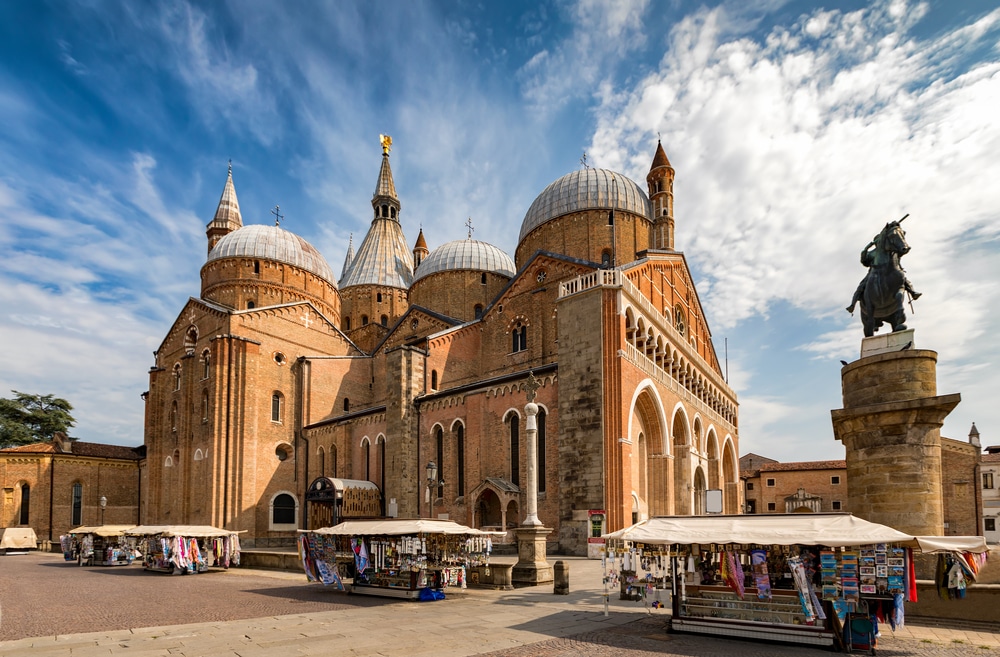
Experience Florence, Padua and Venice as art, canals and timeless beauty welcome you to Italy’s most enchanting cities. Starting from $1080 per person.
Experience Rome, Florence, Venice and Tuscany as art, history and rolling landscapes create the ultimate Italian journey. Starting from $898 per person.
Padova is celebrated for Giotto’s Scrovegni Chapel and the UNESCO-listed fourteenth century fresco cycles of Urbs Picta, for its university founded in 1222 where Galileo taught, for the pilgrimage Basilica of Saint Anthony, and for a living cafe and market culture centered on the historic Caffe Pedrocchi and the medieval piazzas.
Giotto’s fresco cycle of 1303 to 1305 broke painting free from Byzantine convention, giving figures weight, emotion, and real space for the first time, and art historians trace the origins of the Renaissance directly to this room. Entry is by timed reservation in small groups, and Trips 2 Italy secures chapel slots and private art historians as fixed points of any Padova itinerary.
Guided visits to Palazzo Bo include the wooden Anatomical Theatre of 1594, the oldest of its kind in the world, along with Galileo’s lectern and the coat-of-arms courtyard. The university’s botanical garden of 1545, the world’s oldest academic botanical garden and a UNESCO site, completes the story of Padova’s scientific golden age.
Anthony was a Franciscan friar and celebrated preacher who died near Padova in 1231 and was canonized within a year. His basilica, begun in 1232, holds his tomb and relics alongside Donatello’s bronzes, and it receives millions of pilgrims annually, with the feast of June 13 bringing processions through the whole city.
The spritz was born in the Veneto, where Austrian soldiers once lightened the local wine with a spray of water, and Padova gave the modern version its soul: the bitter orange aperitif that defines it was created here in 1919. The evening spritz in the market squares remains the city’s defining social ritual, and we build aperitivo evenings into every Padova itinerary.
Yes. We pair travelers with private art historians for the Scrovegni Chapel and the Urbs Picta fresco cycles, guides for Palazzo Bo and the Anatomical Theatre, and specialists who read the Basilica of Saint Anthony in both its artistic and devotional registers, with every entry reserved in advance and timed for the day’s best hours.