
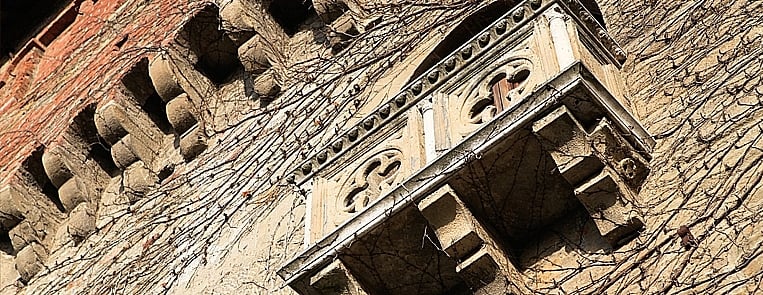
Tagliolo Castle with Wine Tasting
For the ultimate taste of Italy, this 6-hour tour offers the chance to explore Tagliolo Castle and enjoy an Italian wine tasting with some of the area’s finest vintages
HOME » POPULAR ITALIAN DESTINATIONS » CASALE MONFERRATO TRAVEL GUIDE » CASALE MONFERRATO HISTORY GUIDE
About this guide: This guide to the history of Casale Monferrato was written by the Italian-born travel specialists at Trips 2 Italy, a custom tour operator that has designed hand-crafted Italian vacations since 2003. Every recommendation below reflects the same first-hand knowledge our team draws on when we build a private Casale Monferrato itinerary around a traveler’s interests, dates, and pace. Read it for your research, then let us translate it into a trip designed entirely around you.
Casale’s story begins where geography demanded a town: a crossing point on the Po at the edge of the Piedmont hills. The Romans knew a settlement here as Vardacate, one of the river towns of Liguria’s ninth region, and the fertile seam between plain and hill kept the site inhabited through the empire’s long twilight.
The city’s true founding legend belongs to its patron saint. Evasio, an early bishop venerated as a martyr, was buried here, and the community that grew around his church took his name, becoming Casale di Sant’Evasio through the early Middle Ages. By the eleventh century the town was substantial enough to raise the civic tower that still stands, and in 1107 its great Romanesque cathedral was consecrated by Pope Paschal II himself, a measure of how seriously the medieval world took this small city on the river.
Prosperity brought danger. As a free commune allied with Frederick Barbarossa’s imperial party, Casale was caught in the merciless politics of the Lombard wars, and in 1215 the armies of Vercelli, Alessandria, and Milan destroyed the town. The Casalesi rebuilt, as river towns do, and their reconstructed city soon attracted the attention of the remarkable dynasty that would raise it to a capital.
Traces of these earliest centuries still reward the attentive visitor. The lower courses of the Torre Civica preserve eleventh-century masonry, the cathedral’s narthex gathers sculpted fragments and reused stones from the earlier churches on the site, and the city’s museums display Roman finds from the river towns of the plain. A morning with an archaeologically minded guide turns the familiar center into a palimpsest, each wall carrying the handwriting of a different century.
The Monferrato takes its name from one of medieval Europe’s most extraordinary families. The Aleramici, descended from the tenth-century nobleman Aleramo, ruled the hill country between the Po and the Apennines as marquises of Montferrat, and legend says Aleramo won his lands by riding for three days without rest, a story every Monferrino still tells.
In the age of the crusades this small dynasty stepped onto the world stage. Marquis William V and his sons became central figures of the Latin East: Conrad of Montferrat defended Tyre against Saladin and was elected King of Jerusalem in 1192, and Boniface I of Montferrat led the Fourth Crusade and became King of Thessalonica. For two generations, a hill state smaller than many Italian provinces negotiated with emperors in Constantinople and sultans in the Holy Land.
Those eastern adventures reshaped the dynasty’s destiny. When the Aleramici line died out in 1305, the marquisate passed through the marriage of Yolande of Montferrat to the Byzantine imperial family, and Theodore I Palaiologos, son of the Emperor of Constantinople, crossed the Mediterranean to claim the Monferrato. For the next two centuries this corner of Piedmont was ruled by a branch of the last dynasty of Byzantium, a historical improbability that still colors the region’s identity.
The Palaiologos marquises needed a stronghold on the Po, and Casale was their answer. In 1352 Marquis John II began the great castle on the riverfront, and in 1435 the city formally became the capital of Montferrat, seat of the court, the chancery, and the mint of a state that balanced skillfully among Milan, Savoy, and France.
The capital decades were Casale’s first golden age. The court attracted painters, architects, and humanists, the church of San Domenico rose as a Renaissance showpiece beside the palaces of the nobility, and in 1474 the city was raised to a bishopric, confirming its metropolitan rank. Remarkable women shaped the era, none more than Anne d’Alencon, the French-born marchioness who governed with celebrated intelligence in the dynasty’s final years and whose court connected Casale to the high Renaissance world of Mantua and France.
The Palaiologos line ended in 1533, and the succession passed by marriage and imperial decree to the Gonzaga dukes of Mantua in 1536. The Monferrato remained a distinct state under Gonzaga rule, elevated to a duchy in 1574, but its new masters ruled from afar, and Casale’s role shifted from court city to something more dangerous: the most contested fortress in northern Italy.
The Gonzaga understood exactly what they held. Casale commanded the Po crossing between Spanish Milan and Savoyard Turin, and in 1590 Duke Vincenzo I began the citadel, a vast hexagonal star fortress that contemporaries ranked among the strongest in Europe. For the next century, diplomats and generals called Casale the key to Italy.
Keys attract locks and armies. The two Wars of the Monferrato succession drew Spanish, French, and Savoyard forces into the region, and during the War of the Mantuan Succession the city endured its epic ordeal: the great siege of 1628 to 1630, in which the fortress held out through famine and plague while the powers of Europe bargained over its walls. Later in the century French garrisons held the citadel for decades as an instrument of Louis XIV’s Italian ambitions, until European coalitions forced its demolition in 1695.
The Treaty of Utrecht settlements finally delivered the Monferrato to the House of Savoy in the early eighteenth century, ending six centuries of independent and semi-independent statehood. Casale exhaled, becoming a dignified provincial capital of Piedmont, its ramparts gradually softening into boulevards while the castle, the cathedral, and the palaces of its capital centuries stood as reminders of how much history had passed across this one river crossing.
Under Savoy rule the city turned its energies from war to commerce, and its Jewish community entered its most brilliant period. Concentrated in the ghetto established in 1724 but increasingly prominent in banking, trade, and manufacturing, the community completed the magnificent embellishment of its synagogue and produced scholars and civic leaders who shaped the city through emancipation in the Risorgimento era, when Piedmont led the unification of Italy.
The nineteenth century made Casale an industrial capital of an unexpected kind: cement. The marl quarried from the Monferrato hills proved ideal for hydraulic lime, and by the early twentieth century Casale was the cement capital of Italy, its kilns and engineering works exporting expertise across Europe. The same era gave the city its grand theater seasons, its monuments, and its most famous son in the sculptor Leonardo Bistolfi, whose symbolist marbles adorned the memorials of the new Italian nation.
The twentieth century brought hardship and renewal in the pattern of northern Italy, including wartime occupation and the deportation of members of the Jewish community, a memory the city honors with scrupulous care. Modern Casale has reinvented itself around heritage and landscape, anchored by the 2014 UNESCO recognition of the Monferrato’s vineyard country and infernot, which confirmed what the Casalesi always knew: their quiet corner of Piedmont is a cultural treasury of European rank.
The Risorgimento decades deserve their own footnote in the city’s story. As a frontier stronghold of the Kingdom of Sardinia, Casale was refortified in 1849 and stood as a bulwark on the Po during the wars of independence, and the monument to King Carlo Alberto in Piazza Mazzini commemorates the era when this old capital of the marquises helped guard the birth of modern Italy. It is a fitting symmetry: a city built to hold the river crossing performed that duty one last time for the nation Piedmont was creating.
The cathedral of Sant’Evasio is the deepest archive, nine centuries old and still the city’s spiritual heart, its narthex, silver crucifix, and mosaic fragments carrying the medieval capital’s ambition into the present. A short walk away, the Torre Civica marks the free commune, and the Castello del Monferrato on the riverfront preserves the fortress footprint of the Palaiologos and Gonzaga centuries, its courtyard and ramparts now hosting exhibitions above the Po.
The synagogue and its museums narrate five centuries of Jewish Casale, from ghetto lanes to gilded prayer hall to the contemporary Museum of Lights, while the Museo Civico in the former convent of Santa Croce gathers the city’s painting and the Bistolfi Gipsoteca. Fragments of the great citadel, the palaces along the old court streets, and the nineteenth-century theater complete the walk through the capital’s ages.
Beyond the walls, history climbs into the hills. The Sacro Monte di Crea, one of the UNESCO-listed Sacred Mountains of Piedmont, spreads its chapels through the woods above the vineyards, and the infernot villages preserve the underground craftsmanship of the farming centuries. We compose history-focused itineraries chronologically where interests allow, from Romanesque narthex to baroque synagogue to hand-carved cellar, with historian guides chosen for their narrative gift, as part of our cultural tours of Italy.
Preservation in Casale is a civic passion. The synagogue’s restoration and its internationally celebrated museums grew from a partnership between the small surviving community and the city that has become a model for Jewish heritage across Europe, while the castle’s rehabilitation as a cultural venue returned the fortress to the daily life of the Casalesi after centuries as a barracks.
In the hills, UNESCO recognition transformed how the Monferrato cares for itself. The infernot are inventoried, studied, and interpreted through the ecomuseum of the Pietra da Cantoni at Cella Monte, village facades and dry-stone walls are restored in the traditional pale sandstone, and the vineyard landscape itself is managed as living heritage, farmed by families who now understand themselves as custodians of a World Heritage Site.
For travelers, this means the past here is unusually intact and unusually personal. The people who open an infernot, a palace courtyard, or the synagogue’s treasures are often the very families and volunteers who saved them, and their pride is contagious. We arrange encounters with this preservation world where access allows, because meeting the custodians is one of the Monferrato’s quiet privileges, and it turns a history tour into a friendship with a place.
Casale Monferrato deserves more than a template. Since 2003, Trips 2 Italy has designed private Italian vacations one traveler at a time, hand selecting every experience based on what you tell us rather than fitting you into a predefined package. Our Italian-born team plans Casale Monferrato with the knowledge of people who call Italy home, from the Romanesque narthex of Sant’Evasio to the infernot cellars carved beneath the Monferrato hills, and we remain at your side throughout your trip with 24/7 assistance. Tell us how you imagine Casale Monferrato, and we will craft the itinerary that matches it.
For the ultimate taste of Italy, this 6-hour tour offers the chance to explore Tagliolo Castle and enjoy an Italian wine tasting with some of the area’s finest vintages
Rich architecture and history, fine gastronomy and wine, and splendid landscapes are all part of this mini tour off the beaten path in the Piedmont and Val d’Aosta regions.
Montferrat was one of medieval Italy’s storied small states, ruled first by the Aleramici dynasty, whose crusading marquises included a King of Jerusalem and the leader of the Fourth Crusade, and then by the Palaiologos, a branch of the Byzantine imperial family. Casale became its capital in 1435 and remained the seat of the state until it passed to the Gonzaga and eventually to Savoy.
Because its fortress commanded the Po crossing between Spanish-ruled Milan and Savoyard Piedmont. The huge hexagonal citadel begun by the Gonzaga in 1590 was ranked among Europe’s strongest fortresses, and for a century the great powers besieged, garrisoned, and bargained over Casale, most dramatically during the siege of 1628 to 1630.
Jewish families settled in Casale in the fifteenth and sixteenth centuries and built one of Europe’s most beautiful synagogues, founded in 1595 and gloriously embellished in the eighteenth century. The community flourished in banking, trade, and scholarship, endured the ghetto era and wartime persecution, and its heritage is now honored in museums of international standing that Trips 2 Italy includes in guided visits.
Yes. The Duomo di Sant’Evasio was consecrated by Pope Paschal II in 1107 and remains one of the oldest and most important Romanesque cathedrals in Piedmont, famed for its two-story narthex of interlaced arches, its twelfth-century silver-clad crucifix, and its surviving medieval mosaics.
When the local Aleramici dynasty died out in 1305, the marquisate passed through marriage to Theodore I Palaiologos, son of the Byzantine emperor, and for over two centuries Montferrat was ruled by a branch of Constantinople’s last imperial dynasty. Their court made Casale a capital, built its castle, and connected this corner of Piedmont to the wider Mediterranean world.
Absolutely. The castle on the Po, the cathedral, the Torre Civica, San Domenico, the court-era palaces, and the synagogue of 1595 all survive within a walkable center, with the Sacro Monte di Crea and the infernot villages in the hills beyond. Trips 2 Italy arranges historian-led walks that connect these places into a single narrative of the Monferrato capital.