L'Aquila History Guide

HOME » POPULAR ITALIAN DESTINATIONS » L’AQUILA TRAVEL GUIDE » L’AQUILA HISTORY GUIDE

L’Aquila Travel Guide        Culture        History        Food and Wine        Things to Do        Plan My Trip

About this guide: This guide to the history of L’Aquila was written by the Italian-born travel specialists at Trips 2 Italy, a custom tour operator that has designed hand-crafted Italian vacations since 2003. Every recommendation below reflects the same first-hand knowledge our team draws on when we build a private L’Aquila itinerary around a traveler’s interests, dates, and pace. Read it for your research, then let us translate it into a trip designed entirely around you.

How Was L'Aquila Founded?

L’Aquila is that rarest of Italian cities: one founded not by Romans or saints but by an act of collective will in the full Middle Ages. Around 1254, the castles and villages of the Aterno valley, weary of feudal lords and eager for the freedoms of a city, united to build a new capital on a hill beside the river, with the blessing of the Hohenstaufen crown. Tradition numbers the founding communities at ninety-nine, and holds that each built its own quarter with its own church, square, and fountain.

The eagle of the imperial standard gave the city its name, Aquila, and its coat of arms. Destroyed within a few years amid the wars between empire and papacy, the city was promptly refounded under Charles I of Anjou, a resilience that would become its defining trait. By 1272 the new city had raised its great civic monument, the Fontana delle 99 Cannelle, whose ninety-nine carved masks still pour mountain water in honor of the founders.

That federal birth shaped everything after. Within the walls, each founding community kept its identity, producing the astonishing density of churches and squares that still distinguishes the capital of the Abruzzo region. Walking the city with a historian who can read this pattern in the street plan is one of the great pleasures of a visit, and we pair travelers with exactly such storytellers.

How Did Medieval L'Aquila Rise to Prominence?

The young city grew with startling speed. Positioned on the routes between the Kingdom of Naples and central Italy, L’Aquila built its wealth on wool from the vast mountain flocks and on saffron from the Navelli plateau, a spice so valuable that Aquilan merchants traded it to the banking houses of Milan, Venice, and Germany. By the fourteenth and fifteenth centuries the city ranked among the most important of the Kingdom of Naples, second only to the capital itself.

Prosperity built in stone. The city raised its walls, its ninety-nine quarters filled with Romanesque and Gothic churches, and its merchants endowed palaces and convents. The Basilica di Santa Maria di Collemaggio rose outside the eastern gate from 1287, and within a decade it had witnessed an event that placed L’Aquila at the center of Christendom: the coronation of a pope.

The medieval city also minted its own coin, hosted one of Italy’s earliest printing presses in 1482, and defended a fierce autonomy within the kingdom, governing itself through its guilds and quarters. That independent streak, celebrated and occasionally punished by distant kings, remains recognizable in the Aquilan character today, and the city’s museums and archives preserve its documents and treasures for travelers who want the full story.

Why Is Celestine V Central to L'Aquila's Story?

In July 1294, after a papal vacancy of more than two years, the cardinals elected Pietro da Morrone, a hermit famous for his holiness who lived in a mountain cave above Sulmona. On August 29 of that year he was crowned Pope Celestine V at the Basilica di Collemaggio in L’Aquila, before a crowd reported in the tens of thousands, the only papal coronation ever held outside Rome’s orbit in this manner.

A month later he issued the Bull of Forgiveness, granting a full pardon to all who entered Collemaggio through its Holy Door each year on the anniversary of his coronation. It was an act of radical generosity, the world’s first jubilee, offered not to those who could afford pilgrimage to distant shrines but to anyone who came. Celestine resigned the papacy within months, the only pope to do so freely until modern times, and returned toward his mountains.

Dante placed the great refusal in his poem, but L’Aquila kept the gift. The Perdonanza has been celebrated every year for more than seven centuries, and Celestine rests in a Renaissance mausoleum inside Collemaggio. His story, of humility raised to the throne of the world and choosing to descend again, remains the city’s moral signature, and hearing it told inside the basilica itself is an experience travelers do not forget.

What Did the Renaissance and the Spanish Era Bring?

The fifteenth century was L’Aquila’s golden age. Bernardino of Siena, the most celebrated preacher of the age, died in the city in 1444, and L’Aquila kept his relics and raised over them the Basilica di San Bernardino, its splendid facade by Cola dell’Amatrice and its mausoleum by the sculptor Silvestro dell’Aquila marking the arrival of the full Renaissance in the mountains. Wool and saffron money endowed churches, palaces, and one of the earliest printing presses in Italy.

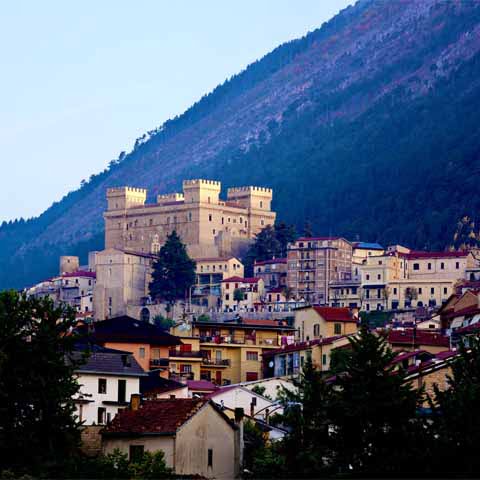
The sixteenth century changed the city’s masters. After L’Aquila backed the losing side against the Spanish crown, the viceroyalty answered with stone: from 1534 the great Spanish Fort rose at the highest point of the city, a state-of-the-art bastioned citadel designed by the military engineer Pirro Aloisio Scriva, built to watch the city as much as to defend it. Its massive walls and moat survive intact, and its silhouette still crowns the town.

Under Spanish and then Bourbon rule the city settled into a quieter provincial dignity, punctuated by catastrophe: the earthquake of 1703 leveled much of the medieval fabric, and L’Aquila rebuilt itself in the baroque taste of the day. That rebuilding gave the center its present layered character, Romanesque facades beside baroque domes, and proved for the first time on record that this city answers destruction with reconstruction.

The baroque rebirth left masterpieces of its own: the church of Santa Maria del Suffragio, raised by the survivors of 1703 in memory of the lost and crowned in the nineteenth century with an elegant dome, and the gilded wooden ceiling and great organ that transformed the interior of San Bernardino. Walking the center today, travelers read this dialogue of centuries on every block, and a guide who can point out where medieval stone meets baroque invention turns the streets into an open book of resilience.

How Did L'Aquila Enter the Modern Era?

With Italian unification in 1860, L’Aquila became the capital of the Abruzzo region within the new kingdom, seat of prefecture and province, its role confirmed by the handsome nineteenth-century palaces of the Emiciclo, today the seat of the regional council. The railway arrived, the university tradition consolidated, and the city grew as the administrative and intellectual heart of the central Apennines.

The twentieth century added chapters both somber and remarkable. In 1943, in one of the most audacious episodes of the Second World War, the deposed Mussolini was held at the hotel on Campo Imperatore high above the city until German gliders landed on the plateau to carry him away, a story every guide on the mountain still tells. In the postwar decades, the city built its modern identity around learning: the university expanded, the concert society brought world-class music to the mountains, and beneath Gran Sasso engineers carved the world’s greatest underground physics laboratory, where scientists from across the planet now study the deepest questions of the universe in the silence of the rock.

By the early twenty-first century L’Aquila was a flourishing university capital of art, science, and mountain life, a city whose depth of history was matched by an unusually young population, and whose next chapter would prove to be its most extraordinary.

How Has the City's Restoration Become a Renaissance?

The earthquake of April 2009 tested L’Aquila as few European cities have been tested in our lifetime. The response became one of the largest and most sophisticated heritage restoration campaigns in history: an entire historic center studied, secured, and returned to life stone by stone, fresco by fresco, with conservators, engineers, and master craftsmen from across Europe making the city their workshop.

The results speak in the streets. The Basilica di Collemaggio was restored to its luminous medieval form in a celebrated project completed in 2017, the church of Santa Maria del Suffragio reopened with its dome renewed through French partnership, the Spanish Fort’s quarter hums again, and block after block of the center has emerged cleaner, stronger, and more beautiful than living memory can recall. Renzo Piano’s timber auditorium in the castle park announced early that the city’s answer to loss would be creation.

Today travelers experience something genuinely rare: a Renaissance in progress. Artisans work at their benches behind Renaissance portals, the university and research institutes fill the reborn center with students, and Italy has crowned the achievement by naming L’Aquila its Capital of Culture for 2026. Visiting now means witnessing the most hopeful chapter in the city’s seven-century habit of rising again, and we design itineraries that let travelers meet the people writing it.

Which Places Bring L'Aquila's History to Life Today?

Collemaggio first, always: the facade, the Holy Door, the tomb of Celestine V, and the lawn where a hermit was crowned pope in 1294. The Basilica di San Bernardino carries the Renaissance chapter, the Fontana delle 99 Cannelle the founding legend, and the Spanish Fort the age of viceroys; together they compress seven centuries into a single day’s unhurried walk.

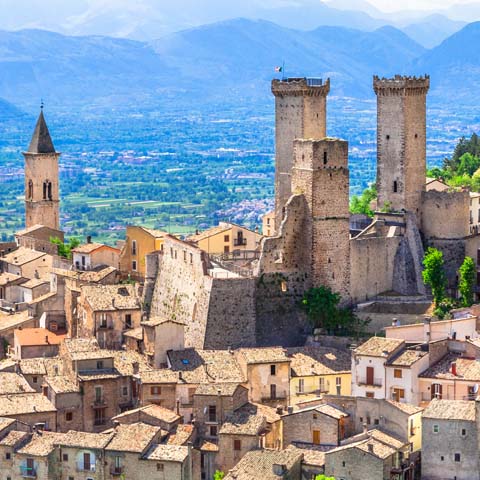
The National Museum of Abruzzo gathers the region’s memory in beautifully restored quarters near the great fountain, from the skeleton of a prehistoric mammoth found in the valley to medieval wooden Madonnas, Renaissance panels, and the treasures of churches across the mountains. Beyond the walls, history climbs the hills: Rocca Calascio, the highest fortress of the Apennines, the Medici-marked lanes of Santo Stefano di Sessanio, and the frescoed oratory of Bominaco, each a chapter of the same mountain story.

Sequence turns these sites into a narrative. We compose history-focused days chronologically where interests allow, from the founding fountain to the restoration workshops, guided by historians chosen for their storytelling gift, as part of our cultural tours of Italy. Three centuries or seven, the story lands differently when it is told in the right order, in the right rooms.

Ready to Begin Planning Your L'Aquila Vacation?

L’Aquila deserves more than a template. Since 2003, Trips 2 Italy has designed private Italian vacations one traveler at a time, hand selecting every experience based on what you tell us rather than fitting you into a predefined package. Our Italian-born team plans L’Aquila with the knowledge of people who call Italy home, from the pink and white facade of Collemaggio to the high meadows of Campo Imperatore, and we remain at your side throughout your trip with 24/7 assistance. Tell us how you imagine L’Aquila, and we will craft the itinerary that matches it.

Explore Our L'Aquila Vacation Itineraries

Frequently Asked Questions About the History of L'Aquila

Around 1254, when the castles and villages of the Aterno valley united to build a new city, traditionally ninety-nine of them, each endowing its own quarter with a church, square, and fountain. Destroyed in 1259, the city was refounded within a decade and raised the Fontana delle 99 Cannelle in 1272 to honor its founders.

Pietro da Morrone was a hermit from the Abruzzo mountains elected pope in 1294 and crowned at L’Aquila’s Basilica di Collemaggio. He instituted the Perdonanza, the world’s first jubilee, then resigned the papacy within months, the only pope to do so freely for over seven centuries. He rests in a Renaissance mausoleum inside the basilica.

The Forte Spagnolo is a massive bastioned citadel begun in 1534 under the Spanish viceroyalty after the city rebelled against the crown. Its walls and moat survive intact at the top of the town, surrounded by the city’s finest park, and its silhouette remains one of L’Aquila’s defining landmarks.

It became the site of one of Europe’s largest heritage restoration campaigns, with churches, palaces, and entire streets returned to life by master craftsmen and conservators. The Basilica di Collemaggio reopened in 2017 after a celebrated restoration, the reborn center earned L’Aquila the title of Italian Capital of Culture for 2026, and Trips 2 Italy designs itineraries that let travelers witness this renaissance up close, including encounters with the restoration world itself.

Yes. In 1943 the deposed dictator was held at the hotel on Campo Imperatore, the high plateau above L’Aquila, until German glider troops landed on the mountain and carried him away. The episode remains one of the most extraordinary stories of the Second World War, and guides on Gran Sasso still recount it on the very spot.

Yes, and it transforms the visit. Trips 2 Italy pairs travelers with historians and licensed guides who unfold the founding legend, the story of Celestine V, and the restoration renaissance in the places where they happened, sequencing the day so seven centuries arrive as a story rather than a list of monuments.