Aquileia and Wine Tasting
Italy’s famed wines and the historical village of Aquileia are the focus of this enjoyable 4.3-hour walking tour, ideal for those who want to get a real taste of
L’Aquila Travel Guide Culture History Food and Wine Things to Do Plan My Trip
About this guide: This L’Aquila travel guide was written by the Italian-born travel specialists at Trips 2 Italy, a custom tour operator that has designed hand-crafted Italian vacations since 2003. Every recommendation below reflects the same first-hand knowledge our team draws on when we build a private L’Aquila itinerary around a traveler’s interests, dates, and pace. Read it for your research, then let us translate it into a trip designed entirely around you.
L’Aquila begins with a legend no other Italian city can match. In the middle of the thirteenth century, the story goes, ninety-nine castles of the surrounding valleys joined together to found a single city, and each built its own square, its own church, and its own fountain within the new walls. The number ninety-nine became the city’s signature, rung out to this day by the civic bell tower each evening, and it explains why a mountain city of modest size holds such an astonishing density of churches, palaces, and piazzas.
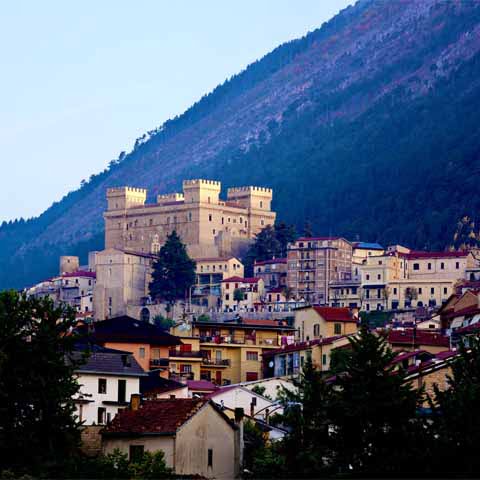
The city is the historic capital of the Abruzzo region, set high in a broad valley beneath Gran Sasso, the tallest massif of the Apennines. That setting gives L’Aquila a character unlike any other Italian regional capital: crisp mountain light, snow-capped peaks framing Renaissance facades, and wild high country beginning minutes from the cathedral square.
L’Aquila is also one of the most inspiring stories in Italy today. After the earthquake of 2009, the city undertook one of the largest and most meticulous heritage restoration projects Europe has ever seen, and the result is a historic center reborn: facades cleaned to their original honey-colored stone, frescoes conserved by master craftsmen, and a young, energetic city moving back into its beautiful old rooms. Italy recognized that renaissance by naming L’Aquila its Capital of Culture for 2026.
Our specialists have followed this rebirth closely, and we design L’Aquila itineraries for travelers who want an Italy of substance: profound history, genuine mountain culture, and landscapes that stop conversation. This guide distills what we know, and every trip we build from it is composed by hand around what you tell us.
L’Aquila sits at roughly 2,300 feet above sea level in the valley of the Aterno river, making it one of the highest regional capitals in Italy. To the northeast rises the Gran Sasso d’Italia, whose summit, the Corno Grande, is the highest peak in the Apennines at just over 9,500 feet. To the south and west spread the Navelli plateau and the ranges of the Velino and Sirente, so the city is ringed by mountains on every horizon.
That altitude shapes everything travelers experience. Summers are warm by day and refreshingly cool by night, a welcome contrast to the heat of the lowland cities, while winters bring genuine snow and a clear alpine light. The surrounding province holds two vast protected areas, the Gran Sasso and Monti della Laga National Park and the Sirente Velino Regional Park, which together protect wolves, chamois, golden eagles, and some of the wildest country in the Italian peninsula.
The geography also explains the city’s table and its calendar. High pastures feed the flocks that define the local cuisine, the sunny Navelli plateau produces one of the world’s most prized saffron crops, and the plateau of Campo Imperatore, often called Italy’s Little Tibet, turns from ski terrain in winter to a sea of wildflowers and grazing herds in early summer. Few Italian cities live so closely with their landscape, and a well-designed itinerary lets you feel that intimacy every day.
Late August holds the city’s defining event. The Perdonanza Celestiniana, the festival of forgiveness instituted by Pope Celestine V in 1294 and recognized by UNESCO as Intangible Cultural Heritage, fills the last days of August with historical processions, concerts, and the ceremonial opening of the Holy Door at the Basilica di Santa Maria di Collemaggio. Experiencing it well requires planning, and it rewards that planning richly.
Autumn is the connoisseur’s season. Late October brings the saffron harvest on the Navelli plateau, when the purple crocus fields are picked by hand at dawn, and the mountain woods turn gold while the kitchens fill with truffles, chestnuts, and new cheeses. Spring answers with snowmelt streams, wildflowers climbing the slopes, and comfortable weather for exploring both the city and the hill villages around it.
Summer is the season of the high country, when Campo Imperatore offers cool air, long days, and some of the finest walking in Italy, and the city’s squares fill with evening life. Winter turns Gran Sasso into a quiet, atmospheric snow world with skiing on historic slopes. Whenever you travel, we align the itinerary with what the mountains and the calendar are actually doing, so the season becomes an asset rather than an accident.
The year 2026 adds a reason all its own: as Italian Capital of Culture, L’Aquila is hosting a full calendar of exhibitions, concerts, and special openings across its restored palaces and churches, and the city is welcoming visitors with an energy that has been building for years. Travelers who come now will see a great Italian city in the most celebratory chapter of its modern story, and we track the program closely so your dates align with its best moments.
Two full days serve the city itself well: one for the great monuments, from the Basilica di Collemaggio and the Basilica di San Bernardino to the Spanish Fort and the Fontana delle 99 Cannelle, and one for the museums, the artisan workshops, and the unhurried pleasures of the porticoed corso and the cafe squares. L’Aquila’s compact center rewards exactly this kind of measured pace.
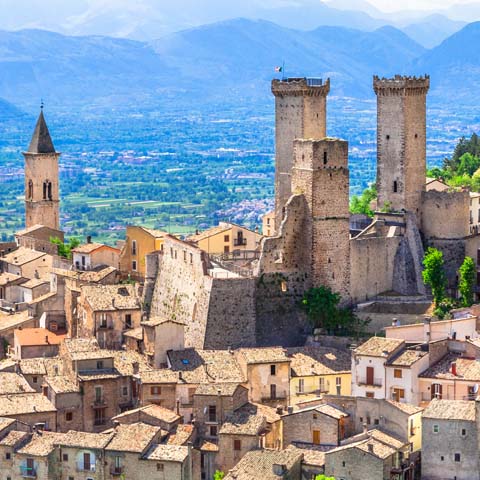
A third and fourth day transform the visit, because the country around L’Aquila is among the most spectacular in Italy. One day belongs to Gran Sasso and Campo Imperatore, riding the cable car to the high plateau and lunching on mountain fare, and another to the hill villages: Rocca Calascio, the ruined fortress at 4,800 feet that cinema has made famous, Santo Stefano di Sessanio with its beautifully restored medieval lanes, and Bominaco, whose frescoed oratory is called the Sistine Chapel of Abruzzo.
Travelers with more time use L’Aquila as a base for the wider region, reaching Sulmona, the lakes, and the national parks on successive days. Because every Trips 2 Italy itinerary is designed by hand, we weigh L’Aquila against the other chapters of your Italian journey and give it the nights that serve the whole trip best.
The historic center is the city’s heart, laid out on a gentle slope within its medieval walls. Piazza del Duomo, the great market square, anchors the lower town, while the Corso Vittorio Emanuele, the porticoed main street, climbs toward the Fontana Luminosa and the park of the Spanish Fort. Between them run streets of Renaissance and baroque palaces whose courtyards reward every curious glance.
Two landmarks bracket the center. At the eastern edge, beyond the walls, stands the Basilica di Santa Maria di Collemaggio on its wide green lawn, its facade of pink and white stone one of the most beautiful in Italy. At the southwestern corner, in the old Rivera quarter, the Fontana delle 99 Cannelle pours from ninety-nine carved spouts into a stone courtyard that has served the city since 1272.
Around the Spanish Fort spreads the city’s finest park, home to the Auditorium del Parco, the colorful concert hall designed by Renzo Piano as a gift to the reborn city. The quarter near the fountain holds the National Museum of Abruzzo in a handsomely restored setting. Where you stay shapes the trip, and matching the base to the traveler, whether a palazzo in the center or a countryside estate beneath the mountains, is one of the first decisions we make together.
Beyond the walls, the territory itself becomes part of the address book: Assergi and Fonte Cerreto at the foot of the Gran Sasso cable car, the villages of the Navelli plateau amid the saffron fields, and the restored stone hamlets toward Rocca Calascio, where travelers can sleep inside medieval lanes with the peaks outside the window. Each base gives the same itinerary a different soul, and choosing well is a judgment our specialists have refined over hundreds of Abruzzo journeys.
Within the walls, on foot. The historic center is compact and largely calm, arranged so that the basilicas, the fort, the fountain, and the squares connect through a pleasant hour of walking, with cafes placed exactly where a pause feels right. The climb of the corso is gentle, and the evening passeggiata along it is one of the city’s daily pleasures.
For everything beyond the center, we arrange private drivers who know these mountains intimately. The roads to Campo Imperatore, Rocca Calascio, and the Navelli plateau are spectacular but demand local knowledge, and a driver turns them into pure scenery: every viewpoint stopped for, every village lane navigated with ease, every mountain lunch reached without a moment of stress. The Gran Sasso cable car from Fonte Cerreto lifts travelers to the high plateau in minutes, and we time it to the clearest hours.
Arrivals are simpler than the mountain setting suggests. Rome lies about an hour and a half away by road, which makes L’Aquila one of the most accessible alpine-feeling destinations in Italy, and we arrange every transfer in advance so the journey from a Roman hotel or airport to the mountains unfolds seamlessly. In a landscape this dramatic, thoughtful logistics are not a detail. They are the difference between seeing the Apennines and being carried through them.
L’Aquila’s position makes it a natural mountain chapter in a larger Italian story. Rome lies about ninety minutes to the west, so the city pairs effortlessly with the capital, offering cool air, silence, and wild landscapes as the perfect counterpoint to Roman intensity. Eastward, the road descends through the Abruzzo hills toward Sulmona and the Adriatic, opening a coast-to-mountains journey few travelers ever think to make.
The occasion shapes the composition. For travelers drawn to the outdoors, L’Aquila anchors active trips in Italy built around hiking, cycling, and the high country of Campo Imperatore. For those who plan around the table, the saffron fields, mountain cheeses, and honest trattorias become part of a wine and culinary journey. And for those composing something larger, the city becomes a chapter in a custom trip to Italy designed entirely from what you tell us.
This guide is one of five we have written on the city. Continue with our L’Aquila culture guide, L’Aquila history guide, L’Aquila food and wine guide, and L’Aquila things to do guide, or widen the lens with our Abruzzo travel guide to see the region around the city.
L’Aquila deserves more than a template. Since 2003, Trips 2 Italy has designed private Italian vacations one traveler at a time, hand selecting every experience based on what you tell us rather than fitting you into a predefined package. Our Italian-born team plans L’Aquila with the knowledge of people who call Italy home, from the pink and white facade of Collemaggio to the high meadows of Campo Imperatore, and we remain at your side throughout your trip with 24/7 assistance. Tell us how you imagine L’Aquila, and we will craft the itinerary that matches it.

Italy’s famed wines and the historical village of Aquileia are the focus of this enjoyable 4.3-hour walking tour, ideal for those who want to get a real taste of
Emphatically yes. L’Aquila offers one of Italy’s great churches in the Basilica di Collemaggio, a UNESCO-recognized festival in the Perdonanza Celestiniana, the highest peaks of the Apennines at its doorstep, and a historic center whose restoration has made it one of the most inspiring city stories in Europe. Italy named it Capital of Culture for 2026 in recognition of exactly that renaissance.
About ninety minutes to two hours by road, which makes L’Aquila one of the easiest mountain destinations in Italy to reach. Trips 2 Italy arranges private transfers from Rome, so the journey from the capital to the high Apennines becomes a scenic drive rather than a logistical puzzle, with stops along the way if the itinerary invites them.
Two days serve the city’s basilicas, museums, and squares well, and a third and fourth day open Gran Sasso, Campo Imperatore, and the hill villages of Rocca Calascio, Santo Stefano di Sessanio, and Bominaco. Because we design every itinerary by hand, the right length depends on how L’Aquila fits within your wider Italian journey.
Late August brings the Perdonanza Celestiniana, late October the saffron harvest on the Navelli plateau, summer the wildflowers and cool air of Campo Imperatore, and winter the snow of Gran Sasso. Every season offers a different city, and the specialists at Trips 2 Italy align your dates with what the mountains and the calendar are doing.
Yes, and beautifully so. The years since 2009 have seen one of Europe’s most meticulous restoration campaigns, and the center today rewards visitors with cleaned facades, reopened churches and museums, lively squares, and the energy of a university city returning to its historic rooms. Watching a city practice heritage craftsmanship at this scale is itself a reason to visit.
The founding legend of the ninety-nine castles and the Fontana delle 99 Cannelle, the Basilica di Collemaggio where Celestine V instituted the world’s first jubilee in 1294, saffron from the Navelli plateau, arrosticini and mountain cuisine, and the Gran Sasso massif with the high plateau of Campo Imperatore.