Things To Do in Lecce

HOME » POPULAR ITALIAN DESTINATIONS » LECCE TRAVEL GUIDE » LECCE THINGS TO DO GUIDE

Lecce Travel Guide        Culture        History        Food and Wine        Things to Do        Plan My Trip

About this guide: This guide to things to do in Lecce was written by the Italian-born travel specialists at Trips 2 Italy, a custom tour operator that has designed hand-crafted Italian vacations since 2003. Every recommendation below reflects the same first-hand knowledge our team draws on when we build a private Lecce itinerary around a traveler’s interests, dates, and pace. Read it for your research, then let us translate it into a trip designed entirely around you.

What Belongs at the Top of Every Lecce Itinerary?

Begin with the baroque trinity. The Basilica di Santa Croce’s facade is the most celebrated wall in southern Italy, a century of carving crowned by its great rose window, and it deserves both a morning study and a return visit at dusk when the stone ignites. Piazza del Duomo follows, the enclosed square whose cathedral, bell tower, Bishop’s Palace, and Seminary compose one of Italy’s great urban stage sets, entered through a single gateway that makes every arrival a reveal.

Piazza Sant’Oronzo completes the essential triangle: the Roman amphitheatre sunk at its center, the patron saint’s column brought from Brindisi rising above, and the city’s cafe life arranged around both. Between the three landmarks, the lanes deliver the rest, Sant’Irene, Santa Chiara, San Matteo, the Castle of Charles V, and Porta Napoli, all within a quarter hour’s walk of one another.

The compact center rewards guided depth, and it anchors the region explored in our Apulia travel guide. We pair travelers with art historians who unfold the facades symbol by symbol, arrange visits timed to the light and the quiet hours, and sequence the great set pieces so each arrives at its theatrical best rather than its busiest.

What Is the Signature Lecce Experience?

The evening passeggiata through the golden center is the experience no traveler forgets. As the sun drops, the pietra leccese turns from honey to amber to rose, the street lamps take over, and the whole city drifts between Sant’Oronzo and the Duomo at conversation pace, gelato and aperitivo in hand. The baroque was designed as theater, and evening is when the performance plays.

The connoisseur’s version adds the workshops. An hour in a cartapesta studio, watching a master build a saint from paper, wire, and fire, connects the city’s craft soul to its carved facades, and a stone carver’s atelier explains the material that made the baroque possible. These visits, arranged through our relationships with the artisans, transform Lecce from a beautiful backdrop into a living workshop.

For a final layer, we arrange rooftop and bell tower vantages where travelers take in the whole composition at once, the domes and campaniles of the center with the Adriatic glinting beyond, and evening concerts in baroque churches or the gilded Politeama Greco when the season offers them. Lecce’s signature is not a single sight but an atmosphere, and we design evenings that let travelers settle into it completely.

Morning has its own signature: the amphitheatre at first light with the square to yourself, a warm pasticciotto and a caffe leccese at a historic counter, and the churches in their quietest hour before the day begins. Travelers who give Lecce both ends of the day discover two different cities, and our itineraries are paced so they can.

Which Beaches and Coastal Wonders Lie Near Lecce?

The Adriatic coast east of the city is a sequence of small marvels. The Grotta della Poesia at Roca Vecchia, a natural limestone pool ringed by low cliffs beside a Messapian archaeological site, is one of the Mediterranean’s most photogenic swimming places, its name, the Cave of Poetry, earned by legend and deserved by looks. Nearby, Torre dell’Orso pairs a white crescent beach with the twin sea stacks called the Two Sisters, and pine woods shade the dunes behind.

The Ionian side answers with a different beauty: long shallow golds around Gallipoli and Porto Cesareo, dune parks and watchtowers, and the wild coves of the Porto Selvaggio nature reserve, where a swim is earned by a walk through pines and rewarded with some of the clearest water in Italy. San Cataldo, fifteen minutes from the center, remains the leccesi’s own quick escape.

Because the peninsula is narrow, a single day can hold both seas, a morning at the Grotta della Poesia and a sunset swim on the Ionian, with a masseria lunch between. We compose beach days with private drivers who know which coves suit which wind, reserve beach club comforts in high season, and time coastal excursions so the famous spots arrive before or after their busiest hours.

Wind is the local secret. The Salento’s beach culture reads the day’s breeze the way sailors do, choosing the Adriatic when the wind blows from one quarter and the Ionian when it turns, and a driver who knows that habit can rescue a beach day that a fixed plan would lose. It is a small example of why local knowledge, not a list of famous names, makes coastal itineraries succeed.

Is Otranto Worth a Day Trip From Lecce?

Emphatically. Italy’s easternmost town, about forty-five minutes from Lecce, packs an extraordinary density of history inside its walls: the Aragonese castle, the lanes of the old town above a turquoise harbor, and a cathedral holding one of the medieval world’s great artworks, the twelfth-century mosaic floor on which the monk Pantaleone laid out the tree of life, months, monsters, and legends across the entire nave.

The cathedral also keeps the town’s darkest chapter: the chapel of the martyrs of 1480, commemorating the townspeople killed in the Ottoman sack of Otranto, an event that shook Renaissance Europe. Few places in Italy hold beauty and gravity in such close quarters, and a guide who can read the mosaic’s symbols transforms the visit entirely.

The coast road between Lecce’s latitude and Otranto adds its own rewards, from the Alimini lakes to swimming coves, and continuing south beyond Otranto leads to sea caves and the lighthouse of Santa Maria di Leuca, the very tip of the heel, where Salento tradition says the two seas meet. We compose these runs as single fluid days with a private driver, so the coast unfolds without a minute’s logistics.

What Does Gallipoli Offer on the Ionian Side?

Gallipoli, the beautiful city of the Greeks by name, splits in two: a modern town on the mainland and an old town packed onto a small island reached by a seventeenth-century bridge, ringed by walls and washed by the Ionian on every side. Inside, whitewashed lanes hide a baroque cathedral of Lecce-stone exuberance, a Greek fountain, and a fishing culture still landing its catch at dawn beside the castle.

The town’s western exposure makes it the Salento’s sunset capital, and an evening on the ramparts, watching the sun sink into the Ionian while the fishing fleet returns, is one of the peninsula’s essential hours. The beaches south of town, from Baia Verde’s lidos to the wild dunes of Punta della Suina, are among the most loved in southern Italy.

We design Gallipoli days that combine the old town’s morning fish market and lanes with a beach afternoon and the sunset ramparts, timed and sequenced by a driver who knows the coast’s rhythms. Paired with Otranto on the opposite shore, it completes the Salento’s perfect pair of maritime day trips, one facing the sunrise and one the sunset.

In summer the town doubles as the Salento’s most spirited evening scene, its lanes filling with music and its seafood tables spilling onto the walls, while spring and autumn return it to the fishermen and the light. Both versions reward a visit, and we match the day to the season and to the traveler, lively for some itineraries, contemplative for others.

Where Is the Quieter Side of Lecce and the Salento?

Inland, mostly. The villages of the Grecia Salentina, where the Griko dialect descended from Greek still survives, keep frescoed Byzantine crypts, weekly markets, and squares where the pizzica is danced for neighbors rather than audiences. Galatina, half an hour south, guards the basilica of Santa Caterina d’Alessandria, whose fourteenth-century fresco cycles rank among southern Italy’s greatest and least-visited artistic treasures.

The countryside itself is the other quiet. The Salento’s dry stone lanes thread olive groves toward fortified masserie, many now working estates that welcome visitors for lunch, oil tastings, or a night among the groves, and the megalithic dolmens and menhirs scattered through the fields whisper of the peninsula’s deepest past. Even the coasts keep secrets, from the Porto Selvaggio pines to the coves south of Otranto.

Within Lecce, quiet is a matter of hours: the churches at opening time, the courtyards of the Giravolte district in the siesta lull, the amphitheatre at first light before the cafes wake. Our itineraries deliberately alternate the celebrated with the hidden, because the alternation is what keeps a Salento journey feeling like discovery rather than a checklist.

What Day Trips and Extensions Pair Well With Lecce?

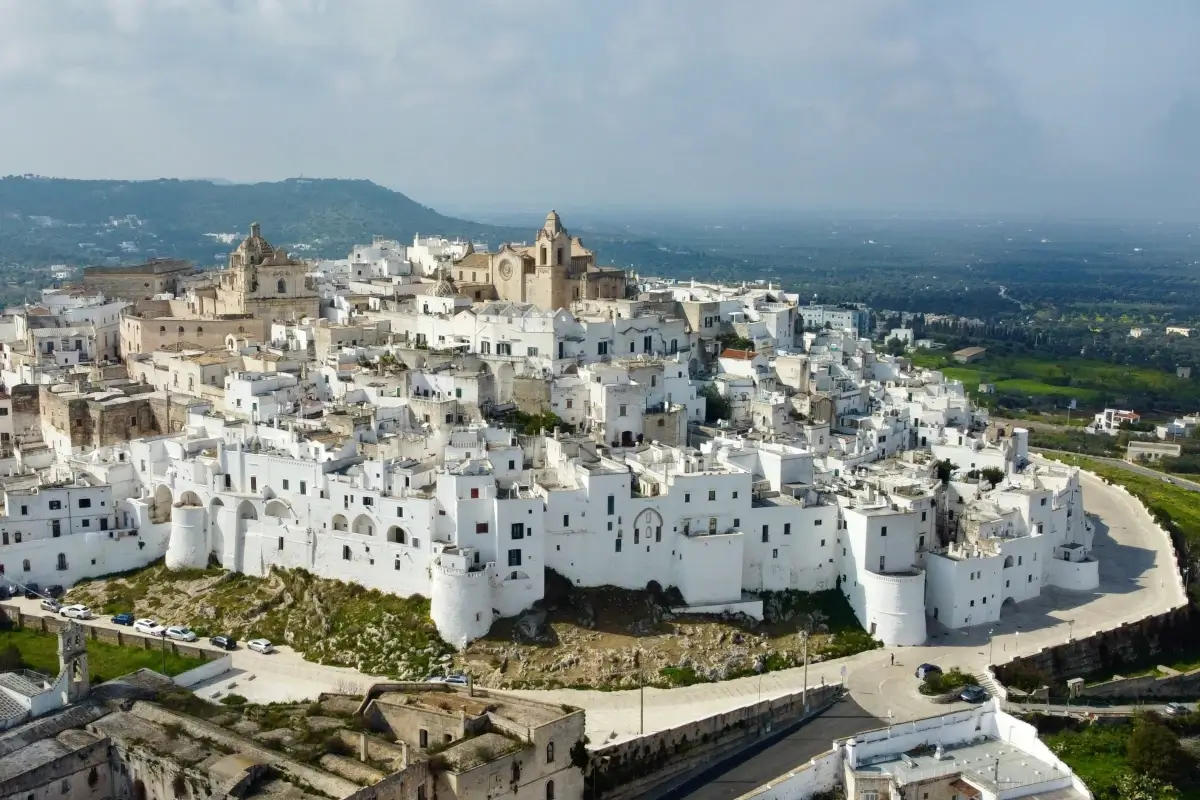
Within the Salento, the essential rotation is Otranto, Gallipoli, the Grotta della Poesia coast, Galatina’s frescoes, and a masseria or wine estate day in between. Further north, the white towns of the Itria Valley, Ostuni, Locorotondo, and the trulli of Alberobello, sit within comfortable reach, and Matera’s ancient stone districts across the regional border make a spectacular overnight extension for travelers continuing their southern journey.

The peninsula’s flat lanes and sea breezes also make it one of Italy’s most pleasant landscapes for gentle cycling, from olive grove routes to coastal towers, experiences we fold into itineraries as part of our active trips in Italy. For families, the Salento is a natural fit, with shallow Ionian beaches, castle ramparts, and cartapesta workshops that hold every generation’s attention, woven into our family vacations to Italy.

How far to reach depends on the trip’s rhythm, and that judgment is our craft. As part of a custom trip to Italy, we sequence Lecce’s days so the city, the two coasts, and the countryside each get their ideal hours, with every transfer arranged and supported around the clock. The Salento rewards travelers who resist the urge to see everything, and we design itineraries that make that restraint feel like luxury.

Ready to Begin Planning Your Lecce Vacation?

Lecce deserves more than a template. Since 2003, Trips 2 Italy has designed private Italian vacations one traveler at a time, hand selecting every experience based on what you tell us rather than fitting you into a predefined package. Our Italian-born team plans Lecce with the knowledge of people who call Italy home, from the carved facades of the baroque center to the twin coastlines of the Salento, and we remain at your side throughout your trip with 24/7 assistance. Tell us how you imagine Lecce, and we will craft the itinerary that matches it.

Explore Our Lecce Vacation Itineraries

Frequently Asked Questions About Things to Do in Lecce

The baroque center itself: the Basilica di Santa Croce’s celebrated facade, the enclosed stage set of Piazza del Duomo, and the Roman amphitheatre in Piazza Sant’Oronzo, ideally crowned by the evening passeggiata when the golden stone ignites at dusk. Trips 2 Italy pairs these with art historians and times each set piece to its best light and quietest hours.

Yes, in season. The natural limestone pool at Roca Vecchia, about thirty minutes from Lecce, is one of the Mediterranean’s most beautiful swimming places, set beside a Messapian archaeological site. It is best early or late in the day in summer, and we time coastal excursions so travelers experience it before the crowds arrive.

They are different pleasures: Otranto offers the great twelfth-century mosaic floor, the Aragonese castle, and a turquoise harbor on the Adriatic, while Gallipoli answers with an island old town, a dawn fish market, and the Salento’s finest sunsets on the Ionian. Most Lecce itineraries we design include both, one facing the sunrise coast and one the sunset coast.

Four or five nights is the sweet spot: two days for the baroque city and its workshops, and two or three for Otranto, Gallipoli, the beaches, and the countryside masserie. Travelers combining the Salento with the Itria Valley or Matera typically add two or three more nights, and Trips 2 Italy shapes the balance around your interests.

Very. The center is flat, compact, and traffic-free, the cartapesta workshops fascinate children, the castle and amphitheatre make history physical, and the Salento’s shallow Ionian beaches are among the most family-friendly in Italy. We compose family itineraries so baroque art and beach days balance each other, with private drivers keeping every excursion effortless.

The passeggiata through the illuminated baroque center is the essential ritual, followed by an aperitivo with Salento rosato, dinner in a courtyard trattoria, and in season a concert in a baroque church or at the historic Politeama Greco theater. In late August the feast of Sant’Oronzo adds processions and spectacular street illuminations, and summer nights across the peninsula ring with pizzica festivals.