
A Taste of Umbria Tour | Vacation Packages for 2025 – 2026
Discover Bettona, Assisi and Perugia as hilltop towns, art, olive oil and chocolate reveal the heart of Umbria’s timeless charm. Starting from $998 per person.
HOME » POPULAR ITALIAN DESTINATIONS » SPOLETO TRAVEL GUIDE » SPOLETO THINGS TO DO GUIDE
Spoleto Travel Guide Culture History Food and Wine Things to Do Plan My Trip
About this guide: This guide to things to do in Spoleto was written by the Italian-born travel specialists at Trips 2 Italy, a custom tour operator that has designed hand-crafted Italian vacations since 2003. Every recommendation below reflects the same first-hand knowledge our team draws on when we build a private Spoleto itinerary around a traveler’s interests, dates, and pace. Read it for your research, then let us translate it into a trip designed entirely around you.
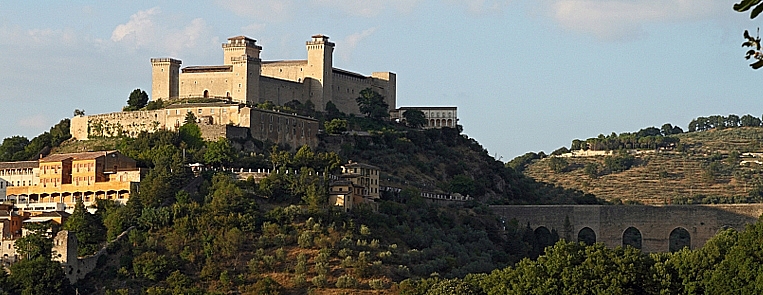
Three encounters define a first visit. The Rocca Albornoziana, the six-towered papal fortress crowning the town, holds the National Museum of the Duchy of Spoleto and commands the finest views in this corner of Umbria. The Duomo below it keeps Filippo Lippi’s final fresco cycle glowing in its apse. And the Ponte delle Torri, the ten-arched medieval aqueduct bridge striding the gorge, delivers the single image every traveler carries home.
The pleasure is how naturally they connect. From Piazza del Duomo, lanes climb to the fortress; the level path around its base opens suddenly onto the bridge and the wooded gorge; and the descent returns you through the oldest quarters to the market square. Two unhurried hours cover the circuit, though most travelers find reasons to take four.
Timing is the quiet secret. The cathedral square is at its most beautiful at first light and again in late afternoon when the sun reaches the facade mosaic; the fortress walk is glorious toward sunset; and midday belongs to museums and long lunches. We sequence Spoleto days around exactly these hours, with guides who turn stones into stories and access arranged in advance.
Around the essential trio orbit the pleasures that fill out a first day: the Arch of Drusus and Germanicus opening onto the market square, the Roman theatre at the town’s edge, an aperitivo on Corso Mazzini as the passeggiata flows past, and dinner under medieval vaults with a glass of Trebbiano Spoletino. Spoleto’s greatest luxury is that none of this requires hurry.
Spoleto’s signature experience costs nothing and asks only shoes. The Giro della Rocca, the level panoramic path circling the fortress hill, and its extension the Giro dei Condotti, which follows the line of the old aqueduct conduits along the flank of Monteluco, together form one of the loveliest short walks in central Italy: cypress and holm oak, the gorge falling away below, and the Ponte delle Torri appearing and reappearing at ever more dramatic angles.
The full circuit takes under an hour at a stroll, remains nearly flat the entire way, and delivers views that photographers plan whole days around: the fortress above, the bridge spanning the ravine, the valley opening north toward Assisi, and the wooded mountain pressing close behind. At sunset the stone turns copper and the swifts take over the gorge.
Goethe walked here in 1786 and recorded his admiration for the bridge in his Italian Journey; the view has scarcely changed. We build the walk into nearly every Spoleto itinerary we design, timed to the light and paired with an aperitivo afterward in the upper town, and for keener walkers we extend it up Monteluco’s pilgrim path or along the aqueduct trails into the gorge.
The Duomo comes first: Lippi’s Life of the Virgin frescoes and his tomb, the Cappella Eroli painted by Pinturicchio, the 1207 facade mosaic, and an autograph letter of St Francis preserved within. The fortress museum follows, walking visitors from the Lombard duchy through the papal centuries in rooms that include the frescoed Camera Pinta. The National Archaeological Museum, arranged beside the Roman theatre, keeps the Lex Spoletina stones that protected the sacred forest twenty-two centuries ago.
The churches form a Romanesque constellation: Sant’Eufemia with its rare matroneum galleries, San Gregorio Maggiore in the lower town, the Basilica of San Salvatore on the UNESCO Longobards listing, and San Pietro extra moenia, whose sculpted facade of lions, wolves, and moral fables is the finest Romanesque storytelling in Umbria. Casa Romana adds a patrician Roman house with mosaic floors beneath the town hall.
Spoleto’s collections are blessedly human in scale: nothing requires a half day, everything sits minutes apart, and quiet is normal rather than lucky. We compose art-and-history days with specialist guides, arrange entries so the hours flow without queues, and match depth to appetite, from a highlights morning to a full connoisseur’s circuit.
Lovers of the modern arts have their own Spoleto. Palazzo Collicola, the town’s museum of modern and contemporary art, grew from the festival’s decades of artistic traffic, and Alexander Calder’s monumental Teodelapio, created for the celebrated 1962 exhibition of sculpture in the city, still commands its piazza by the station, greeting travelers with the message that this medieval town keeps one foot firmly in the twentieth century and beyond.
Above the Ponte delle Torri rises Monteluco, the mountain of the sacred grove, its dense holm oak forest protected since the third century BC, when the Lex Spoletina made cutting it a crime against the gods. Hermits settled its caves in late antiquity, and in 1218 St Francis founded the small hermitage that still crowns the summit, a place of wells, tiny cells, and terraces looking over half of Umbria.
The ascent is an experience in itself. Walkers take the old pilgrim path from the bridge through the forest, a steady climb of about an hour through filtered green light, while a scenic road winds to the top for everyone else. At the summit, the Bosco Sacro’s clearings, the hermitage of San Francesco, and the belvedere terraces reward the journey; Michelangelo himself came in 1556 seeking the mountain’s silence.
We arrange Monteluco as each traveler wants it: a guided forest walk with the pilgrim route’s stories, a private visit to the Franciscan sanctuary, or simply a driver to the summit for the views and a slow descent on foot. Paired with the fortress walk below, it makes one of the finest active mornings in central Italy.
Spoleto is already the quieter side of Umbria, but its deepest calm hides in plain sight. The lanes of the upper town above Sant’Eufemia see few visitors even in festival season, the amphitheatre district of the lower town rewards aimless walking, and San Pietro’s sculpted facade, five minutes below the walls, is routinely admired in complete solitude. Early morning in Piazza del Duomo, before the first tour arrives, may be the most beautiful free experience in the region.
Evenings are the town’s gift. When the day visitors leave, Spoleto returns to its residents: the passeggiata flows along Corso Mazzini, the wine bars fill with local conversation, and the fortress, floodlit above the rooftops, keeps watch over piazzas that have gone back to belonging to the town. Dinner reserved in a vaulted cellar room, then a lamplit walk home, completes the day.
We deliberately build unscheduled hours into every Spoleto itinerary, because the town rewards wandering more than almost any destination we plan. The travelers who fall hardest for Spoleto are always the ones whose itinerary left room for it to happen.
Behind Spoleto opens the Valnerina, the steep green valley of the Nera river, one of the most beautiful and least-visited corners of central Italy: fortified hamlets like Vallo di Nera and Scheggino above the rushing water, trout farms and truffle woods, and mountain scenery that feels a century removed from the valley’s calm. At its head sits Norcia, birthplace of St Benedict and capital of Italian pork butchery, its shops a pilgrimage for every serious eater.
South of the valley thunders the Cascata delle Marmore, among the tallest waterfalls in Europe at some 540 feet, and astonishingly a Roman public work: the consul Curius Dentatus first cut the channel that sends the Velino river over the cliff in 271 BC. Its flow is regulated, opening in scheduled releases that turn the gorge into spectacle, and we time visits so travelers stand at the belvedere for the moment the water arrives.
In the high season of early summer, the Piano Grande above Castelluccio erupts into the fiorita, the wildflower bloom that carpets an entire mountain plain in color beneath the Sibillini peaks. With a private driver, these excursions combine gracefully: Norcia and the flowering plain in a day, or the falls and the lower Valnerina with a long lunch by the river.
Gentler excursions run north through the olive belt: Trevi on its perfect cone of a hill among the groves, Montefalco with its Sagrantino cellars and the panoramic terrace that earned it the nickname railing of Umbria, and flower-hung Spello a little beyond. Any of them pairs with Spoleto for a day of villages, oil, and wine at the most civilized possible pace.
Spoleto rewards composition more than accumulation. The town itself asks for a rhythm of art, walking, and table: Lippi in the morning, the fortress circuit before sunset, truffle at dinner. The countryside asks for choices: the sacred mountain or the wine cellars of Montefalco, the waterfall or the wildflower plain, and the right answer depends entirely on the traveler, which is why we never plan from a template.
Active travelers extend the walking: the pilgrim path up Monteluco, stretches of the old aqueduct trails, cycling on the valley’s quiet roads, and rafting beneath the Marmore falls for the adventurous, woven into itineraries as part of our active trips in Italy. Lovers of performance plan around the festival or a night at the Teatro Nuovo; lovers of the table build weeks around truffle, oil, and Trebbiano Spoletino.
However you imagine it, Spoleto works best inside a larger Umbrian story, with Assisi, Perugia, Gubbio, and Orvieto within easy reach and Rome ninety minutes down the rail line. As part of a custom trip to Italy, we sequence the days so each one refreshes the journey, with every transfer, guide, and reservation arranged in advance and supported around the clock.
Spoleto deserves more than a template. Since 2003, Trips 2 Italy has designed private Italian vacations one traveler at a time, hand selecting every experience based on what you tell us rather than fitting you into a predefined package. Our Italian-born team plans Spoleto with the knowledge of people who call Italy home, from the frescoed apse of the Duomo to the sacred forest of Monteluco, and we remain at your side throughout your trip with 24/7 assistance. Tell us how you imagine Spoleto, and we will craft the itinerary that matches it.
Discover Bettona, Assisi and Perugia as hilltop towns, art, olive oil and chocolate reveal the heart of Umbria’s timeless charm. Starting from $998 per person.
The ideal tour package for those seeking tranquility and purity in a region that is still relatively undiscovered. A perfect location also for families with children.
A short active holiday in Umbria for a taste of nature hiking through the National park of Monti Sibillini and surrounding charming villages. Tour includes a taste of the
The circuit that links the Duomo with Filippo Lippi’s frescoes, the Rocca Albornoziana fortress and its museum, and the walk around the fortress hill facing the Ponte delle Torri is the essential Spoleto experience, ideally timed for late afternoon light. Trips 2 Italy sequences the circuit with expert guides and arranges the day around its best hours.
The bridge’s walkway has been subject to closures for safety checks in recent years, so access varies; the panoramic paths facing it, the Giro della Rocca and Giro dei Condotti, remain open and deliver the celebrated views in full. We confirm current access when planning and route your walk accordingly.
Very much so. The sacred holm oak forest has been protected since the third century BC, the summit holds the hermitage founded by St Francis in 1218, and the terraces overlook a great sweep of Umbria. Walkers can climb the old pilgrim path from the bridge in about an hour, or we arrange a driver to the summit.
The Valnerina valley with Norcia, the Cascata delle Marmore waterfall, the wine cellars of Montefalco, and in early summer the wildflower bloom on the Piano Grande at Castelluccio all lie within an easy drive. Trips 2 Italy arranges each with a private driver and timing matched to flow schedules, seasons, and light.
The falls are regulated and released on a published schedule that varies by season, typically with openings in the late morning and afternoon. Created by a Roman channel cut in 271 BC, the 540-foot cascade is at its most dramatic in the minutes after release, and we time visits so you are at the viewpoint for that moment.
Excellent. The level Giro della Rocca and Giro dei Condotti circle the fortress hill with continuous views, the pilgrim path climbs Monteluco through ancient forest, and the Valnerina offers riverside and village-to-village routes. We match routes to ability and pair them with long lunches, so effort and pleasure share every day.