
A Taste of Umbria Tour | Vacation Packages for 2025 – 2026
Discover Bettona, Assisi and Perugia as hilltop towns, art, olive oil and chocolate reveal the heart of Umbria’s timeless charm. Starting from $998 per person.
HOME » POPULAR ITALIAN DESTINATIONS » SPOLETO TRAVEL GUIDE » SPOLETO HISTORY GUIDE
About this guide: This guide to the history of Spoleto was written by the Italian-born travel specialists at Trips 2 Italy, a custom tour operator that has designed hand-crafted Italian vacations since 2003. Every recommendation below reflects the same first-hand knowledge our team draws on when we build a private Spoleto itinerary around a traveler’s interests, dates, and pace. Read it for your research, then let us translate it into a trip designed entirely around you.
Spoleto’s story begins with the Umbri, the Italic people who gave the region of Umbria its name and who fortified this spur above the valley with massive polygonal walls in the fourth century BC. Stretches of that cyclopean masonry still underpin the medieval circuit, so that a traveler tracing the walls today touches stone set in place before Rome ruled central Italy.
Rome arrived in 241 BC, planting the Latin colony of Spoletium on the hill, and the town soon earned a place in the annals. In 217 BC, fresh from annihilating a Roman army at Lake Trasimeno, Hannibal marched on Spoletium and was driven back from its gates; the town’s Porta Fuga, the Gate of Flight, still commemorates the repulse that helped convince him to bypass central Umbria.
Loyalty paid. Spoletium prospered on the Via Flaminia, the great consular road from Rome to the Adriatic, and grew into one of the flourishing municipia of Roman Umbria, with theatres, temples, baths, and villas spreading across the hillside. The third-century-BC Lex Spoletina inscriptions protecting Monteluco’s sacred forest, preserved in the town’s archaeological museum, show a community already ancient in its reverences when Caesar was young.
More than almost any town its size in central Italy. The first-century-BC Roman theatre survives nearly whole at the edge of the upper town, its stone cavea and marble-paved orchestra now the setting for festival dance and concerts, with the National Archaeological Museum arranged in the monastery beside it. The amphitheatre’s great oval, built in the second century, is still legible in the lower town’s street plan.
The Casa Romana, a patrician house of the first century AD, preserves its atrium, mosaic floors, and household shrine beneath the town hall, and tradition attributes it to Vespasia Polla, mother of the emperor Vespasian, whose family came from these hills. A few lanes away, the Arch of Drusus and Germanicus, raised in AD 23 to honor the sons of the imperial house, still frames the entrance to what was the forum and is now Piazza del Mercato, the market square that has never moved. Beneath Piazza Garibaldi in the lower town, the Ponte Sanguinario, a first-century-BC Roman bridge of massive travertine blocks that once carried the Via Flaminia across a since-vanished stream, survives intact underground and can still be visited, a whole Roman monument hidden beneath the traffic.
That continuity is Spoleto’s signature. The forum still sells vegetables, the theatre still seats audiences, and the Via Flaminia still runs through the valley below. With a good historian as your companion, Roman Spoletium is not an excavation to peer into but a functioning layer of the living town, and we pair travelers with guides who read that layer fluently.
When the Lombards swept into Italy in the later sixth century, one of their war leaders, Faroald, carved out a duchy with Spoleto as its capital around the year 570. The Duchy of Spoleto became one of the two great Lombard powers of central and southern Italy, controlling the mountain spine and the roads between Rome and the Adriatic, and its dukes acted at times as virtual kings, twice even claiming the Lombard crown itself.
The duchy outlived its founders’ kingdom by centuries. After Charlemagne toppled the Lombard crown in 774, the Duchy of Spoleto passed into the Frankish orbit and endured as a power in central Italy for another four hundred years; in the ninth century two of its dukes, Guy and his son Lambert, were crowned Holy Roman Emperors. For a town of Spoleto’s size, it is an almost implausibly imperial resume.
The great monument of that age is the Basilica of San Salvatore at the edge of town, a church of fourth- and fifth-century origin whose classical columns and carved friezes were treasured and reworked under the Lombard dukes. In 2011 UNESCO inscribed it among the seven sites of the Longobards in Italy, Places of Power, the serial World Heritage listing that traces the Lombards’ transformation from invaders into builders of medieval Europe.
The duchy arrived after a brutal prologue. In the Gothic Wars of the sixth century, when the empires of East and West fought over Italy’s ruins, Spoleto changed hands repeatedly and its walls were dismantled by the Gothic king Totila; the Lombards who followed found a strategic prize worth rebuilding. That resilience, destroyed and remade yet never abandoned, runs through the town’s entire story, and travelers can read it in the layered masonry of the walls themselves.
Medieval Spoleto learned the cost of independence. In 1155 the town defied Frederick Barbarossa and was burned for it, then rebuilt itself within new walls, and through the thirteenth century it passed definitively into the orbit of the papacy, which prized the town as a key to central Italy. The Romanesque churches that crown the town today, the Duomo consecrated in 1198 among them, rose from that resilient rebuilding.
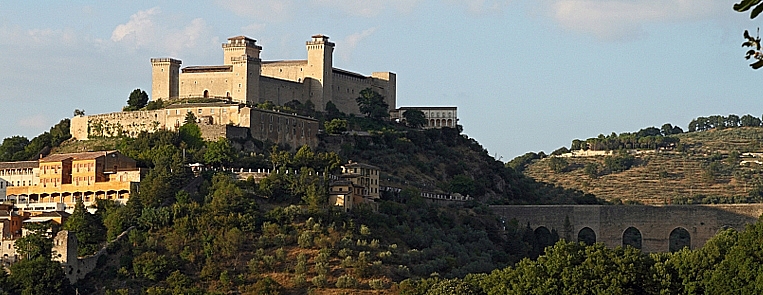
In the mid fourteenth century, with the popes in Avignon and their Italian lands in disorder, the formidable Cardinal Gil Albornoz set about reconquering the Papal States fortress by fortress. At Spoleto, beginning in 1359, he commissioned the architect Matteo Gattapone of Gubbio to raise the Rocca Albornoziana on the summit where the ancient acropolis had stood: six towers, two great courtyards, and walls that announced papal authority to the entire valley.
The same engineering campaign gave the town its icon. The Ponte delle Torri, the tower bridge spanning the gorge behind the fortress on ten arches nearly 250 feet high, served as aqueduct and fortified link to Monteluco, likely rising on the line of a Roman predecessor. Fortress and bridge together form one of the great medieval ensembles of Italy, and the level walk that circles them is the finest history lesson in Umbria that requires no reading.
In August 1499 Pope Alexander VI appointed his daughter Lucrezia Borgia governor of Spoleto, an office normally reserved for cardinals and seasoned administrators. She was nineteen years old. Lucrezia rode north from Rome with a magnificent retinue, installed herself in the Rocca Albornoziana, and for several months administered the city and its territory, hearing petitions and dispatching business with a competence that surprised contemporaries and has intrigued historians ever since.
Her Spoleto season sits at the hinge of the Borgia drama: sent partly to remove her from Rome’s intrigues after the collapse of her first marriage, she would within a few years become Duchess of Ferrara and one of the most discussed women of the Renaissance. The fortress remembers her; the elegant Camera Pinta tower room, frescoed with courtly scenes, evokes the world of the Rocca as a governor’s palace rather than a garrison.
The Rocca’s later centuries were harsher: from the early nineteenth century until 1982 it served as a prison, holding among others political prisoners of the Fascist era. Its restoration returned it to the town as the National Museum of the Duchy of Spoleto, whose galleries walk visitors from the Lombard dukes to the Renaissance, and whose ramparts offer the finest views in southern Umbria. We arrange expert-guided visits that braid the building’s three lives together.
After the Renaissance, history’s main road moved elsewhere, and Spoleto settled into the long, quiet life of a papal provincial capital. It was a favored residence of governors and cardinals, and the eighteenth and nineteenth centuries added palaces and the gilded Teatro Nuovo, but the town escaped both industrial sprawl and wholesale rebuilding, which is why its Roman, Lombard, and medieval layers survive so legibly.
In 1860 Spoleto passed with the rest of Umbria into the newborn Kingdom of Italy, ending eleven centuries of papal association, and settled into a modest modern role as a market and administrative town. Its second act arrived unexpectedly in 1958, when Gian Carlo Menotti chose it as the seat of his Festival of Two Worlds precisely because its beauty had been left alone, and the festival returned Spoleto to the world’s attention as a capital of the arts.
The town has managed its revival with unusual grace. Restoration rather than replacement remains the rule, the escalator systems tucked modern access invisibly beneath the medieval fabric, and the 2016 earthquakes that struck the Valnerina spared Spoleto’s monuments while deepening the region’s commitment to preservation. Today’s traveler inherits the result: twenty-five centuries in a town that can be walked end to end in twenty minutes.
Start at the top. The Rocca Albornoziana and its museum tell the story from the Lombard duchy to the papal centuries, and the rampart walk surveys the whole geography of that history, the Via Flaminia’s valley, the sacred mountain, and the bridge striding the gorge. Descend to Piazza del Duomo for the cathedral, Lippi’s frescoes, and the 1207 mosaic, then to Piazza del Mercato, where the Arch of Drusus and Germanicus still opens onto the Roman forum’s unbroken marketplace.
The Roman theatre and archaeological museum, the Casa Romana, and the amphitheatre district carry the ancient chapters; Sant’Eufemia and San Pietro’s sculpted facade carry the Romanesque; San Salvatore, on the UNESCO Longobards listing, carries the age of the dukes. Few itineraries anywhere let a traveler walk two and a half millennia in a single unhurried day, and fewer still do it without a single line.
Sequence is everything, and it is our craft. We compose history-focused Spoleto days chronologically with historian guides who narrate rather than recite, arrange access and timing so each site is met at its best hour, and place the town within larger journeys through Umbria and Rome as part of our cultural tours of Italy. History here is not a subject; it is the town itself, and we know how to open it.
Spoleto deserves more than a template. Since 2003, Trips 2 Italy has designed private Italian vacations one traveler at a time, hand selecting every experience based on what you tell us rather than fitting you into a predefined package. Our Italian-born team plans Spoleto with the knowledge of people who call Italy home, from the frescoed apse of the Duomo to the sacred forest of Monteluco, and we remain at your side throughout your trip with 24/7 assistance. Tell us how you imagine Spoleto, and we will craft the itinerary that matches it.
Discover Bettona, Assisi and Perugia as hilltop towns, art, olive oil and chocolate reveal the heart of Umbria’s timeless charm. Starting from $998 per person.
The ideal tour package for those seeking tranquility and purity in a region that is still relatively undiscovered. A perfect location also for families with children.
A short active holiday in Umbria for a taste of nature hiking through the National park of Monti Sibillini and surrounding charming villages. Tour includes a taste of the
Founded around 570 by the Lombard leader Faroald, the Duchy of Spoleto was one of the great Lombard powers of Italy, ruling much of the central peninsula from this hilltop capital for centuries; two of its ninth-century dukes were even crowned Holy Roman Emperors. The Basilica of San Salvatore, reworked under the dukes, is part of the UNESCO World Heritage listing of Lombard sites.
Cardinal Gil Albornoz commissioned the fortress beginning in 1359, during the papacy’s campaign to reassert control over the Papal States, and the architect Matteo Gattapone gave it six towers and two grand courtyards on the site of Spoleto’s ancient acropolis. It later served as a governor’s residence, then as a prison until 1982, and today houses the National Museum of the Duchy of Spoleto.
Yes. In August 1499 Pope Alexander VI named his nineteen-year-old daughter governor of Spoleto, and she administered the city from the Rocca Albornoziana for several months with notable competence. Her tenure remains one of the most storied chapters in the fortress’s history, and the museum’s rooms evoke the courtly world she briefly ruled.
The bridge in its present form dates to the thirteenth and fourteenth centuries, likely rising on the line of a Roman aqueduct, and carried water and a fortified passage between the fortress and Monteluco on ten arches nearly 250 feet high. Goethe admired it in 1786, and it remains Spoleto’s most iconic monument.
The first-century-BC Roman theatre, still used for festival performances, the adjacent National Archaeological Museum with the Lex Spoletina inscriptions, the Casa Romana with its mosaic floors, the Arch of Drusus and Germanicus of AD 23, and the outline of the amphitheatre in the lower town. Trips 2 Italy pairs travelers with historian guides who connect them into a single vivid story.
According to the Roman historian Livy, after his victory at Lake Trasimeno in 217 BC Hannibal advanced on Spoletium and was repulsed at its gates, a defense remembered in the name of Porta Fuga, the Gate of Flight. Trips 2 Italy’s guides delight in telling the story on the spot, beneath the very walls that turned him away.