

Milan Rome and Perugia Cultural Travel Package
Discover vibrant Milan, the rolling hills of Umbria, and timeless Rome, where art, history, and culinary delights come together to create unforgettable memories for every traveler. Starting from $6,862
HOME » POPULAR ITALIAN DESTINATIONS » PERUGIA TRAVEL GUIDE » PERUGIA THINGS TO DO GUIDE
Perugia Travel Guide Culture History Food and Wine Things to Do Plan My Trip
About this guide: This guide to things to do in Perugia was written by the Italian-born travel specialists at Trips 2 Italy, a custom tour operator that has designed hand-crafted Italian vacations since 2003. Every recommendation below reflects the same first-hand knowledge our team draws on when we build a private Perugia itinerary around a traveler’s interests, dates, and pace. Read it for your research, then let us translate it into a trip designed entirely around you.
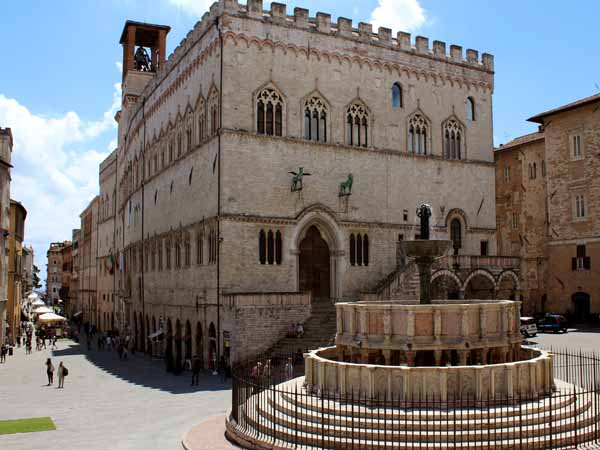
Start where the city does, in Piazza IV Novembre. The Fontana Maggiore, carved by Nicola and Giovanni Pisano in the 1270s with fifty panels of saints, seasons, and civic pride, is among the most beautiful medieval fountains in existence, and the battlemented Palazzo dei Priori behind it announces the ambition of the commune that ruled this corner of Umbria. The Cathedral of San Lorenzo completes the ensemble.
Inside the Palazzo dei Priori, two visits reward every traveler. The Galleria Nazionale dell’Umbria unfolds the whole story of Umbrian painting, with Perugino and Pinturicchio at its summit and works by Fra Angelico, Duccio, and Piero della Francesca beside them. Down the corridor, the Collegio del Cambio preserves Perugino’s frescoed guild hall of 1500, one of the most complete Renaissance rooms in Italy.
Timing shapes all of it. We arrange private guides who take the gallery in the quiet morning hours, sequence the piazza, the Sala dei Notari, and the Cambio into one unhurried arc, and leave you on Corso Vannucci as the cafes set their tables. The essentials of Perugia fit into a single glorious day when that day is designed well, and designing it well is our work.
Give the fountain itself more than a glance. Its two carved basins read like a medieval encyclopedia, with the labors of the months, the liberal arts, biblical scenes, and the symbols of the city circling in stone, and a guide who decodes even a handful of panels transforms it from a pretty landmark into a book you can walk around. It is the single most rewarding ten minutes of interpretation in Perugia.
No experience in Perugia startles travelers like this one. When Pope Paul III crushed the city’s rebellion in 1540, his architect buried an entire medieval quarter beneath a fortress, and those streets survive intact in the dark: house fronts, vaulted lanes, arches, and wells, sealed like an insect in amber beneath the modern city.
Today public escalators glide through the buried Via Bagliona, so the descent from Piazza Italia to the lower city doubles as a journey through the sixteenth century. Lamplight picks out doorways that last saw daylight when the fortress rose, and information panels and exhibitions along the route tell the story of the Baglioni quarter it consumed.
We recommend walking it twice: once quickly, as Perugians do, to feel it as the city’s living infrastructure, and once slowly with a guide who can rebuild the vanished neighborhood in your imagination, from the palaces of the Baglioni to the pope’s revenge that entombed them. It costs nothing, operates daily, and remains one of the most extraordinary free experiences in Italy.
The underground city also hosts a changing program of exhibitions and installations in its vaulted halls, so the buried quarter doubles as one of Perugia’s most atmospheric event spaces. Checking what is showing during your dates is exactly the kind of detail our specialists fold into an itinerary without being asked.
Begin at the Etruscan Arch at the foot of Via Ulisse Rocchi, a colossal double-tiered gate of the third century BC that still funnels daily life into the city. The inscription Augusta Perusia, carved after Octavian rebuilt the town, runs across its face, and standing beneath it you read two civilizations in a single glance upward.
A few minutes away, the Etruscan Well beneath Piazza Danti drops more than 120 feet through the rock, a feat of hydraulic engineering that supplied the ancient city. Visitors descend to a walkway over the water, where the scale of the third-century BC construction becomes viscerally clear. Long stretches of the Etruscan walls still shoulder the historic center between the surviving gates.
Complete the story just outside the city at the Hypogeum of the Volumni, an aristocratic family tomb discovered in 1840 with its carved travertine urns still gathered in the burial chamber, and in the National Archaeological Museum of Umbria beside San Domenico, whose collections gather the grave goods, bronzes, and inscriptions of Etruscan Perusia. We compose these sites into a half-day Etruscan itinerary with guides who make the civilization feel present rather than lost.
The Basilica of San Pietro, at the southern tip of the city beyond Borgo XX Giugno, is Perugia’s hidden masterpiece. Founded in the tenth century, its interior glows with gilded coffering, canvases, and one of the finest carved wooden choirs of the Italian Renaissance, and its medieval gardens look out over the Umbrian countryside. Travelers who make the walk invariably call it a highlight.
The Basilica of San Domenico, the largest church in Umbria, raises a vast Gothic interior lit by an enormous stained-glass window and shelters the carved tomb of Pope Benedict XI, who died in Perugia in 1304. The Cathedral of San Lorenzo on the main piazza keeps its own treasures, including the venerated relic Perugians call the Holy Ring, and the Oratorio di San Bernardino’s sculpted facade is a Renaissance jewel a few lanes west.
Between the churches, the museums deepen the picture: the Galleria Nazionale for painting, the archaeological museum for the Etruscans, and the smaller civic collections that reward a second day. We sequence these visits around your energy and interests, pairing the essential with the intimate, so the city’s sacred art arrives as discovery rather than obligation.
San Pietro deserves a special word for its gardens. The medieval Orto Medievale behind the basilica recreates the symbolic plantings of a monastic garden, and its terraces open quietly onto the Umbrian countryside with Assisi visible across the valley on clear days. Few visitors find it, which is precisely why we include it, usually as the contemplative close of a morning among the southern churches.
Every evening, Perugia performs its oldest ritual. From Piazza IV Novembre to the Giardini Carducci, the broad spine of Corso Vannucci fills with the passeggiata: families, students, and elegant retirees strolling, greeting, and pausing at the cafes as the light turns gold on the palaces. It costs nothing and explains the city better than any monument.
The street rewards participation. Take an aperitivo at a historic cafe, browse the chocolate shops and artisan windows, and drift with the crowd to the gardens at the southern end, where the balustrade opens onto one of central Italy’s great views: the Tiber valley and the Umbrian hills rolling toward Assisi, lit like a fresco background at sunset.
We time our travelers’ evenings around this hour deliberately. A guided stroll that ends with a reserved terrace table, a tasting of local wines as the sky performs, or simply the counsel to be on the Corso at seven rather than in transit: small design decisions like these are what make an itinerary feel lived rather than executed, and they are our signature.
For photographers and romantics, the hour after the passeggiata is just as rewarding. The lanes off the Corso fall quiet, the medieval aqueduct walkway glows under its lamps, and the viewpoints at Porta Sole frame the valley lights. An evening walk through this Perugia, unhurried and largely unshared, is the memory many of our travelers name first when they write to us after the trip.
Chocolate leads the list. We arrange private workshops where master chocolatiers teach tempering and molding, tastings that trace the craft from bean to praline, and, for October travelers, itineraries composed around the Eurochocolate festival, when the whole center celebrates the city’s sweetest industry. In July the same streets belong to Umbria Jazz, and a trip planned around its evenings ranks among Italy’s great festival experiences.
Beyond the city’s two famous celebrations, the experiences turn hands-on. Cooking sessions built around torta al testo and hand-rolled pasta, truffle hunts in the surrounding oak woods, olive mill visits during the November harvest, and artisan studios where ceramics and textiles are still worked by hand all sit within easy reach. Active travelers can walk or cycle the quiet lanes of the Tiber valley as part of the active trips in Italy we design.
Perugia also makes a wonderful stage for family travel: escalators through an underground city, a fountain covered in carved animals, chocolate in every window, and gelato-paced lanes hold every generation’s attention. We compose family vacations to Italy here that let history arrive as adventure, with rhythms tuned to the youngest and oldest travelers alike.
Assisi comes first, under half an hour away, where the Basilica of Saint Francis holds the fresco cycles that changed Western painting and the saint’s tomb draws pilgrims from every continent. Seen in a single day from Perugia with a private guide, it pairs the two cities’ stories, rival hilltops in the Middle Ages, into one resonant excursion.
Lake Trasimeno, Italy’s fourth largest lake, spreads its olive-ringed shores a short drive west. Castiglione del Lago juts into the water beneath its fortress, boats cross to the fishing villages of Isola Maggiore, and the sunsets belong on canvas. History travelers can stand where Hannibal ambushed the Roman legions on its northern shore in 217 BC. South of Perugia, Deruta has painted majolica since the Renaissance, and its workshops and ceramics museum make an irresistible half day for lovers of craft, easily joined to the wine village of Torgiano.
Farther afield, Gubbio, Spoleto, Todi, and Orvieto each reward a full day, and every one of them returns you to a Perugia evening on the Corso. With a private driver and thoughtful sequencing, which we arrange for every itinerary, the city becomes the hub of an Umbrian week in which no day repeats and nothing feels rushed.
The choice and order of excursions is where judgment matters. Assisi asks for a morning start before the pilgrim buses, Trasimeno is loveliest toward sunset, Deruta and Torgiano combine naturally into one artisan-and-wine day, and the longer reaches to Orvieto or Gubbio deserve unhurried scheduling. We weigh your interests, the season, and the calendar of local festivals, then compose the week so each day complements the last.
Perugia deserves more than a template. Since 2003, Trips 2 Italy has designed private Italian vacations one traveler at a time, hand selecting every experience based on what you tell us rather than fitting you into a predefined package. Our Italian-born team plans Perugia with the knowledge of people who call Italy home, from the carved basins of the Fontana Maggiore to the underground streets beneath the Rocca Paolina and the chocolate workshops the city is famous for, and we remain at your side throughout your trip with 24/7 assistance. Tell us how you imagine Perugia, and we will craft the itinerary that matches it.
Discover vibrant Milan, the rolling hills of Umbria, and timeless Rome, where art, history, and culinary delights come together to create unforgettable memories for every traveler. Starting from $6,862
Discover Bettona, Assisi and Perugia as hilltop towns, art, olive oil and chocolate reveal the heart of Umbria’s timeless charm. Starting from $998 per person.
This short tour is dedicated to discovering the rustic beauty of this marvelous region full of cultural and natural richness waiting to be explored.
Begin in Piazza IV Novembre with the Fontana Maggiore and Palazzo dei Priori, then see the Perugino masterpieces of the Galleria Nazionale dell’Umbria and the frescoed Collegio del Cambio. Trips 2 Italy sequences all of it into one unhurried day with a private guide, timed for the quiet hours.
Yes. The public escalators run daily through the buried medieval streets of the Via Bagliona beneath the Rocca Paolina fortress, connecting the lower city to the historic summit. Walking them slowly, ideally once with a guide who can resurrect the vanished Baglioni quarter, is one of the most extraordinary experiences in central Italy.
The monumental Etruscan Arch, the 120-foot Etruscan Well beneath Piazza Danti, long stretches of the third-century BC city walls, the National Archaeological Museum of Umbria, and the Hypogeum of the Volumni tomb just outside the city together form one of Italy’s richest Etruscan encounters, easily composed into a half-day itinerary.
Very. Escalators through an underground city, a medieval fountain carved with animals, chocolate workshops, gelato-paced lanes, and boat rides on nearby Lake Trasimeno keep every generation engaged. Trips 2 Italy composes family itineraries so history arrives as adventure, with pacing tuned to the youngest travelers.
Assisi and the Basilica of Saint Francis lead the list, followed by Lake Trasimeno’s shoreline villages and island crossings, the majolica workshops of Deruta, the wine village of Torgiano, and full days in Gubbio, Spoleto, Todi, or Orvieto. With a private driver arranged by our specialists, each excursion returns you to Perugia in time for the evening passeggiata.
Come in July for Umbria Jazz, when the historic center becomes a ten-day open-air stage, or in October for Eurochocolate and the surrounding truffle and harvest season. Both periods require lodging and access arranged well in advance, which Trips 2 Italy secures for travelers planning around them.