

Milan Rome and Perugia Cultural Travel Package
Discover vibrant Milan, the rolling hills of Umbria, and timeless Rome, where art, history, and culinary delights come together to create unforgettable memories for every traveler. Starting from $6,862
HOME » POPULAR ITALIAN DESTINATIONS » PERUGIA TRAVEL GUIDE » PERUGIA HISTORY GUIDE
About this guide: This guide to the history of Perugia was written by the Italian-born travel specialists at Trips 2 Italy, a custom tour operator that has designed hand-crafted Italian vacations since 2003. Every recommendation below reflects the same first-hand knowledge our team draws on when we build a private Perugia itinerary around a traveler’s interests, dates, and pace. Read it for your research, then let us translate it into a trip designed entirely around you.
Perugia opens its story among the Etruscans. As Perusia, it stood among the twelve principal cities of the Etruscan federation, commanding the upper Tiber from its hilltop and growing wealthy on the river trade between the Etruscan west and the Umbrian peoples across the valley. It remains today the historic gateway between those worlds, and the capital of modern Umbria.
The Etruscan city still frames everyday life. Long stretches of the massive travertine walls raised in the fourth and third centuries BC continue to hold up the historic center, and the Etruscan Arch, a monumental double-tiered gate from the third century BC, still serves as a working entrance to the city, one of the best-preserved Etruscan gateways in existence.
Below the streets the evidence deepens. The Etruscan Well near the cathedral drops more than 120 feet through the rock, an engineering feat that supplied the ancient city and still astonishes visitors who descend to its walkway. Just outside town, the Hypogeum of the Volumni preserves an aristocratic family tomb with its carved urns in place. Walking these sites with a guide who can people them again is one of central Italy’s great historical experiences, and we build Etruscan mornings around exactly that.
Perusia’s Etruscan centuries were prosperous and outward-looking. The city minted, traded, and buried its aristocrats with bronze and carved travertine that now fill the National Archaeological Museum of Umbria, and inscriptions found here remain among the longest Etruscan texts known. For travelers who caught the Etruscan fascination in Tuscany’s museums, Perugia offers something rarer: a living city still entered through Etruscan gates, where the ancient fabric is not an excavation but an address.
Perugia entered Rome’s orbit in the aftermath of the great Etruscan defeats of the third century BC and prospered quietly for generations, until history singled it out violently. In the winter of 41 to 40 BC, Mark Antony’s brother Lucius took refuge in the city with his legions, and the young Octavian, the future Augustus, starved it into surrender in the conflict remembered as the Perusine War. In the chaos of the fall, a fire consumed much of the ancient city.
The victor rebuilt what he had broken. Perugia rose again as Augusta Perusia, and the emperor’s name remains carved in Roman capitals across the face of the Etruscan Arch, a stone conversation between the two civilizations that made the city. That inscription, still legible above the daily foot traffic, is among the most evocative details a traveler can find here.
The Roman centuries left their quieter marks as well: the mosaic of Orpheus preserved beneath the university quarter, the street grid fossilized in the medieval lanes, and the city’s enduring role as a stronghold on the roads of central Italy. Late antiquity treated Perugia roughly, with Gothic sieges and Byzantine recoveries, but the hilltop never emptied, and continuity is precisely what makes its layers so rich to read today.
By the twelfth century Perugia had organized itself into a free commune, and for the next three hundred years it behaved like a small imperial power, subduing neighboring towns, fielding armies, and negotiating with popes as an equal. Its wealth and confidence produced the monuments that still define the city: the Fontana Maggiore, completed in 1278 with sculpted panels by Nicola and Giovanni Pisano, and the Palazzo dei Priori, begun in 1293 as a statement that few civic buildings in Italy have ever matched.
Learning followed power. The commune won a papal charter for its university in 1308, drawing students and jurists from across Europe, and the guilds that governed the economy built themselves halls, the money changers’ Collegio del Cambio among them, that rank with the finest rooms of the age.
Medieval Perugia was also fervent and turbulent. The flagellant movement that swept Europe in 1260 began here, penitential processions pouring down the same streets that hosted guild pageants and market days. That combination of piety, prosperity, and pugnacity is the medieval city in miniature, and its stones tell the story plainly to anyone walking with a guide who knows how to read them.
The commune’s engineering matched its architecture. To bring water to the summit, thirteenth-century Perugia built an aqueduct across the valley to feed the Fontana Maggiore, an audacious public work whose elevated channel survives today as one of the most charming pedestrian lanes in the city. Walking it from the old quarter up toward the cathedral, houses rising on either side of what was once flowing water, is medieval urbanism made intimate, and it is a favorite passage on our historical walks.
The fifteenth century delivered Perugia into the hands of the Baglioni, a warrior dynasty whose story reads like a stage tragedy. From their palaces on the southern hill they dominated the city’s politics, produced celebrated condottieri who fought across Italy, and feuded with rivals and with each other in cycles of vendetta that scandalized and fascinated the peninsula.
The dynasty’s darkest hour came in 1500, when one branch of the family slaughtered another during a wedding celebration, a night remembered as the wedding of blood. The survivor, Giampaolo Baglioni, retook the city within days and ruled it with a blend of brilliance and menace until a pope lured him to Rome and had him executed in 1520. Renaissance chroniclers could not look away, and neither can modern visitors once they learn the tale.
The Baglioni matter because their fall reshaped the city physically. When the family led Perugia’s last rebellion against papal authority in the Salt War of 1540, the victorious pope did not merely punish the dynasty; he buried its entire neighborhood beneath a fortress. That act of architectural vengeance created the city’s most extraordinary historical site, and it deserves its own chapter.
In 1540 Perugia rose against a papal tax on salt, and Pope Paul III answered with overwhelming force. To stamp his authority on the defeated city he commissioned Antonio da Sangallo the Younger to build the Rocca Paolina, a colossal fortress at the summit’s southern edge, and he built it directly on top of the Baglioni quarter, swallowing towers, houses, and whole streets as foundations for the papal citadel.
For three centuries the fortress glowered over Perugia as the emblem of papal rule, garrisoned and hated in equal measure. When the papal government fell in 1860, the citizens attacked the Rocca with picks and bare hands, demolishing the visible fortress with a thoroughness that said everything about what it had represented. On its footprint they laid out the Giardini Carducci and the elegant Piazza Italia.
Yet the buried city survived beneath, and that is the marvel. Today public escalators climb through the underground Via Bagliona, past medieval house fronts, vaulted lanes, and wells sealed in the dark since 1540, delivering travelers from the lower city into the heart of the center. It is at once a commute and a time machine, and walking it slowly with a historian is one of the most atmospheric experiences we arrange in central Italy.
The Rocca also explains the city’s fierce relationship with its own memory. Perugians kept the buried streets, named the underground route for the family the fortress erased, and turned the papal citadel’s foundations into exhibition space and daily passage. Few places in Europe let you feel a city arguing with its past so physically, which is why we give the Rocca more time than guidebooks suggest and pair it with the story told upstairs in the Palazzo dei Priori.
Perugia’s modern chapter opened in defiance. In June 1859 the city rose against papal rule, and the rising was crushed by Swiss mercenary troops with a brutality that shocked Europe and hardened Italian resolve. Fifteen months later Piedmontese forces entered the city, the Rocca Paolina came down stone by stone, and Perugia voted itself into the new Kingdom of Italy as the capital of Umbria in 1860.
The decades that followed gave the city its confident nineteenth-century face: Piazza Italia and its ministries rose where the fortress had stood, the prospect walks were laid out over the bastions, and in 1907 a small confectionery workshop opened that would grow into the chocolate industry the city is known for worldwide. The University for Foreigners followed in the 1920s, renewing Perugia’s ancient vocation as a crossroads of learning.
The twentieth century brought hardship and renewal in the national pattern, and the city emerged as one of central Italy’s liveliest capitals: a seat of government and universities, a stage for Umbria Jazz since 1973 and Eurochocolate since the 1990s, and a place where three thousand years of history function as the setting for a thoroughly contemporary life.
For visitors, the nineteenth and twentieth centuries are easy to overlook and rewarding to find. The prospect terraces over the Tiber valley, the belle epoque cafes along the Corso, and the quiet monuments to 1859 in the streets where it happened all repay a guide’s commentary. We often close a historical day on the Carducci gardens balustrade at sunset, where the fortress once stood and the whole story, from Etruscan walls to modern capital, lies visible in a single view.
Few cities let you walk their whole biography in a morning. Begin beneath the Etruscan Arch with Augustus’s inscription overhead, descend the Etruscan Well, then climb to Piazza IV Novembre where the Fontana Maggiore and Palazzo dei Priori announce the medieval commune at full power. The Sala dei Notari’s painted vaults and the Galleria Nazionale dell’Umbria carry the story through the Renaissance.
Then ride the escalators down into the Rocca Paolina and let the buried Baglioni quarter tell the papal centuries from below. Finish among the basilicas: San Domenico, the largest church in Umbria, holding the Gothic tomb of Pope Benedict XI, and San Pietro at the city’s southern tip, its tenth-century foundation wrapped in one of the most sumptuously decorated naves in the region.
Sequence is what turns these sites into a story, and sequence is our craft. We compose history-focused days with historians who narrate rather than recite, arrange quiet-hour access where it is available, and thread Perugia into the wider historical fabric of Umbria as part of our cultural tours of Italy. Three millennia arrive as a narrative, not a shuffle of dates.
Perugia deserves more than a template. Since 2003, Trips 2 Italy has designed private Italian vacations one traveler at a time, hand selecting every experience based on what you tell us rather than fitting you into a predefined package. Our Italian-born team plans Perugia with the knowledge of people who call Italy home, from the carved basins of the Fontana Maggiore to the underground streets beneath the Rocca Paolina and the chocolate workshops the city is famous for, and we remain at your side throughout your trip with 24/7 assistance. Tell us how you imagine Perugia, and we will craft the itinerary that matches it.
Discover vibrant Milan, the rolling hills of Umbria, and timeless Rome, where art, history, and culinary delights come together to create unforgettable memories for every traveler. Starting from $6,862
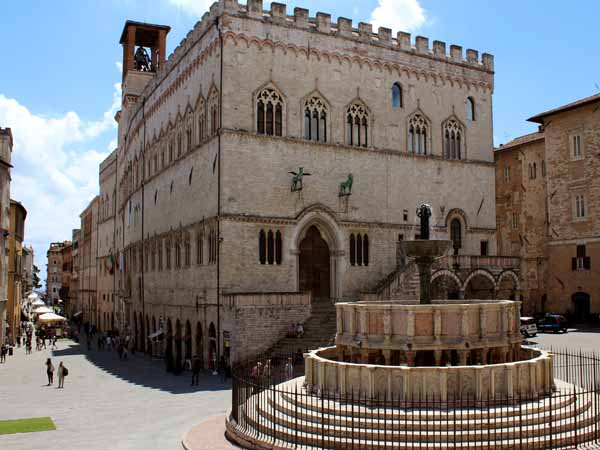
Discover Bettona, Assisi and Perugia as hilltop towns, art, olive oil and chocolate reveal the heart of Umbria’s timeless charm. Starting from $998 per person.
This short tour is dedicated to discovering the rustic beauty of this marvelous region full of cultural and natural richness waiting to be explored.
Perugia has been continuously inhabited for roughly three thousand years. It stood among the twelve principal cities of the Etruscan federation, and its massive travertine walls and monumental Etruscan Arch from the third century BC still frame the historic center today.
The Etruscan Arch is a monumental double-tiered city gate built in the third century BC, one of the best-preserved Etruscan gateways in existence. After Octavian conquered and rebuilt the city, the name Augusta Perusia was carved across its face, and the inscription remains legible above the street traffic passing through it today.
It is the fortress Pope Paul III built after crushing Perugia’s Salt War rebellion in 1540, raised directly over the Baglioni family quarter so that entire medieval streets were sealed beneath it. Citizens demolished the visible fortress after liberation in 1860, but the buried lanes survive, and escalators now carry visitors through the underground Via Bagliona.
The Baglioni were the warrior dynasty that dominated Renaissance Perugia, famous for celebrated condottieri and for the 1500 massacre remembered as the wedding of blood. Their last rebellion against the papacy in 1540 ended with their quarter buried beneath the Rocca Paolina, a story travelers can walk through underground today.
Perugia joined the Kingdom of Italy in 1860, after an 1859 uprising against papal rule was violently suppressed and Piedmontese troops liberated the city the following year. The citizens then tore down the hated Rocca Paolina fortress, and Perugia became the capital of the new region of Umbria.
Yes. Trips 2 Italy arranges private walks with historians and licensed guides who sequence the city chronologically, from the Etruscan Arch and well through the medieval piazzas to the underground Rocca Paolina and the great basilicas. Each itinerary is composed around your interests and pace, with every detail arranged before you arrive.