Aquileia and Wine Tasting
Italy’s famed wines and the historical village of Aquileia are the focus of this enjoyable 4.3-hour walking tour, ideal for those who want to get a real taste of
Abruzzo Travel Guide Culture History Food and Wine Things to Do Plan My Trip
About this guide: This Abruzzo travel guide was written by the Italian-born travel specialists at Trips 2 Italy, a custom tour operator that has designed hand-crafted Italian vacations since 2003. Every recommendation below reflects the same first-hand knowledge our team draws on when we build a private Abruzzo itinerary around a traveler’s interests, dates, and pace. Read it for your research, then let us translate it into a trip designed entirely around you.
Abruzzo is the Italy that stayed itself. Barely an hour east of Rome, the Apennines rise to their highest peaks, wolves and bears still move through beech forests, and stone villages crown hilltops that have watched over shepherd roads for a thousand years. Roughly a third of the region sits under formal protection, across three national parks, a major regional park, and dozens of reserves, which is why Abruzzo is often called the greenest region in Europe.
Yet Abruzzo is far more than a nature destination. It holds a coastline of golden Adriatic beaches punctuated by trabocchi, the spidery wooden fishing platforms that the poet Gabriele d’Annunzio immortalized. It holds L’Aquila, a mountain capital of Renaissance courtyards and great basilicas, and Sulmona, the elegant birthplace of the poet Ovid. It holds a pastoral culture, the transumanza, recognized by UNESCO as intangible heritage of humanity, and a table that ranks among Italy’s most honest and most memorable.
What travelers notice first is the absence of crowds and the presence of welcome. Abruzzo receives a fraction of the visitors of Italy’s celebrated regions, so its piazzas, trails, and family cellars still treat a guest as an event rather than a transaction. For travelers who have already loved Tuscany and the Amalfi Coast, this region is the discovery that renews their affection for Italy itself.
Our specialists have been designing journeys through these mountains and along this coast for over two decades. Every Abruzzo vacation we build is composed from what you tell us, hand selected experience by experience, never assembled from a predefined package.
Abruzzo occupies the broad shoulder of the Italian peninsula where the Apennines reach their greatest height. Corno Grande, the summit of the Gran Sasso massif, rises to 9,554 feet, the highest point in the Apennine chain, and shelters the Calderone, the southernmost glacier in Europe. Beneath it spreads Campo Imperatore, a vast alpine plateau so austere and beautiful that Italians call it Little Tibet.
From those heights the land steps down through wooded parks and hill country to a coastline of roughly eighty miles on the Adriatic. The northern beaches around Pescara and Teramo are wide and sandy, while south of Ortona the shore turns rocky and intimate, threaded by the famous trabocchi fishing platforms of the Costa dei Trabocchi. Between mountain and sea lie vineyards, olive groves, and the saffron fields of the Navelli plain.
The two Abruzzos keep two climates. The coast is classically Mediterranean, with hot, dry summers and mild winters, while the interior is genuinely alpine, with snow that holds on the high plateaus well into spring and cool, brilliant summer days at altitude. The practical gift of this geography is range: in a single day, travelers can breakfast by the Adriatic, lunch in a medieval hill town, and watch the evening light sweep across Campo Imperatore.
For travelers, the practical meaning of this geography is contrast on demand. A single Abruzzo itinerary can hold glacier-carved peaks, wildlife-rich forests, saffron plains, vineyard hills, and a swim in the Adriatic, provided someone sequences it well. That is the work our specialists do first, matching the region’s many landscapes to the trip you actually want.
Late spring and early summer are glorious. From May through July the high meadows bloom, the transumanza country turns emerald, wildlife watching in the parks is at its peak, and the coast is warm without the August holiday rhythm. June is the connoisseur’s month, when wildflowers carpet Campo Imperatore and the hill towns sit in perfect light.
Autumn answers with the vendemmia in the Montepulciano d’Abruzzo vineyards, the saffron harvest at Navelli in late October, forests turning gold through the national parks, and the year’s richest table of mushrooms, chestnuts, and new wine. Winter transforms the interior into the Apennines’ great snow country, with skiing at Roccaraso, Campo Felice, and Ovindoli, and firelit dinners in stone villages. Summer belongs to the beaches, the festivals, and evenings on a trabocco over the water.
When we plan an Abruzzo itinerary, your dates become the first design decision. We align mountain days with the season’s character, book trabocco experiences when the coast is at its best, and time hill town visits around the festivals worth planning a trip around. There is no single best month for Abruzzo, only the month that best fits the trip you imagine, and matching the two is precisely our work.
A first meaningful encounter with Abruzzo wants five to seven days: two based near Gran Sasso for Campo Imperatore, Rocca Calascio, and Santo Stefano di Sessanio, a day for L’Aquila’s basilicas and fountains, a day for Sulmona and the Peligna valley, and two along the Trabocchi Coast for the cycleway, the seafood, and the slow Adriatic evenings.
Travelers with more time discover that Abruzzo rewards depth unusually well. A second week opens the Majella wilderness with its hermitages carved into cliff faces, the lake village of Scanno, the wildlife heartland of the Abruzzo, Lazio and Molise National Park, and the vineyards of the Teramo and Chieti hills, all with the sense of having the region nearly to yourself.
Because every Trips 2 Italy itinerary is built by hand, the right length depends on what Abruzzo is doing in your larger Italian journey. For some travelers it is a revelatory three-day counterpoint to Rome; for others it is the entire point of the trip. We weigh your interests, your pace, and your other destinations, then give Abruzzo the space it deserves rather than the space a standard package allows.
Where you sleep shapes the trip as much as where you go. A restored stone house in Santo Stefano di Sessanio, a countryside estate among the Teramo vineyards, and a room above the water on the Trabocchi Coast each produce a completely different Abruzzo from the same list of sights. Matching the bases to the traveler is the first act of our planning, because in this region the view from your morning espresso is part of the itinerary.
L’Aquila anchors the mountain interior. The regional capital, founded in the thirteenth century and lovingly restored after the 2009 earthquake, keeps the Basilica of Santa Maria di Collemaggio, the Fountain of the Ninety-Nine Spouts, a Spanish fort, and a lively university-town energy at altitude. Sulmona, ringed by peaks in the Peligna valley, pairs Ovid’s legacy with a medieval aqueduct, elegant squares, and the confetti workshops that have made its sugared almonds famous for five centuries.
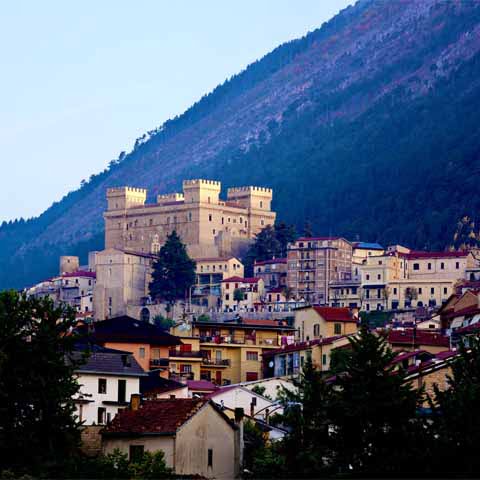
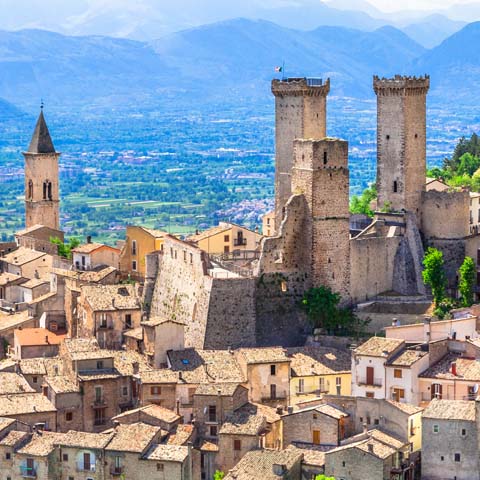
The hill villages are Abruzzo’s crown. Santo Stefano di Sessanio, a fortified Medici-era wool village of honey-colored stone, has become a model for thoughtful borgo revival. Nearby, the castle of Rocca Calascio rides a ridge at nearly 4,800 feet, one of the highest fortifications in Italy and a setting filmmakers return to again and again. Scanno curls around its heart-shaped lake, famous for photographers, filigree goldsmiths, and traditional dress, while Pacentro raises the twin towers of its Caldora Castle above the Sulmona valley.
The coast plays a different melody. Pescara brings modern seafront energy and the region’s transport hub, Ortona and Vasto bookend the Trabocchi Coast, and the abbey of San Giovanni in Venere watches the whole shoreline from its headland. The art of an Abruzzo itinerary is composing mountain, village, and sea into one journey, and that composition, matched to your tastes, is what our specialists do first.
Abruzzo is a region of small roads, high passes, and scattered treasures, which makes how you move through it the single most important practical decision. We arrange private drivers who know the switchbacks up to Campo Imperatore, the shortcuts between hill villages, and the viewpoints worth an unscheduled stop, so the landscape becomes scenery rather than navigation.
Distances are shorter than the drama suggests. Rome’s airports sit roughly two hours from L’Aquila and the Gran Sasso area, Pescara’s airport and rail hub serve the coast, and most of the region’s highlights lie within ninety minutes of one another. A well-sequenced itinerary can pair a mountain morning with a coastal evening without ever feeling rushed.
Within the villages and historic centers, everything worth seeing is reached on foot, exactly as these places were built to be experienced. Every transfer in a Trips 2 Italy itinerary is arranged in advance and supported around the clock, from the moment you land to the morning you depart. In a region whose finest moments live at the end of mountain roads, thoughtful logistics are not a detail; they are the difference between seeing Abruzzo and being carried through it.
Abruzzo’s secret advantage is its address. Rome sits roughly two hours to the west, which makes the region the most rewarding wilderness extension in Italy: three or four days of mountains, castles, and trabocchi appended to the capital transforms a classic itinerary into something no one else at the dinner party has done. It pairs equally well with Puglia to the south along the Adriatic, or with the Marche and Umbria for travelers tracing the quieter center of the peninsula.
The occasion shapes the composition. For travelers who measure a trip by what lands on the table, Abruzzo’s shepherd cooking, saffron, and Montepulciano d’Abruzzo cellars can carry a full chapter of an Italian wine and culinary journey. For walkers, cyclists, and wildlife watchers, the parks and the coastal cycleway anchor our active trips in Italy. And for those composing something larger, Abruzzo becomes a movement in a custom trip to Italy designed entirely from what you tell us.
This guide is one of five we have written on the region. Continue with our Abruzzo culture guide, Abruzzo history guide, Abruzzo food and wine guide, and Abruzzo things to do guide for the deeper layers of the region.
Abruzzo deserves more than a template. Since 2003, Trips 2 Italy has designed private Italian vacations one traveler at a time, hand selecting every experience based on what you tell us rather than fitting you into a predefined package. Our Italian-born team plans Abruzzo with the knowledge of people who call Italy home, from the high meadows of Campo Imperatore to the trabocchi of the Adriatic shore, and we remain at your side throughout your trip with 24/7 assistance. Tell us how you imagine Abruzzo, and we will craft the itinerary that matches it.

Italy’s famed wines and the historical village of Aquileia are the focus of this enjoyable 4.3-hour walking tour, ideal for those who want to get a real taste of
Abruzzo occupies the mountainous center of Italy’s Adriatic side, directly east of Rome. Most travelers arrive through Rome’s airports, roughly two hours by road from L’Aquila and the Gran Sasso area, while Pescara’s airport and rail connections serve the coast. Trips 2 Italy arranges private transfers for every arrival and departure, so the mountain roads become part of the scenery rather than a logistical concern.
Roughly a third of Abruzzo’s territory is formally protected, an extraordinary proportion that includes the Gran Sasso and Monti della Laga, Majella, and Abruzzo, Lazio and Molise national parks, the Sirente Velino regional park, and dozens of smaller reserves. That protection has preserved not only landscapes but wildlife, including the Marsican brown bear and Apennine chamois found nowhere else on earth.
Late spring through early summer brings wildflowers to Campo Imperatore and ideal walking weather, autumn brings the grape and saffron harvests with golden forests, winter opens the Apennines’ finest ski areas, and summer belongs to the Trabocchi Coast and the festival calendar. The specialists at Trips 2 Italy align your dates with what the region does best in that season.
Five to seven days allows a satisfying first journey: the Gran Sasso area and its hill villages, L’Aquila, Sulmona, and two days on the Trabocchi Coast. A shorter three-day visit works beautifully as a wilderness extension from Rome, while a second week opens the Majella, Scanno, and the wildlife heartland of the parks. The right length depends on your larger Italian itinerary, which is exactly what we design around.
Abruzzo is precisely the region we recommend to returning travelers. It offers castles, abbeys, hill towns, celebrated wine, and a dramatic coastline with a fraction of the visitors found elsewhere, and its hospitality still treats guests as an event. Many of our returning guests describe it as the trip that renewed their love of Italy.
The region’s treasures are scattered across mountains and coast, so private transportation is essential, but you need not drive it yourself. We arrange private drivers who know the high passes, village lanes, and coastal roads intimately, letting you enjoy every viewpoint and every glass of Montepulciano d’Abruzzo while the logistics disappear into the trip.