Best of Italy’s Lake District and Dolomites Semi Escorted Tour
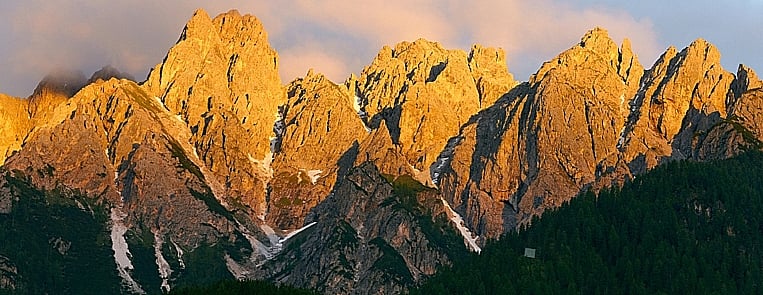
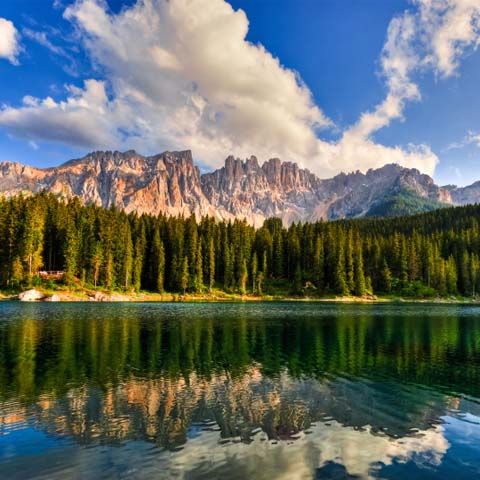
The majesty of the Italian Alps, charming Villas and picturesque sights, are all breathtaking landscapes on this enchanting tour along Italy’s northern Lakes and Alps.
HOME » POPULAR ITALIAN DESTINATIONS » BOLZANO TRAVEL GUIDE » BOLZANO HISTORY GUIDE
About this guide: This guide to the history of Bolzano was written by the Italian-born travel specialists at Trips 2 Italy, a custom tour operator that has designed hand-crafted Italian vacations since 2003. Every recommendation below reflects the same first-hand knowledge our team draws on when we build a private Bolzano itinerary around a traveler’s interests, dates, and pace. Read it for your research, then let us translate it into a trip designed entirely around you.
Few cities can put a face on their prehistory. Bolzano can, because the South Tyrol Museum of Archaeology holds Otzi the Iceman, the 5,300 year old hunter found in 1991 melting out of a glacier saddle below the Similaun peak, on the crest between Italy and Austria. His copper axe, sewn clothing, medicinal fungi, and tattooed skin revealed a Copper Age alpine world of astonishing sophistication, and his presence makes the depth of human life in these valleys physically real.
The valleys themselves were settled long before Rome arrived. Raetian peoples farmed the terraces and worked the passes, and when Rome pushed north under Augustus, the general Drusus threw a bridge across the Isarco around 15 BC and left a way station remembered as Pons Drusi. The site mattered for the same reason it always would: this basin is where the roads over the Alps gather before descending into Italy.
After Rome’s fade, Bavarian settlers moved down from the north while Lombard power reached up from the south, and the valley became a frontier of languages that it has remained ever since. The medieval city was born in the late twelfth century, when the prince-bishops of Trent laid out a single arcaded market street between the rivers, the Via dei Portici, and invited merchants to settle. That street is still the city’s spine.
Geography made Bolzano rich. The city sits where the Brenner route, the lowest of the great alpine passes, meets the roads to Venice and the German lands, and by the Middle Ages its trade fairs were among the most important in the eastern Alps, four times a year drawing merchants from Augsburg and Nuremberg to meet their counterparts from Venice and Verona.
The fairs grew so consequential that in 1635 Archduchess Claudia de’ Medici granted Bolzano its own Mercantile Magistrate, a merchant court where Italian and German traders resolved disputes under a shared commercial law. Its Baroque seat, the Palazzo Mercantile on the Via dei Portici, still stands, and its painted halls and archives, open as a museum, preserve the world of contracts, samples, and handshakes that built the city.
That mercantile centuries-long conversation between north and south explains Bolzano’s character better than any single event. The arcaded houses with their deep storerooms and bay windows were built as trading machines, the city’s families grew practiced at living in two languages, and the habit of exchange became the local temperament. Walking the Portici with a historian, the whole apparatus comes back to life.
Trade also gave the city its measure of tolerance. Fair weeks required innkeepers, warehousemen, notaries, and carters who could work across languages and legal traditions, and chroniclers described a town that treated the stranger as a customer rather than a threat. In a province whose modern history turned on the question of coexistence, it is worth remembering that Bolzano practiced it for profit centuries before it legislated it.
From the high Middle Ages, Bolzano’s fortunes were tied to the county of Tyrol, named for a castle above nearby Merano, and when the last countess, Margarete, ceded the land in 1363, the city passed under Habsburg rule. For more than five centuries thereafter, with one Napoleonic interruption, Bolzano lived inside the Austrian world as its southern commercial gateway.
The Habsburg centuries left deep marks: the parish churches rebuilt in Gothic and then Baroque taste, the pilgrimage traditions and rifle companies, and the loyalty of figures like Andreas Hofer, the Tyrolean innkeeper who led the 1809 uprising against Napoleonic rule and remains the great folk hero of the land. Bolzano’s merchants meanwhile kept their Italian connections warm, because trade with Venice and Lombardy was the family business.
By the nineteenth century the railway had arrived, the Brenner line opening in 1867 and turning Bolzano into a stop on Europe’s new grand tour of the Alps. Spa culture flourished in neighboring Gries, orchards and vineyards were replanted on an industrial scale, and the city entered the twentieth century prosperous, Tyrolean, and entirely unaware of how radically the map was about to change.
Gries tells the era’s gentler story. In the late nineteenth century the village across the Talvera became a fashionable winter health resort, its mild air prescribed to northern European guests, and grand villas, gardens, and promenades rose among the vineyards. Joined to Bolzano in 1925, it keeps that spa-town serenity to this day, and walking its lanes remains the pleasantest history lesson in the city.
In 1385 two wealthy Bolzano merchant brothers, Niklaus and Franz Vintler, bought a thirteenth-century castle on a porphyry crag above the Talvera and set about decorating it not with saints but with stories. The result, miraculously preserved, is the largest cycle of secular medieval frescoes in the world, and it makes Runkelstein one of the most rewarding castle visits in the Alps.
The walls read like a medieval library in pictures: the romance of Tristan and Isolde told scene by scene, King Arthur’s knights, the adventures of Garel, giants and heroes, and, most preciously, panoramas of courtly life itself, nobles dancing, hunting, fencing, and playing games in the fashions of the 1390s. For historians these images are primary documents of how the medieval elite imagined pleasure, chivalry, and themselves.
The frescoes also announce something about Bolzano: that its merchant class had grown rich and confident enough to commission art on a princely scale, and cosmopolitan enough to want the literature of the whole German and French world on its walls. We arrange visits with medievalists who unfold the cycles room by room, an experience that regularly becomes the surprise highlight of a history-focused itinerary.
Getting there is part of the pleasure: the castle stands a half hour’s level walk from the center along the Talvera promenade, so the visit folds naturally into a riverside stroll, with the return timed for an aperitivo under the arcades. In summer the courtyard hosts concerts beneath the painted walls, a setting the Vintler brothers, who built for exactly such pleasures, would have thoroughly approved.
The First World War redrew the map. In 1919 the Treaty of Saint-Germain moved the border to the Brenner Pass, and Bolzano, overwhelmingly German-speaking, became Italian. The Fascist regime that followed pursued a harsh program of Italianization: German place names replaced, German schools suppressed, a monumental Victory Monument raised, and tens of thousands of workers from other regions settled in new industrial quarters across the Talvera.
In 1939 the notorious Option forced South Tyroleans to choose between emigrating to the German Reich or remaining as a minority stripped of language rights, a wound that divided families for generations. War brought Nazi occupation in 1943, bombing of the rail yards, and a transit camp on Via Resia whose memory the city now honors. The postwar years began in distrust and, by the 1960s, episodes of violence over the province’s status.
What followed is one of Europe’s great political success stories. The 1972 autonomy statute, patiently expanded over the following decades, gave the province self-government, bilingual institutions, and guaranteed representation for its language groups, and the arrangement formally settled the dispute between Italy and Austria in 1992. Modern Bolzano, prosperous and studied worldwide as a model of minority accommodation, is the direct fruit of that settlement.
The population tells the story in numbers: a town of some 25,000 before the First World War grew into a city of more than 100,000, its new quarters drawing workers from every Italian region while the old town kept its Tyrolean bones. Modern Bolzano is the child of both migrations, and its everyday bilingualism is the visible form of the peace concluded between them.
Start beneath the arcades of the Via dei Portici, the twelfth-century market street that has never stopped trading, and step into the Palazzo Mercantile to meet the merchant republic in its painted courtroom. The cathedral and the Dominican church carry the Gothic city, the latter holding Giotto-school frescoes that mark the moment Italian painting climbed into the Alps.
The castles frame the longer story: Runkelstein with its medieval fresco cycles, Mareccio moated among the vineyards minutes from the center, and Firmiano at Sigmundskron, whose walls saw both medieval sieges and the 1957 autonomy rally, and which now houses the Messner Mountain Museum. Each one is a chapter with a view.
For the twentieth century, the Monument to Victory’s documentation center examines the Fascist era with unusual honesty, and the BZ ’18-’45 exhibition beneath it has won European recognition for turning a divisive monument into a place of understanding. We sequence these sites chronologically with historian guides as part of our Italian cultural tours, so five millennia arrive as a story rather than a shuffle.
Preservation in Bolzano is both scientific and civic. Otzi rests in a chamber engineered to glacier conditions, monitored by an international research program that continues to publish discoveries about his life, health, and death; a new museum home for the Iceman has been the subject of careful planning for years, a measure of how seriously the city takes its most ancient citizen.
The built city receives the same care. The arcades, castles, and churches are maintained under the province’s heritage authorities, Runkelstein’s frescoes are conserved with painstaking restraint, and even the most difficult inheritances, the Fascist-era monuments, have been reframed with documentation centers rather than erased, a choice that has drawn praise across Europe.
Living traditions are treated as heritage too: bilingual schooling, Ladin language protection in the Dolomite valleys, farmhouse inns handed down for centuries, and craft and musical traditions supported as everyday culture rather than folklore performances. For travelers this means Bolzano’s past is unusually intact and unusually honest, and meeting the people who keep it, curators, conservators, castle keepers, is one of the quiet privileges we can arrange.
Bolzano deserves more than a template. Since 2003, Trips 2 Italy has designed private Italian vacations one traveler at a time, hand selecting every experience based on what you tell us rather than fitting you into a predefined package. Our Italian-born team plans Bolzano with the knowledge of people who call Italy home, from the arcades of Via dei Portici to the vineyards of Santa Maddalena and the Dolomite valleys beyond, and we remain at your side throughout your trip with 24/7 assistance. Tell us how you imagine Bolzano, and we will craft the itinerary that matches it.

The majesty of the Italian Alps, charming Villas and picturesque sights, are all breathtaking landscapes on this enchanting tour along Italy’s northern Lakes and Alps.

Breathtaking landscapes and enchanting Alpine villages surround the scenery in this fantastic tour along the majestic peaks of the Dolomites.
The medieval city was founded in the late twelfth century, when the prince-bishops of Trent laid out the arcaded market street of Via dei Portici, but the site has far deeper roots: Rome maintained the way station of Pons Drusi here from about 15 BC, and Otzi the Iceman proves that people lived and traveled these valleys more than 5,300 years ago.
Otzi was discovered in September 1991 by hikers at the Tisenjoch, a glacier saddle below the Similaun peak on the Italian-Austrian border, about 10,500 feet up in the Otztal Alps northwest of Bolzano. Scientific study placed the find just inside Italy, which is why the Iceman rests today in Bolzano’s South Tyrol Museum of Archaeology.
Runkelstein, on a crag just north of the city center, preserves the largest surviving cycle of secular medieval frescoes in the world, commissioned by the merchant Vintler brothers in the 1390s. The walls depict Tristan and Isolde, Arthurian knights, and vivid scenes of courtly life. Trips 2 Italy arranges visits with medievalist guides who bring the painted rooms to life.
The Treaty of Saint-Germain in 1919 moved Italy’s border north to the Brenner Pass after the First World War, transferring South Tyrol from Austria to Italy. Decades of tension over language and identity followed, resolved through the autonomy statute of 1972, which made the province self-governing and officially bilingual and is now studied worldwide as a model.
A merchant court founded in 1635 by Archduchess Claudia de’ Medici to govern Bolzano’s four annual trade fairs, where Italian and German merchants met between Venice and the German cities. Its Baroque seat on Via dei Portici, the Palazzo Mercantile, survives as a museum of the city’s centuries as a trading crossroads.
Yes, and it transforms the experience. Trips 2 Italy pairs travelers with historians and licensed guides who sequence the city chronologically, from the Iceman through the medieval arcades and Runkelstein’s frescoes to the twentieth-century documentation centers, turning five millennia of alpine history into a single coherent story.