Things To Do in Genoa

HOME » POPULAR ITALIAN DESTINATIONS » GENOA TRAVEL GUIDE » GENOA THINGS TO DO GUIDE

Genoa Travel Guide        Culture        History        Food and Wine        Things to Do        Plan My Trip

About this guide: This guide to things to do in Genoa was written by the Italian-born travel specialists at Trips 2 Italy, a custom tour operator that has designed hand-crafted Italian vacations since 2003. Every recommendation below reflects the same first-hand knowledge our team draws on when we build a private Genoa itinerary around a traveler’s interests, dates, and pace. Read it for your research, then let us translate it into a trip designed entirely around you.

What Belongs at the Top of Every Genoa Itinerary?

Begin on Via Garibaldi, the sixteenth-century Strada Nuova, where the palaces of the Rolli stand shoulder to shoulder in Renaissance and Baroque splendor. The Strada Nuova Museums, spread through Palazzo Rosso, Palazzo Bianco, and Palazzo Doria Tursi, gather the republic’s art and treasures, Paganini’s violin among them, beneath frescoed ceilings that upstage the collections. No street in Liguria, and few in Europe, concentrates so much grandeur into five minutes’ walk.

From there, descend into the caruggi toward the cathedral of San Lorenzo, whose black and white striped facade and treasury reward an unhurried visit, then to the Palazzo Ducale, seat of the doges, and the twin towers of Porta Soprana with Columbus’s childhood house alongside. The joy of the old town is the weave between landmarks: medieval squares, historic shops, and sudden church interiors dressed in Genoese Baroque.

Where the old town ends, grand Genoa begins. Piazza De Ferrari gathers the city around its great bronze fountain, flanked by the Teatro Carlo Felice and the Palazzo Ducale, and Via XX Settembre carries the nineteenth century forward beneath mosaic-floored arcades made for strolling. The contrast is the point: within ten minutes the city moves from medieval alley to belle epoque boulevard, and a well-paced first day lets travelers feel both centuries in a single walk.

This is where planning shows its value. We arrange expert guides who unlock the palaces’ stories, time visits to the quiet hours, and secure the special openings, including Rolli Days access, that turn a walk down a beautiful street into an entrance into the republic’s golden age. Genoa hides its best rooms behind plain doors, and our work is holding the keys.

What Should You Experience at the Old Port?

The Porto Antico is Genoa’s reborn heart, the historic harbor transformed by Renzo Piano into a waterfront of promenades, museums, and marinas. Its anchor is the Acquario di Genova, Italy’s great aquarium and one of the largest in Europe, whose tanks of sharks, dolphins, and Mediterranean life justify a full morning, especially for families. Around it rise Piano’s Biosfera, a glass sphere of tropical plants, and the Bigo, the panoramic lift inspired by the harbor cranes, which hoists visitors above the masts for the classic view of the amphitheater city.

The Galata Museo del Mare, the Mediterranean’s largest maritime museum, completes the waterfront education: a seventeenth-century Genoese galley reconstructed at full scale, halls of charts and shipmodels, a submarine moored outside, and a moving floor devoted to the great Italian emigration that departed from these docks. Few museums anywhere explain a city so completely.

Children and romantics alike should look for the Neptune, the full-rigged galleon moored among the yachts, built for the cinema and kept as one of the harbor’s most photographed residents. Add the historic Luzzati gardens, the seasonal ice rink, and the harborside pools, and the old port reveals itself as what Piano intended: not a monument but a public living room between the city and its sea.

The port rewards the evening as much as the day. The promenades fill with Genoese families, the palaces of the old town glow behind the masts, and dinner near the water closes the day in the city’s oldest theater, its harbor. We often design Genoa days that begin among the palaces and end at the port, so the republic’s two faces, gold and salt, are experienced together.

Which Museums and Churches Reward a Deeper Look?

Beyond the Strada Nuova ensemble, the National Gallery in Palazzo Spinola preserves a Rolli palace as its owners left it, paintings, mirrors, and kitchens intact, which makes it many connoisseurs’ favorite interior in the city. The Royal Palace along Via Balbi answers with throne rooms and a hall of mirrors in miniature, and the Doria princes’ palace by the harbor keeps the apartments and gardens of Andrea Doria himself, frescoed for the admiral’s triumphs.

The churches hide astonishments. The Gesù, steps from the Doge’s Palace, hangs two Rubens canvases above its gilded naves; San Matteo was the private chapel of the Doria clan, its facade striped and storied; Santissima Annunziata’s plain front conceals one of Italy’s most sumptuous interiors; and the cathedral treasury guards the Sacro Catino, the green glass basin brought home by crusaders and long believed to be the Holy Grail.

We compose art itineraries with specialists who read these rooms fluently, arrange timed and special access so masterpieces get quiet minutes, and, where access allows, add conversations with curators and restorers. Genoa’s collections are rich, intimate, and blessedly free of lines, which makes the city one of Italy’s most rewarding places to look at art like a connoisseur.

One extraordinary museum lies beyond the center: the monumental cemetery of Staglieno, a nineteenth-century city of marble in the hills where Genoa’s merchant families commissioned funerary sculpture of astonishing realism and emotion. Its porticoes and gardens have moved visitors since Mark Twain described them in The Innocents Abroad, and for travelers with a taste for the unusual, an hour among its veiled mourners and bronze angels is unforgettable.

Where Do You Find the Quieter Side of Genoa?

Boccadasse is the city’s beloved secret in plain sight: a fishing village of pastel houses folded around a pebble cove at the eastern end of the Corso Italia promenade, where boats rest on the beach and evening brings gelato, conversation, and the best sunset ritual in Genoa. It survives inside the modern city like a grandmother’s photograph come to life, and no visit is complete without an hour on its rocks.

Above the center, the vertical city offers its own escapes. The Righi funicular climbs to ridgetop forts and walking paths with the whole amphitheater below, the historic elevator to Castelletto delivers the postcard view over the old town’s slate roofs, and the little Casella train rattles into chestnut mountains that feel a century from the port. East along the shore, Nervi pairs the Passeggiata Anita Garibaldi, a cliff walk above turquoise coves, with historic parks and galleries of nineteenth-century art.

West of the center, Pegli keeps the gardens of Villa Durazzo Pallavicini, a nineteenth-century theatrical park of lakes, temples, and grottoes designed as a walkable stage play and restored to award-winning beauty. It pairs naturally with the Lanterna, whose walkway and small museum bring visitors to the foot of the ancient lighthouse for a view of the working port that most travelers never see.

These are the hours that make travelers fall for Genoa, and we build them in deliberately: a morning market, an afternoon funicular, an evening in Boccadasse. The famous sights explain the city’s greatness; the quiet corners explain why people love it, and a well-made itinerary needs both.

What Do Evenings Look Like in Genoa?

Genoese evenings begin with the aperitivo. The squares of the old town, Piazza delle Erbe above all, fill with conversation as the friggitorie hand over the last farinata and the bars pour Ligurian whites and bitter reds. Along the Porto Antico the harbor lights come up, and the passeggiata drifts along Corso Italia toward Boccadasse as the sea turns violet.

Culture keeps evening hours too. The Teatro Carlo Felice stages opera, ballet, and concerts on Piazza De Ferrari, summer brings open-air cinema and festivals to the old port, and the Rolli palaces host evening openings and performances that let travelers see the frescoed halls lit as their builders intended, by night and by celebration.

Dinner completes the composition, whether a family trattoria in the caruggi, a table by the water, or a fine dining room reinterpreting the Ligurian repertoire. We reserve evenings the way we plan days, matching room and neighborhood to the mood of each night, with drivers arranged so the city at night is pure pleasure.

Which Day Trips Pair Best With Genoa?

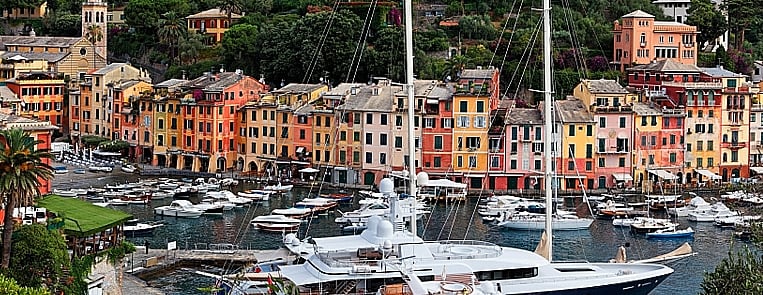
The eastern Riviera is the classic pairing. Camogli, half an hour away, stacks its tall painted houses above a fishing harbor that remains one of the most beautiful in Italy; from there boats cross to the abbey of San Fruttuoso, hidden in a cove reachable only by sea or footpath, and continue to Portofino, the emerald harbor whose piazzetta has hosted the world’s most glamorous arrivals for a century. Done by boat, the three make a single unforgettable day.

Santa Margherita Ligure and Rapallo extend the same coast with palm-lined promenades and a gentler rhythm, while Recco demands a stop for its protected cheese focaccia. Farther east, the Cinque Terre’s five villages cling to their terraced cliffs, a comfortable excursion from Genoa by rail or, more memorably, by sea in season. Westward, the Riviera di Ponente offers Albenga’s medieval towers and the flower coast toward Sanremo.

Inland, the Apennine valleys hide stone villages, chestnut forests, and the pesto basil greenhouses of the coast’s agricultural face. We sequence excursions so each day refreshes the journey rather than crowding it, with private drivers and boats arranged throughout, often as part of a custom trip to Italy that lets Genoa anchor the whole Riviera.

What Active and Family Experiences Does Genoa Offer?

Genoa was made to be moved through. The ridge above the city carries footpaths between seventeenth-century forts with the harbor glittering below, the Nervi cliff walk turns a stroll into theater, and the mule tracks of the coast, including the celebrated paths around Portofino’s headland and down to San Fruttuoso, offer some of the Mediterranean’s finest walking. Sea kayaks trace the same coast from water level, and sailing days out of the marinas put travelers under canvas on the republic’s home sea.

For families, the city is a gift: the aquarium and the Galata museum’s galley and submarine enchant children, the Bigo lift and funiculars turn transport into adventure, focaccia and gelato provide reliable diplomacy, and the beaches at Boccadasse and Nervi close the afternoon. We compose family days so palaces and history arrive as story and adventure, part of a family vacation to Italy paced for every generation.

Walkers, swimmers, and sailors can go further with us: guided hikes on the Portofino peninsula, coastal swims and boat days in the warm months, and cycling in the quiet Apennine valleys, woven into itineraries as part of our active trips in Italy, matched carefully to ability and appetite. In Genoa the effort always ends somewhere delicious, a trattoria, a cove, a terrace above the sea, and we design that pairing deliberately.

Ready to Begin Planning Your Genoa Vacation?

Genoa deserves more than a template. Since 2003, Trips 2 Italy has designed private Italian vacations one traveler at a time, hand selecting every experience based on what you tell us rather than fitting you into a predefined package. Our Italian-born team plans Genoa with the knowledge of people who call Italy home, from the frescoed halls of the Rolli palaces to the fishing harbor at Boccadasse, and we remain at your side throughout your trip with 24/7 assistance. Tell us how you imagine Genoa, and we will craft the itinerary that matches it.

Explore Our Genoa Vacation Itineraries

Genoa and Portofino Tour

For those seeking an exciting getaway while traveling, our Genoa and Portofino tour is an excellent option. At 8.3 hours, it offers an all-day excursion with plenty to see

Explore Trip

Frequently Asked Questions About Things to Do in Genoa

Via Garibaldi and the Rolli palaces, with the Strada Nuova Museums at their heart, are the essential first encounter, followed closely by the caruggi of the old town and the reborn Porto Antico with its aquarium. Trips 2 Italy arranges expert guides and timed visits so the palaces’ hidden interiors open as more than beautiful facades.

Yes, particularly for families. The Acquario di Genova is Italy’s largest aquarium and among Europe’s finest, anchoring Renzo Piano’s old port alongside the Biosfera sphere and the panoramic Bigo lift. Paired with the Galata maritime museum’s full-scale galley and submarine, it makes one of the best family days in northern Italy.

A former fishing village absorbed whole into the modern city: pastel houses around a pebble cove at the end of the Corso Italia seafront, with boats on the beach and gelato at sunset. It is Genoa’s favorite evening ritual and one of the most charming corners of the entire Riviera.

Easily. Camogli lies about half an hour east, boats cross to the sea-locked abbey of San Fruttuoso and on to Portofino’s famous harbor, and Santa Margherita and Rapallo extend the same golden coast. We design these as private boat and driver days, so the Riviera unfolds without timetables.

Yes, a comfortable one by rail along the coast or by boat in season, with the five terraced villages arriving one after another in a single spectacular day. Many travelers base in Genoa for city comforts and let us arrange the Cinque Terre as a guided excursion with every connection handled.

One of Italy’s best cities for them: the aquarium, a pirate-worthy galley at the maritime museum, funiculars and harbor lifts, castles and forts on the heights, beaches at Boccadasse and Nervi, and focaccia at every turn. Trips 2 Italy composes family itineraries so history and art arrive as adventure rather than obligation.