Reggio Emilia is a town steeped in quintessential Italian charm that is a true treasure for all who visit. The city is not as often traveled as neighboring Parma and Bologna, which makes it the perfect respite for those wanting to enjoy the Italian way of life while avoiding large crowds. This quiet city is filled with warm people that are proud of their heritage. The welcoming community, less crowded streets and number of things to do makes Reggio Emilia a must-see on your next trip to Italy.
FESTIVALS & EVENTS
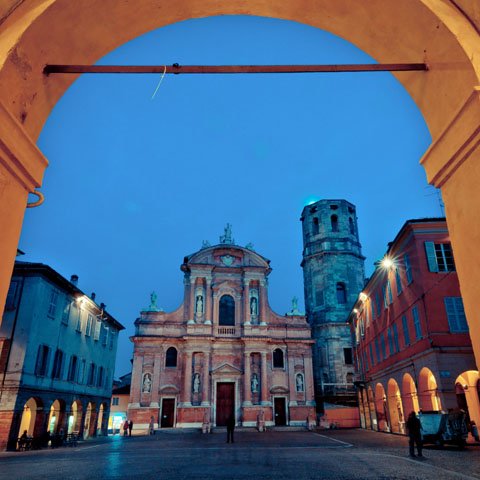
Reggio Emilia’s most lively celebration is tied to Bishop Prospero, who is the Patron Saint of the city. A native of Reggio Emilia, Prospero served as the city’s bishop from 480 to 505 AD. Due to his efforts to protect the city and spread the Christian faith, Prospero was declared a saint. Each year, the locals celebrate their saint on November 24, a day that commemorates a miracle of San Prospero in which the saint covered Reggio Emilia in fog so as to protect the city from Attila the Hun. San Prospero is celebrated in the streets, squares, and churches of the historic city center with religious ceremonies and cultural events.
Another important event is the Tricolor Flag Festival, which commemorates the adoption of the green, white, and red flag by the Cispadane Republic on January 7, 1797 in Reggio Emilia. The flag would go on to be adopted as the national flag of unified Italy, and each year the locals celebrate with concerts and other cultural events.
OUTDOOR
Take an hour or two to relax in nature in the middle of the city at Piazza Fontanesi. This city square is one of the most popular in Reggio Emilia because of all of its green space. On any given day, the piazza is full of locals of all ages enjoying a variety of activities including picnics, childhood games, and good conversation. On a couple of days each week, the Piazza Fontanesi is home to an open-air market that sells fresh fruit and vegetables.
After a large meal, partake in an Italian tradition and enjoy a leisurely walk along Piazza Prampolini. This square at the city’s center is surrounded by important historic buildings such as the Town Hall, the cathedral, the baptistery, and the Bordello Tower. The piazza is so large it is often referred to as Piazza Grande, which means big square. Be sure to rest for a moment at the majestic Crostolo Fountain to take in the beauty of the fountain and your surroundings.
Outside of the city, travelers can visit the former summer villa of legendary Italian poet Ludovico Ariosto. Located along the Rodano River, the villa features stately rooms decorated with historic frescoes.
Also outside of Reggio Emilia lies the Rivalta Realm. The elegant structure that dates back to the eighteenth century was built by the Este family. Today, only part of the villa remains intact, while the majority of the structure is in ruins.
INDOOR
For a comprehensive understanding of the city’s history, make it a point to visit the historic Palazzo del Capitano del Popolo. The palace is full of important artifacts and paintings of Reggio Emilia from over the centuries. Dating back to the thirteenth century, this building is considered to be the heart of Reggio Emilia’s political life.
Take in the overwhelming beauty of the Basilica della Beata Vergine della Ghiara which translates to Basilica of the Blessed Virgin of the Ghiara. Many visitors stop to offer up a prayer in the immense splendor of this intricately and ornately detailed church. Not to be missed here are the stunning altars, painted religious scenes, and the colossal arcades. A visit to the Temple of the Blessed Virgin of the Ghiara is thought to be one of the most reverent experiences in Italy.
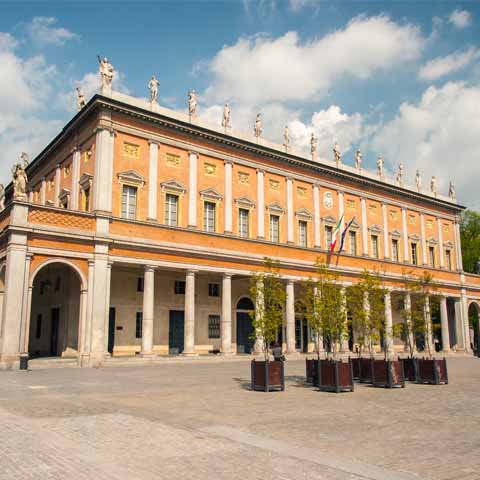
The Teatro Municipale Valli is an enormous theater complex as famous for its stunningly detailed interior as it is for the musical and ballet performances it hosts. In addition to the theater, the complex holds an archive room and a couple of libraries. The inside of the theater is laced in rich red and golden hues and showcases intricate and ornate paintings on the ceiling. Experiencing a musical or ballet performance here is greatly enhanced by the exquisite beauty of this striking theater. It is one of the most lavish theaters in all of Italy. Travelers should also take a moment to admire the fountain located in front of the theater, which was built following specific geometric principles.
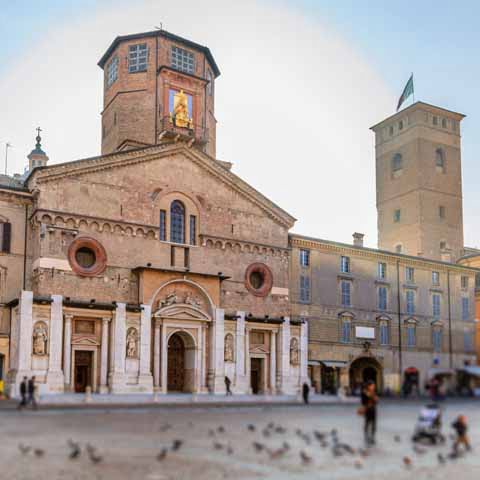
A trip to Reggio Emilia is simply not complete without a visit to see some of the city’s historic architecture and churches. Be sure to visit the Cathedral of Santa Maria Assunta, the Basilica of San Prospero, the Church of San Giovanni Evangelista, the Church of Sant’Agostino, and many others for unparalleled views of period architecture and frescoes.
FAMILIES
Take the family to visit the cozy and quaint Libreria All’Arco in the heart of the city. This charming library of multiple floors is anything but stuffy, with modern lighting, comfortable seating spaces, and bookshelves upon bookshelves lining the walls. On occasion, there may even be a musician tickling the ivories as they sit at the black piano tucked into a corner of the library. Visiting the Libreria All’Arco offers a lovely experience for the whole family.
Another great place to stop is the Salsapariglia Collection. This unique museum hosts 150 motorcycles that date as far back as 1900. In addition to the motorcycles, visitors can also admire historic bicycles, tractors, gramophones, other motors, and weapons.
KIDS
Just outside the city to the northeast is Aquatico, a giant swimming pool complex that is sure to delight the children. Aquatico features a children’s pool and activity area, a large pool, water slides, and more. Be sure to call ahead to verify the days and hours the park will be open.
Reggio Emilia lends its name to a specific teaching style developed by Loris Malaguzzi, which is called the Reggio Emilia Approach. During a visit to Reggio Emilia, families with children can visit the Malaguzzi Center to learn more about this teaching method. The center is located in a former factory, known as the Locatelli Complex, which has been revitalized as part of Reggio Emilia’s changing urban landscape.
Little ones may enjoy a visit to Parco del Popolo, one of Reggio Emilia’s public parks. The grounds feature gardens, monuments, sculptures, rare trees and plants, and fountains. After a day of sightseeing, there’s no better place to unwind in the heart of Reggio Emilia.
UNIQUE EXPERIENCES
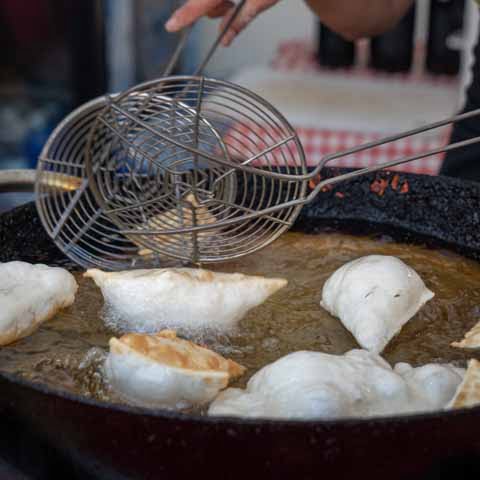
An opportunity to tour an authentic Parmigiano-Reggiano cheese factory can be found about half an hour away. Parmigiano-Reggiano is one of the most ancient cheeses and is the pride and joy of the entire Emilia-Romagna region, as well as an integral part of the cuisine in Reggio Emilia.
One of the best times to visit the factory is earlier in the morning when they are actively making the cheese. Visitors are often able to see and learn about the process of the cheese production. It may be possible to taste some of the fruits of the factory’s labor while touring, and they might even drizzle it with a little of the city’s own locally made balsamic vinegar.
Another unique experience in Reggio Emilia is to tour the Tricolor Flag Museum, also known as Museo del Tricolore. The museum, located in Casotti Square, displays artifacts and documents regarding the fascinating history of the Italian flag, which was born in Reggio Emilia in January of 1797. The building does not take very long to walk through, but this is a stop well worth your while as it offers some unique insight into the city.
When planning a trip to the Emilia-Romagna region in Northern Italy, the city of Reggio Emilia is well worth a stop. Here, travelers have the opportunity to taste the area’s delicious local cuisine and admire the beauty of the Basilica della Beata Vergine della Ghiara and many other historic monuments.
Travel Guides
[wudrelated include="1837"]
The Emilia Romagna Region of Italy
[wudrelated include="2694"]
The Cities of Emilia Romagna, Italy
[wudrelated include="4235"]