Things To Do in Bari

HOME » POPULAR ITALIAN DESTINATIONS » BARI TRAVEL GUIDE » BARI THINGS TO DO GUIDE

Bari Travel Guide        Culture        History        Food and Wine        Things to Do        Plan My Trip

About this guide: This guide to things to do in Bari was written by the Italian-born travel specialists at Trips 2 Italy, a custom tour operator that has designed hand-crafted Italian vacations since 2003. Every recommendation below reflects the same first-hand knowledge our team draws on when we build a private Bari itinerary around a traveler’s interests, dates, and pace. Read it for your research, then let us translate it into a trip designed entirely around you.

What Belongs at the Top of Every Bari Itinerary?

The Basilica di San Nicola comes first: the prototype of Apulian Romanesque, raised from 1087 over the relics of St Nicholas, with its fortress facade, its carved bishop’s throne, and the crypt where Catholic and Orthodox pilgrims pray side by side above the saint’s tomb. Visit early, when the morning sun rakes the pale limestone and the crypt is at its most hushed.

From the basilica, the essential circuit unfolds on foot: the Cathedral of San Sabino with its solstice-aligned rose window, the Norman-Swabian Castle at the old town’s edge, and the lanes of Bari Vecchia stitching them together. Everything sits within a few hundred yards, which makes Bari one of the most efficient great sightseeing cities in the south.

The city rewards guided depth, and it anchors the region explored in our Apulia travel guide. We arrange art historians and local guides who unfold the basilica’s nine centuries, the castle’s emperors and duchesses, and the old town’s living folklore, timed to the hours when each is at its best rather than its busiest.

Give the basilica unhurried time rather than a glance. The building rewards slow reading, from the carved beasts of its portals to the gilded seventeenth-century ceiling and the eleventh-century ciborium over the altar, and travelers who descend to the crypt twice, once amid pilgrims and once in near solitude, understand why the city has organized itself around this church for nine hundred years.

What Is It Like to Walk Bari Vecchia?

Bari Vecchia is a labyrinth by design, its tight lanes angled to baffle invaders and sea winds alike, and walking it remains the city’s essential experience. Streets open without warning into courtyard piazzas, more than forty churches hide behind humble doors, votive shrines glow in wall niches, and daily life proceeds in the open air exactly as it has for centuries.

The famous set piece is the Strada delle Orecchiette, Via dell’Arco Basso, where women shape pasta at tables outside their doors and sell it from the same boards. Around it, look for the Arco Basso itself, the old town’s low arch, Piazza Mercantile with its column of justice where debtors were once shamed, and Piazza Ferrarese opening onto the sea, the quarter’s convivial front porch.

The old town is safe, sociable, and best met with local knowledge. We pair travelers with Bari Vecchia natives who narrate the quarter from the inside, from the folklore of the shrines to which focaccia oven deserves your one mid-morning appetite, and who open doors, bakeries, kitchens, and church sacristies that unaccompanied visitors walk past.

A practical rhythm serves the old town well: enter mid-morning when the ovens and pasta tables are at full work, return at dusk when the lanes turn golden and the piazzas fill. Between visits, the quarter rewards aimlessness; some of its best shrines, courtyards, and bakery windows announce themselves only to travelers who take the wrong turn on purpose.

Why Visit the Norman-Swabian Castle and the Lungomare?

The Norman-Swabian Castle is Bari’s stone biography: Norman foundations, Frederick II’s severe rebuilding of 1233, and the Renaissance court of Isabella of Aragon and Bona Sforza layered into one moated mass at the old town’s landward corner. Its halls host the gipsoteca’s casts of Apulia’s finest Romanesque carving and rotating exhibitions, and its ramparts frame the quarter’s rooftops.

The Lungomare is the counterpoint: a monumental 1930s seafront that sweeps for miles past the Teatro Margherita, the fish dock, and the Pinacoteca, with the Adriatic flashing beyond a balustrade of white stone. Walk it at golden hour, when the whole city seems to join you, or take it at morning pace toward Pane e Pomodoro, the city beach where locals swim from spring to autumn.

Between castle and seafront, give an hour to the fish market’s theater below the Teatro Margherita, where the crudo ritual plays out against rocking boats. These three experiences, fortress, promenade, and dock, are Bari’s open-air trinity, and they cost nothing but time well scheduled, which is precisely the commodity our itineraries are designed to protect.

Photographers should plan the seafront around light. Morning sun strikes the old town’s pale stone from the water, while the last hour of the day turns the Lungomare’s balustrades and the Margherita’s domes to copper; we time walking tours accordingly, and a driver positioned at the promenade’s far end lets the walk finish exactly where the view does.

Which Museums, Theaters, and Churches Reward a Visit?

The Pinacoteca Corrado Giaquinto, on the Lungomare, rewards art lovers with Apulian panel painting, Venetian canvases by Tintoretto and Veronese, and the southern nineteenth century, all in seafront light. The Archaeological Museum of Santa Scolastica reaches back to Bari’s Peucetian and Greek beginnings inside a harbor bastion, and the castle’s cast gallery gathers the region’s Romanesque sculpture into one comparative room.

The Teatro Petruzzelli, southern Italy’s largest theater, reborn in 2009 after its 1991 fire, stages opera, ballet, and symphonic seasons beneath a restored dome; an evening here, preceded by aperitivo in the Murat quarter, is Bari at its most polished. The Teatro Margherita, the Art Nouveau hall built on stilts over the harbor, now shows contemporary art in one of Italy’s most unusual exhibition spaces.

Among churches, beyond basilica and cathedral, seek out the Russian Church of St Nicholas in the Carrassi district, built in the early twentieth century for eastern pilgrims, and the little medieval churches folded into Bari Vecchia’s lanes. We compose museum and performance days with timed entries, expert companions, and seats secured well ahead, so culture arrives without queues.

Booking rhythm matters here: opera seats, castle exhibitions, and the best guides all reward early planning, especially around the May feast and the September fair. We build the cultural spine of a Bari stay first and let the strolling hours arrange themselves around it.

Where Do You Find the Quieter Side of Bari?

Come at the old town from its edges and hours. At dawn, Bari Vecchia belongs to bakers and fishermen; at dusk, Piazza Ferrarese hums gently before dinner. The cloister of Santa Scolastica, the benches of the Giardino Isabella d’Aragona inside the castle moat, and the far reaches of the Lungomare, where the promenade empties toward the horizon, all offer stillness a few minutes from the center.

The coast north and south hides quieter pleasures: Giovinazzo’s miniature harbor and Molfetta’s old port to the north, Mola di Bari’s fishing quays to the south, and Torre a Mare’s coves, all within half an hour and blissfully local in rhythm. Inland, the Murge plateau offers silent olive-grove lanes, jazzo sheepfolds, and the karst gorge country around Gravina and Altamura.

We deliberately alternate Bari’s celebrated hours with these quiet ones, because the alternation is what keeps a journey feeling like discovery. The travelers who fall hardest for the city are almost always those whose itineraries included one morning in a fishing town nobody they know has ever named.

Swimmers should note the locals’ habit of taking the sea straight off the rocks along the southern Lungomare on summer mornings, a small daily liturgy that says more about Bari than any monument. Joining it, towel over shoulder among the regulars, is the kind of unticketed experience we love to point travelers toward.

What Do Evenings in Bari Look Like?

Evening is Bari’s best performance. The passeggiata fills Via Sparano and the seafront, aperitivo tables spread across Piazza Mercantile and Piazza Ferrarese, and the old town’s kitchens send out orecchiette, grilled octopus, and crudo platters until late. Dinner in Bari starts fashionably late and ends reluctantly.

For a composed night, we arrange the classic sequence: golden-hour walk on the Lungomare, aperitivo above the old harbor, an opera or concert at the Petruzzelli in season, and a late supper in Bari Vecchia where the pasta was made that morning within sight of your table. In summer, open-air stages and festival nights extend the city’s living room onto the water.

Families find Bari’s evenings unusually welcoming, since children are constitutionally part of the passeggiata, gelato is a civic duty, and the traffic-free lanes make wandering easy; it is one reason the city fits so naturally into a family vacation to Italy. However you imagine the night, we choreograph it so reservations, seats, and timing are already handled.

What Day Trips Pair Well With Bari?

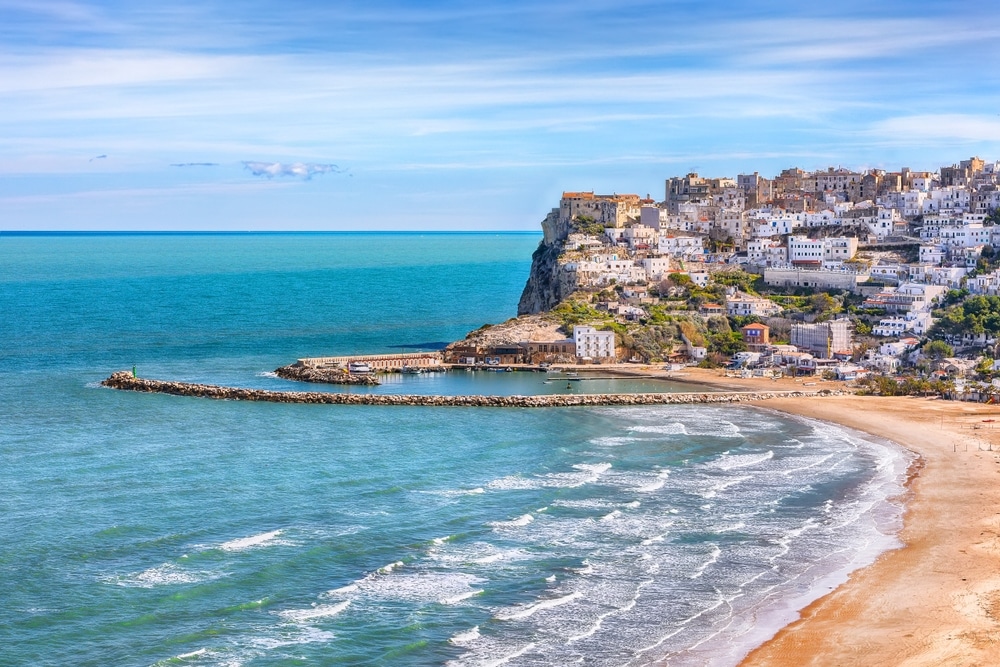
Bari commands the best day trip radius in southern Italy. Polignano a Mare, thirty minutes south, stacks its whitewashed old town on cliffs above a famous cove; Monopoli’s harbor glows a few minutes beyond. Inland, Alberobello’s trulli, the UNESCO-listed cones we explore in our Alberobello guides, share the Itria Valley with Locorotondo and Martina Franca, and the Grotte di Castellana descend into Italy’s most spectacular show caves, culminating in the white alabaster cavern of the Grotta Bianca.

History travelers head northwest to Castel del Monte, Frederick II’s enigmatic octagon on its solitary hill, pairing it with Trani’s luminous seafront cathedral and a tasting in the Nero di Troia vineyards below. Across the Basilicata border, an hour away, Matera’s sassi cave city delivers one of Europe’s most astonishing urban landscapes, and it joins Bari itineraries so naturally that we plan the two as sister chapters.

With a private driver, each excursion becomes a fluid day: swim, cave, castle, or sassi in the morning, a masseria or seaside lunch, and back to Bari for the passeggiata. Active travelers can trade wheels for a coastal bike ride or a Murge hike as part of our active trips in Italy, and however you compose it, a custom trip to Italy sequences the days so each one refreshes rather than repeats.

Whatever the excursions, the guiding principle is rhythm. Bari rewards alternation, a cave morning followed by a seafront evening, a castle followed by a fishing town, and an itinerary that breathes this way sends travelers home rested rather than spent. Composing that rhythm around each traveler is the heart of what we do.

Ready to Begin Planning Your Bari Vacation?

Bari deserves more than a template. Since 2003, Trips 2 Italy has designed private Italian vacations one traveler at a time, hand selecting every experience based on what you tell us rather than fitting you into a predefined package. Our Italian-born team plans Bari with the knowledge of people who call Italy home, from the basilica lanes of the old town to the long seafront promenade, and we remain at your side throughout your trip with 24/7 assistance. Tell us how you imagine Bari, and we will craft the itinerary that matches it.

Explore Our Bari Vacation Itineraries

Frequently Asked Questions About Things to Do in Bari

Visit the Basilica di San Nicola and its crypt, wander Bari Vecchia and the Strada delle Orecchiette, tour the Norman-Swabian Castle, walk the Lungomare at golden hour, watch the raw seafood ritual at the fish dock, and give an evening to the Teatro Petruzzelli in season. Two well-planned days cover them all.

Almost entirely. The old town, the Murat quarter, the castle, and the central seafront sit within one comfortable walking radius, and the lanes of Bari Vecchia are traffic-free. For day trips along the coast and inland, Trips 2 Italy arranges private drivers so the wider province unfolds without logistics.

Polignano a Mare and Monopoli lie about thirty minutes south, Alberobello’s trulli and the Grotte di Castellana under an hour away, Castel del Monte and Trani an easy run northwest, and Matera’s cave city just across the regional border. We compose each as a fluid private day with a driver and, where it enriches, a specialist guide.

Yes. The Castellana caves are Italy’s most celebrated show cave system, a walk through vast chambers of stalactites that ends at the Grotta Bianca, a cavern of white alabaster formations. They pair beautifully with Alberobello or Polignano a Mare for a single varied day trip from Bari.

Yes. Pane e Pomodoro, the city beach at the southern end of the seafront, fills with locals from late spring through October, and finer swimming coves line the coast at Polignano a Mare and Monopoli within half an hour. We fold beach time into itineraries whenever the season and your pace invite it.

Very. The old town is a traffic-free maze children love, the pasta makers welcome small hands, the castle has moats and ramparts, the caves at Castellana feel like an expedition, and the evening passeggiata belongs to all generations. Trips 2 Italy composes family days so history and food arrive as adventure rather than obligation.