Things To Do in Sulmona

HOME » POPULAR ITALIAN DESTINATIONS » SULMONA TRAVEL GUIDE » SULMONA THINGS TO DO GUIDE

Sulmona Travel Guide        Culture        History        Food and Wine        Things to Do        Plan My Trip

About this guide: This guide to things to do in Sulmona was written by the Italian-born travel specialists at Trips 2 Italy, a custom tour operator that has designed hand-crafted Italian vacations since 2003. Every recommendation below reflects the same first-hand knowledge our team draws on when we build a private Sulmona itinerary around a traveler’s interests, dates, and pace. Read it for your research, then let us translate it into a trip designed entirely around you.

What Belongs at the Top of Every Sulmona Itinerary?

The Santissima Annunziata first: the town’s masterpiece, begun in 1320, whose carved facade converses across two centuries of Gothic and Renaissance taste, with a theatrical baroque church beside it and the civic museum within, holding Roman mosaics, medieval goldwork, and the memory of the confraternity that built it all. Give it an unhurried hour with a guide who can read the stone.

Then walk Corso Ovidio, the elegant spine of the capital of the Valle Peligna in the Abruzzo region, past confetti shop windows blooming with sugared flowers, to Piazza XX Settembre and the bronze statue of Ovid, pensive above the cafes since 1925. The corso ends near the cathedral of San Panfilo, raised over a Roman temple site, its medieval crypt intact beneath the baroque nave.

Finish in Piazza Garibaldi, the great square bordered by the pointed arches of the 1256 aqueduct and cornered by the Fontana del Vecchio of 1474. On Wednesday and Saturday mornings the market fills it with the valley’s produce; at Easter the Madonna runs across it; in late July the Giostra’s riders gallop it. We sequence these essential encounters with expert guides and time them to the quiet hours, because monuments this eloquent deserve better than a crowd and a checklist.

Where Can You Experience the Confetti Tradition?

Sulmona’s sweetest attraction is best met at the source. The historic Pelino factory, producing sugared almonds since 1783, maintains a museum of confectionery art and technology where copper pans, nineteenth-century machines, and family archives tell the story of the craft that made the town famous, and the workshop still turns out confetti exactly as the archive describes.

Along Corso Ovidio and the surrounding lanes, the confetti houses display the town’s signature art: sweets wired into roses, daisies, wheat sheaves, and entire everlasting bouquets, arranged in windows that stop every passerby. Watching an artisan build a flower petal by petal, and learning the color language that assigns white to weddings and gold to fiftieth anniversaries, turns a shopping stroll into a cultural education.

The tradition rewards a little context. The almonds themselves are chosen with a jeweler’s eye, the sugar built up in patient layers in slowly turning pans, and the finest houses still refuse starch and filler entirely, a point of pride the confectioners explain with evident pleasure. Understanding what separates a true Sulmona confetto from an ordinary sugared almond takes ten minutes and changes the way you taste them forever.

We arrange private demonstrations with confectioners, visits timed to production hours, and tastings that compare the classic almond with the newer inventions the houses guard proudly. For families, honeymooners, and anyone who loves craft, it is an hour of pure delight, and the boxes that travel home in your luggage will outshine any souvenir.

How Do You Visit the Hermitage of Sant'Onofrio and the Morrone?

High on the flank of the Morrone, white against the gray rock, hangs the hermitage of Sant’Onofrio, where the hermit Pietro da Morrone was living in 1294 when the cardinals climbed to tell him he had been elected pope. The walk up from the village of Badia follows a mule path with immense views over the Valle Peligna, and the little complex at the top, with its frescoed oratory and the saint’s cell against the cliff, rewards every step.

Directly below the hermitage spread the massive terraces of the sanctuary of Hercules Curinus, where the Paeligni and then the Romans honored the god of flocks and springs; bronze and mosaic from the site now rest in the town’s museum. At the mountain’s foot stands the vast Abbey of Santo Spirito al Morrone, the mother house Celestine founded, rebuilt in baroque grandeur and now the seat of the Majella National Park, its church and courtyards open to visitors.

Together the three sites stack two thousand years of faith onto a single slope, and we compose them into one unforgettable half day: a guide who tells the hermit pope’s story where it happened, transport arranged to the trailhead, and lunch waiting in town or in a village below. Travelers of every fitness level can meet this landscape; we simply calibrate how much of it is met on foot.

What Outdoor Experiences Await in the Majella?

The Majella National Park begins at Sulmona’s doorstep, and it is one of wild Italy’s great strongholds: a massif of high plateaus and profound gorges crowned by Monte Amaro at over 9,100 feet, sheltering Marsican brown bears, Apennine wolves, chamois, and golden eagles, its geological wealth recognized as a UNESCO Global Geopark. Hermits sought these heights for a thousand years, and their rock-cut sanctuaries still punctuate the cliffs.

The walking is superb at every level, from gentle valley rambles and the mule paths of the Celestinian hermitages to full ascents for strong hikers, and the seasons multiply the possibilities: wildflowers and birdsong in June, cool high-country traverses in August, copper beech woods in October, and snowshoe silence in winter, with skiing in the highland towns of the plateau nearby.

One experience deserves special mention: the historic railway that climbs from Sulmona into the high Apennines, a line of viaducts, tunnels, and mountain stations often called Italy’s little Transiberiana, running vintage carriages through scenery no road reveals. We fold the railway, guided hikes, wildlife excursions with expert naturalists, and e-bike days into itineraries as part of our active trips in Italy, always with certified guides and private transfers, and always with a reward planned for the end of the effort.

Which Day Trips Reward Travelers Around Sulmona?

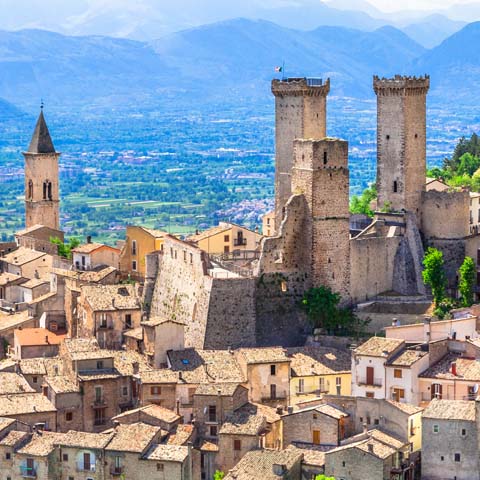
Pacentro is the closest jewel, ten minutes up the Majella’s flank: a village of stone lanes crowned by the towers of the Caldora castle, counted among Italy’s most beautiful villages, with balconies of flowers and views back across the whole valley. It pairs naturally with a mountain lunch and an afternoon amble that asks nothing of the clock.

South through the narrow Gole del Sagittario, one of the most dramatic gorge roads in the Apennines, lies Scanno, the lake and village that enchanted great photographers for a century: women in traditional costume once filled its lanes, its goldsmiths still craft the presentosa pendant, and its heart-shaped lake mirrors the mountains. Eastward on the high plateau, Pescocostanzo answers with patrician elegance, a highland town of stone palaces, a superb collegiate church, and living traditions of lace made on the tombolo, wrought iron, and goldwork.

Each excursion carries its own best hour. Pacentro glows in late afternoon when the towers catch the low light, Scanno’s lake is stillest in the morning before the breeze rises, and Pescocostanzo’s lanes are finest in the cool of the highland evening, when the passeggiata brings the town out among its palaces. Sequencing the day around these hours is the quiet difference between a good excursion and a perfect one.

Farther afield, the choices multiply: the hermitages carved into the Majella’s eastern cliffs, the highland meadows toward Campo di Giove, L’Aquila and Gran Sasso to the north, even the Adriatic’s Trabocchi coast under an hour east. The art is selection and sequence, three or four excursions matched to your tastes and paced with long lunches, and that is exactly how we compose them, with a private driver who knows every switchback.

Where Do You Find the Quieter Side of Sulmona?

Quiet is Sulmona’s natural register, but it deepens in particular corners. Early morning belongs to the cathedral’s crypt and the empty corso, when the light comes low across the palazzi and the mountains stand sharp at the street’s ends. The lanes east of the center, toward the old gates, keep a neighborly hush of workshops and courtyards that most visitors never find.

The valley multiplies the calm. The village of Badia drowses at the foot of the Morrone beneath its immense abbey, the country roads toward Fonte d’Amore pass orchards and garlic fields where Ovid’s family estate is said to have stood, and the smaller Peligna villages, Introdacqua and Bugnara among them, offer evening passeggiate where a visitor is an event. In the Majella’s folds, hermitages and abandoned high pastures hold a silence that recalibrates the nervous system.

Wildlife gives the quiet its wilder register. The Majella is one of the last strongholds of the Marsican brown bear and holds thriving populations of wolves, chamois, and golden eagles, and dawn excursions with expert naturalist guides bring travelers respectfully close to this hidden Italy. Few experiences in the country feel further from the beaten path, and few are easier to reach from a comfortable town base.

Evenings in town complete the quiet register: an aperitivo as the passeggiata flows past, a slow trattoria dinner of chitarra and Montepulciano, a walk to Piazza Garibaldi when the aqueduct’s arches stand floodlit and empty. Our itineraries deliberately alternate the celebrated with the silent, because the alternation is what makes a mountain journey feel like discovery rather than sightseeing.

How Do You Compose the Perfect Days in Sulmona?

The art is alternation. A morning among the Annunziata’s carvings wants an afternoon on the Morrone’s mule path; a day of gorge roads and lake villages wants an evening of confetti windows and a long table; a market morning beneath the aqueduct wants a vineyard afternoon. Sulmona’s compact center and dramatic surroundings make this rhythm effortless when the logistics are handled well, and tiring when they are not.

Timing is the second art. The market runs Wednesday and Saturday mornings, the Madonna runs only on Easter Sunday, the Giostra gallops only in late July, the garlic harvest fills July’s markets, the scenic railway follows a seasonal calendar, and the hermitage rewards clear mornings. A specialist who watches all of these professionally turns coincidence into composition, and that is precisely our work.

Every Sulmona itinerary we design is built by hand from what you tell us, whether the town anchors an Abruzzo week or joins Rome and the coast in a larger custom trip to Italy, with every guide, driver, table, and ticket arranged in advance and supported around the clock. The valley provides the poetry; we provide the ease.

Ready to Begin Planning Your Sulmona Vacation?

Sulmona deserves more than a template. Since 2003, Trips 2 Italy has designed private Italian vacations one traveler at a time, hand selecting every experience based on what you tell us rather than fitting you into a predefined package. Our Italian-born team plans Sulmona with the knowledge of people who call Italy home, from the confetti workshops of Corso Ovidio to the hermitage trails of the Morrone, and we remain at your side throughout your trip with 24/7 assistance. Tell us how you imagine Sulmona, and we will craft the itinerary that matches it.

Explore Our Sulmona Vacation Itineraries

Frequently Asked Questions About Things to Do in Sulmona

The Santissima Annunziata complex, Corso Ovidio and the Ovid statue in Piazza XX Settembre, Piazza Garibaldi with its medieval aqueduct, and the confetti workshops in town, followed by the hermitage of Sant’Onofrio on the Morrone and a day trip to Pacentro, Scanno, or Pescocostanzo. Trips 2 Italy sequences these with expert guides and private drivers so each arrives at its best hour.

Yes. The hermitage where Pietro da Morrone lived before becoming Pope Celestine V clings to the Morrone above the village of Badia and is reached by a scenic mule path, with the Roman sanctuary of Hercules Curinus just below and the great Abbey of Santo Spirito at the mountain’s foot. We arrange guided walks matched to each traveler’s pace.

A historic mountain line, often called Italy’s little Transiberiana, climbs from Sulmona through viaducts and high plateaus of the Apennines in vintage carriages on a seasonal calendar. It is one of Europe’s great slow-travel experiences, and Trips 2 Italy folds its departures into itineraries when the calendar and your dates align.

Very much so. The drive alone, through the dramatic Gole del Sagittario, justifies the day, and Scanno rewards it with a heart-shaped mountain lake, lanes that enchanted a century of great photographers, and goldsmiths still crafting the traditional presentosa pendant. We pair it with a lakeside lunch and unhurried village time.

Confetti workshops delight every age, the aqueduct and castle towers of Pacentro fire young imaginations, the scenic railway feels like an adventure, and gentle Majella walks and lake days at Scanno fill the afternoons. We compose family itineraries so history and mountains arrive as play rather than obligation.

Easter Sunday’s Madonna che Scappa in Piazza Garibaldi and the Giostra Cavalleresca joust on the last weekend of July lead the calendar, joined by the red garlic harvest in July, village festivals across the Peligna valley in summer, and the foliage and truffle season of autumn. Trips 2 Italy tracks the calendar and builds itineraries so events become centerpieces rather than accidents.