Things To Do in Alberobello

HOME » POPULAR ITALIAN DESTINATIONS » ALBEROBELLO TRAVEL GUIDE » ALBEROBELLO THINGS TO DO GUIDE

Alberobello Travel Guide        Culture        History        Food and Wine        Things to Do        Plan My Trip

About this guide: This guide to things to do in Alberobello was written by the Italian-born travel specialists at Trips 2 Italy, a custom tour operator that has designed hand-crafted Italian vacations since 2003. Every recommendation below reflects the same first-hand knowledge our team draws on when we build a private Alberobello itinerary around a traveler’s interests, dates, and pace. Read it for your research, then let us translate it into a trip designed entirely around you.

What Belongs at the Top of Every Alberobello Itinerary?

The trulli districts, walked slowly and at the right hours. Rione Monti’s lanes climb through more than a thousand cones to the trullo-shaped church of Sant’Antonio at the crest, while quieter Rione Aia Piccola preserves the residential town, and the belvedere terraces near the main square compose the whole rooftop landscape into the view every traveler carries home.

Timing and narration are our value here. A guided early morning, before the day-trip hours, delivers the districts at their most atmospheric, with a local specialist reading the painted symbols, the pinnacles, and the dry-stone technique building by building. It is the essential first encounter, and it anchors the wider region we introduce in our Apulia travel guide.

Round out the essentials with the Trullo Sovrano, the basilica of the patron saints, and an unhurried lunch of the valley’s cooking, then return to the lanes as the light lowers. Alberobello is small; experienced well, it is inexhaustible, and the difference is entirely in the composition of the day.

Plan the day around the light. Morning delivers the districts fresh and quiet; midday suits the museum interiors, a long lunch, or a drive into the valley; late afternoon returns you to the lanes as the tone warms; and evening belongs to the passeggiata and an aperitivo above the rooftops. Alberobello punishes the checklist and rewards the rhythm, which is why we compose its days as sequences rather than lists.

What Should You See in Rione Monti and Rione Aia Piccola?

In Rione Monti, let the main lanes lead you upward past workshops and viewpoints, but give equal time to the parallel streets a few steps over, where the crowds thin and the district’s texture returns. Seek out the siamese trulli, the joined twin cones with two entrances and a story of divided brothers, and finish at Sant’Antonio, whose stone dome closes the climb.

Rione Aia Piccola asks for different manners and gives more in return. Its four hundred trulli remain homes, so you walk as a guest: quietly, camera judicious, along lanes where daily life proceeds around you. The district preserves the old threshing floor that named it, and toward evening, when cooking drifts from the doorways, it becomes the most honest hour in town.

Between the districts, the Museo del Territorio occupies the Casa Pezzolla, a complex of fifteen communicating trulli, and furnishes the interiors with the beds, hearths, looms, and tools of trullo life, the domestic answer to the architecture outside. Our guided mornings link all three, with the belvederes sequenced for the best light.

Give yourself at least one deliberate wander with no destination. The districts are compact enough that you cannot truly be lost, and their pleasures multiply off the main lines: a courtyard of flowerpots, a cone under repair with its stones sorted into neat piles, a doorway conversation you will not understand and will not forget. Guides open the town’s meaning; the aimless half hour makes it yours, and we build that half hour into every day we design here.

Why Visit the Trullo Sovrano and the Town's Churches?

The Trullo Sovrano, behind the basilica, is the technique’s masterpiece: the town’s only two-story trullo, raised in the eighteenth century for a prosperous priestly family and now a house museum. Inside, the corbelled cone rises overhead in perfect courses, and the period furnishings restore the life the building held: kitchen, chapel, bedrooms, and the staircase hidden in the wall’s thickness.

The Basilica of Saints Cosmas and Damian holds the town’s devotional heart, with the relics and images of the physician saints whose September feast is Alberobello’s great celebration. Nearby, the Casa d’Amore of 1797, the first building raised with mortar after royal liberation, quietly marks the town’s proudest date.

At the crown of Rione Monti, the Church of Sant’Antonio repays the climb: a twentieth-century church composed in the trullo language, Greek cross in plan, its dome rising about seventy feet among the cones. Taken together, these buildings tell the whole civic story, and a good guide threads them into a single narrative morning.

Practicalities matter more here than travelers expect: the Trullo Sovrano and the territory museum keep seasonal hours, the basilica pauses at midday, and Sant’Antonio pairs naturally with the top of the Monti climb. We sequence these openings into the day’s design so travelers never climb to a closed door, one of those small pieces of logistics that quietly decide how a visit feels.

Where Do You Find the Quieter Side of Alberobello?

In the hours, first. Dawn and early morning belong to residents and the fortunate few staying overnight, when the lanes are empty, the light rakes across the whitewash, and photographers have the belvederes to themselves. Evening answers with the passeggiata and the slow gold that settles over the cones after the day visitors depart.

In the corners, second. Aia Piccola at any hour, the parallel lanes of Monti, the newer town’s piazzas where locals take their espresso, and the short walk beyond the districts to where trulli scatter into gardens and groves. Alberobello’s fame concentrates on a few streets; its charm does not.

And in the countryside, finally. The lanes out of town thread between dry-stone walls, vineyards, and rural trulli, beautiful on foot or by bicycle, and the valley’s agriturismi and masserie offer afternoons of complete unhurried calm. We build these quiet hours into every itinerary deliberately, because they are what turn a famous sight into a personal memory.

Seasonal quiet is also worth planning for. November through March, outside the Christmas weeks, gives the districts to you almost alone, with mild weather and the valley’s kitchens at their most local. Even in high summer, the countryside absorbs the season’s energy effortlessly: a shaded masseria courtyard, a grove at siesta hour, and a late evening in town make July days both full and calm.

Which Itria Valley White Towns Pair With Alberobello?

Locorotondo sits ten minutes away, a perfect circle of whitewashed lanes crowned with the pointed gabled roofs called cummerse, its balconies spilling flowers and its name attached to the valley’s crisp white wine. It is many travelers’ favorite half-day in the region, ideally closing at a terrace over the vineyards.

Martina Franca, the valley’s aristocrat, answers the trulli with baroque: a historic center of palaces, theatrical churches, and the grand Palazzo Ducale, plus the summer opera festival that fills its courtyards with music, and the capocollo that makes its butchers famous. Cisternino completes the trio, a tangle of white lanes where the evening ritual is dinner at the fornello, the butcher’s grill, bombette straight from the coals.

Each town keeps its own calendar of evenings worth catching: Locorotondo’s wine celebrations, Martina Franca’s opera nights in July and August, Cisternino’s summer lanes at grill hour. We match the valley’s calendar to your dates when we compose the week, so the towns arrive not as stops on a route but as scenes in a story.

The three towns ring Alberobello within twenty minutes’ drive, and with a private driver they compose into unhurried days: a town each morning, a masseria or cellar each afternoon, the trulli districts at evening. Sequencing them well is precisely the craft of a custom itinerary, and it is where the valley rewards planning most.

What Day Trips Reach Beyond the Valley?

The Grotte di Castellana, twenty minutes north, are among Europe’s great show caves: a subterranean itinerary of chambers and formations discovered in 1938, descending through the vast sinkhole called the Grave to the dazzling white alabaster chamber, the Grotta Bianca. Paired with Alberobello, they make a striking study in what limestone does above and below ground.

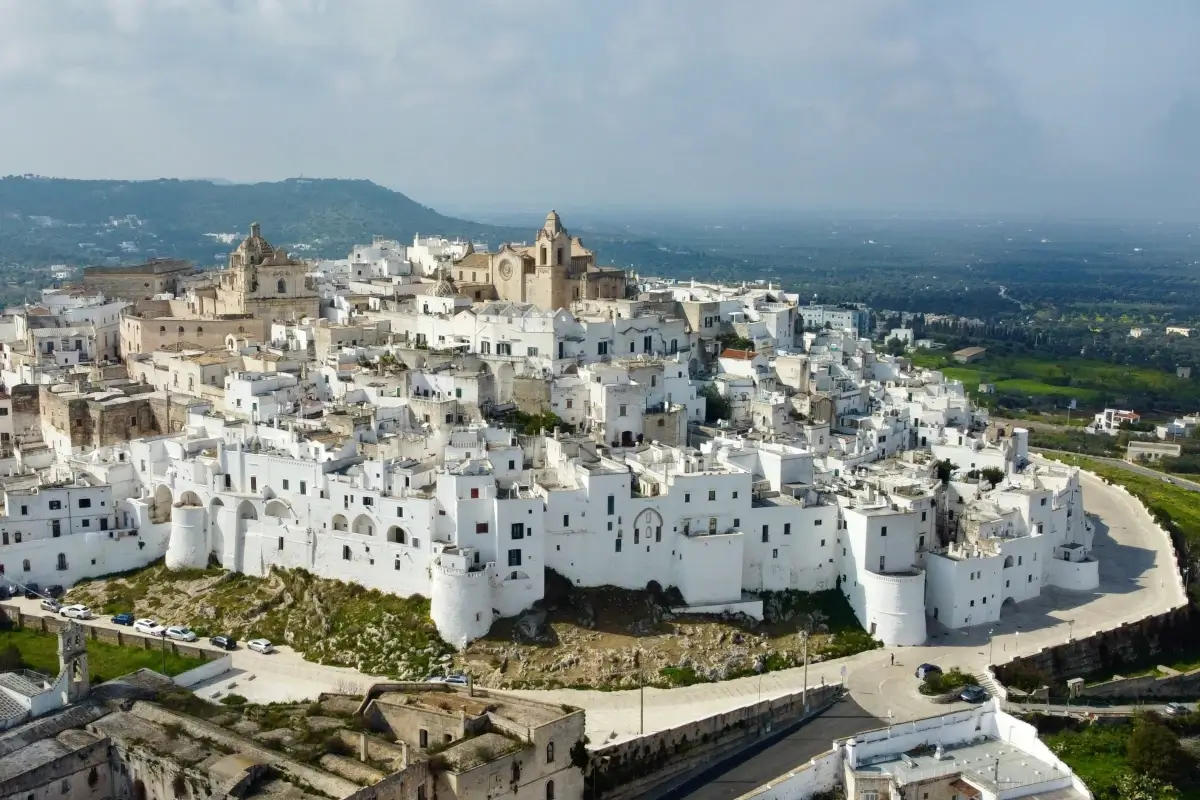
The Adriatic is half an hour away. Polignano a Mare stacks its old town on cliffs above the famous pebble cove of Lama Monachile, with terraces hung over the water, while Monopoli keeps a working harbor of blue boats beside its bastioned old town. South along the ridge, Ostuni rises in a white pyramid of lanes around its cathedral, the citta bianca gleaming above a sea of olives.

The coast deserves flexibility. On a hot day, we convert an afternoon into a swim at the coves around Polignano or a boat outing along the limestone shore; in cooler months, the same coastline serves clifftop walks and long seafood lunches over the water. Keeping one day loose for the Adriatic is advice we give with nearly every valley itinerary.

The grandest excursion crosses into Basilicata: Matera, little more than an hour away, where the sassi cave districts descend their ravine in one of the oldest continuously inhabited landscapes on earth. It pairs with Alberobello as naturally as any two places in the south, two answers to the same question of building from stone, and we arrange it as a guided full day with a private driver.

How Do We Compose the Perfect Alberobello Days?

We begin with what you tell us. For couples, that might mean a trullo stay, a sunset tasting over the vineyards, and a table for two among ancient olives. For families, a treasure-hunt walk through the cones, an orecchiette lesson where children shape their own lunch, and a beach afternoon at Polignano, woven into a family vacation to Italy that keeps every generation engaged.

For travelers who like their days in motion, the valley obliges: cycling the lanes between white towns, walking sections of the old rail greenway that threads the vineyards, and swimming the Adriatic coves, arranged as part of our active trips in Italy. Every version comes with a private driver, timed entries where they matter, and guides chosen for their storytelling.

However you imagine it, the town rewards composition over accumulation: two or three experiences a day, sequenced for light and appetite, with room left for the lanes themselves. That judgment, applied to your dates and your pace, is what our specialists have practiced across two decades of designing the south.

Finally, resist the urge to treat Alberobello as a single photograph. The town gives its best to travelers who meet it three times, in the morning, in the evening, and once by wandering, and who let the valley carry the rest of the day. Build the visit that way and the famous cones become only the beginning of what you remember, which, from us, is the highest recommendation a place can earn.

Ready to Begin Planning Your Alberobello Vacation?

Alberobello deserves more than a template. Since 2003, Trips 2 Italy has designed private Italian vacations one traveler at a time, hand selecting every experience based on what you tell us rather than fitting you into a predefined package. Our Italian-born team plans Alberobello with the knowledge of people who call Italy home, from the conical rooftops of Rione Monti to the vineyards and masserie of the Itria Valley, and we remain at your side throughout your trip with 24/7 assistance. Tell us how you imagine Alberobello, and we will craft the itinerary that matches it.

Explore Our Alberobello Vacation Itineraries

Frequently Asked Questions About Things to Do in Alberobello

Walk the two trulli districts at the right hours: Rione Monti climbing through more than a thousand cones to the trullo-shaped church of Sant’Antonio, and residential Rione Aia Piccola, with the belvedere viewpoints between them. Trips 2 Italy schedules guided early-morning walks so travelers experience the districts before the day-trip crowds arrive.

Exceptional, especially at dawn and in the last hour of light, when the whitewash and grey cones take the sun beautifully and the lanes are quiet. The belvedere terraces frame the classic rooftop panorama, and overnight guests have the best hours to themselves. We plan photography-minded itineraries around exactly those windows.

The Grotte di Castellana caves, the clifftop old town of Polignano a Mare, Monopoli’s harbor, the white city of Ostuni, and Matera’s cave districts across the Basilicata border all lie within roughly an hour, with Locorotondo, Martina Franca, and Cisternino even closer. A private driver lets these compose into unhurried, flowing days.

The main square, belvederes, and principal lanes of Rione Monti are reachable with care, though the districts are stone-paved and parts are stepped and sloping. We plan routes that favor the gentler approaches, arrange drivers for door-to-door transfers, and pace visits so every traveler experiences the town comfortably.

Join the passeggiata as the light turns gold, take an aperitivo of taralli and local rosato, dine on the valley’s cooking in a trullo or masseria kitchen, and walk the illuminated districts after dark, when the cones glow and the lanes are nearly private. Evenings are the town’s finest hours, and overnight guests own them.

Naturally. Matera lies little more than an hour away across the Basilicata border, and the two make one of southern Italy’s most powerful pairings: the built cones of the trulli and the carved caves of the sassi. Trips 2 Italy arranges the day with a private driver and guides in both places, timed to each town’s best hours.