
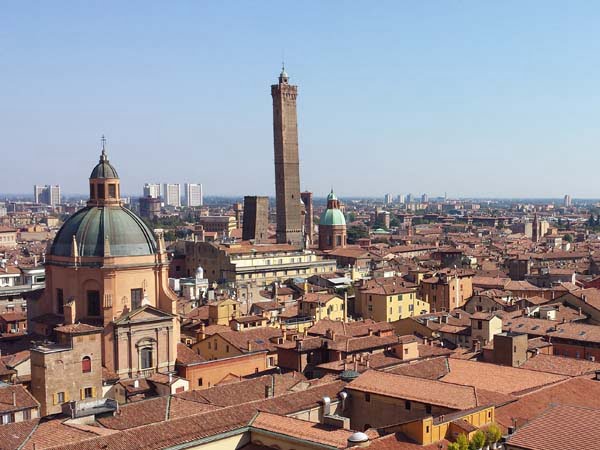
Italian Peninsula and Sicily 17 Day Escorted Tour | Vacation Packages for 2025 – 2026
Explore Rome, Florence, Venice and Sicily as art, history and breathtaking landscapes create the ultimate Italian journey. Starting from $6,404 per person.
HOME » POPULAR ITALIAN DESTINATIONS » MONTEPULCIANO TRAVEL GUIDE » MONTEPULCIANO HISTORY GUIDE
About this guide: This guide to the history of Montepulciano was written by the Italian-born travel specialists at Trips 2 Italy, a custom tour operator that has designed hand-crafted Italian vacations since 2003. Every recommendation below reflects the same first-hand knowledge our team draws on when we build a private Montepulciano itinerary around a traveler’s interests, dates, and pace. Read it for your research, then let us translate it into a trip designed entirely around you.
Montepulciano’s story begins with the Etruscans. Local tradition credits its founding to Porsenna, the legendary king of nearby Chiusi, one of the great cities of the Etruscan league, and archaeology confirms a settlement on this defensible ridge by the fourth century BC. The town thus belongs to the deepest historical layer of Tuscany, the civilization that gave the region its name.
Remarkably, travelers can touch this ancestry on the main street. The base of Palazzo Bucelli along the Corso is studded with Etruscan cinerary urns, carved reliefs, and inscriptions, assembled in the eighteenth century by the antiquarian Pietro Bucelli, whose collection later enriched museums in Florence. Few towns anywhere display their pre-Roman past as casually as Montepulciano mortars it into a palace wall.
Rome absorbed the Etruscan world and left the ridge a quieter place, a fortified point above the Chiana valley as the empire’s roads and farms organized the lowlands. The town’s Latin name, Mons Politianus, survived the empire’s fall and later gave both the townspeople and their most famous poet the name they still carry: poliziano.
The Etruscan layer also explains the town’s bones. The ridge was chosen twenty-three centuries ago for the same reasons travelers love it now, defensibility then, panoramas today, and the cellars’ deepest chambers show how thoroughly that ancient occupation shaped what followed. In Montepulciano, nearly everything since has been renovation of an Etruscan idea.
By the Middle Ages, Montepulciano occupied one of the most contested seats in Tuscany, a wealthy hilltop commune standing between the ambitions of Siena and Florence. Siena regarded the town as naturally its own; Montepulciano, valuing its independence, repeatedly sought Florentine protection, and the town changed alignment through wars, sieges, and treaties across three centuries. First documented in 715, the settlement had grown by then into a walled commune worth fighting over.
The struggle came to define the town’s politics until 1390, when Montepulciano bound itself decisively to Florence. The Florentine alliance held, and the town prospered as a loyal frontier stronghold of the Florentine state, its walls rebuilt and its noble families growing rich on land, law, and the wine already famous enough to be recorded in medieval documents.
That medieval inheritance still frames the town: the circuit of gates and walls, the vertical lanes climbing the ridge, and the division into contrade whose rivalries, once defensive, are now festive. Walking from the Porta al Prato up through the town is walking the plan the Middle Ages drew.
The town’s medieval fortunes also produced its statutes and civic pride. Montepulciano governed itself through councils, guilds, and written law even while great powers contested it, and that tradition of self-regard, a small town insisting on city dignity, is precisely what later financed the Renaissance rebuilding. The palaces of the Cinquecento are medieval stubbornness translated into classical stone.
The sixteenth century was Montepulciano’s golden age. Secure under Florence and enriched by its noble families, the town rebuilt itself as a Renaissance showpiece, summoning Antonio da Sangallo the Elder to raise palaces along the Corso and inviting the finest hands of the age, Vignola among them, to complete the transformation. Earlier, Michelozzo, the Medici’s own architect, had given the Palazzo Comunale its Florentine face, a deliberate echo of the Palazzo Vecchio that announced the town’s allegiance in stone.
The nobility competed facade by facade. Palazzo Avignonesi, Palazzo Cervini, built for the future Pope Marcellus II, who was born nearby, Palazzo Contucci, and their neighbors turned the main street into a gallery of High Renaissance design, while the Piazza Grande received its wells, its palaces, and its enduring composition. The town earned the name it still carries, the Pearl of the Cinquecento.
What makes the achievement moving today is its completeness. Montepulciano was never industrialized, never rebuilt, never overwhelmed, so the Renaissance town survives essentially whole. We pair travelers with historians who walk this golden age palace by palace, reading ambition, alliance, and artistry in every course of stone.
The era left human stories as well as facades. Marcello Cervini, raised in the town whose palace bears his family name, ascended to the papacy in 1555, and the humanist traffic between Montepulciano and Florence carried the town’s sons into the centers of European learning. A walk along the Corso with a good historian is a roll call of ambition.
On a grassy terrace below the western walls stands Montepulciano’s masterpiece. The Tempio di San Biagio, begun in 1518 by Antonio da Sangallo the Elder, rose on the site of an early church where a miraculous image of the Madonna was said to have moved its eyes, an event that summoned pilgrims and funded one of the purest centrally planned churches of the High Renaissance. Built of honey-colored travertine on a Greek cross plan, it distills the era’s ideal of divine geometry.
The church belongs to the same family of experiments that produced Todi’s Santa Maria della Consolazione and reflects the age’s fascination with the centralized temple, the form Bramante pursued at Saint Peter’s. Sangallo gave it a great dome, a freestanding campanile that was never fully finished, and an isolation that lets the building be read in the round, framed by cypress and open sky, with the Val di Chiana rolling away behind it.
Pilgrims still walk down to San Biagio, and so should every traveler. We time the visit for the golden hour, when the travertine ignites and the church glows against the valley, and pair it with the walk back up through the walls, one of the finest short ascents in Tuscany.
Pilgrimage shaped the church’s setting as much as its architecture. San Biagio stands deliberately apart from the town, reached by a descending lane that slows the visitor into the right frame of mind, and the composition of dome, tower, meadow, and valley was designed to be seen exactly as travelers first see it today. Few Renaissance buildings control their own approach so completely.
Wine runs through Montepulciano’s records almost from the beginning; documents mention the town’s vineyards as early as the eighth century. By the late Middle Ages its wine traveled well beyond Tuscany, and by the seventeenth century it held a reputation few Italian wines could match: in 1685 the physician-poet Francesco Redi, in his celebrated Bacco in Toscana, crowned Montepulciano’s wine the king of all wines.
The name Vino Nobile records its clientele: this was the wine of nobles, of papal tables and aristocratic cellars, pressed from Sangiovese grown on the ridge’s slopes and aged in the galleries beneath the palazzi. When the Italian Republic created its highest classification, the wine’s standing was confirmed for the modern age: Vino Nobile di Montepulciano stood among the first wines granted DOCG status in 1980.
That continuity, from medieval vineyard rolls to Redi’s verse to the modern denomination, makes wine the single longest thread in the town’s history. Tasting Vino Nobile in a cellar carved beneath a Renaissance palace is not a diversion from Montepulciano’s story; it is the most direct way to drink it in.
The wine’s history is also visible infrastructure. The galleries beneath the palazzi were dug and extended across centuries precisely because the wine demanded them, making Montepulciano one of the few towns anywhere whose architecture grew downward as well as upward to serve its signature product. The cellars are the wine’s biography written in stone.
The town itself is the archive. Begin at Palazzo Bucelli’s Etruscan-studded base, climb the medieval lanes to the Renaissance Corso, and finish in the Piazza Grande, where the Palazzo Comunale’s tower rewards the ascent with a panorama reaching, on clear days, from the Val d’Orcia to Lake Trasimeno. The Duomo adds Taddeo di Bartolo’s 1401 altarpiece, and the Museo Civico gathers paintings, ceramics, and Etruscan material under one roof.
Below the walls, San Biagio embodies the golden age, while the historic cellars beneath the palazzi let travelers descend physically through the centuries, from Renaissance courtyards into medieval galleries and, in places, chambers of Etruscan origin. Few towns allow a vertical journey through their whole past in a single afternoon.
The surrounding country completes the story: Chiusi’s national Etruscan museum and painted tombs, Pienza’s papal Renaissance experiment, and the fortress towns of the Val d’Orcia. We compose history-focused days that sequence these layers chronologically with guides chosen for their narrative gift, as part of our cultural tours of Italy.
History here is also best read at dusk. When the tour buses have gone, the Piazza Grande empties to its stones and swallows, and the town’s five centuries stand unusually close to the surface. We schedule history-focused stays so travelers hold the square at that hour, because no lecture equals standing alone in the middle of the Cinquecento.
Montepulciano’s preservation is the quiet work of continuity. The town was spared industrial rebuilding, and its modern life, wine, tourism, craft, and festivity, runs through the same fabric the Renaissance left, so conservation here means maintenance of a living town rather than restoration of a relic. Strict protections govern the historic center and the surrounding landscape, which forms part of the protected Val d’Orcia ensemble to the west.
The wine community carries a great share of the stewardship. The producers’ consortium guards the standards of Vino Nobile, families maintain the historic cellars as working spaces rather than museums, and the Bravio delle Botti keeps the contrade system, with its costumes, crafts, and loyalties, in vigorous annual use. Heritage in Montepulciano is not curated; it is practiced.
For travelers, this means the past is unusually intact and unusually hospitable. We arrange encounters with the people doing the preserving, cellar masters, artisans, contrada members, and festival organizers, because meeting the custodians is the deepest way to understand what has been kept. In Montepulciano, history is a working enterprise, and it welcomes company.
The town’s careful stewardship earned wider recognition as well: Montepulciano’s setting between two protected landscapes, with the UNESCO listed Val d’Orcia beginning at its western slopes and Pienza a quarter hour away, places it inside one of the most rigorously conserved rural ensembles in Europe. What travelers see from the walls is not accidental beauty; it is centuries of policy.
Montepulciano deserves more than a template. Since 2003, Trips 2 Italy has designed private Italian vacations one traveler at a time, hand selecting every experience based on what you tell us rather than fitting you into a predefined package. Our Italian-born team plans Montepulciano with the knowledge of people who call Italy home, from the Renaissance palazzi of the Corso to the noble cellars resting beneath them, and we remain at your side throughout your trip with 24/7 assistance. Tell us how you imagine Montepulciano, and we will craft the itinerary that matches it.
Explore Rome, Florence, Venice and Sicily as art, history and breathtaking landscapes create the ultimate Italian journey. Starting from $6,404 per person.
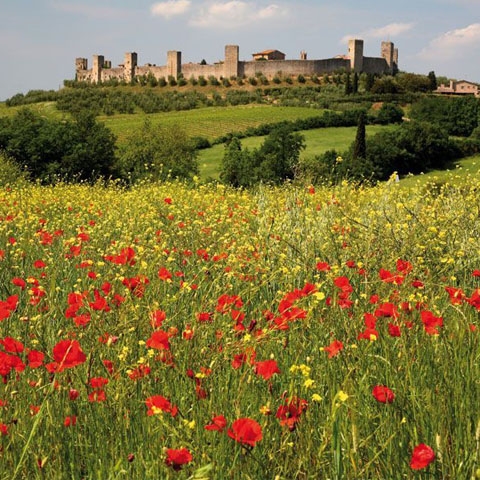
Experience Rome, Florence, Venice and Tuscany as art, history and rolling landscapes create the ultimate Italian journey. Starting from $898 per person.
Experience the simplicity of two authentic Tuscan towns full of timeless traditions through this escorted tour and sightseeing package.
The ridge was settled by the Etruscans by the fourth century BC, with local legend crediting the founding to Porsenna, king of nearby Chiusi. The town enters written records in 715, flourished as a contested medieval commune between Siena and Florence, and reached its golden age in the sixteenth century.
Yes. It began as an Etruscan settlement in the orbit of Chiusi, and travelers can still see Etruscan cinerary urns and inscriptions mortared into the base of Palazzo Bucelli on the Corso, while some of the cellars beneath the town reach chambers of Etruscan origin. The national Etruscan museum in nearby Chiusi completes the picture.
After allying with Florence in 1390, Montepulciano’s noble families rebuilt the town in the sixteenth century as a Renaissance showpiece, engaging Antonio da Sangallo the Elder, Michelozzo, and Vignola. The result earned it the name Pearl of the Cinquecento, and because the town was never rebuilt afterward, the ensemble survives essentially whole.
Begun in 1518 by Sangallo the Elder, San Biagio is one of the purest centrally planned churches of the High Renaissance, a Greek cross temple of golden travertine standing alone below the town walls. It was built to honor a miraculous image of the Madonna and remains a pilgrimage destination, at its most beautiful in late afternoon light.
Vineyards around the town appear in documents as early as the eighth century, the wine was famous across Italy by the Renaissance, and in 1685 the poet Francesco Redi declared it the king of all wines. In 1980 Vino Nobile di Montepulciano stood among the first Italian wines granted DOCG status, confirming seven centuries of reputation.
Yes. We design Montepulciano days that move chronologically from the Etruscan traces through the medieval lanes to the Renaissance piazza and cellars, led by historian guides chosen for their storytelling, and we extend the itinerary to Chiusi’s Etruscan tombs and Pienza’s papal Renaissance for travelers who want the full arc.