Things To Do in Parma

HOME » POPULAR ITALIAN DESTINATIONS » PARMA TRAVEL GUIDE » PARMA THINGS TO DO GUIDE

Parma Travel Guide        Culture        History        Food and Wine        Things to Do        Plan My Trip

About this guide: This guide to things to do in Parma was written by the Italian-born travel specialists at Trips 2 Italy, a custom tour operator that has designed hand-crafted Italian vacations since 2003. Every recommendation below reflects the same first-hand knowledge our team draws on when we build a private Parma itinerary around a traveler’s interests, dates, and pace. Read it for your research, then let us translate it into a trip designed entirely around you.

What Belongs at the Top of Every Parma Itinerary?

Begin in Piazza Duomo, where the Romanesque cathedral and the pink Verona marble Baptistery compose one of the most perfect medieval squares in Italy. Inside the cathedral, Correggio’s Assumption of the Virgin spirals up through the dome in a whirl of cloud and light that anticipated the Baroque by a century, and Antelami’s Deposition relief of 1178 rewards a quiet minute; the Baptistery answers with his sculpted months and a painted interior that glows like a jewel box.

A short walk northwest stands the Palazzo della Pilotta, the Farnese dynasty’s colossal brick statement, holding the wooden Teatro Farnese of 1618, the Galleria Nazionale with Correggio, Parmigianino, and Leonardo da Vinci’s La Scapigliata, plus the Palatine Library and the Bodoni typographic museum. It anchors the western reaches of the Emilia Romagna region as its single richest museum complex.

This is where planning shows its value. We arrange guides who unfold Correggio’s revolution dome by dome, time the Pilotta for its quietest hours, and sequence the center so the marquee sights, the food streets, and an unhurried lunch fall into a natural rhythm. Parma’s essentials fit into two well-designed days, which is precisely why the design matters.

Allow the essentials to breathe. The cathedral rewards a return visit at a different hour, when the changing light through the drum transforms Correggio’s clouds entirely, and the Pilotta’s galleries deserve an unhurried half day rather than a checklist hour. Parma’s compactness is an invitation to depth, not speed, and the itineraries we design treat it that way.

What Is the Signature Parma Experience?

The day that defines Parma starts before sunrise. In a working dairy in the valleys, the casaro judges the curd by hand and lifts a newborn wheel of Parmigiano Reggiano from the copper cauldron, and travelers who witness it never look at cheese the same way again. The morning continues south to Langhirano, where the curing halls open their windows to the Apennine breeze and thousands of hams age toward their ducal crown.

The afternoon belongs to the fog country or the castle country, depending on the traveler. North, a culatello cellar in the Bassa near Zibello offers the rarest cured meat in Italy, tasted in the vaulted dark where it ages, often with the producing family. South, the castle of Torrechiara rises above the vineyards, its frescoed Camera d’Oro among the most romantic rooms of the Italian fifteenth century.

We compose this day privately, with a driver who knows the valleys, appointments arranged through two decades of relationships, and a table waiting at the end where the morning’s discoveries reappear as lunch. It is the single most requested day in our Parma itineraries and the heart of many an Italian culinary journey.

Which Castles of the Duchy Reward a Day Trip?

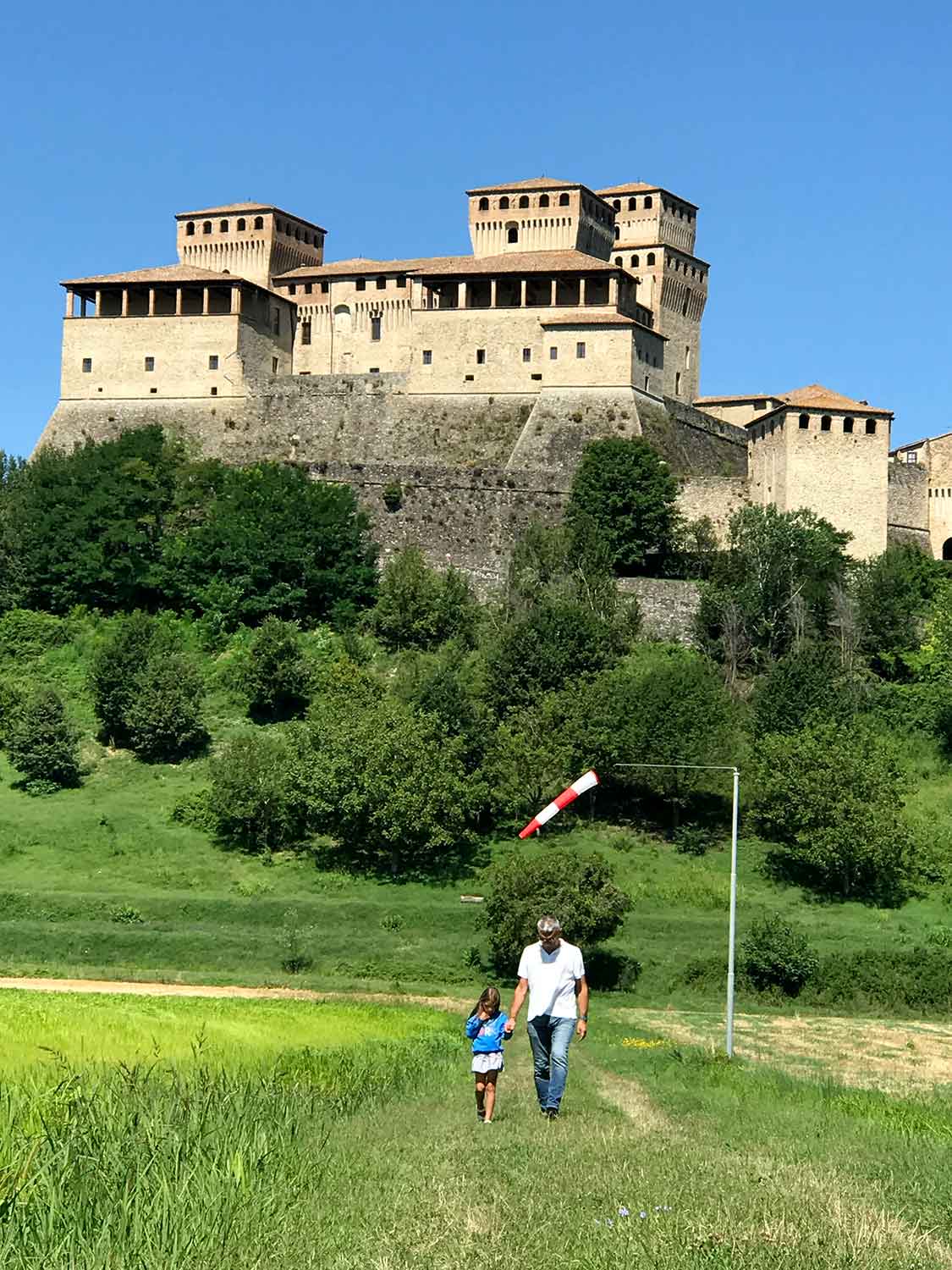
The province of Parma holds one of the densest castle networks in Italy, the legacy of the noble houses that guarded the duchy’s valleys. Torrechiara is the masterpiece: built between 1448 and 1460 by Pier Maria Rossi, it crowns its vineyard hill with triple walls and towers, and the Camera d’Oro he dedicated to Bianca Pellegrini turns fortification into a love letter. The view over the Parma valley alone justifies the drive.

Fontanellato, on the plain, is the fairy tale: the moated Rocca Sanvitale rises straight from the water in the middle of its village, sheltering Parmigianino’s frescoed room of Diana and Actaeon, painted in 1524, and an optical camera obscura that still projects the piazza onto its wall. Nearby Soragna remains the furnished home of its princely family, and Colorno’s ducal palace, the little Versailles of the Bourbons, presides over French gardens near the Po.

Bardi’s dramatic fortress and Compiano’s walled village extend the trail deep into the Apennines for travelers who want the wilder valleys. We compose castle days with a private driver and guides who animate the Rossi, Sanvitale, and Farnese stories, pairing the strongholds with vineyard lunches and village pauses so the day breathes.

For travelers based in the city, the castles also solve the question of pace. A morning fortress, a vineyard lunch, and an afternoon village return you to Parma in time for the passeggiata, a day-shape we have refined over hundreds of itineraries. In December, several castles dress for the season with markets and candlelit visits, a quietly magical version few foreign travelers ever see.

Which Museums and Churches Reward Art Lovers?

After the cathedral, follow Correggio to the Camera di San Paolo, the abbess’s private dining room he frescoed in 1519 with a pergola of putti, and to San Giovanni Evangelista, whose dome holds his vision of Christ among the apostles and whose choir hides Parmigianino’s early chapels. Santa Maria della Steccata keeps Parmigianino’s final masterpiece, the wise and foolish virgins arched above the presbytery.

The Galleria Nazionale in the Pilotta gathers the school together, from Correggio’s great altarpieces to Parmigianino’s sinuous portraits, alongside Leonardo’s La Scapigliata and works by Canaletto and El Greco. The Glauco Lombardi Museum preserves Maria Luigia’s court in miniature, and Toscanini’s birthplace in the Oltretorrente honors the conductor with scores, batons, and memories.

For music lovers, the Teatro Regio itself can be visited by day, gilded tier upon gilded tier, and the Casa della Musica documents the city’s operatic obsession. We pair these rooms with specialists, art historians and musicologists chosen for their storytelling, and arrange access timed so masterpieces get quiet minutes rather than crowd views.

Second visits earn two more names: San Francesco del Prato, the great Gothic church that served as a prison for nearly two centuries before its luminous restoration, and the Certosa di Paradigna north of the city, a Cistercian abbey that now houses the university’s celebrated communication and design archives. Parma has a way of rewarding travelers who return, and many of ours do.

Where Do You Find the Quieter Side of Parma?

Cross the stream into the Oltretorrente, the old popular quarter, where the pace softens among neighborhood osterias, artisan shops, and the long history of a district that raised barricades in 1922 and gave the world Toscanini. Its churches, Santa Maria del Quartiere’s hexagonal dome among them, see a fraction of the cathedral’s visitors and reward the detour.

The Parco Ducale, laid out for Ottavio Farnese in 1561 and given its French elegance in the eighteenth century, is the city’s green drawing room, ideal for a morning walk among the plane trees before the museums open. The botanical garden of the university, the cloisters of San Giovanni, and the benches of Piazzale della Pace beside the Pilotta offer the same unhurried register inside the center.

Quiet in Parma is also a matter of timing: the Baptistery at opening hour, the food streets in late morning while the city shops, the piazzas at dusk when the passeggiata begins. Our itineraries deliberately alternate the celebrated with the calm, because the alternation is what keeps a trip feeling like discovery rather than collection.

The Bassa offers the deepest quiet of all. The fog-softened lowlands along the Po, with their poplar avenues, brick farmsteads, and drowsy piazzas, feel a century removed from the autostrada twenty minutes away. Travelers who take a slow afternoon there, between a culatello cellar and Verdi’s villages, discover the landscape that shaped the province’s soul.

What Do Evenings in Parma Look Like?

The evening begins under the porticoes with an aperitivo, a chilled Malvasia or Lambrusco beside a small plate of the world’s best salumi, as the passeggiata flows down Via Farini and Strada della Repubblica. Dinner follows at the unhurried local pace, whether in a wood-paneled trattoria of anolini and bollito or a fine dining room reinterpreting the ducal pantry with contemporary craft.

On performance nights, the city inclines toward the Teatro Regio, and joining the audience there, especially during October’s Festival Verdi, is among the great evenings Italy offers. We secure seats and boxes far ahead, brief travelers on the theater’s beloved rituals, and fold concerts, recitals, and festival dates into itineraries as part of our entertainment and festival experiences in Italy.

Summer stretches the evening outdoors, with concerts in courtyards and the Parco Ducale, and the university keeps a young pulse in the bars around Via D’Azeglio. Parma after dark is neither sleepy nor loud; it is convivial in the exact measure of a city that considers a good evening part of its cultural patrimony.

Season shapes the evening as much as the venue. October glows with the festival, December brings concerts and lit porticoes, and late spring moves the music outdoors into courtyards and the park. Whatever the month, we build evenings into the itinerary with the same care as the days, because in a city this musical, what happens after dinner is often the memory that lasts.

What Day Trips Pair Well With Parma?

Verdi country comes first. Busseto, forty minutes north, keeps the composer’s whole world in miniature: the church of his baptism at Roncole, the Casa Barezzi where his patron nurtured him, and the pocket-sized Teatro Verdi on the main square. Travelers with a musical soul often call this fog-wrapped corner of the Bassa the most moving day of their Italian journey.

The regional food capitals line up along the old Roman road. Modena, with its UNESCO cathedral and balsamic vinegar attics, lies half an hour east; Bologna’s porticoed immensity is under an hour; and Reggio Emilia, birthplace of the tricolor flag, sits between them. Across the Apennines, a scenic drive reaches the Ligurian coast and the Cinque Terre for a complete change of air.

How far to reach depends on the trip’s rhythm, and that judgment is our craft. As part of a custom trip to Italy, we sequence Parma’s excursions so each one refreshes the journey rather than crowding it, with every transfer privately driven, arranged in advance, and supported around the clock.

Wine lovers can bend the compass south, where the estates of the Colli di Parma pour their Malvasia within a half hour of the city, and walkers can trade a day for the chestnut woods and stone villages of the upper valleys. The province rewards improvisation, and a private driver keeps every option open until the morning itself.

Ready to Begin Planning Your Parma Vacation?

Parma deserves more than a template. Since 2003, Trips 2 Italy has designed private Italian vacations one traveler at a time, hand selecting every experience based on what you tell us rather than fitting you into a predefined package. Our Italian-born team plans Parma with the knowledge of people who call Italy home, from Correggio’s painted dome to the aging cellars of Langhirano and the castles of the old duchy, and we remain at your side throughout your trip with 24/7 assistance. Tell us how you imagine Parma, and we will craft the itinerary that matches it.

Explore Our Parma Vacation Itineraries

Frequently Asked Questions About Things to Do in Parma

Piazza Duomo leads every itinerary: the cathedral with Correggio’s Assumption spiraling through its dome, Antelami’s pink marble Baptistery beside it, and the bishop’s palace completing the square. Pair it with the Teatro Farnese and Galleria Nazionale in the Palazzo della Pilotta, and you have touched the city’s medieval, Renaissance, and ducal summits in a single day.

A Parmigiano Reggiano dairy at dawn, the prosciutto curing halls of Langhirano, and a culatello cellar in the fog country of the Bassa form the essential trio, ideally with a hands-on pasta session or market morning added. Trips 2 Italy arranges these privately with producers we know personally, with a driver so every tasting can be enjoyed.

Emphatically yes. Torrechiara is among the most beautiful castles in Italy, with its frescoed Camera d’Oro above the vineyards; Fontanellato’s moated Rocca Sanvitale holds a room painted by Parmigianino; and Soragna, Colorno, and the Apennine fortresses extend the trail. We compose castle days with private drivers and storytelling guides.

Yes, and it is one of Italy’s great musical evenings, especially during the Festival Verdi each October when the composer’s operas fill the house he owes to Maria Luigia. Seats and boxes for the finest productions are reserved far in advance, and Trips 2 Italy secures them as centerpieces of autumn itineraries.

Very. The Baptistery and castle moats enchant children, Fontanellato’s camera obscura feels like magic, dairy visits show cheese being born, and torta fritta is a dish every generation agrees on. We compose family itineraries so art and history arrive as adventure, with distances kept short and afternoons kept free.

Busseto and the Verdi country of the Bassa, the balsamic attics of Modena, Bologna’s porticoes, and Reggio Emilia all lie within an hour, and a scenic drive across the Apennines reaches the Ligurian coast. We sequence excursions with private transfers so each day refreshes the journey rather than crowding it.