Lake Garda History Guide

HOME » POPULAR ITALIAN DESTINATIONS » LAKE GARDA TRAVEL GUIDE » LAKE GARDA HISTORY GUIDE

Lake Garda Travel Guide        Culture        History        Food and Wine        Things to Do        Plan My Trip

About this guide: This guide to the history of Lake Garda was written by the Italian-born travel specialists at Trips 2 Italy, a custom tour operator that has designed hand-crafted Italian vacations since 2003. Every recommendation below reflects the same first-hand knowledge our team draws on when we build a private Lake Garda itinerary around a traveler’s interests, dates, and pace. Read it for your research, then let us translate it into a trip designed entirely around you.

How Did Lake Garda's Story Begin?

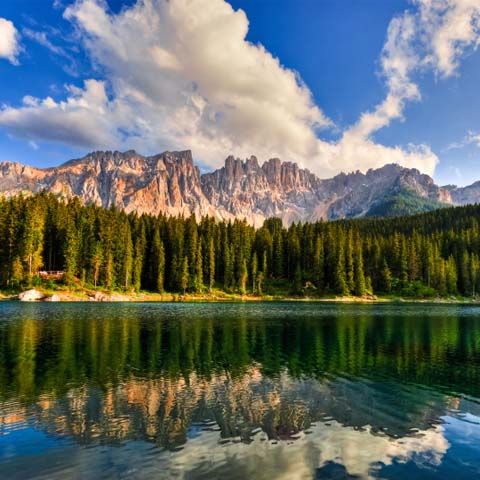
The lake itself is the region’s first monument, gouged by glaciers over successive ice ages and left cradled in the horseshoe of moraine hills that now carry its vineyards. Humans arrived early and stayed. Around the southern shore, Bronze Age communities built villages on wooden piles at the water’s edge some four thousand years ago, and their preserved remains, at sites such as Lavagnone near the lake’s foot, now belong to a UNESCO World Heritage listing of prehistoric pile dwellings around the Alps.

The lake the Romans found was already a crossroads. They called it Benacus, planted it with vines and olives whose descendants still hold the terraces, and prized its shores as a retreat from the cities of the plain. The poet Catullus, born in nearby Verona in the first century BC, sang of Sirmione as the jewel of all peninsulas, giving the lake its first love letter and its most enduring association.

Rome also fought here. In 268 AD the emperor Claudius II broke an invading Alemanni force at the Battle of Lake Benacus, a reminder that this beautiful water has always been a frontier, the hinge between the Mediterranean world and the passes of the Alps. That double identity, pleasure ground and border, runs through every century of the lake’s story.

Even the lake’s modern name records its defended past. It comes from the town of Garda on the eastern shore, whose own name descends from a Germanic word for watchtower, a memory of the lookout kept from the Rocca, the great headland above the town, in the centuries after Rome. The water that now hosts sails and ferries was watched anxiously for a very long time.

What Did Rome Leave on the Lake?

The grandest Roman remains on Garda crown the tip of the Sirmione peninsula. The so-called Grotte di Catullo is the ruin of an enormous villa of the early imperial age, nearly two football fields long, terraced above the water on three sides with its own baths, cryptoporticus, and olive grove. It is the most important Roman private residence surviving in northern Italy, and its museum gathers frescoes and finds from across the site.

At the lake’s southwestern corner, Desenzano preserves a later chapter: a fourth-century Roman villa whose polychrome floor mosaics, hunting scenes, vintaging cupids, and geometric carpets of stone, rank among the finest late antique mosaics in the north. Together the two villas frame the Roman lake, the first built for Augustan pleasure, the second for late imperial comfort as the empire’s center of gravity shifted.

Rome’s most durable legacy, though, is agricultural. The vine and the olive arrived with the legions and never left, and the wine now poured as Bardolino descends from vineyards the Romans planted on these same moraine hills. Walking the Grotte di Catullo with a guide who can rebuild it in words, then tasting oil from trees on the same shore, closes a circle twenty centuries wide, and we design days that do exactly that.

How Did the Scaligers Fortify the Lake?

After the fall of Rome, the lake passed through Lombard and Frankish hands, and its communities learned to defend themselves. Lazise won a remarkable charter of self-government in 983, a document that leads some historians to call it the first free commune in Italy, and its walls still express that early independence. But the lake’s defining medieval builders were the Della Scala, the Scaliger lords of Verona.

From the mid thirteenth century the Scaligers held Garda’s eastern and southern shores as the frontier of their state, and they built as if they meant it to last forever. The moated castle at Sirmione, rising from the water with a fortified dock for its fleet, the crag-top fortress at Malcesine, the compact castle at Torri del Benaco, and the circuit of walls at Lazise all carry their swallow-tailed battlements, one of the most recognizable signatures in Italian military architecture.

Their century of dominance tied the lake permanently to Verona, a bond that survives today in everything from dialect to wine routes. When the Scaliger state fell at the end of the fourteenth century, the lake became a prize contested by Milan and Venice, and its next master would hold it far longer than the castle builders did.

What Did Venetian Rule Bring to Lake Garda?

Venice took the eastern shore in 1405 and kept it for nearly four hundred years, until Napoleon extinguished the Republic in 1797. Under the lion of St. Mark, the lake towns became trading harbors in a commercial empire, shipping oil, citrus, wine, and lake fish toward the lagoon, and the Venetian customs house still standing on Lazise’s harbor marks the era at water level.

The Republic’s most audacious moment on Garda came in 1439, during its wars with Milan. Blocked from the lake by water, Venice hauled a fleet of war galleys overland from the Adige valley across the mountains and launched them at Torbole, an engineering feat celebrated as the Galeas per Montes. The fleet’s eventual victory secured the lake, and the story is still told in the towns of the upper shore.

Venetian centuries gave the eastern lake its lasting character: harbors engineered for sail, arcaded lakefronts, olive commerce, and a certain lagoon elegance in the architecture. When travelers sense that Lazise or Garda town feels faintly Venetian, they are reading four centuries of history correctly, and our guides make that reading explicit and vivid.

How Did Lake Garda Pass From Empires to Modern Italy?

After Napoleon extinguished Venice, the lake passed to Austria, and its southern shore became the western edge of the Quadrilateral, the four-fortress system anchored at Peschiera del Garda that held northern Italy for Vienna. The wars of unification broke against this ground: in June 1859 the hills just south of the lake carried the twin battles of Solferino and San Martino, a day of such suffering that a Swiss witness, Henry Dunant, was moved to found what became the Red Cross. The memorial towers and chapels raised on those battlefields still stand within an easy drive of the southern shore.

Veneto and the lake’s eastern shore joined the young Kingdom of Italy in 1866, and the border anxieties of centuries finally dissolved. The railways arrived, the first resort hotels followed, and the visitors Goethe’s pages had inspired began transforming the frontier into one of Europe’s most beloved lakes, a process the dramatic shoreline roads of the 1930s completed by making every village reachable.

The twentieth century left one dark chapter: from 1943 to 1945 Mussolini’s puppet Italian Social Republic was headquartered on the western shore at Salo, giving the regime its informal name. Peace returned the lake to its travelers, and the postwar decades built the tourism that now defines its economy without displacing the older lake of fishermen, olive growers, and winemakers.

Today Garda balances both identities. It is one of Europe’s great resort lakes and, at the same time, a working agricultural shore with two UNESCO listings, a fishing fleet, and villages whose calendars still turn on harvest and patron saints. That layered present is exactly what a thoughtful itinerary reveals.

Which Places Bring Lake Garda's History to Life?

Sirmione compresses the whole story into one peninsula: the Scaliger castle at its neck, with battlements and fortified dock to walk, the medieval lanes beyond it, and the Grotte di Catullo at the tip, where Roman terraces hang above the water among ancient olives. Few single sites in Italy carry two thousand years so gracefully, and timing the visit well transforms it.

Along the eastern shore, Malcesine’s castle keeps its Goethe room and its museum above a plunging view of the lake, Torri del Benaco’s castle shelters its museum of fishing and olive pressing beside the 1760s lemon house, and Lazise’s walls, gates, and Venetian customs house make the harbor an open-air archive. At the lake’s foot, Peschiera’s star-shaped ramparts reward a slow circuit on foot.

The shoreline itself is a document for travelers who learn to read it. Swallow-tailed battlements mean the Scaligers, arcaded harbors and a stone lion mean Venice, star-shaped earthworks mean the age of artillery, and the white pillars of a lemon house mean the centuries when citrus was the lake’s gold. An afternoon with one of our historians turns that alphabet into fluent reading.

South of the water, the Solferino and San Martino battlefields, with their memorial towers and chapels, complete the nineteenth-century chapter. We sequence history-focused days chronologically where interests allow, from pile dwellings to Roman villas to castles to ramparts, with historians who narrate rather than recite, as part of our cultural tours of Italy. Three thousand years arrive as a story rather than a shuffle.

How Is Lake Garda Preserving Its Heritage?

The lake holds two UNESCO World Heritage inscriptions, the prehistoric pile dwelling sites around its southern shore and the Venetian defense works at Peschiera del Garda, and both anchor a wider preservation culture. Archaeological oversight protects the Roman villas at Sirmione and Desenzano, and the Scaliger castles are maintained as museums rather than left as picturesque shells.

Preservation here extends to landscape and livelihood. The Garda DOP consortium protects the olive oil tradition and its centuries-old groves, the Bardolino wine consortium safeguards vineyards first planted in antiquity, and restored lemon houses on the upper lake keep a unique horticulture alive with public support. The lake’s historic ferry fleet, more than a century old in parts, is itself a piece of working heritage.

For travelers, this means the past is unusually intact and unusually open. We arrange visits that reach behind the ticket line where access allows, from castle towers to mill cellars to archaeological storerooms, because meeting the custodians of the lake’s memory is one of Garda’s quiet privileges, and it is the kind of arrangement our relationships here make possible.

Ready to Begin Planning Your Lake Garda Vacation?

Lake Garda deserves more than a template. Since 2003, Trips 2 Italy has designed private Italian vacations one traveler at a time, hand selecting every experience based on what you tell us rather than fitting you into a predefined package. Our Italian-born team plans Lake Garda with the knowledge of people who call Italy home, from the Roman ruins of Sirmione to the lemon terraces of the northern shore, and we remain at your side throughout your trip with 24/7 assistance. Tell us how you imagine Lake Garda, and we will craft the itinerary that matches it.

Explore Our Lake Garda Vacation Itineraries

Frequently Asked Questions About the History of Lake Garda

The Grotte di Catullo is the ruin of a vast Roman villa of the early imperial age crowning the tip of the Sirmione peninsula, the most important Roman private residence surviving in northern Italy. Terraced above the lake among ancient olive trees, with a museum of frescoes and finds, it takes its name from the poet Catullus, who praised Sirmione in verse in the first century BC.

The lake was a frontier for most of its history. The Scaliger lords of Verona fortified the shore in the thirteenth and fourteenth centuries, leaving the moated castle at Sirmione, the crag-top fortress at Malcesine, the castle at Torri del Benaco, and the walls of Lazise. Their swallow-tailed battlements give the lake one of the most consistent medieval skylines in Europe.

Venice held the eastern shore from 1405 until 1797, turning the lake towns into trading harbors of its commercial empire. In 1439 the Republic famously hauled a fleet of war galleys overland across the mountains and launched them at Torbole, the feat known as the Galeas per Montes. Lazise still keeps its Venetian customs house on the harbor.

Two inscriptions touch the lake: the prehistoric pile dwelling sites around the Alps, which include Bronze Age villages preserved near the southern shore, and the Venetian works of defense, which include the star-shaped fortress ramparts of Peschiera del Garda. Both can be woven into a history-focused itinerary alongside the Roman villas and Scaliger castles.

In June 1859 the battles of Solferino and San Martino were fought in the hills just south of the lake during the wars of Italian unification. The suffering witnessed there moved Henry Dunant to found what became the Red Cross. Memorial towers, chapels, and museums on the battlefields can be visited within an easy drive of the southern shore, and Trips 2 Italy arranges guided days that tell the story with care.

Yes. Desenzano del Garda preserves a fourth-century Roman villa whose polychrome floor mosaics rank among the finest late antique examples in northern Italy. It pairs naturally with the Grotte di Catullo at Sirmione for a Roman day on the southern shore, and we arrange archaeologist guides who bring both sites vividly to life.