
The Italian Christmas Tree You Have to See to Believe: Mount Ingino in Gubbio, Umbria
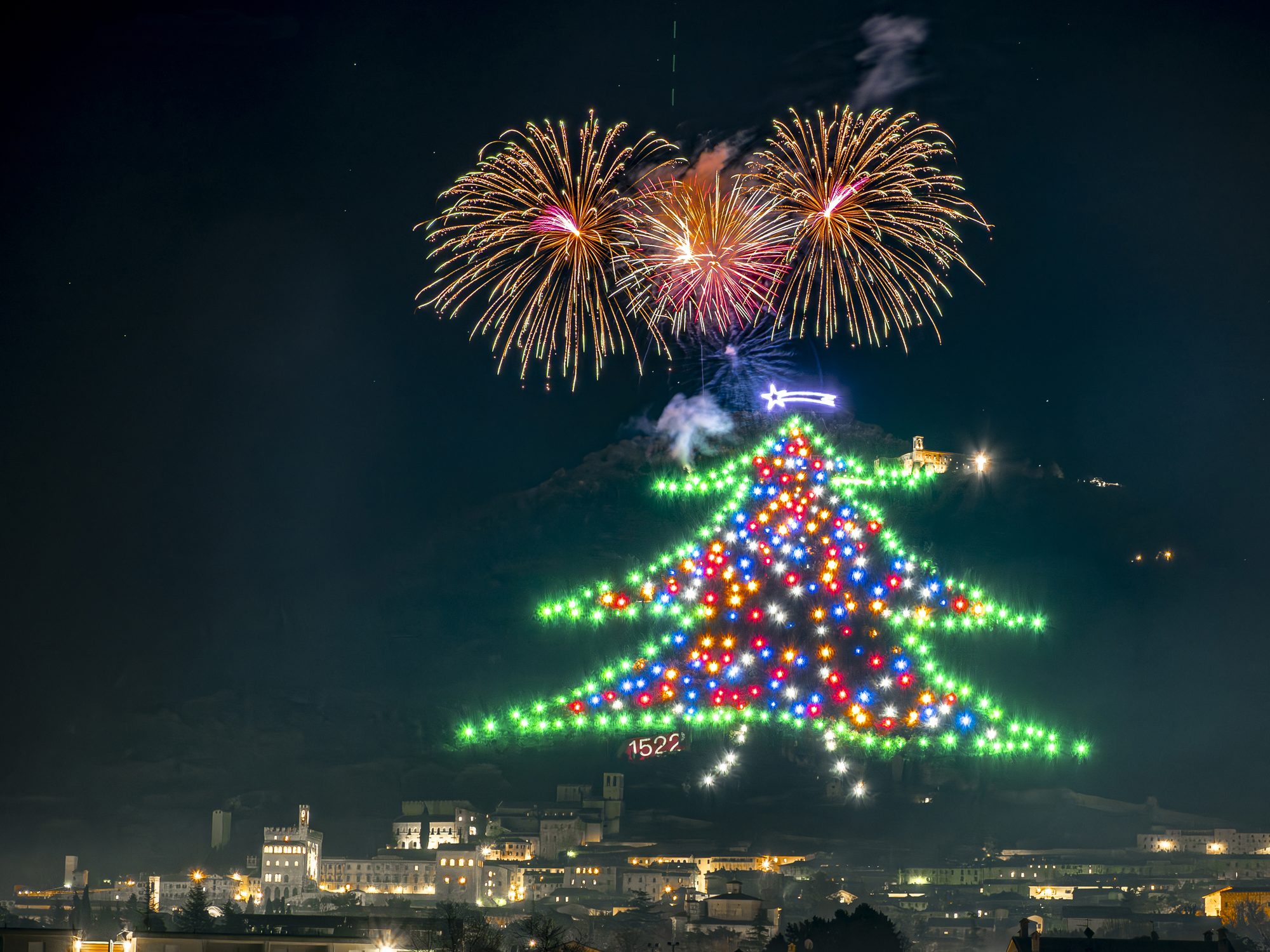
Imagine arriving in Gubbio at dusk in early December. The stone streets of this medieval Umbrian town are cooling, the shops are lighting their windows, and behind the rooftops Mount Ingino is only a dark shape against the sky. Then a line of light appears near the foot of the mountain, just beyond the old walls. Another follows, and another, until the whole slope seems to be drawing itself into the night. Row by row, the outline of a Christmas tree takes shape and climbs toward the Basilica of Sant’Ubaldo, the church that watches over the town. At the very top, a shooting star of white light settles into place above the green shape below. On a clear evening, the whole scene can be seen from as far as 30 miles away.
Only then does the scale begin to sink in. The tree extends more than 750 meters up the mountain and measures approximately 450 meters across its base. More than 300 green lights trace its outer shape, while over 400 multicolored lights fill the interior. The star at the summit covers approximately 1,000 square meters and is composed of 250 lights, according to the committee responsible for the installation.
How Big Is the Gubbio Christmas Tree on Mount Ingino?
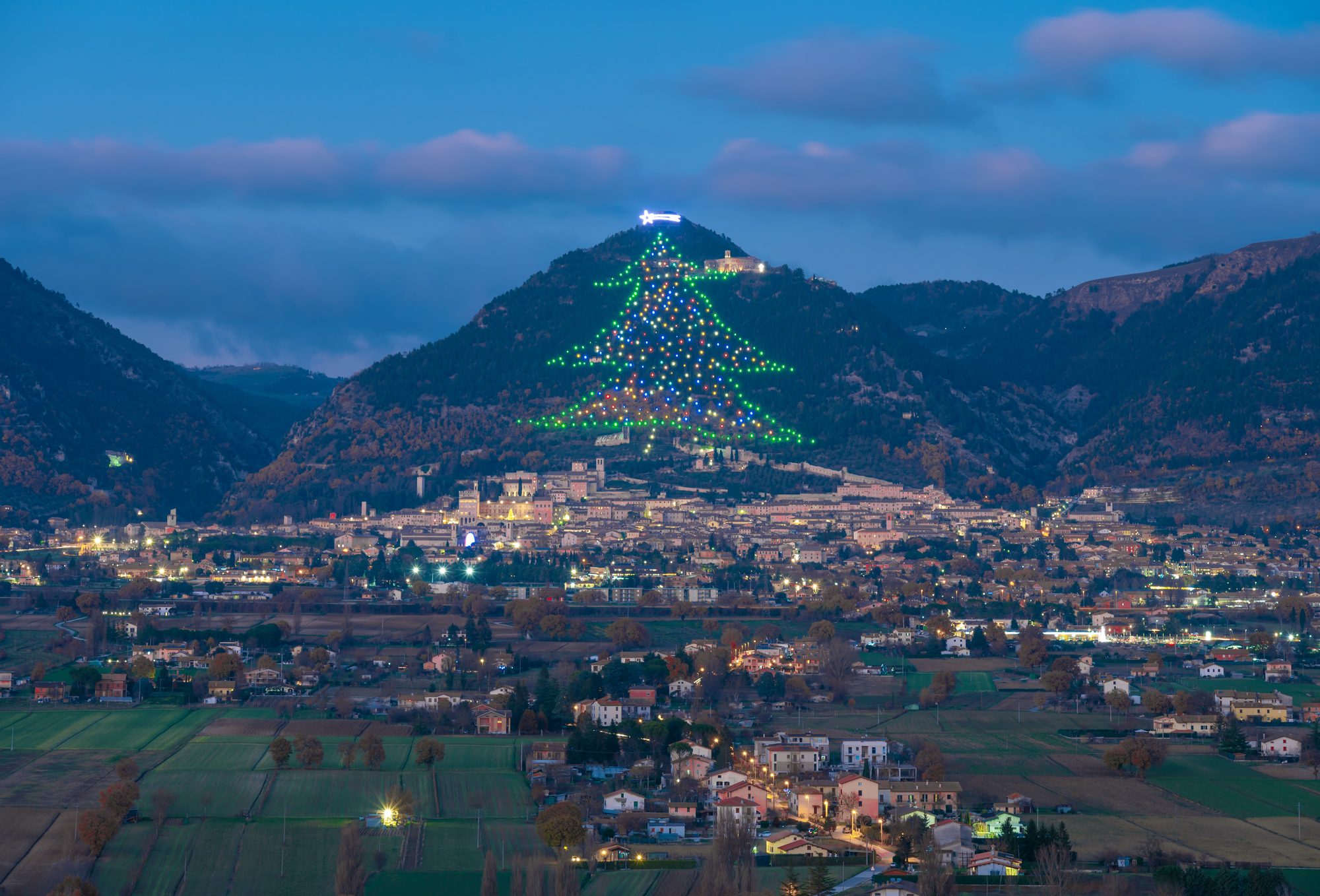
From the streets of Gubbio, the tree reads as a single vast image set against the dark slope. Up close, it reveals itself as something quite different: a carefully planned network of lights, cables, sockets, and connections laid across the terrain. The design follows the natural contours of Mount Ingino, so that the mountain itself becomes the frame of the tree. More than 7,500 meters of electrical cable and approximately 1,350 sockets and plugs bring it to life.
The installation is known as the largest Christmas tree in the world, a title recognized by the Guinness Book of Records in 1991. The distinction draws visitors from well beyond Umbria, yet the tree is first of all an expression of Gubbio’s identity. It is assembled by local volunteers, inaugurated each year on the same date, and cared for as a community project. Its size may bring the world to the town, but it endures because of the people who live beneath it.
When Was the Gubbio Christmas Tree First Lit?
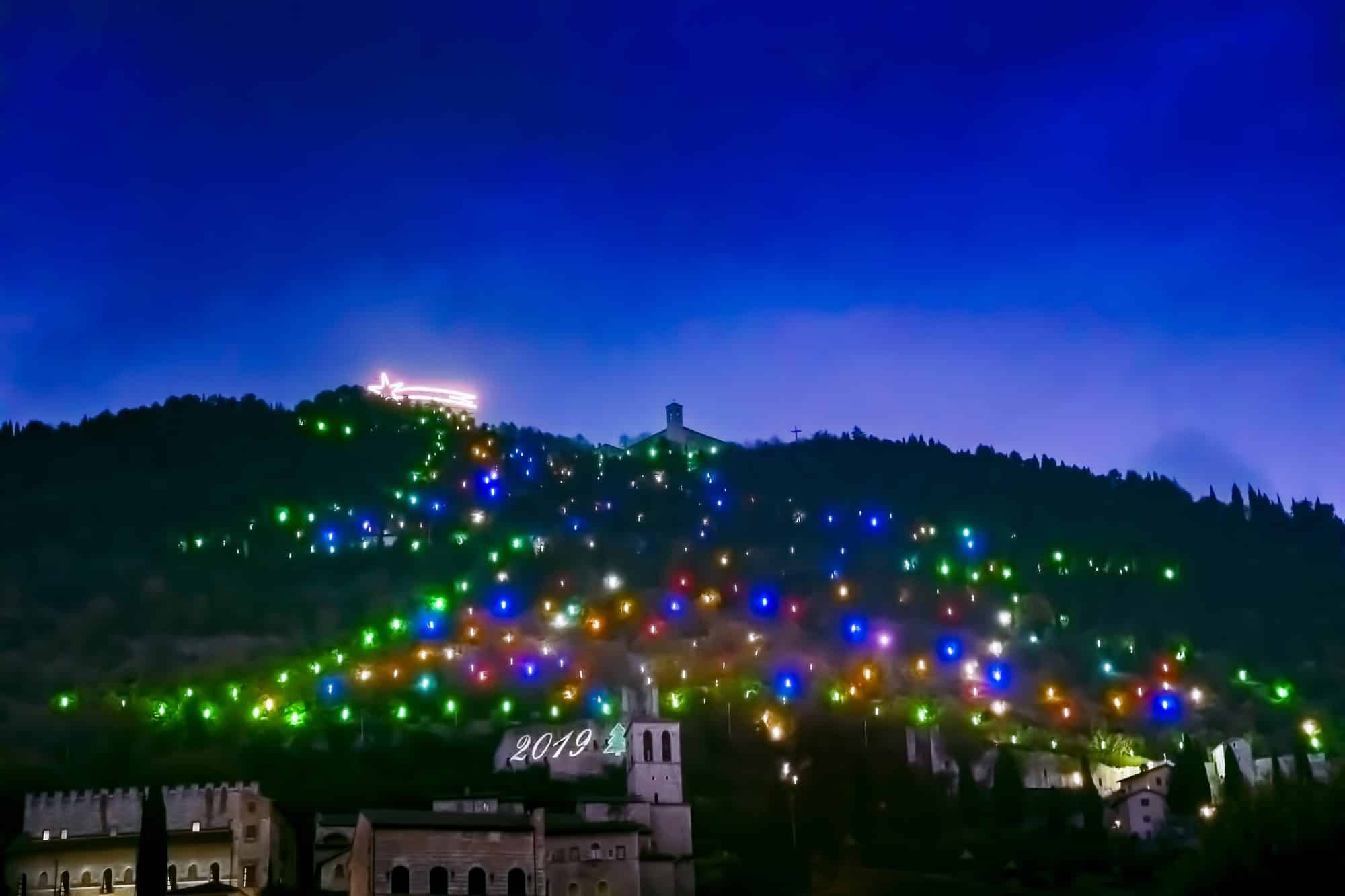
The Night the Mountain First Lit Up, December 7, 1981
The idea took shape among the residents of Gubbio in the early 1980s. Mount Ingino rises directly behind the historic center, and its broad slope is visible across much of the surrounding valley. A group of local people looked at that slope and saw an opportunity. Rather than place a decorated tree in a square, they would use the hillside itself and draw the outline of a tree in light.
The first version was illuminated on December 7, 1981. The project involved several local contributors, including Pietrangelo Farneti and Enzo Grilli, while the surveyor Mario Santini is associated with the technical design. Turning the vision into a working installation meant solving practical questions about the shape of the tree, the placement of the lights, and the problem of carrying electricity across a steep and uneven surface. The challenge was to make a large design visible from a great distance, using the materials and equipment available at the time.
The date of that first lighting soon became part of the tradition. December 7 is the eve of the Feast of the Immaculate Conception, celebrated throughout Italy on December 8, and the annual illumination still takes place on that evening. It marks the opening of the tree’s Christmas season in Gubbio and gives the town a fixed point in the winter calendar.
In 1991, a decade after its first appearance, the installation was recognized by the Guinness Book of Records as the largest Christmas tree in the world. The honor brought the project to a far wider audience, but it did not transform the tree into a commercial attraction run by an outside company. The work remained in the hands of the local group, and the volunteers kept returning to the mountain each year.
The design has been refined as lighting and electrical technology have advanced, yet its essential concept remains intact. The tree is still drawn across the same mountainside, with its outline, its interior, and its star arranged to be viewed from a distance. What began as a local Christmas idea has become an annual undertaking with an established place in Gubbio’s calendar.
Who Are the Alberaioli Who Build the Tree?
The volunteers who build and maintain the tree are known as the Alberaioli, and their work is the foundation of the tradition. In the months before the lighting, they prepare equipment, inspect cables, position lights, check connections, and make repairs. The installation must be assembled across a large area of sloping ground, which calls for careful planning as well as patience and technical experience.
The committee has around 50 members, with ages ranging from young adults to people in their eighties. It brings together several generations of Eugubini, as the people of Gubbio are known. Parents and children, grandparents and grandchildren, and longtime members work side by side with newer volunteers. Some have given years to the project and know every part of the installation. Others learn the craft by taking part, guided by those who have done it before.
The committee estimates that constructing the tree takes approximately 2,100 working hours. The figure suggests the depth of commitment, though the task is far more complex than hanging lights. The team must prepare the components, organize the installation, check the electrical system, and ensure that its many sections work together. Because the tree is spread across the mountain, a fault in one area can take time to find and reach.
The group was formally established as a committee in 1992, after the first decade of the project. A formal association gave the work structure and helped preserve the knowledge needed to repeat it each year. Equipment changes as technology improves, but much of the expertise passes directly from one group of volunteers to the next.
For visitors, the tree seems to appear all at once on the evening it is switched on. For the Alberaioli, that moment arrives after months of preparation. Their contribution is largely out of sight during the holidays, yet it is what allows the mountain to glow again year after year.
Why Does the Tree Rise Toward the Basilica of Sant'Ubaldo?
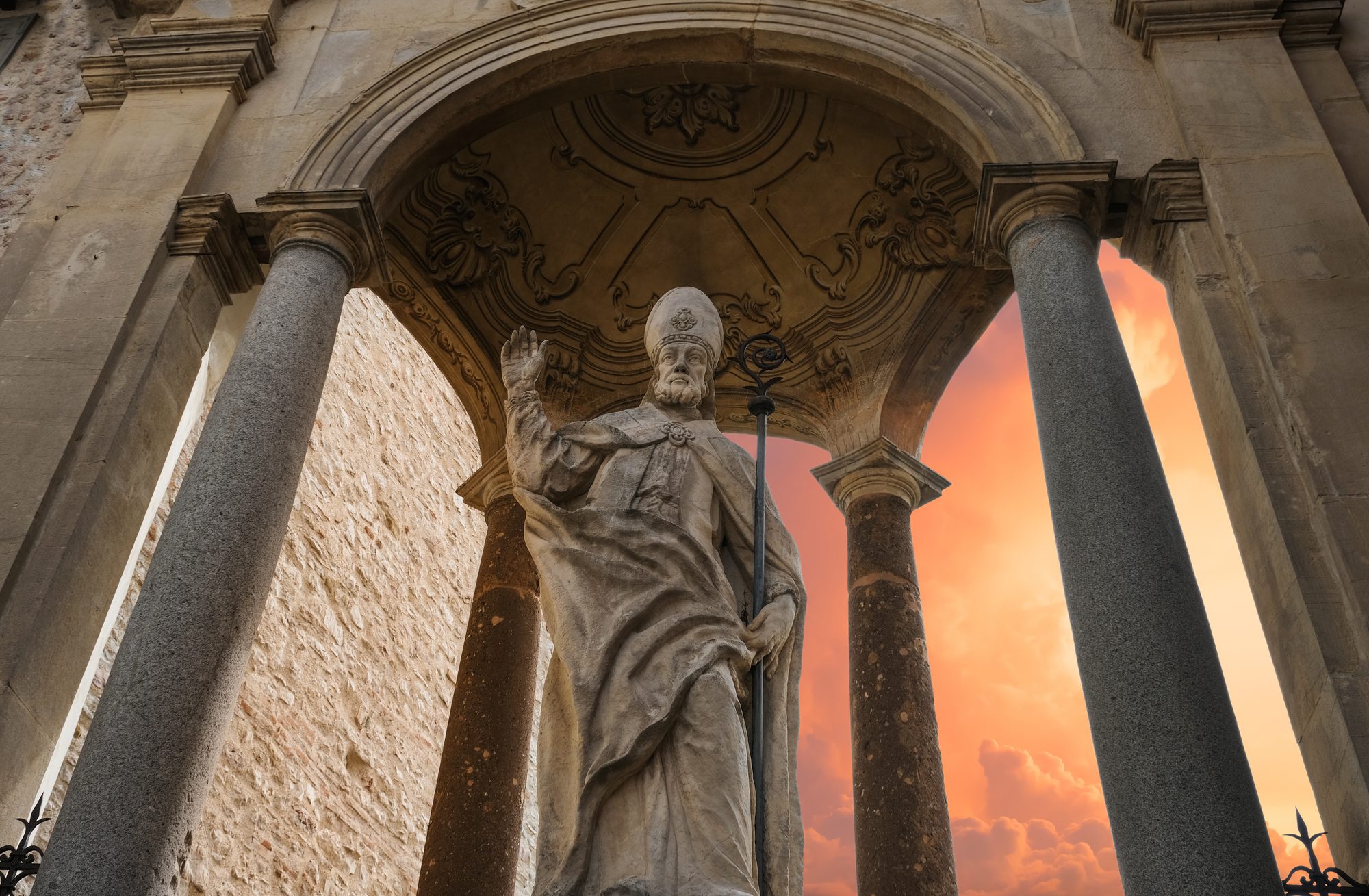
The upper point of the tree is bound to one of Gubbio’s most cherished landmarks. The Basilica of Sant’Ubaldo stands near the summit of Mount Ingino and is dedicated to the town’s patron saint. The illuminated design rises toward the basilica, so that the church becomes part of the composition rather than a building that merely overlooks it.
Sant’Ubaldo was a bishop of Gubbio who died in 1160 and was later canonized. His remains are preserved in the basilica, which has been a place of devotion for the town for centuries. The saint is also at the heart of the Festa dei Ceri, held each year on May 15. During this major local celebration, three large wooden structures are carried through Gubbio in honor of Sant’Ubaldo and the town’s other patron figures. The procession and its customs are inseparable from the identity of the town.
The Christmas tree and the basilica belong to different chapters of Gubbio’s history, but their shared setting gives the display a deeper meaning. The lights climb from the edge of the medieval town toward the sanctuary above it. At night, the eye follows the glowing shape up the mountain and comes to rest near the place associated with the town’s patron saint.
Visitors can reach the basilica by road or aboard the Funivia Colle Eletto, a small open-cage cableway that travels up the mountain from Gubbio. The ride unfolds over the rooftops and the surrounding valley. At the upper station, the basilica and its grounds offer a different perspective on the town and on the slopes that carry the Christmas installation.
What Powers the World's Largest Christmas Tree?
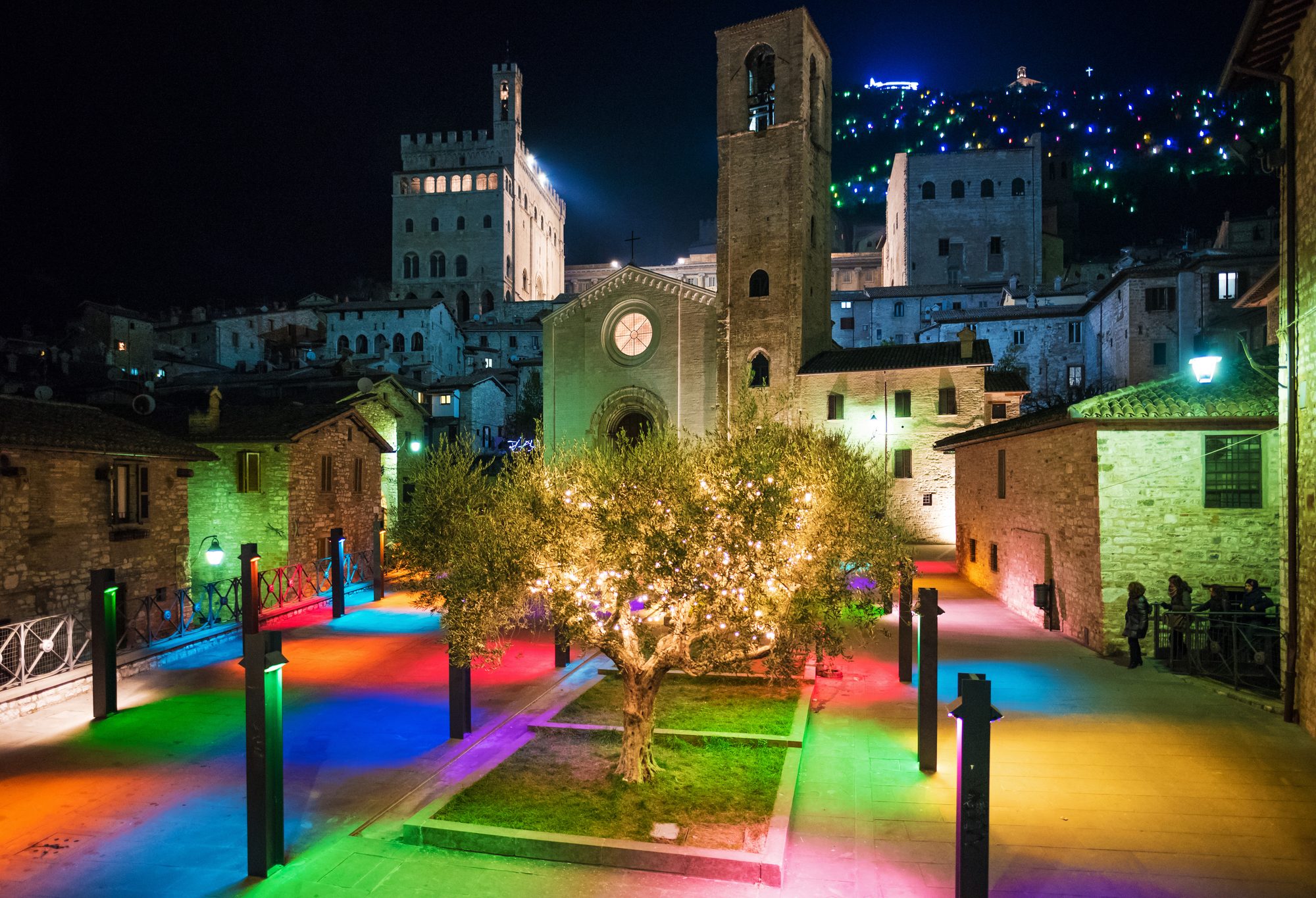
The tree’s appearance rests on an extensive electrical installation. More than 7,500 meters of cable and approximately 1,350 sockets and plugs connect the display. Over 300 green lights define its outline, while more than 400 multicolored lights illuminate the interior. At the summit, the star covers approximately 1,000 square meters and is made up of 250 lights. Every element must be placed with care across the uneven slope of Mount Ingino so that the complete design can be viewed from Gubbio and from the countryside beyond.
When fully illuminated, the installation requires approximately 35 kilowatts of power. Over the course of its annual lighting period, it consumes an average of around 11,500 kilowatt-hours of electricity. These figures offer a sense of the resources behind a display of this size. Cables and connections must be checked, individual sections tested, and the entire system coordinated so that thousands of separate points of light read as one continuous image.
The equipment and methods in use today have evolved considerably since the tree was first illuminated in 1981. Advances in lighting technology and electrical components have helped the committee maintain the installation while managing its energy needs. The original concept remains clearly recognizable, while the systems that support it have been adapted with the years.
The committee adopted solar power in 2010, taking a significant step toward offsetting part of the electricity the display requires. Today, a photovoltaic system on the roof of its headquarters consists of 16 solar panels, each with a capacity of 280 watts. The panels generate electricity throughout the year and contribute a significant portion of the energy needed to light the tree. The system remains connected to the electricity grid, so solar power supplements the installation rather than supplying it alone.
Visitors can also take part in the tradition through the committee’s Adotta una luce, or “Adopt a Light,” initiative. By adopting a light, individuals help fund the lighting of the tree and support the continuation of the project. It is a way for residents, returning guests, and anyone who feels a connection to Gubbio to share in the tree, even from afar.
The photovoltaic system, the adoption initiative, and the work of the Alberaioli together show how many hands sustain the tree. The display is most visible at Christmas, but keeping it in place each year requires planning, resources, and support long before the lights are switched on.
What Happens on December 7 When the Tree Is Lit?
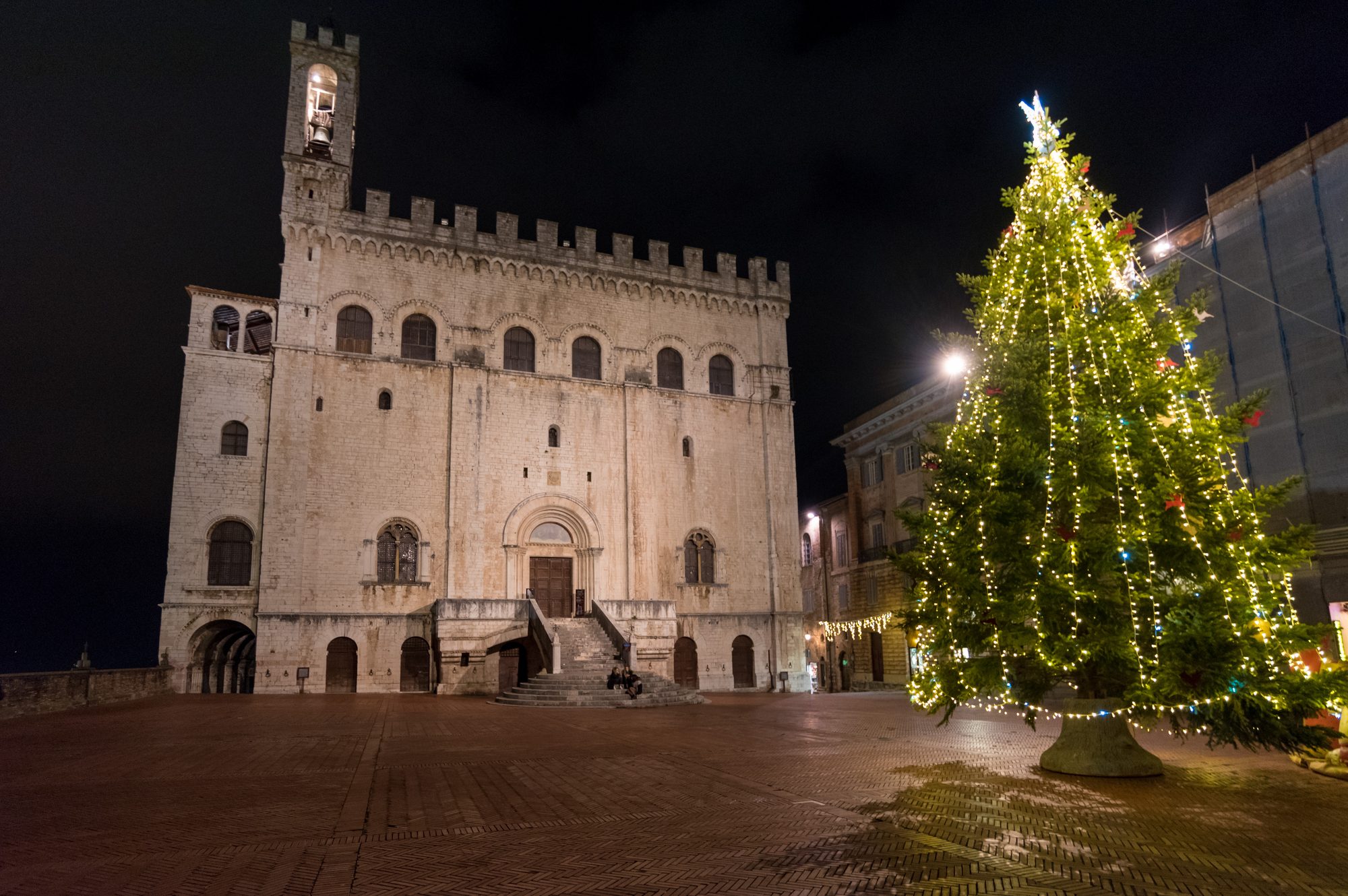
The tree is officially illuminated each year on December 7, the eve of the Feast of the Immaculate Conception. The ceremony is the moment when months of preparation become visible to all. Residents and visitors gather in Gubbio for the occasion, which has become one of the central events of the town’s Christmas calendar.
The inauguration is attended by representatives of public institutions, cultural organizations, associations, and other areas of public life. Each year, a different testimonial takes part in the lighting. The guest may be a public figure, an institution, or an association, and the choice often honors a contribution to civic life, culture, science, or volunteer work.
Past editions have drawn guests from across Italian public life. Former Italian President Giorgio Napolitano was involved in 2012, and Caritas was represented in 2013. Other guests have included the Fire Brigade and the Frecce Tricolori, the Italian Air Force’s aerobatic team.
Several of the most memorable lightings have taken place from a great distance. On December 7, 2011, Pope Benedict XVI lit the tree from his apartment in the Vatican. Connected to Gubbio by satellite link, he switched on the lights using an application on a tablet, a form of remote control made possible by modern home automation technology. Before the lights came on, he addressed the people of Gubbio in remarks broadcast on Italian television, reflecting that the tree reaches upward and that its lights recall how much people need a light to guide them through life.
Pope Francis lit the tree in the same remote fashion on December 7, 2014, once again with the touch of a tablet. In his message to Gubbio, he said, “A Christmas without light is not Christmas,” and wished that there would be light in the soul and in the heart before inviting everyone to turn on the lights together.
The most distant lighting of all came in 2017, when Italian astronaut Paolo Nespoli lit the tree from the International Space Station. Orbiting high above the earth, he sent a video message to the ceremony in Gubbio, and the mountain answered with its lights. For a tradition drawn on a hillside in 1981, it was a striking reminder of how far the story of the tree has traveled.
For 2026, the official lighting ceremony is scheduled for December 7 at 6:00 p.m. The tree is due to remain illuminated each evening from 5:00 p.m. until late at night, through January 10, 2027. The display therefore continues for several days after Epiphany on January 6, even though the wider Gubbio Christmas program is scheduled to conclude on that date.
The inauguration is a public event, but there is no need to attend the ceremony in order to see the tree. Anyone in Gubbio during the lighting period can view it after dark from suitable points in and around the town. The opening evening is likely to be especially busy, and travelers who prefer a quieter experience may wish to choose another night.
What Else Is There to Enjoy at Christmas in Gubbio?
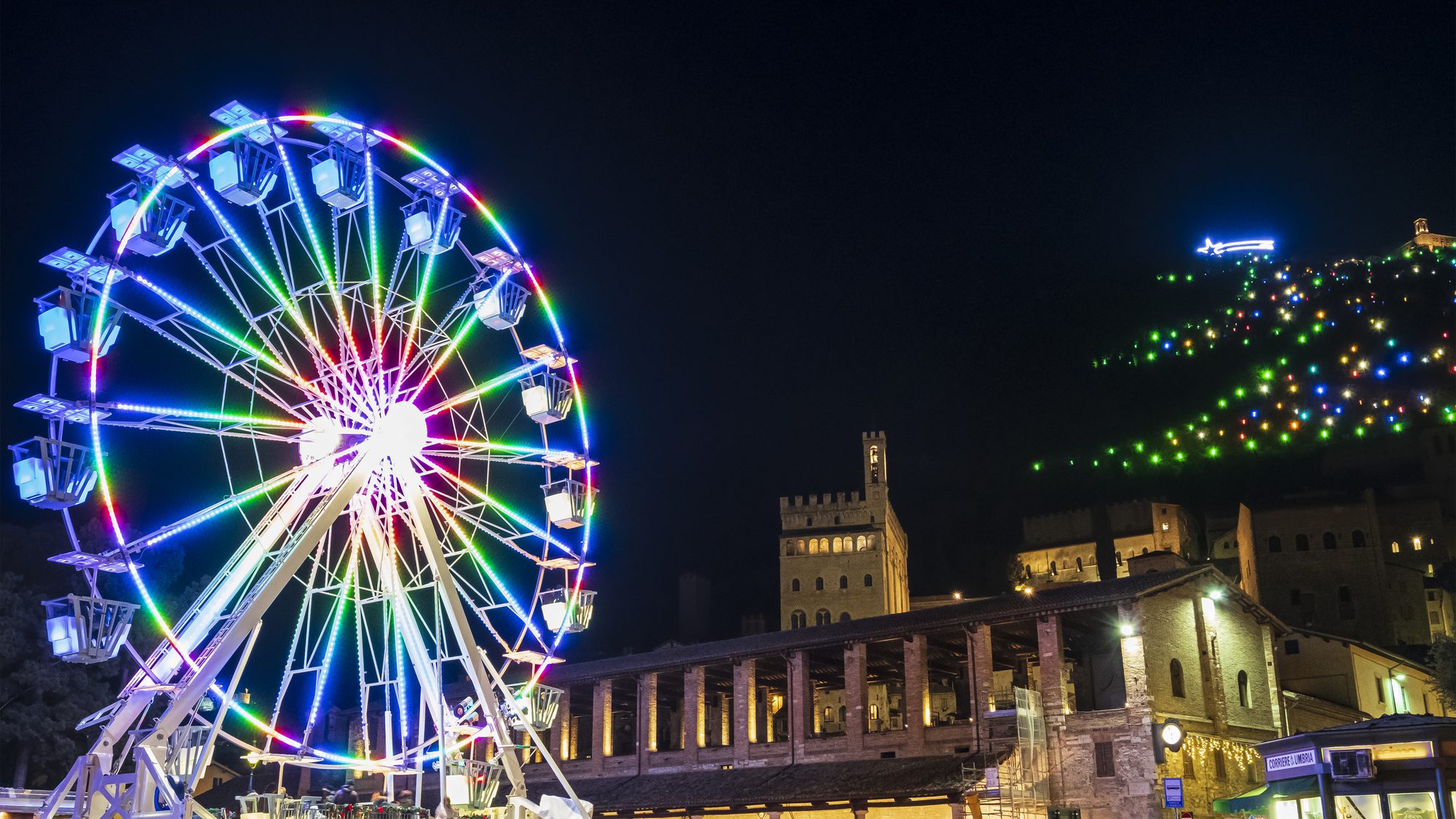
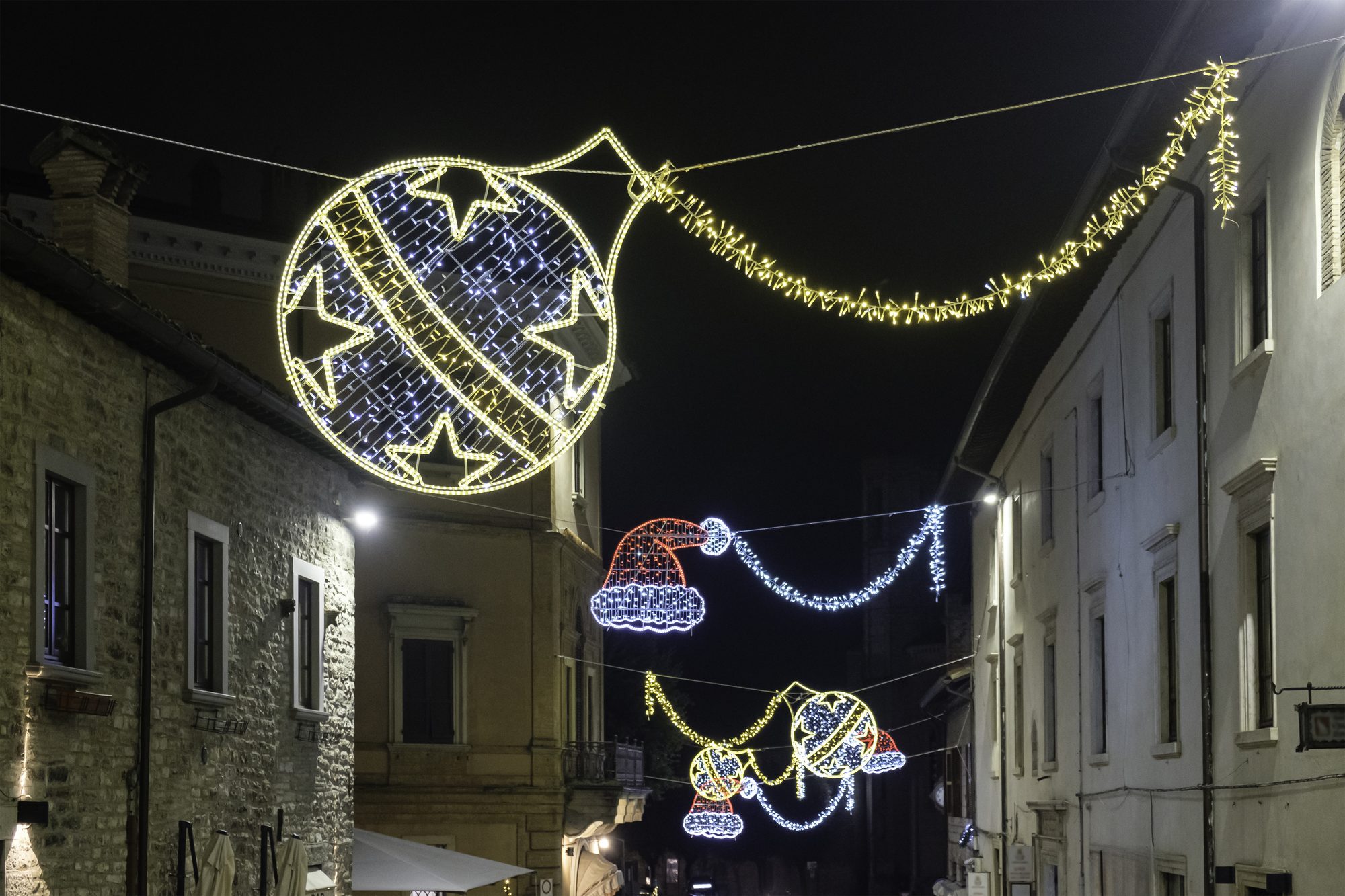
The tree is the best-known feature of Gubbio’s Christmas season, but it is not the only one. The town’s holiday program, called Gubbio è Natale, uses the historic center as its stage, with activities spread across squares, streets, and indoor venues.
The Christmas Market in Piazza Quaranta Martiri
Piazza Quaranta Martiri is one of the main gathering places of the season and hosts the Christmas market. Stalls offer seasonal products, gifts, and food, giving visitors a pleasant place to wander before continuing through the historic center. The square is also a convenient starting point for exploring the nearby streets and other seasonal attractions.
ChristmasLand and Family Attractions
The program has included ChristmasLand, a collection of themed settings and activities, along with attractions designed for families. Depending on the year, visitors may also find an ice rink, a Ferris wheel associated with the North Pole theme, and the Gubbio Express Christmas train.
La Via del Presepe: A Life-Size Nativity
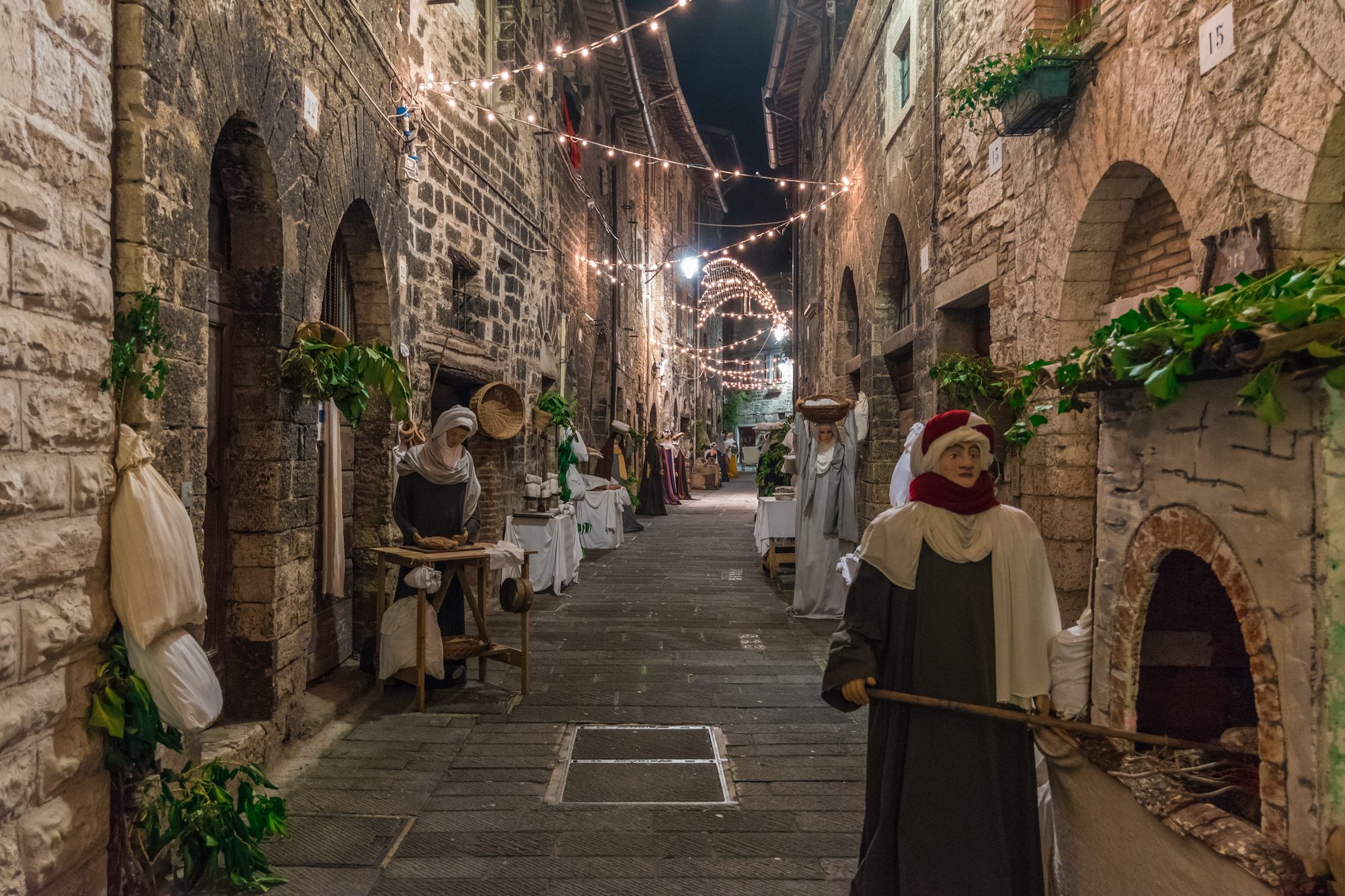
Another distinctive Christmas tradition can be found in Gubbio’s historic San Martino neighborhood. Known as La Via del Presepe, this life-size Nativity display transforms the area’s narrow medieval streets into an open-air exhibition of figures portraying traditional crafts, occupations, and scenes of everyday life in historic Gubbio.
Created through the work of local families and volunteers, the display brings together religious tradition and the town’s cultural heritage. Rather than being confined to one location, the figures are arranged throughout the neighborhood, inviting visitors to discover them while exploring its streets.
For 2026, the Nativity scenes are scheduled to be displayed from December 8 through January 6, offering another reason to wander through Gubbio during the Christmas season.
The Medieval Center
Gubbio offers much to see beyond its seasonal program. The medieval center is among the best preserved in Umbria, with stone buildings, narrow streets, stairways, and small squares arranged along the lower slopes of Mount Ingino. Its architecture recalls the importance the town held in the Middle Ages, when Gubbio was a significant center of civic and commercial life.
Palazzo dei Consoli and the Eugubine Tablets
The Palazzo dei Consoli is among the town’s defining landmarks. Built in the fourteenth century, it rises above Piazza Grande, an elevated square with views across the rooftops and the countryside beyond. The palace houses the Civic Museum, which includes the Eugubine Tablets, a group of ancient bronze tablets inscribed in the Umbrian language. They are among the most important surviving records of that language and offer a glimpse of the region before Roman rule.
The Roman Theater
Outside the medieval center, the remains of the Roman Theater offer another view into Gubbio’s long past. Dating to the first century BC, the theater reflects the importance of the town in Roman times. Its position near the modern town makes it easy to include in a visit, especially for travelers who enjoy seeing how the different periods of Gubbio’s history fit together.
A Winter Evening in Gubbio
A winter visit lets travelers combine the town’s historic sites with its Christmas events. The market and seasonal attractions bring life to the squares, while the medieval streets carry on with the rhythm of everyday Gubbio. As evening approaches, the illuminated tree appears above the rooftops, joining the town center to the mountain that defines its setting.
How Do You Plan a Visit to See the Gubbio Christmas Tree in 2026?
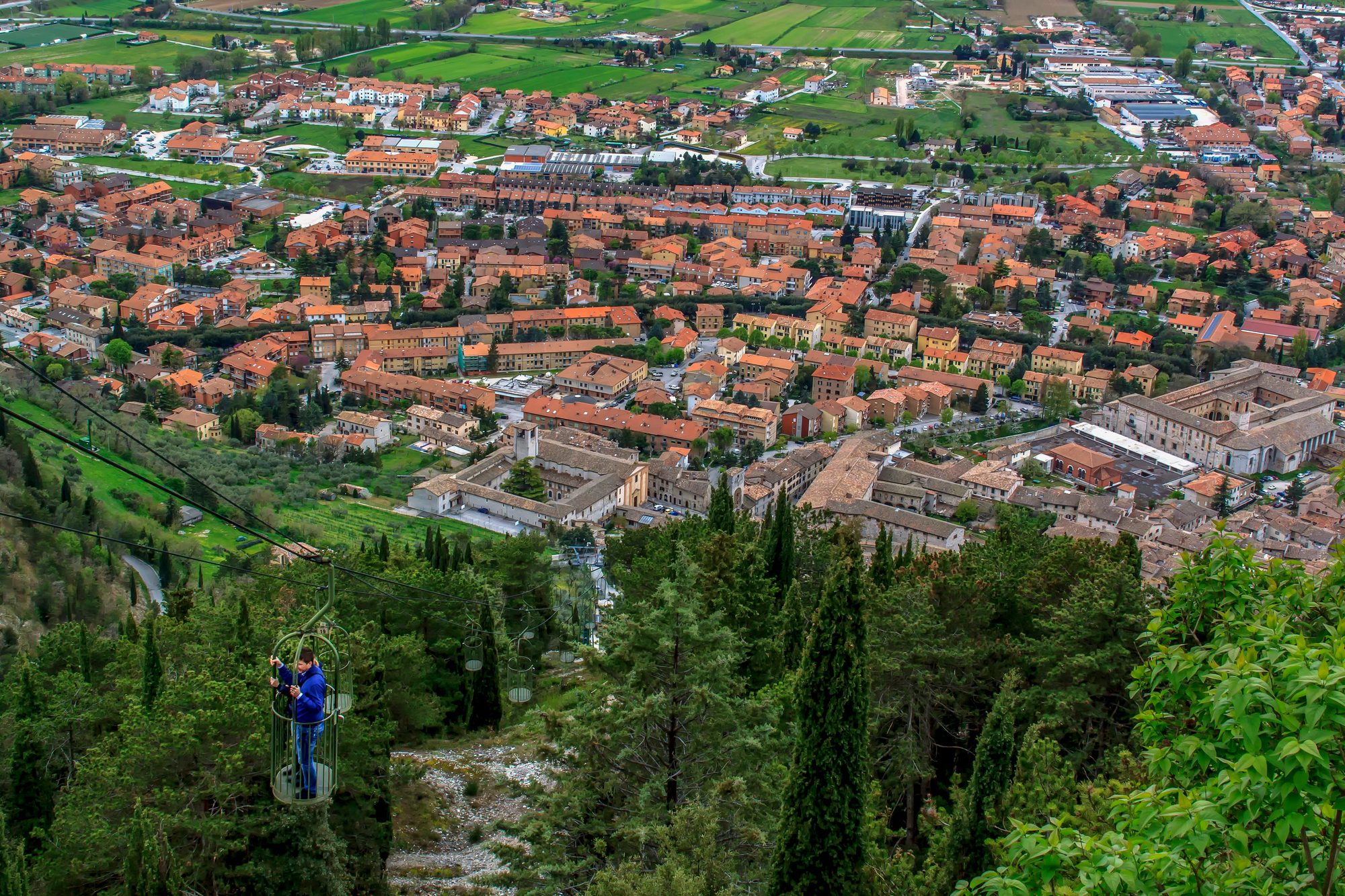
Gubbio lies in northeastern Umbria, in the province of Perugia. The town does not have a major railway station, so travelers arriving by train generally continue by bus, rental car, or private transfer. Perugia is one of the principal nearby cities and makes a natural starting point for reaching Gubbio. The town is also accessible by road from other parts of Umbria and from neighboring regions.
For those already exploring central Italy, Gubbio fits naturally into an itinerary through Umbria. Perugia and Assisi are among the better known destinations nearby, and the area holds several other historic towns worth considering. A day trip is possible, but an overnight stay allows more time to explore the historic center and to see the tree after dark without hurrying on to another destination.
At Trips 2 Italy, we often build winter journeys around moments like this one. Gubbio sits well alongside Perugia, Assisi, and the other historic towns of Umbria, and our travel specialists can shape a route around the December 7 ceremony, the number of nights the traveler wishes to stay, and whatever else the journey should include, whether that is Umbria alone or a longer path through central Italy.
The best vantage point depends on what each traveler hopes to see. From the historic center, the tree rises behind the medieval buildings, revealing the relationship between the town and the mountain. Open spaces and elevated viewpoints around Gubbio offer different angles on the display. The tree can also be seen from outside the town, and its visibility across the surrounding area is part of what makes it distinctive.
It is worth remembering that the tree is not an attraction with an entrance or a path running through it. The lights are spread across the slope of Mount Ingino and are best admired from suitable locations around Gubbio and the surrounding area. The Basilica of Sant’Ubaldo can be visited separately by road or by the Funivia Colle Eletto, though reaching the basilica does not place visitors inside the illuminated outline.
Weather shapes the experience. A clear evening offers the best chance of seeing the full outline, including the star at the summit. Fog, rain, or low cloud can veil parts of the mountain, so some flexibility in timing is helpful. December evenings in Umbria can be cold, particularly in exposed areas, and visitors planning to linger outdoors should dress warmly.
Why Does This Tradition Still Matter to the People of Gubbio?
The Christmas tree on Mount Ingino is often introduced through its record-setting dimensions. Its height, its width, and its visibility explain why it draws attention, but they do not tell the whole story. The project began with residents who wanted to create something distinctive for their town. It has endured because the people of Gubbio have chosen, year after year, to take responsibility for it.
The Alberaioli connect that original idea to the present day. Their work calls for technical skill, organization, and time, and it relies on knowledge handed from one generation to the next. The tree is assembled for the holiday season, illuminated for several weeks, and then taken down. The cycle begins again the following year, as the committee prepares its equipment and returns to the mountain.
The setting matters just as much. The lights rise from the edge of Gubbio’s medieval center toward the Basilica of Sant’Ubaldo, joining a modern Christmas tradition to the history and landscape of the town. The ceremony on December 7 gathers residents and visitors together, and the illuminated mountain remains a familiar presence throughout the holidays.
For travelers, the tree is a reason to discover Gubbio in winter and to spend time in a part of Umbria that is sometimes overlooked in favor of the region’s better known destinations. A visit can include the medieval center, Piazza Grande, the Palazzo dei Consoli, the Roman Theater, and the basilica above the town. During the Christmas season, the market and other events give a reason to stay on into the evening.
The display goes dark in January, but the work behind it does not end with the holidays. Equipment must be checked and stored, and the volunteers keep up the systems that will be needed again the following year. The scale of the tree may be what first draws attention to Gubbio. What stays with the visitor is the community that builds it, and the light it sends up the mountain each winter.
We have always believed that some of the best places to travel in Italy are those where a community still gathers around a tradition of its own making. Gubbio in December is one of them.
Questions Travelers Ask About the Gubbio Christmas Tree
Is the Gubbio Christmas tree really the largest in the world?
Yes. The illuminated tree on Mount Ingino was recognized by the Guinness Book of Records in 1991 as the largest Christmas tree in the world. It extends more than 750 meters up the mountain and measures about 450 meters across its base, with a star of roughly 1,000 square meters at the top.
When is the Gubbio Christmas tree lit in 2026?
The official lighting ceremony is scheduled for December 7, 2026 at 6:00 p.m., the eve of the Feast of the Immaculate Conception. The tree is due to shine each evening from 5:00 p.m. until late at night through January 10, 2027.
Where is the best place to see the Gubbio Christmas tree?
The tree is spread across the slope of Mount Ingino, so it is best admired from a distance rather than up close. The historic center shows it rising behind the medieval buildings, while open spaces and elevated viewpoints around Gubbio offer wider angles. On a clear night it can be seen from as far as 30 miles away.
Who builds the Gubbio Christmas tree?
A committee of around 50 local volunteers known as the Alberaioli builds and maintains the tree. Their ages range from young adults to people in their eighties, and the committee estimates that the installation takes about 2,100 working hours each year.
Can you walk up to the tree or ride the cableway?
The tree is not an attraction with an entrance or a path running through it. The Basilica of Sant'Ubaldo near the summit can be reached by road or by the Funivia Colle Eletto cableway, which offers views over the rooftops, but reaching the basilica does not place you inside the illuminated outline.
How do you get to Gubbio, and is a day trip enough?
Gubbio has no major railway station, so travelers usually continue from Perugia by bus, rental car or private transfer. A day trip is possible, but an overnight stay lets you explore the medieval center and see the tree after dark without rushing on. Our specialists can build Gubbio into a wider Umbria itinerary with Perugia and Assisi.
Related Pages
- Italy in December: A Custom Winter Escape Guide: Markets, mountains and cities for a December journey through Italy.
- Gubbio Travel Guide: Plan your time in Umbria’s best-preserved medieval town.
- The Festa dei Ceri in Gubbio: The May 15 celebration in honor of Sant’Ubaldo.
- Italy’s Christmas Markets: A regional tour of Italy’s best Christmas markets.
- New Year’s Eve in Italy: Where and how to ring in the new year across Italy.
- Gubbio Vacation Packages: Custom itineraries that include Gubbio and central Umbria.
Ready to See the Gubbio Christmas Tree for Yourself?
Tell us when you would like to travel and how many nights you have, and we will build a winter journey around the December 7 lighting, the medieval streets of Gubbio and the rest of Umbria. Call us at 713-952-4055 or start planning online.